| Activity |
|---|
| Catalytic type | Metallo |
| Peplist | Included in the Peplist with identifier PL00126 |
| NC-IUBMB | 3.3.2.6
|
| Enzymology | BRENDA database |
| Activity status | human: active (Haeggstrom, 2004)
mouse: active (Wetterholm et al., 1992)
|
| Physiology | Conversion of leukotriene A4 to B4 in inflammation and allergic reactions. |
| Knockout | Genetically-deficient develop normally and are healthy. They show that the enzyme is required for the production of leukotriene B4 in an in vivo inflammatory response. The deficient mice are resistant to platelet-activating factor, identifying LTB4 as one mediator of the physiological changes seen in systemic shock. However, no in vivo role of the aminopeptidase activity of leukotriene A4 hydrolase was identified (Byrum et al., 1999). |
| Pharmaceutical relevance | Catalysing the rate-limiting step in leukotriene B4 production, the enzyme represents an attractive target for therapeutic agents to reduce leukotriene B4 concentrations and control inflammation. The enzyme is suggested to be implicated in diseases including inflammatory bowel disease and psoriasis (Askonas et al., 2002). |
| Pathways |
KEGG | Arachidonic acid metabolism |
|
Other databases
| TREEFAM | http://www.treefam.org/family/TF300758 |
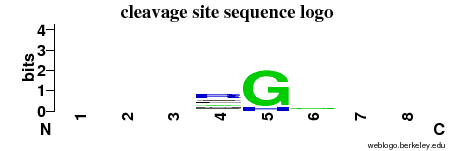
| Cleavage site specificity |
Explanations of how to interpret the
following cleavage site sequence logo and specificity matrix can be found here. |
|---|
| Cleavage pattern | -/-/-/r G/-/-/- (based on 21 cleavages) G/-/-/- (based on 21 cleavages) |