| Activity |
|---|
| Catalytic type | Cysteine |
| Peplist | Included in the Peplist with identifier PL00078 |
| NC-IUBMB | Subclass 3.4 (Peptidases) >> Sub-subclass 3.4.22 (Cysteine endopeptidases) >> Peptidase 3.4.22.53
|
| Enzymology | BRENDA database |
| Proteolytic events | CutDB database (112 cleavages) |
| Activity status | human: active (Sorimachi, 2004)
mouse: active (Azuma et al., 2003)
|
| Physiology | Calcium-dependent degradation of cytoskeletal proteins in mammalian cytosol. Implicated in anoxic neuronal cell death in stroke and spinal injuries. |
| Knockout | In mouse, homozygous disruption of the gene for the calpain small subunit common to mu- and m-calpain eliminated both activities, but this did not affect survival and proliferation of cultured embryonic stem cells or embryonic fibroblasts, or the early stages of organogenesis. However, mutant embryos died at mid-gestation and displayed defects in the cardiovascular system, haemorrhaging, and accumulation of erythroid progenitors (Arthur et al., 2000). Experiments with RNAi and chemical inhibitors have indicated that calpain-2 plays an essential role in mitosis in cells in vitro (Honda et al., 2003). |
| Pharmaceutical relevance | A drug target for stroke and neural injuries (Huang & Wang, 2001). Also, calpain-mediated proteolysis may be a contributing factor in the insolubilization of crystallins occurring during normal maturation of lens or during cataract formation (Shih et al., 2001). |
| Pathways |
KEGG | Alzheimer's disease |
|
KEGG | Apoptosis |
|
KEGG | Focal adhesion |
|
Other databases
| WIKIPEDIA | http://en.wikipedia.org/wiki/Calpain-2 |
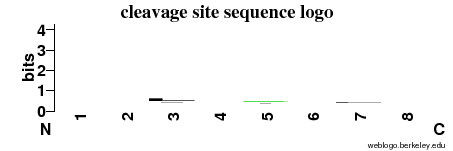
| Cleavage site specificity |
Explanations of how to interpret the
following cleavage site sequence logo and specificity matrix can be found here. |
|---|
| Cleavage pattern | -/-/l/- -/-/-/- (based on 453 cleavages) -/-/-/- (based on 453 cleavages) |