
|
|
|
|
|
 |
Contents |
 |
|
|
|
|
|
|
|
|
|
|
|
|
* Residue conservation analysis
|
|
|
|
|
|
|
|
|
|
Enzyme class 2:
|
|
Chains A, B, C:
E.C.2.1.1.-
- ?????
|
|
|
|
|
|
|
Enzyme class 3:
|
|
Chains A, B, C:
E.C.2.1.1.56
- mRNA (guanine-N(7))-methyltransferase.
|
|
|
|
|
|
|
Reaction:
|
|
a 5'-end (5'-triphosphoguanosine)-ribonucleoside in mRNA + S-adenosyl-L- methionine = a 5'-end (N(7)-methyl 5'-triphosphoguanosine)-ribonucleoside in mRNA + S-adenosyl-L-homocysteine
|
|
|
|
|
|
5'-end (5'-triphosphoguanosine)-ribonucleoside in mRNA
|
+
|
 S-adenosyl-L- methionine
|
=
|
5'-end (N(7)-methyl 5'-triphosphoguanosine)-ribonucleoside in mRNA
|
+
|
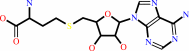 S-adenosyl-L-homocysteine
|
|
|
|
|
|
|
|
|
|
Enzyme class 4:
|
|
Chains A, B, C:
E.C.2.1.1.57
- methyltransferase cap1.
|
|
|
|
|
|
|
Reaction:
|
|
a 5'-end (N(7)-methyl 5'-triphosphoguanosine)-ribonucleoside in mRNA + S-adenosyl-L-methionine = a 5'-end (N(7)-methyl 5'-triphosphoguanosine)- (2'-O-methyl-ribonucleoside) in mRNA + S-adenosyl-L-homocysteine + H+
|
|
|
|
|
|
5'-end (N(7)-methyl 5'-triphosphoguanosine)-ribonucleoside in mRNA
|
+
|
S-adenosyl-L-methionine
|
=
|
5'-end (N(7)-methyl 5'-triphosphoguanosine)- (2'-O-methyl-ribonucleoside) in mRNA
|
+
|
S-adenosyl-L-homocysteine
|
+
|
H(+)
|
|
|
|
|
|
|
|
|
|
Enzyme class 5:
|
|
Chains A, B, C:
E.C.2.7.7.48
- RNA-directed Rna polymerase.
|
|
|
|
|
|
|
Reaction:
|
|
RNA(n) + a ribonucleoside 5'-triphosphate = RNA(n+1) + diphosphate
|
|
|
|
|
|
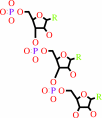 RNA(n)
|
+
|
ribonucleoside 5'-triphosphate
|
=
|
RNA(n+1)
|
+
|
 diphosphate
|
|
|
|
|
|
|
|
|
|
Enzyme class 6:
|
|
Chains A, B, C:
E.C.2.7.7.50
- mRNA guanylyltransferase.
|
|
|
|
|
|
|
Reaction:
|
|
a 5'-end diphospho-ribonucleoside in mRNA + GTP + H+ = a 5'-end (5'-triphosphoguanosine)-ribonucleoside in mRNA + diphosphate
|
|
|
|
|
|
5'-end diphospho-ribonucleoside in mRNA
|
+
|
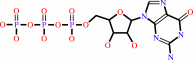 GTP
GTP
|
+
|
H(+)
|
=
|
5'-end (5'-triphosphoguanosine)-ribonucleoside in mRNA
|
+
|
diphosphate
|
|
|
|
|
|
|
|
|
|
Enzyme class 7:
|
|
Chains A, B, C:
E.C.3.1.13.-
- ?????
|
|
|
|
|
|
|
Enzyme class 8:
|
|
Chains A, B, C:
E.C.3.4.19.12
- ubiquitinyl hydrolase 1.
|
|
|
|
|
|
|
Reaction:
|
|
Thiol-dependent hydrolysis of ester, thiolester, amide, peptide and isopeptide bonds formed by the C-terminal Gly of ubiquitin (a 76-residue protein attached to proteins as an intracellular targeting signal).
|
|
|
|
|
|
Enzyme class 9:
|
|
Chains A, B, C:
E.C.3.4.22.-
- ?????
|
|
|
|
|
|
|
Enzyme class 10:
|
|
Chains A, B, C:
E.C.3.4.22.69
- Sars coronavirus main proteinase.
|
|
|
|
|
|
|
Enzyme class 11:
|
|
Chains A, B, C:
E.C.3.6.4.12
- Dna helicase.
|
|
|
|
|
|
|
Reaction:
|
|
ATP + H2O = ADP + phosphate + H+
|
|
|
|
|
|
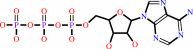 ATP
ATP
|
+
|
H2O
|
=
|
 ADP
ADP
|
+
|
 phosphate
|
+
|
H(+)
|
|
|
|
|
|
|
|
|
|
Enzyme class 12:
|
|
Chains A, B, C:
E.C.3.6.4.13
- Rna helicase.
|
|
|
|
|
|
|
Reaction:
|
|
ATP + H2O = ADP + phosphate + H+
|
|
|
|
|
|
ATP
|
+
|
H2O
|
=
|
ADP
|
+
|
phosphate
|
+
|
H(+)
|
|
|
|
|
|
|
|
|
|
Enzyme class 13:
|
|
Chains A, B, C:
E.C.4.6.1.-
- ?????
|
|
|
|
|
|
|
|
|
|
Note, where more than one E.C. class is given (as above), each may
correspond to a different protein domain or, in the case of polyprotein
precursors, to a different mature protein.
|
|
|
|
Molecule diagrams generated from .mol files obtained from the
KEGG ftp site
|
|
|
|
|
|
|
|
|
|
|
|
|
|
 |
|
|
|
|
|
|
| |
|
|
| |
|
|
J Virol
82:2515-2527
(2008)
|
|
PubMed id:
|
|
|
|
|
|
| |
|
Structures of two coronavirus main proteases: implications for substrate binding and antiviral drug design.
|
|
X.Xue,
H.Yu,
H.Yang,
F.Xue,
Z.Wu,
W.Shen,
J.Li,
Z.Zhou,
Y.Ding,
Q.Zhao,
X.C.Zhang,
M.Liao,
M.Bartlam,
Z.Rao.
|
|
|
|
|
| |
ABSTRACT
|
|
|
|
| |
|
|
Coronaviruses (CoVs) can infect humans and multiple species of animals, causing
a wide spectrum of diseases. The coronavirus main protease (M(pro)), which plays
a pivotal role in viral gene expression and replication through the proteolytic
processing of replicase polyproteins, is an attractive target for anti-CoV drug
design. In this study, the crystal structures of infectious bronchitis virus
(IBV) M(pro) and a severe acute respiratory syndrome CoV (SARS-CoV) M(pro)
mutant (H41A), in complex with an N-terminal autocleavage substrate, were
individually determined to elucidate the structural flexibility and substrate
binding of M(pro). A monomeric form of IBV M(pro) was identified for the first
time in CoV M(pro) structures. A comparison of these two structures to other
available M(pro) structures provides new insights for the design of
substrate-based inhibitors targeting CoV M(pro)s. Furthermore, a Michael
acceptor inhibitor (named N3) was cocrystallized with IBV M(pro) and was found
to demonstrate in vitro inactivation of IBV M(pro) and potent antiviral activity
against IBV in chicken embryos. This provides a feasible animal model for
designing wide-spectrum inhibitors against CoV-associated diseases. The
structure-based optimization of N3 has yielded two more efficacious lead
compounds, N27 and H16, with potent inhibition against SARS-CoV M(pro).
|
|
|
|
|
|
|
|
|
|
|
|
|
|
|
|
|
|
 |
 |
 |
|
Literature references that cite this PDB file's key reference
|
|
|
| |
PubMed id
|
|
Reference
|
|
|
|
|
|
X.Jia,
R.Singh,
S.Homann,
H.Yang,
J.Guatelli,
and
Y.Xiong
(2012).
Structural basis of evasion of cellular adaptive immunity by HIV-1 Nef.
|
| |
Nat Struct Mol Biol,
19,
701-706.
|
|
|
PDB codes:
|
|
|
|
|
|
|
|
J.Shi,
N.Han,
L.Lim,
S.Lua,
J.Sivaraman,
L.Wang,
Y.Mu,
and
J.Song
(2011).
Dynamically-driven inactivation of the catalytic machinery of the SARS 3C-like protease by the N214A mutation on the extra domain.
|
| |
PLoS Comput Biol,
7,
e1001084.
|
|
|
|
|
|
|
C.P.Chuck,
L.T.Chong,
C.Chen,
H.F.Chow,
D.C.Wan,
and
K.B.Wong
(2010).
Profiling of substrate specificity of SARS-CoV 3CL.
|
| |
PLoS One,
5,
e13197.
|
|
|
|
|
|
|
M.Y.Tsai,
W.H.Chang,
J.Y.Liang,
L.L.Lin,
G.G.Chang,
and
H.P.Chang
(2010).
Essential covalent linkage between the chymotrypsin-like domain and the extra domain of the SARS-CoV main protease.
|
| |
J Biochem,
148,
349-358.
|
|
|
|
|
|
|
R.N.Kostoff
(2010).
The highly cited SARS research literature.
|
| |
Crit Rev Microbiol,
36,
299-317.
|
|
|
|
|
|
|
S.C.Cheng,
G.G.Chang,
and
C.Y.Chou
(2010).
Mutation of Glu-166 blocks the substrate-induced dimerization of SARS coronavirus main protease.
|
| |
Biophys J,
98,
1327-1336.
|
|
|
|
|
|
|
S.Fang,
H.Shen,
J.Wang,
F.P.Tay,
and
D.X.Liu
(2010).
Functional and genetic studies of the substrate specificity of coronavirus infectious bronchitis virus 3C-like proteinase.
|
| |
J Virol,
84,
7325-7336.
|
|
|
|
|
|
|
Y.Piotrowski,
G.Hansen,
A.L.Boomaars-van der Zanden,
E.J.Snijder,
A.E.Gorbalenya,
and
R.Hilgenfeld
(2009).
Crystal structures of the X-domains of a Group-1 and a Group-3 coronavirus reveal that ADP-ribose-binding may not be a conserved property.
|
| |
Protein Sci,
18,
6.
|
|
|
PDB codes:
|
|
|
|
|
|
|
|
Y.Xu,
L.Cong,
C.Chen,
L.Wei,
Q.Zhao,
X.Xu,
Y.Ma,
M.Bartlam,
and
Z.Rao
(2009).
Crystal structures of two coronavirus ADP-ribose-1''-monophosphatases and their complexes with ADP-Ribose: a systematic structural analysis of the viral ADRP domain.
|
| |
J Virol,
83,
1083-1092.
|
|
|
PDB codes:
|
|
|
|
|
|
|
|
J.Shi,
J.Sivaraman,
and
J.Song
(2008).
Mechanism for controlling the dimer-monomer switch and coupling dimerization to catalysis of the severe acute respiratory syndrome coronavirus 3C-like protease.
|
| |
J Virol,
82,
4620-4629.
|
|
|
PDB code:
|
|
|
|
|
|
|
|
Q.Zhao,
S.Li,
F.Xue,
Y.Zou,
C.Chen,
M.Bartlam,
and
Z.Rao
(2008).
Structure of the main protease from a global infectious human coronavirus, HCoV-HKU1.
|
| |
J Virol,
82,
8647-8655.
|
|
|
PDB code:
|
|
|
|
|
|
|
The most recent references are shown first.
Citation data come partly from CiteXplore and partly
from an automated harvesting procedure. Note that this is likely to be
only a partial list as not all journals are covered by
either method. However, we are continually building up the citation data
so more and more references will be included with time.
Where a reference describes a PDB structure, the PDB
codes are
shown on the right.
|
 |


 Links
Links


