 |
PDBsum entry 1uk2

|
|
|
|
|
 |
Contents |
 |
|
|
|
|
|
|
|
|
|
|
* Residue conservation analysis
|
|
|
|
|
|
PDB id:
|
|
|
|
| Name: |
|
Hydrolase
|
|
|
Title:
|
|
Crystal structure of sars coronavirus main proteinase (3clpro) at ph8.0
|
|
Structure:
|
|
3c-like proteinase. Chain: a, b. Synonym: sars coronavirus main proteinase, 3clpro. Engineered: yes
|
|
Source:
|
|
Sars coronavirus. Organism_taxid: 227859. Strain: sars. Expressed in: escherichia coli bl21(de3). Expression_system_taxid: 469008.
|
|
Biol. unit:
|
|
Dimer (from
)
|
|
Resolution:
|
|
|
2.20Å
|
R-factor:
|
0.226
|
R-free:
|
0.253
|
|
|
Authors:
|
|
H.Yang,M.Yang,Y.Liu,M.Bartlam,Y.Ding,Z.Lou,L.Sun,Z.Zhou,S.Ye,K.Anand, H.Pang,G.F.Gao,R.Hilgenfeld,Z.Rao
|
Key ref:

|
|
H.Yang
et al.
(2003).
The crystal structures of severe acute respiratory syndrome virus main protease and its complex with an inhibitor.
Proc Natl Acad Sci U S A,
100,
13190-13195.
PubMed id:
DOI:

|
|
|
Date:
|
|
|
14-Aug-03
|
Release date:
|
18-Nov-03
|
|
|
|
|
|
|
PROCHECK
|

|
|
|
|
|
Headers
|
|
|
|
References
|
|
|
|
|
|

|
|
P0C6X7
(R1AB_CVHSA) -
Replicase polyprotein 1ab from Severe acute respiratory syndrome coronavirus
|
|
|
|
Seq:
Struc:
|
|
|
|
7073 a.a.
302 a.a.
|
|

|

|
|
|
|
|
|
|
|
|
|
|
|
Key: |
 |
PfamA domain |
|
|
 |
Secondary structure |
|
 |
CATH domain |
|
|
|
|
|
|
|
|
|
|
|
|
|
Enzyme class 2:
|
|
E.C.2.1.1.-
- ?????
|
|
|
|
|
|
|
Enzyme class 3:
|
|
E.C.2.1.1.56
- mRNA (guanine-N(7))-methyltransferase.
|
|
|
|
|
|
|
Reaction:
|
|
a 5'-end (5'-triphosphoguanosine)-ribonucleoside in mRNA + S-adenosyl-L- methionine = a 5'-end (N(7)-methyl 5'-triphosphoguanosine)-ribonucleoside in mRNA + S-adenosyl-L-homocysteine
|
|
|
|
|
|
5'-end (5'-triphosphoguanosine)-ribonucleoside in mRNA
|
+
|
 S-adenosyl-L- methionine
|
=
|
5'-end (N(7)-methyl 5'-triphosphoguanosine)-ribonucleoside in mRNA
|
+
|
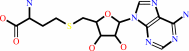 S-adenosyl-L-homocysteine
|
|
|
|
|
|
|
|
|
|
Enzyme class 4:
|
|
E.C.2.1.1.57
- methyltransferase cap1.
|
|
|
|
|
|
|
Reaction:
|
|
a 5'-end (N(7)-methyl 5'-triphosphoguanosine)-ribonucleoside in mRNA + S-adenosyl-L-methionine = a 5'-end (N(7)-methyl 5'-triphosphoguanosine)- (2'-O-methyl-ribonucleoside) in mRNA + S-adenosyl-L-homocysteine + H+
|
|
|
|
|
|
5'-end (N(7)-methyl 5'-triphosphoguanosine)-ribonucleoside in mRNA
|
+
|
S-adenosyl-L-methionine
|
=
|
5'-end (N(7)-methyl 5'-triphosphoguanosine)- (2'-O-methyl-ribonucleoside) in mRNA
|
+
|
S-adenosyl-L-homocysteine
|
+
|
H(+)
|
|
|
|
|
|
|
|
|
|
Enzyme class 5:
|
|
E.C.2.7.7.48
- RNA-directed Rna polymerase.
|
|
|
|
|
|
|
Reaction:
|
|
RNA(n) + a ribonucleoside 5'-triphosphate = RNA(n+1) + diphosphate
|
|
|
|
|
|
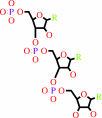 RNA(n)
|
+
|
ribonucleoside 5'-triphosphate
|
=
|
RNA(n+1)
|
+
|
 diphosphate
|
|
|
|
|
|
|
|
|
|
Enzyme class 6:
|
|
E.C.2.7.7.50
- mRNA guanylyltransferase.
|
|
|
|
|
|
|
Reaction:
|
|
a 5'-end diphospho-ribonucleoside in mRNA + GTP + H+ = a 5'-end (5'-triphosphoguanosine)-ribonucleoside in mRNA + diphosphate
|
|
|
|
|
|
5'-end diphospho-ribonucleoside in mRNA
|
+
|
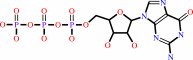 GTP
GTP
|
+
|
H(+)
|
=
|
5'-end (5'-triphosphoguanosine)-ribonucleoside in mRNA
|
+
|
diphosphate
|
|
|
|
|
|
|
|
|
|
Enzyme class 7:
|
|
E.C.3.1.13.-
- ?????
|
|
|
|
|
|
|
Enzyme class 8:
|
|
E.C.3.4.19.12
- ubiquitinyl hydrolase 1.
|
|
|
|
|
|
|
Reaction:
|
|
Thiol-dependent hydrolysis of ester, thiolester, amide, peptide and isopeptide bonds formed by the C-terminal Gly of ubiquitin (a 76-residue protein attached to proteins as an intracellular targeting signal).
|
|
|
|
|
|
Enzyme class 9:
|
|
E.C.3.4.22.-
- ?????
|
|
|
|
|
|
|
Enzyme class 10:
|
|
E.C.3.4.22.69
- Sars coronavirus main proteinase.
|
|
|
|
|
|
|
Enzyme class 11:
|
|
E.C.3.6.4.12
- Dna helicase.
|
|
|
|
|
|
|
Reaction:
|
|
ATP + H2O = ADP + phosphate + H+
|
|
|
|
|
|
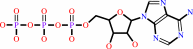 ATP
ATP
|
+
|
H2O
|
=
|
 ADP
ADP
|
+
|
 phosphate
|
+
|
H(+)
|
|
|
|
|
|
|
|
|
|
Enzyme class 12:
|
|
E.C.3.6.4.13
- Rna helicase.
|
|
|
|
|
|
|
Reaction:
|
|
ATP + H2O = ADP + phosphate + H+
|
|
|
|
|
|
ATP
|
+
|
H2O
|
=
|
ADP
|
+
|
phosphate
|
+
|
H(+)
|
|
|
|
|
|
|
|
|
|
Enzyme class 13:
|
|
E.C.4.6.1.-
- ?????
|
|
|
|
|
|
|
|
|
|
Note, where more than one E.C. class is given (as above), each may
correspond to a different protein domain or, in the case of polyprotein
precursors, to a different mature protein.
|
|
|
|
Molecule diagrams generated from .mol files obtained from the
KEGG ftp site
|
|
|
|
|
|
|
|
|
|
|
|
|
|
 |
|
|
|
|
|
|
| |
|
|
| |
|
DOI no:
|
Proc Natl Acad Sci U S A
100:13190-13195
(2003)
|
|
PubMed id:
|
|
|
|
|
|
| |
|
The crystal structures of severe acute respiratory syndrome virus main protease and its complex with an inhibitor.
|
|
H.Yang,
M.Yang,
Y.Ding,
Y.Liu,
Z.Lou,
Z.Zhou,
L.Sun,
L.Mo,
S.Ye,
H.Pang,
G.F.Gao,
K.Anand,
M.Bartlam,
R.Hilgenfeld,
Z.Rao.
|
|
|
|
|
| |
ABSTRACT
|
|
|
|
| |
|
|
A newly identified severe acute respiratory syndrome coronavirus (SARS-CoV), is
the etiological agent responsible for the outbreak of SARS. The SARS-CoV main
protease, which is a 33.8-kDa protease (also called the 3C-like protease), plays
a pivotal role in mediating viral replication and transcription functions
through extensive proteolytic processing of two replicase polyproteins, pp1a
(486 kDa) and pp1ab (790 kDa). Here, we report the crystal structures of the
SARS-CoV main protease at different pH values and in complex with a specific
inhibitor. The protease structure has a fold that can be described as an
augmented serine-protease, but with a Cys-His at the active site. This series of
crystal structures, which is the first, to our knowledge, of any protein from
the SARS virus, reveal substantial pH-dependent conformational changes, and an
unexpected mode of inhibitor binding, providing a structural basis for rational
drug design.
|
|
|
|
|
|
| |
Selected figure(s)
|
|
|
|
| |
|
|

|
|

|
|
Figure 1.
Fig. 1. The SARS-CoV Mpro dimer structure complexed with a
substrate-analogue hexapeptidyl CMK inhibitor. (A) The SARS-CoV
Mpro dimer structure is presented as ribbons, and inhibitor
molecules are shown as ball-and-stick models. Protomer A (the
catalytically competent enzyme) is red, protomer B (the inactive
enzyme) is blue, and the inhibitor molecules are yellow. The
N-finger residues of protomer B are green. The molecular surface
of the dimer is superimposed. (B) A cartoon diagram illustrating
the important role of the N-finger in both dimerization and
maintenance of the active form of the enzyme.
|
|
Figure 4.
Fig. 4. Molecular recognition interactions in the
substrate-analogue hexapetidyl CMK inhibitor
(Cbz-Val-Asn-Ser-Thr-Leu-Gln-CMK) complexed with SARS Mpro. (A)
A stereoview of the substrate-binding pocket (green) in protomer
A of the CMK inhibitor complex. The inhibitor molecule (red) is
shown in the 2.5-Å original F[o] - F[c] difference
electron-density map (1.5  ). Hydrogen bonds are
shown as dashed lines. The Gln-P1 is bound to the S1
substrate-specificity subsite, but Leu-P2 fails to bind at the
S2 subsite (near Asp-A187), which is instead occupied by Thr-P3.
The amino acid residues of the protein are labeled in single
letters; for example, H163A stands for His-163 of monomer A
(i.e., His-A163). (B) A stereoview of the substrate-binding
pocket (green) in protomer B of the CMK inhibitor complex. The
inhibitor molecule (red) is shown in the original F[o] - F[c]
difference electron-density map (1.5 ). The Gln-P1 does not
bind to the partly collapsed S1 subsite in this protomer, but
Leu-P2 and Ser-P4 are in their canonical binding sites. See text
for further details. ). Hydrogen bonds are
shown as dashed lines. The Gln-P1 is bound to the S1
substrate-specificity subsite, but Leu-P2 fails to bind at the
S2 subsite (near Asp-A187), which is instead occupied by Thr-P3.
The amino acid residues of the protein are labeled in single
letters; for example, H163A stands for His-163 of monomer A
(i.e., His-A163). (B) A stereoview of the substrate-binding
pocket (green) in protomer B of the CMK inhibitor complex. The
inhibitor molecule (red) is shown in the original F[o] - F[c]
difference electron-density map (1.5 ). The Gln-P1 does not
bind to the partly collapsed S1 subsite in this protomer, but
Leu-P2 and Ser-P4 are in their canonical binding sites. See text
for further details.
|
|
|
|
| |
Figures were
selected
by an automated process.
|
|
|
|
|
|
|
|
|
|
|
|
|
|
|
|
 |
 |
 |
|
Literature references that cite this PDB file's key reference
|
|
|
| |
PubMed id
|
|
Reference
|
|
|
|
|
|
J.Shi,
N.Han,
L.Lim,
S.Lua,
J.Sivaraman,
L.Wang,
Y.Mu,
and
J.Song
(2011).
Dynamically-driven inactivation of the catalytic machinery of the SARS 3C-like protease by the N214A mutation on the extra domain.
|
| |
PLoS Comput Biol,
7,
e1001084.
|
|
|
|
|
|
|
T.T.Nguyen,
H.J.Ryu,
S.H.Lee,
S.Hwang,
V.Breton,
J.H.Rhee,
and
D.Kim
(2011).
Virtual screening identification of novel severe acute respiratory syndrome 3C-like protease inhibitors and in vitro confirmation.
|
| |
Bioorg Med Chem Lett,
21,
3088-3091.
|
|
|
|
|
|
|
Y.Kumaki,
M.K.Wandersee,
A.J.Smith,
Y.Zhou,
G.Simmons,
N.M.Nelson,
K.W.Bailey,
Z.G.Vest,
J.K.Li,
P.K.Chan,
D.F.Smee,
and
D.L.Barnard
(2011).
Inhibition of severe acute respiratory syndrome coronavirus replication in a lethal SARS-CoV BALB/c mouse model by stinging nettle lectin, Urtica dioica agglutinin.
|
| |
Antiviral Res,
90,
22-32.
|
|
|
|
|
|
|
C.P.Chuck,
L.T.Chong,
C.Chen,
H.F.Chow,
D.C.Wan,
and
K.B.Wong
(2010).
Profiling of substrate specificity of SARS-CoV 3CL.
|
| |
PLoS One,
5,
e13197.
|
|
|
|
|
|
|
D.N.Okamoto,
L.C.Oliveira,
M.Y.Kondo,
M.H.Cezari,
Z.Szeltner,
T.Juhász,
M.A.Juliano,
L.Polgár,
L.Juliano,
and
I.E.Gouvea
(2010).
Increase of SARS-CoV 3CL peptidase activity due to macromolecular crowding effects in the milieu composition.
|
| |
Biol Chem,
391,
1461-1468.
|
|
|
|
|
|
|
H.M.Wang,
and
P.H.Liang
(2010).
Picornaviral 3C protease inhibitors and the dual 3C protease/coronaviral 3C-like protease inhibitors.
|
| |
Expert Opin Ther Pat,
20,
59-71.
|
|
|
|
|
|
|
M.Y.Tsai,
W.H.Chang,
J.Y.Liang,
L.L.Lin,
G.G.Chang,
and
H.P.Chang
(2010).
Essential covalent linkage between the chymotrypsin-like domain and the extra domain of the SARS-CoV main protease.
|
| |
J Biochem,
148,
349-358.
|
|
|
|
|
|
|
R.N.Kostoff
(2010).
The highly cited SARS research literature.
|
| |
Crit Rev Microbiol,
36,
299-317.
|
|
|
|
|
|
|
S.C.Cheng,
G.G.Chang,
and
C.Y.Chou
(2010).
Mutation of Glu-166 blocks the substrate-induced dimerization of SARS coronavirus main protease.
|
| |
Biophys J,
98,
1327-1336.
|
|
|
|
|
|
|
S.Fang,
H.Shen,
J.Wang,
F.P.Tay,
and
D.X.Liu
(2010).
Functional and genetic studies of the substrate specificity of coronavirus infectious bronchitis virus 3C-like proteinase.
|
| |
J Virol,
84,
7325-7336.
|
|
|
|
|
|
|
J.Tan,
C.Vonrhein,
O.S.Smart,
G.Bricogne,
M.Bollati,
Y.Kusov,
G.Hansen,
J.R.Mesters,
C.L.Schmidt,
and
R.Hilgenfeld
(2009).
The SARS-Unique Domain (SUD) of SARS Coronavirus Contains Two Macrodomains That Bind G-Quadruplexes.
|
| |
PLoS Pathog,
5,
e1000428.
|
|
|
PDB codes:
|
|
|
|
|
|
|
|
K.Phakthanakanok,
K.Ratanakhanokchai,
K.L.Kyu,
P.Sompornpisut,
A.Watts,
and
S.Pinitglang
(2009).
A computational analysis of SARS cysteine proteinase-octapeptide substrate interaction: implication for structure and active site binding mechanism.
|
| |
BMC Bioinformatics,
10,
S48.
|
|
|
|
|
|
|
N.Zhong,
S.Zhang,
F.Xue,
X.Kang,
P.Zou,
J.Chen,
C.Liang,
Z.Rao,
C.Jin,
Z.Lou,
and
B.Xia
(2009).
C-terminal domain of SARS-CoV main protease can form a 3D domain-swapped dimer.
|
| |
Protein Sci,
18,
839-844.
|
|
|
PDB codes:
|
|
|
|
|
|
|
|
Y.Wang,
L.Y.Wu,
J.H.Zhang,
Z.W.Zhan,
X.S.Zhang,
and
L.Chen
(2009).
Evaluating protein similarity from coarse structures.
|
| |
IEEE/ACM Trans Comput Biol Bioinform,
6,
583-593.
|
|
|
|
|
|
|
Y.Xu,
L.Cong,
C.Chen,
L.Wei,
Q.Zhao,
X.Xu,
Y.Ma,
M.Bartlam,
and
Z.Rao
(2009).
Crystal structures of two coronavirus ADP-ribose-1''-monophosphatases and their complexes with ADP-Ribose: a systematic structural analysis of the viral ADRP domain.
|
| |
J Virol,
83,
1083-1092.
|
|
|
PDB codes:
|
|
|
|
|
|
|
|
C.Niu,
J.Yin,
J.Zhang,
J.C.Vederas,
and
M.N.James
(2008).
Molecular docking identifies the binding of 3-chloropyridine moieties specifically to the S1 pocket of SARS-CoV Mpro.
|
| |
Bioorg Med Chem,
16,
293-302.
|
|
|
|
|
|
|
I.Robel,
J.Gebhardt,
J.R.Mesters,
A.Gorbalenya,
B.Coutard,
B.Canard,
R.Hilgenfeld,
and
J.Rohayem
(2008).
Functional characterization of the cleavage specificity of the sapovirus chymotrypsin-like protease.
|
| |
J Virol,
82,
8085-8093.
|
|
|
|
|
|
|
J.Pan,
X.Peng,
Y.Gao,
Z.Li,
X.Lu,
Y.Chen,
M.Ishaq,
D.Liu,
M.L.Dediego,
L.Enjuanes,
and
D.Guo
(2008).
Genome-wide analysis of protein-protein interactions and involvement of viral proteins in SARS-CoV replication.
|
| |
PLoS ONE,
3,
e3299.
|
|
|
|
|
|
|
J.S.Sparks,
E.F.Donaldson,
X.Lu,
R.S.Baric,
and
M.R.Denison
(2008).
A novel mutation in murine hepatitis virus nsp5, the viral 3C-like proteinase, causes temperature-sensitive defects in viral growth and protein processing.
|
| |
J Virol,
82,
5999-6008.
|
|
|
|
|
|
|
J.Shi,
J.Sivaraman,
and
J.Song
(2008).
Mechanism for controlling the dimer-monomer switch and coupling dimerization to catalysis of the severe acute respiratory syndrome coronavirus 3C-like protease.
|
| |
J Virol,
82,
4620-4629.
|
|
|
PDB code:
|
|
|
|
|
|
|
|
M.Bartlam,
X.Xue,
and
Z.Rao
(2008).
The search for a structural basis for therapeutic intervention against the SARS coronavirus.
|
| |
Acta Crystallogr A,
64,
204-213.
|
|
|
|
|
|
|
M.J.van Hemert,
S.H.van den Worm,
K.Knoops,
A.M.Mommaas,
A.E.Gorbalenya,
and
E.J.Snijder
(2008).
SARS-coronavirus replication/transcription complexes are membrane-protected and need a host factor for activity in vitro.
|
| |
PLoS Pathog,
4,
e1000054.
|
|
|
|
|
|
|
M.R.Suresh,
P.K.Bhatnagar,
and
D.Das
(2008).
Molecular targets for diagnostics and therapeutics of severe acute respiratory syndrome (SARS-CoV).
|
| |
J Pharm Pharm Sci,
11,
1s.
|
|
|
|
|
|
|
N.Zhong,
S.Zhang,
P.Zou,
J.Chen,
X.Kang,
Z.Li,
C.Liang,
C.Jin,
and
B.Xia
(2008).
Without its N-finger, the main protease of severe acute respiratory syndrome coronavirus can form a novel dimer through its C-terminal domain.
|
| |
J Virol,
82,
4227-4234.
|
|
|
|
|
|
|
Q.Zhao,
S.Li,
F.Xue,
Y.Zou,
C.Chen,
M.Bartlam,
and
Z.Rao
(2008).
Structure of the main protease from a global infectious human coronavirus, HCoV-HKU1.
|
| |
J Virol,
82,
8647-8655.
|
|
|
PDB code:
|
|
|
|
|
|
|
|
W.G.Nichols,
A.J.Peck Campbell,
and
M.Boeckh
(2008).
Respiratory viruses other than influenza virus: impact and therapeutic advances.
|
| |
Clin Microbiol Rev,
21,
274.
|
|
|
|
|
|
|
X.Xue,
H.Yu,
H.Yang,
F.Xue,
Z.Wu,
W.Shen,
J.Li,
Z.Zhou,
Y.Ding,
Q.Zhao,
X.C.Zhang,
M.Liao,
M.Bartlam,
and
Z.Rao
(2008).
Structures of two coronavirus main proteases: implications for substrate binding and antiviral drug design.
|
| |
J Virol,
82,
2515-2527.
|
|
|
PDB codes:
|
|
|
|
|
|
|
|
Y.Kumaki,
C.W.Day,
M.K.Wandersee,
B.P.Schow,
J.S.Madsen,
D.Grant,
J.P.Roth,
D.F.Smee,
L.M.Blatt,
and
D.L.Barnard
(2008).
Interferon alfacon 1 inhibits SARS-CoV infection in human bronchial epithelial Calu-3 cells.
|
| |
Biochem Biophys Res Commun,
371,
110-113.
|
|
|
|
|
|
|
A.K.Ghosh,
K.Xi,
M.E.Johnson,
S.C.Baker,
and
A.D.Mesecar
(2007).
Progress in Anti-SARS Coronavirus Chemistry, Biology and Chemotherapy.
|
| |
Annu Rep Med Chem,
41,
183-196.
|
|
|
|
|
|
|
C.C.Lai,
M.J.Jou,
S.Y.Huang,
S.W.Li,
L.Wan,
F.J.Tsai,
and
C.W.Lin
(2007).
Proteomic analysis of up-regulated proteins in human promonocyte cells expressing severe acute respiratory syndrome coronavirus 3C-like protease.
|
| |
Proteomics,
7,
1446-1460.
|
|
|
|
|
|
|
C.W.Yang,
Y.N.Yang,
P.H.Liang,
C.M.Chen,
W.L.Chen,
H.Y.Chang,
Y.S.Chao,
and
S.J.Lee
(2007).
Novel small-molecule inhibitors of transmissible gastroenteritis virus.
|
| |
Antimicrob Agents Chemother,
51,
3924-3931.
|
|
|
|
|
|
|
D.Plewczynski,
M.Hoffmann,
M.von Grotthuss,
K.Ginalski,
and
L.Rychewski
(2007).
In silico prediction of SARS protease inhibitors by virtual high throughput screening.
|
| |
Chem Biol Drug Des,
69,
269-279.
|
|
|
|
|
|
|
E.F.Donaldson,
R.L.Graham,
A.C.Sims,
M.R.Denison,
and
R.S.Baric
(2007).
Analysis of murine hepatitis virus strain A59 temperature-sensitive mutant TS-LA6 suggests that nsp10 plays a critical role in polyprotein processing.
|
| |
J Virol,
81,
7086-7098.
|
|
|
|
|
|
|
H.P.Chang,
C.Y.Chou,
and
G.G.Chang
(2007).
Reversible unfolding of the severe acute respiratory syndrome coronavirus main protease in guanidinium chloride.
|
| |
Biophys J,
92,
1374-1383.
|
|
|
|
|
|
|
J.Li,
W.Shen,
M.Liao,
and
M.Bartlam
(2007).
Preliminary crystallographic analysis of avian infectious bronchitis virus main protease.
|
| |
Acta Crystallogr Sect F Struct Biol Cryst Commun,
63,
24-26.
|
|
|
|
|
|
|
J.Zhao,
W.Wang,
W.Wang,
Z.Zhao,
Y.Zhang,
P.Lv,
F.Ren,
and
X.M.Gao
(2007).
Comparison of immunoglobulin G responses to the spike and nucleocapsid proteins of severe acute respiratory syndrome (SARS) coronavirus in patients with SARS.
|
| |
Clin Vaccine Immunol,
14,
839-846.
|
|
|
|
|
|
|
K.Zheng,
G.Ma,
J.Zhou,
M.Zen,
W.Zhao,
Y.Jiang,
Q.Yu,
and
J.Feng
(2007).
Insight into the activity of SARS main protease: Molecular dynamics study of dimeric and monomeric form of enzyme.
|
| |
Proteins,
66,
467-479.
|
|
|
|
|
|
|
M.Bartlam,
Y.Xu,
and
Z.Rao
(2007).
Structural proteomics of the SARS coronavirus: a model response to emerging infectious diseases.
|
| |
J Struct Funct Genomics,
8,
85-97.
|
|
|
|
|
|
|
M.Oostra,
E.G.te Lintelo,
M.Deijs,
M.H.Verheije,
P.J.Rottier,
and
C.A.de Haan
(2007).
Localization and membrane topology of coronavirus nonstructural protein 4: involvement of the early secretory pathway in replication.
|
| |
J Virol,
81,
12323-12336.
|
|
|
|
|
|
|
M.S.Almeida,
M.A.Johnson,
T.Herrmann,
M.Geralt,
and
K.Wüthrich
(2007).
Novel beta-barrel fold in the nuclear magnetic resonance structure of the replicase nonstructural protein 1 from the severe acute respiratory syndrome coronavirus.
|
| |
J Virol,
81,
3151-3161.
|
|
|
PDB codes:
|
|
|
|
|
|
|
|
P.Liu,
L.Li,
J.J.Millership,
H.Kang,
J.L.Leibowitz,
and
D.P.Giedroc
(2007).
A U-turn motif-containing stem-loop in the coronavirus 5' untranslated region plays a functional role in replication.
|
| |
RNA,
13,
763-780.
|
|
|
|
|
|
|
Q.S.Du,
R.B.Huang,
Y.T.Wei,
C.H.Wang,
and
K.C.Chou
(2007).
Peptide reagent design based on physical and chemical properties of amino acid residues.
|
| |
J Comput Chem,
28,
2043-2050.
|
|
|
|
|
|
|
S.Q.Wang,
Q.S.Du,
K.Zhao,
A.X.Li,
D.Q.Wei,
and
K.C.Chou
(2007).
Virtual screening for finding natural inhibitor against cathepsin-L for SARS therapy.
|
| |
Amino Acids,
33,
129-135.
|
|
|
|
|
|
|
V.C.Cheng,
S.K.Lau,
P.C.Woo,
and
K.Y.Yuen
(2007).
Severe acute respiratory syndrome coronavirus as an agent of emerging and reemerging infection.
|
| |
Clin Microbiol Rev,
20,
660-694.
|
|
|
|
|
|
|
X.Tian,
Y.Feng,
T.Zhao,
H.Peng,
J.Yan,
J.Qi,
F.Jiang,
K.Tian,
and
F.Gao
(2007).
Molecular cloning, expression, purification and crystallographic analysis of PRRSV 3CL protease.
|
| |
Acta Crystallogr Sect F Struct Biol Cryst Commun,
63,
720-722.
|
|
|
|
|
|
|
Y.M.Shao,
W.B.Yang,
H.P.Peng,
M.F.Hsu,
K.C.Tsai,
T.H.Kuo,
A.H.Wang,
P.H.Liang,
C.H.Lin,
A.S.Yang,
and
C.H.Wong
(2007).
Structure-based design and synthesis of highly potent SARS-CoV 3CL protease inhibitors.
|
| |
Chembiochem,
8,
1654-1657.
|
|
|
|
|
|
|
A.E.Gorbalenya,
L.Enjuanes,
J.Ziebuhr,
and
E.J.Snijder
(2006).
Nidovirales: evolving the largest RNA virus genome.
|
| |
Virus Res,
117,
17-37.
|
|
|
|
|
|
|
A.Mandavilli
(2006).
China: open season.
|
| |
Nature,
439,
382-383.
|
|
|
|
|
|
|
D.Q.Wei,
R.Zhang,
Q.S.Du,
W.N.Gao,
Y.Li,
H.Gao,
S.Q.Wang,
X.Zhang,
A.X.Li,
S.Sirois,
and
K.C.Chou
(2006).
Anti-SARS drug screening by molecular docking.
|
| |
Amino Acids,
31,
73-80.
|
|
|
|
|
|
|
D.Su,
Z.Lou,
F.Sun,
Y.Zhai,
H.Yang,
R.Zhang,
A.Joachimiak,
X.C.Zhang,
M.Bartlam,
and
Z.Rao
(2006).
Dodecamer structure of severe acute respiratory syndrome coronavirus nonstructural protein nsp10.
|
| |
J Virol,
80,
7902-7908.
|
|
|
PDB codes:
|
|
|
|
|
|
|
|
D.van Aken,
E.J.Snijder,
and
A.E.Gorbalenya
(2006).
Mutagenesis analysis of the nsp4 main proteinase reveals determinants of arterivirus replicase polyprotein autoprocessing.
|
| |
J Virol,
80,
3428-3437.
|
|
|
|
|
|
|
E.De Clercq
(2006).
Potential antivirals and antiviral strategies against SARS coronavirus infections.
|
| |
Expert Rev Anti Infect Ther,
4,
291-302.
|
|
|
|
|
|
|
J.Barrila,
U.Bacha,
and
E.Freire
(2006).
Long-range cooperative interactions modulate dimerization in SARS 3CLpro.
|
| |
Biochemistry,
45,
14908-14916.
|
|
|
|
|
|
|
J.R.Mesters,
J.Tan,
and
R.Hilgenfeld
(2006).
Viral enzymes.
|
| |
Curr Opin Struct Biol,
16,
776-786.
|
|
|
|
|
|
|
J.Shi,
and
J.Song
(2006).
The catalysis of the SARS 3C-like protease is under extensive regulation by its extra domain.
|
| |
FEBS J,
273,
1035-1045.
|
|
|
|
|
|
|
K.Ratia,
K.S.Saikatendu,
B.D.Santarsiero,
N.Barretto,
S.C.Baker,
R.C.Stevens,
and
A.D.Mesecar
(2006).
Severe acute respiratory syndrome coronavirus papain-like protease: structure of a viral deubiquitinating enzyme.
|
| |
Proc Natl Acad Sci U S A,
103,
5717-5722.
|
|
|
PDB code:
|
|
|
|
|
|
|
|
L.H.Chu,
W.Y.Choy,
S.N.Tsai,
Z.Rao,
and
S.M.Ngai
(2006).
Rapid peptide-based screening on the substrate specificity of severe acute respiratory syndrome (SARS) coronavirus 3C-like protease by matrix-assisted laser desorption/ionization time-of-flight mass spectrometry.
|
| |
Protein Sci,
15,
699-709.
|
|
|
|
|
|
|
M.D.Sørensen,
B.Sørensen,
R.Gonzalez-Dosal,
C.J.Melchjorsen,
J.Weibel,
J.Wang,
C.W.Jun,
Y.Huanming,
and
P.Kristensen
(2006).
Severe acute respiratory syndrome (SARS): development of diagnostics and antivirals.
|
| |
Ann N Y Acad Sci,
1067,
500-505.
|
|
|
|
|
|
|
P.Hamill,
D.Hudson,
R.Y.Kao,
P.Chow,
M.Raj,
H.Xu,
M.J.Richer,
and
F.Jean
(2006).
Development of a red-shifted fluorescence-based assay for SARS-coronavirus 3CL protease: identification of a novel class of anti-SARS agents from the tropical marine sponge Axinella corrugata.
|
| |
Biol Chem,
387,
1063-1074.
|
|
|
|
|
|
|
S.I.Al-Gharabli,
S.T.Shah,
S.Weik,
M.F.Schmidt,
J.R.Mesters,
D.Kuhn,
G.Klebe,
R.Hilgenfeld,
and
J.Rademann
(2006).
An efficient method for the synthesis of peptide aldehyde libraries employed in the discovery of reversible SARS coronavirus main protease (SARS-CoV Mpro) inhibitors.
|
| |
Chembiochem,
7,
1048-1055.
|
|
|
|
|
|
|
S.L.Smits,
E.J.Snijder,
and
R.J.de Groot
(2006).
Characterization of a torovirus main proteinase.
|
| |
J Virol,
80,
4157-4167.
|
|
|
|
|
|
|
S.Ricagno,
M.P.Egloff,
R.Ulferts,
B.Coutard,
D.Nurizzo,
V.Campanacci,
C.Cambillau,
J.Ziebuhr,
and
B.Canard
(2006).
Crystal structure and mechanistic determinants of SARS coronavirus nonstructural protein 15 define an endoribonuclease family.
|
| |
Proc Natl Acad Sci U S A,
103,
11892-11897.
|
|
|
PDB code:
|
|
|
|
|
|
|
|
X.Xu,
Y.Zhai,
F.Sun,
Z.Lou,
D.Su,
Y.Xu,
R.Zhang,
A.Joachimiak,
X.C.Zhang,
M.Bartlam,
and
Z.Rao
(2006).
New antiviral target revealed by the hexameric structure of mouse hepatitis virus nonstructural protein nsp15.
|
| |
J Virol,
80,
7909-7917.
|
|
|
PDB codes:
|
|
|
|
|
|
|
|
A.Putics,
W.Filipowicz,
J.Hall,
A.E.Gorbalenya,
and
J.Ziebuhr
(2005).
ADP-ribose-1"-monophosphatase: a conserved coronavirus enzyme that is dispensable for viral replication in tissue culture.
|
| |
J Virol,
79,
12721-12731.
|
|
|
|
|
|
|
B.Liu,
and
J.Zhou
(2005).
SARS-CoV protease inhibitors design using virtual screening method from natural products libraries.
|
| |
J Comput Chem,
26,
484-490.
|
|
|
|
|
|
|
B.Yount,
R.S.Roberts,
A.C.Sims,
D.Deming,
M.B.Frieman,
J.Sparks,
M.R.Denison,
N.Davis,
and
R.S.Baric
(2005).
Severe acute respiratory syndrome coronavirus group-specific open reading frames encode nonessential functions for replication in cell cultures and mice.
|
| |
J Virol,
79,
14909-14922.
|
|
|
|
|
|
|
C.J.Stark,
and
C.D.Atreya
(2005).
Molecular advances in the cell biology of SARS-CoV and current disease prevention strategies.
|
| |
Virol J,
2,
35.
|
|
|
|
|
|
|
D.A.Groneberg,
R.Hilgenfeld,
and
P.Zabel
(2005).
Molecular mechanisms of severe acute respiratory syndrome (SARS).
|
| |
Respir Res,
6,
8.
|
|
|
|
|
|
|
E.De Clercq
(2005).
Recent highlights in the development of new antiviral drugs.
|
| |
Curr Opin Microbiol,
8,
552-560.
|
|
|
|
|
|
|
E.Garman
(2005).
SARS proteomics reveals viral secrets.
|
| |
Structure,
13,
1582-1583.
|
|
|
|
|
|
|
H.Yang,
W.Xie,
X.Xue,
K.Yang,
J.Ma,
W.Liang,
Q.Zhao,
Z.Zhou,
D.Pei,
J.Ziebuhr,
R.Hilgenfeld,
K.Y.Yuen,
L.Wong,
G.Gao,
S.Chen,
Z.Chen,
D.Ma,
M.Bartlam,
and
Z.Rao
(2005).
Design of wide-spectrum inhibitors targeting coronavirus main proteases.
|
| |
PLoS Biol,
3,
e324.
|
|
|
PDB codes:
|
|
|
|
|
|
|
|
K.Nakamura,
Y.Someya,
T.Kumasaka,
G.Ueno,
M.Yamamoto,
T.Sato,
N.Takeda,
T.Miyamura,
and
N.Tanaka
(2005).
A norovirus protease structure provides insights into active and substrate binding site integrity.
|
| |
J Virol,
79,
13685-13693.
|
|
|
PDB code:
|
|
|
|
|
|
|
|
L.Chen,
C.Gui,
X.Luo,
Q.Yang,
S.Günther,
E.Scandella,
C.Drosten,
D.Bai,
X.He,
B.Ludewig,
J.Chen,
H.Luo,
Y.Yang,
Y.Yang,
J.Zou,
V.Thiel,
K.Chen,
J.Shen,
X.Shen,
and
H.Jiang
(2005).
Cinanserin is an inhibitor of the 3C-like proteinase of severe acute respiratory syndrome coronavirus and strongly reduces virus replication in vitro.
|
| |
J Virol,
79,
7095-7103.
|
|
|
|
|
|
|
N.Barretto,
D.Jukneliene,
K.Ratia,
Z.Chen,
A.D.Mesecar,
and
S.C.Baker
(2005).
The papain-like protease of severe acute respiratory syndrome coronavirus has deubiquitinating activity.
|
| |
J Virol,
79,
15189-15198.
|
|
|
|
|
|
|
S.Chen,
L.L.Chen,
H.B.Luo,
T.Sun,
J.Chen,
F.Ye,
J.H.Cai,
J.K.Shen,
X.Shen,
and
H.L.Jiang
(2005).
Enzymatic activity characterization of SARS coronavirus 3C-like protease by fluorescence resonance energy transfer technique.
|
| |
Acta Pharmacol Sin,
26,
99.
|
|
|
|
|
|
|
S.G.Sawicki,
D.L.Sawicki,
D.Younker,
Y.Meyer,
V.Thiel,
H.Stokes,
and
S.G.Siddell
(2005).
Functional and genetic analysis of coronavirus replicase-transcriptase proteins.
|
| |
PLoS Pathog,
1,
e39.
|
|
|
|
|
|
|
S.R.Weiss,
and
S.Navas-Martin
(2005).
Coronavirus pathogenesis and the emerging pathogen severe acute respiratory syndrome coronavirus.
|
| |
Microbiol Mol Biol Rev,
69,
635-664.
|
|
|
|
|
|
|
S.S.Wong,
and
K.Y.Yuen
(2005).
The severe acute respiratory syndrome (SARS).
|
| |
J Neurovirol,
11,
455-468.
|
|
|
|
|
|
|
W.Peti,
M.A.Johnson,
T.Herrmann,
B.W.Neuman,
M.J.Buchmeier,
M.Nelson,
J.Joseph,
R.Page,
R.C.Stevens,
P.Kuhn,
and
K.Wüthrich
(2005).
Structural genomics of the severe acute respiratory syndrome coronavirus: nuclear magnetic resonance structure of the protein nsP7.
|
| |
J Virol,
79,
12905-12913.
|
|
|
PDB code:
|
|
|
|
|
|
|
|
Y.F.Shan,
and
G.J.Xu
(2005).
Study on substrate specificity at subsites for severe acute respiratory syndrome coronavirus 3CL protease.
|
| |
Acta Biochim Biophys Sin (Shanghai),
37,
807-813.
|
|
|
|
|
|
|
Y.Zhai,
F.Sun,
X.Li,
H.Pang,
X.Xu,
M.Bartlam,
and
Z.Rao
(2005).
Insights into SARS-CoV transcription and replication from the structure of the nsp7-nsp8 hexadecamer.
|
| |
Nat Struct Mol Biol,
12,
980-986.
|
|
|
PDB code:
|
|
|
|
|
|
|
|
A.Hillisch,
L.F.Pineda,
and
R.Hilgenfeld
(2004).
Utility of homology models in the drug discovery process.
|
| |
Drug Discov Today,
9,
659-669.
|
|
|
|
|
|
|
B.H.Harcourt,
D.Jukneliene,
A.Kanjanahaluethai,
J.Bechill,
K.M.Severson,
C.M.Smith,
P.A.Rota,
and
S.C.Baker
(2004).
Identification of severe acute respiratory syndrome coronavirus replicase products and characterization of papain-like protease activity.
|
| |
J Virol,
78,
13600-13612.
|
|
|
|
|
|
|
C.Y.Wu,
J.T.Jan,
S.H.Ma,
C.J.Kuo,
H.F.Juan,
Y.S.Cheng,
H.H.Hsu,
H.C.Huang,
D.Wu,
A.Brik,
F.S.Liang,
R.S.Liu,
J.M.Fang,
S.T.Chen,
P.H.Liang,
and
C.H.Wong
(2004).
Small molecules targeting severe acute respiratory syndrome human coronavirus.
|
| |
Proc Natl Acad Sci U S A,
101,
10012-10017.
|
|
|
|
|
|
|
E.De Clercq
(2004).
Antivirals and antiviral strategies.
|
| |
Nat Rev Microbiol,
2,
704-720.
|
|
|
|
|
|
|
G.Sutton,
E.Fry,
L.Carter,
S.Sainsbury,
T.Walter,
J.Nettleship,
N.Berrow,
R.Owens,
R.Gilbert,
A.Davidson,
S.Siddell,
L.L.Poon,
J.Diprose,
D.Alderton,
M.Walsh,
J.M.Grimes,
and
D.I.Stuart
(2004).
The nsp9 replicase protein of SARS-coronavirus, structure and functional insights.
|
| |
Structure,
12,
341-353.
|
|
|
PDB code:
|
|
|
|
|
|
|
|
J.E.Blanchard,
N.H.Elowe,
C.Huitema,
P.D.Fortin,
J.D.Cechetto,
L.D.Eltis,
and
E.D.Brown
(2004).
High-throughput screening identifies inhibitors of the SARS coronavirus main proteinase.
|
| |
Chem Biol,
11,
1445-1453.
|
|
|
|
|
|
|
J.R.St-Jean,
H.Jacomy,
M.Desforges,
A.Vabret,
F.Freymuth,
and
P.J.Talbot
(2004).
Human respiratory coronavirus OC43: genetic stability and neuroinvasion.
|
| |
J Virol,
78,
8824-8834.
|
|
|
|
|
|
|
J.Ziebuhr
(2004).
Molecular biology of severe acute respiratory syndrome coronavirus.
|
| |
Curr Opin Microbiol,
7,
412-419.
|
|
|
|
|
|
|
K.A.Ivanov,
V.Thiel,
J.C.Dobbe,
Y.van der Meer,
E.J.Snijder,
and
J.Ziebuhr
(2004).
Multiple enzymatic activities associated with severe acute respiratory syndrome coronavirus helicase.
|
| |
J Virol,
78,
5619-5632.
|
|
|
|
|
|
|
M.Parera,
B.Clotet,
and
M.A.Martinez
(2004).
Genetic screen for monitoring severe acute respiratory syndrome coronavirus 3C-like protease.
|
| |
J Virol,
78,
14057-14061.
|
|
|
|
|
|
|
S.C.Baker
(2004).
Coronaviruses: from common colds to severe acute respiratory syndrome.
|
| |
Pediatr Infect Dis J,
23,
1049-1050.
|
|
|
|
|
|
|
Y.P.Pang
(2004).
Three-dimensional model of a substrate-bound SARS chymotrypsin-like cysteine proteinase predicted by multiple molecular dynamics simulations: catalytic efficiency regulated by substrate binding.
|
| |
Proteins,
57,
747-757.
|
|
|
PDB codes:
|
|
|
|
|
|
|
The most recent references are shown first.
Citation data come partly from CiteXplore and partly
from an automated harvesting procedure. Note that this is likely to be
only a partial list as not all journals are covered by
either method. However, we are continually building up the citation data
so more and more references will be included with time.
Where a reference describes a PDB structure, the PDB
codes are
shown on the right.
|
|


 Links
Links


