 |
PDBsum entry 2bx4

|
|
|
|
|
 |
Contents |
 |
|
|
|
|
|
|
|
|
|
|
* Residue conservation analysis
|
|
|
|
|
|
PDB id:
|
|
|
|
| Name: |
|
Hydrolase
|
|
|
Title:
|
|
Crystal structure of sars coronavirus main proteinase (p21212)
|
|
Structure:
|
|
3c-like proteinase nsp5. Chain: a. Fragment: residues 3241-3546. Synonym: 3cl-pro,3clp,main protease,mpro,non-structural protein 5, nsp5,sars coronavirus main proteinase. Engineered: yes
|
|
Source:
|
|
Sars coronavirus sin2774. Organism_taxid: 235410. Gene: 1a. Expressed in: escherichia coli. Expression_system_taxid: 562.
|
|
Biol. unit:
|
|
 Dimer (from PDB file)
|
|
Resolution:
|
|
|
2.79Å
|
R-factor:
|
0.221
|
R-free:
|
0.302
|
|
|
Authors:
|
|
K.H.G.Verschueren,J.R.Mesters,J.Bigalke,R.Hilgenfeld
|
Key ref:

|
|
J.Tan
et al.
(2005).
pH-dependent conformational flexibility of the SARS-CoV main proteinase (M(pro)) dimer: molecular dynamics simulations and multiple X-ray structure analyses.
J Mol Biol,
354,
25-40.
PubMed id:
DOI:

|
|
|
Date:
|
|
|
22-Jul-05
|
Release date:
|
26-Sep-05
|
|
|
|
|
|
|
PROCHECK
|

|
|
|
|
|
Headers
|
|
|
|
References
|
|
|
|
|
|

|
|
P0C6X7
(R1AB_CVHSA) -
Replicase polyprotein 1ab from Severe acute respiratory syndrome coronavirus
|
|
|
|
Seq:
Struc:
|
|
|
|
7073 a.a.
298 a.a.
|
|

|

|
|
|
|
|
|
|
|
|
|
|
|
Key: |
 |
PfamA domain |
|
|
 |
Secondary structure |
|
 |
CATH domain |
|
|
|
|
|
|
|
|
|
|
|
|
|
Enzyme class 2:
|
|
E.C.2.1.1.-
- ?????
|
|
|
|
|
|
|
Enzyme class 3:
|
|
E.C.2.1.1.56
- mRNA (guanine-N(7))-methyltransferase.
|
|
|
|
|
|
|
Reaction:
|
|
a 5'-end (5'-triphosphoguanosine)-ribonucleoside in mRNA + S-adenosyl-L- methionine = a 5'-end (N(7)-methyl 5'-triphosphoguanosine)-ribonucleoside in mRNA + S-adenosyl-L-homocysteine
|
|
|
|
|
|
5'-end (5'-triphosphoguanosine)-ribonucleoside in mRNA
|
+
|
 S-adenosyl-L- methionine
|
=
|
5'-end (N(7)-methyl 5'-triphosphoguanosine)-ribonucleoside in mRNA
|
+
|
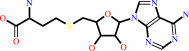 S-adenosyl-L-homocysteine
|
|
|
|
|
|
|
|
|
|
Enzyme class 4:
|
|
E.C.2.1.1.57
- methyltransferase cap1.
|
|
|
|
|
|
|
Reaction:
|
|
a 5'-end (N(7)-methyl 5'-triphosphoguanosine)-ribonucleoside in mRNA + S-adenosyl-L-methionine = a 5'-end (N(7)-methyl 5'-triphosphoguanosine)- (2'-O-methyl-ribonucleoside) in mRNA + S-adenosyl-L-homocysteine + H+
|
|
|
|
|
|
5'-end (N(7)-methyl 5'-triphosphoguanosine)-ribonucleoside in mRNA
|
+
|
S-adenosyl-L-methionine
|
=
|
5'-end (N(7)-methyl 5'-triphosphoguanosine)- (2'-O-methyl-ribonucleoside) in mRNA
|
+
|
S-adenosyl-L-homocysteine
|
+
|
H(+)
|
|
|
|
|
|
|
|
|
|
Enzyme class 5:
|
|
E.C.2.7.7.48
- RNA-directed Rna polymerase.
|
|
|
|
|
|
|
Reaction:
|
|
RNA(n) + a ribonucleoside 5'-triphosphate = RNA(n+1) + diphosphate
|
|
|
|
|
|
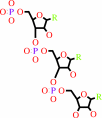 RNA(n)
|
+
|
ribonucleoside 5'-triphosphate
|
=
|
RNA(n+1)
|
+
|
 diphosphate
|
|
|
|
|
|
|
|
|
|
Enzyme class 6:
|
|
E.C.2.7.7.50
- mRNA guanylyltransferase.
|
|
|
|
|
|
|
Reaction:
|
|
a 5'-end diphospho-ribonucleoside in mRNA + GTP + H+ = a 5'-end (5'-triphosphoguanosine)-ribonucleoside in mRNA + diphosphate
|
|
|
|
|
|
5'-end diphospho-ribonucleoside in mRNA
|
+
|
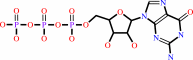 GTP
GTP
|
+
|
H(+)
|
=
|
5'-end (5'-triphosphoguanosine)-ribonucleoside in mRNA
|
+
|
diphosphate
|
|
|
|
|
|
|
|
|
|
Enzyme class 7:
|
|
E.C.3.1.13.-
- ?????
|
|
|
|
|
|
|
Enzyme class 8:
|
|
E.C.3.4.19.12
- ubiquitinyl hydrolase 1.
|
|
|
|
|
|
|
Reaction:
|
|
Thiol-dependent hydrolysis of ester, thiolester, amide, peptide and isopeptide bonds formed by the C-terminal Gly of ubiquitin (a 76-residue protein attached to proteins as an intracellular targeting signal).
|
|
|
|
|
|
Enzyme class 9:
|
|
E.C.3.4.22.-
- ?????
|
|
|
|
|
|
|
Enzyme class 10:
|
|
E.C.3.4.22.69
- Sars coronavirus main proteinase.
|
|
|
|
|
|
|
Enzyme class 11:
|
|
E.C.3.6.4.12
- Dna helicase.
|
|
|
|
|
|
|
Reaction:
|
|
ATP + H2O = ADP + phosphate + H+
|
|
|
|
|
|
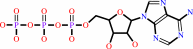 ATP
ATP
|
+
|
H2O
|
=
|
 ADP
ADP
|
+
|
 phosphate
|
+
|
H(+)
|
|
|
|
|
|
|
|
|
|
Enzyme class 12:
|
|
E.C.3.6.4.13
- Rna helicase.
|
|
|
|
|
|
|
Reaction:
|
|
ATP + H2O = ADP + phosphate + H+
|
|
|
|
|
|
ATP
|
+
|
H2O
|
=
|
ADP
|
+
|
phosphate
|
+
|
H(+)
|
|
|
|
|
|
|
|
|
|
Enzyme class 13:
|
|
E.C.4.6.1.-
- ?????
|
|
|
|
|
|
|
|
|
|
Note, where more than one E.C. class is given (as above), each may
correspond to a different protein domain or, in the case of polyprotein
precursors, to a different mature protein.
|
|
|
|
Molecule diagrams generated from .mol files obtained from the
KEGG ftp site
|
|
|
|
|
|
|
|
|
|
|
|
|
|
 |
|
|
|
|
|
|
| |
|
|
| |
|
DOI no:
|
J Mol Biol
354:25-40
(2005)
|
|
PubMed id:
|
|
|
|
|
|
| |
|
pH-dependent conformational flexibility of the SARS-CoV main proteinase (M(pro)) dimer: molecular dynamics simulations and multiple X-ray structure analyses.
|
|
J.Tan,
K.H.Verschueren,
K.Anand,
J.Shen,
M.Yang,
Y.Xu,
Z.Rao,
J.Bigalke,
B.Heisen,
J.R.Mesters,
K.Chen,
X.Shen,
H.Jiang,
R.Hilgenfeld.
|
|
|
|
|
| |
ABSTRACT
|
|
|
|
| |
|
|
The SARS coronavirus main proteinase (M(pro)) is a key enzyme in the processing
of the viral polyproteins and thus an attractive target for the discovery of
drugs directed against SARS. The enzyme has been shown by X-ray crystallography
to undergo significant pH-dependent conformational changes. Here, we assess the
conformational flexibility of the M(pro) by analysis of multiple crystal
structures (including two new crystal forms) and by molecular dynamics (MD)
calculations. The MD simulations take into account the different protonation
states of two histidine residues in the substrate-binding site and explain the
pH-activity profile of the enzyme. The low enzymatic activity of the M(pro)
monomer and the need for dimerization are also discussed.
|
|
|
|
|
|
| |
Selected figure(s)
|
|
|
|
| |
|
|

|
|

|
|
Figure 1.
Figure 1. Structure of the (a) monomer and (b) dimer of
SARS-CoV Mpro. (a) Domains I (light blue) and II (green) each
contain a six-stranded b-barrel and domain III (orange) is
composed mainly of a-helices. The amino and the carboxy terminus
are marked by a blue and an orange sphere, respectively. The
flexible loops L1, L2, and L3 (red) comprise residues 138-145
(the oxyanion-binding loop), 165-172, and 185-200, respectively.
(b) a-Helices are red and b-strands are light blue. The amino
and the carboxy termini are marked by blue and orange spheres,
respectively. Dimerization is mainly due to interactions between
the helical domains III of each monomer (top). (c)
Superimposition (in stereo) of the C^a backbone as determined in
three different crystal forms. Blue, monoclinic form; red,
tetragonal form; green, orthorhombic form. (a) and (b) were
prepared by MOLSCRIPT,40 (c) was prepared by PyMOL.41
|
|
Figure 8.
Figure 8. Some characteristic distances in the MD
simulations of the SARS-CoV Mpro dimer at (a) pH 6.0, (b) pH
7.6, (c) pH 8.0, and (d) pH 5.0. For each simulation, the
distance between Glu166 and His163, Glu166 and His172, Glu166
and Ser1(N) of the other monomer in the dimer, and Phe140
(center of mass of phenyl ring) and His163 (center of mass of
imidazole ring) are shown. The shorter of the two distances to
the carboxylate oxygen atoms of Glu166, Oe1 and Oe2, is
displayed. Green, monomer A; blue, monomer B.
|
|
|
|
|
|
| |
The above figures are
reprinted
by permission from Elsevier:
J Mol Biol
(2005,
354,
25-40)
copyright 2005.
|
|
| |
Figures were
selected
by an automated process.
|
|
|
|
|
|
|
|
|
|
|
|
|
|
|
|
 |
 |
 |
|
Literature references that cite this PDB file's key reference
|
|
|
| |
PubMed id
|
|
Reference
|
|
|
|
|
|
J.Tan,
C.Vonrhein,
O.S.Smart,
G.Bricogne,
M.Bollati,
Y.Kusov,
G.Hansen,
J.R.Mesters,
C.L.Schmidt,
and
R.Hilgenfeld
(2009).
The SARS-Unique Domain (SUD) of SARS Coronavirus Contains Two Macrodomains That Bind G-Quadruplexes.
|
| |
PLoS Pathog,
5,
e1000428.
|
|
|
PDB codes:
|
|
|
|
|
|
|
|
C.Niu,
J.Yin,
J.Zhang,
J.C.Vederas,
and
M.N.James
(2008).
Molecular docking identifies the binding of 3-chloropyridine moieties specifically to the S1 pocket of SARS-CoV Mpro.
|
| |
Bioorg Med Chem,
16,
293-302.
|
|
|
|
|
|
|
J.Shi,
J.Sivaraman,
and
J.Song
(2008).
Mechanism for controlling the dimer-monomer switch and coupling dimerization to catalysis of the severe acute respiratory syndrome coronavirus 3C-like protease.
|
| |
J Virol,
82,
4620-4629.
|
|
|
PDB code:
|
|
|
|
|
|
|
|
N.Zhong,
S.Zhang,
P.Zou,
J.Chen,
X.Kang,
Z.Li,
C.Liang,
C.Jin,
and
B.Xia
(2008).
Without its N-finger, the main protease of severe acute respiratory syndrome coronavirus can form a novel dimer through its C-terminal domain.
|
| |
J Virol,
82,
4227-4234.
|
|
|
|
|
|
|
R.L.Graham,
J.S.Sparks,
L.D.Eckerle,
A.C.Sims,
and
M.R.Denison
(2008).
SARS coronavirus replicase proteins in pathogenesis.
|
| |
Virus Res,
133,
88.
|
|
|
|
|
|
|
S.Chen,
T.Hu,
J.Zhang,
J.Chen,
K.Chen,
J.Ding,
H.Jiang,
and
X.Shen
(2008).
Mutation of Gly-11 on the dimer interface results in the complete crystallographic dimer dissociation of severe acute respiratory syndrome coronavirus 3C-like protease: crystal structure with molecular dynamics simulations.
|
| |
J Biol Chem,
283,
554-564.
|
|
|
PDB code:
|
|
|
|
|
|
|
|
U.Bacha,
J.Barrila,
S.B.Gabelli,
Y.Kiso,
L.Mario Amzel,
and
E.Freire
(2008).
Development of broad-spectrum halomethyl ketone inhibitors against coronavirus main protease 3CL(pro).
|
| |
Chem Biol Drug Des,
72,
34-49.
|
|
|
PDB code:
|
|
|
|
|
|
|
|
E.F.Donaldson,
R.L.Graham,
A.C.Sims,
M.R.Denison,
and
R.S.Baric
(2007).
Analysis of murine hepatitis virus strain A59 temperature-sensitive mutant TS-LA6 suggests that nsp10 plays a critical role in polyprotein processing.
|
| |
J Virol,
81,
7086-7098.
|
|
|
|
|
|
|
H.P.Chang,
C.Y.Chou,
and
G.G.Chang
(2007).
Reversible unfolding of the severe acute respiratory syndrome coronavirus main protease in guanidinium chloride.
|
| |
Biophys J,
92,
1374-1383.
|
|
|
|
|
|
|
M.S.Almeida,
M.A.Johnson,
T.Herrmann,
M.Geralt,
and
K.Wüthrich
(2007).
Novel beta-barrel fold in the nuclear magnetic resonance structure of the replicase nonstructural protein 1 from the severe acute respiratory syndrome coronavirus.
|
| |
J Virol,
81,
3151-3161.
|
|
|
PDB codes:
|
|
|
|
|
|
|
|
H.Chen,
P.Wei,
C.Huang,
L.Tan,
Y.Liu,
and
L.Lai
(2006).
Only one protomer is active in the dimer of SARS 3C-like proteinase.
|
| |
J Biol Chem,
281,
13894-13898.
|
|
|
|
|
|
|
J.Barrila,
U.Bacha,
and
E.Freire
(2006).
Long-range cooperative interactions modulate dimerization in SARS 3CLpro.
|
| |
Biochemistry,
45,
14908-14916.
|
|
|
|
|
|
|
J.R.Mesters,
J.Tan,
and
R.Hilgenfeld
(2006).
Viral enzymes.
|
| |
Curr Opin Struct Biol,
16,
776-786.
|
|
|
|
|
|
|
S.I.Al-Gharabli,
S.T.Shah,
S.Weik,
M.F.Schmidt,
J.R.Mesters,
D.Kuhn,
G.Klebe,
R.Hilgenfeld,
and
J.Rademann
(2006).
An efficient method for the synthesis of peptide aldehyde libraries employed in the discovery of reversible SARS coronavirus main protease (SARS-CoV Mpro) inhibitors.
|
| |
Chembiochem,
7,
1048-1055.
|
|
|
|
|
|
The most recent references are shown first.
Citation data come partly from CiteXplore and partly
from an automated harvesting procedure. Note that this is likely to be
only a partial list as not all journals are covered by
either method. However, we are continually building up the citation data
so more and more references will be included with time.
Where a reference describes a PDB structure, the PDB
codes are
shown on the right.
|
|


 Links
Links


