 |
PDBsum entry 1zqo

|
|
|
|
|
|

|

|

|

|
|

|
|

|
|

|
|

|
|

|
|

|
|
|
 |

|

|
|
|
|
|
|
|
|
|
|
|
|
|
|
|
|
|
|
|
|
|
|
|
|
|
|
|
|
|
|
|
|
|
|
|
Transferase/DNA
|
PDB id
|
|
|
|
1zqo
|
|
|
|
|
|
|
|
|
|
|
|
|
|
|

|

|

|
|
|
|
|
|
|
|
 |
Contents |
 |
|
|
|
|
|
|
|
|
|
|
|
|
|
|
* Residue conservation analysis
|
|
|
|
|
|
|
|
|
|
|
Enzyme class 1:
|
|
E.C.2.7.7.7
- DNA-directed Dna polymerase.
|
|
|
|
|
|
|
Reaction:
|
|
DNA(n) + a 2'-deoxyribonucleoside 5'-triphosphate = DNA(n+1) + diphosphate
|
|
|
|
|
|
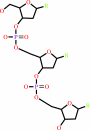 DNA(n)
|
+
|
2'-deoxyribonucleoside 5'-triphosphate
|
=
|
DNA(n+1)
|
+
|
 diphosphate
|
|
|
|
|
|
|
|
|
|
Enzyme class 2:
|
|
E.C.4.2.99.-
- ?????
|
|
|
|
|
|
|
Enzyme class 3:
|
|
E.C.4.2.99.18
- DNA-(apurinic or apyrimidinic site) lyase.
|
|
|
|
|
|
|
Reaction:
|
|
2'-deoxyribonucleotide-(2'-deoxyribose 5'-phosphate)- 2'-deoxyribonucleotide-DNA = a 3'-end 2'-deoxyribonucleotide-(2,3- dehydro-2,3-deoxyribose 5'-phosphate)-DNA + a 5'-end 5'-phospho- 2'-deoxyribonucleoside-DNA + H+
|
|
|
|
|
|
|
|
|
Note, where more than one E.C. class is given (as above), each may
correspond to a different protein domain or, in the case of polyprotein
precursors, to a different mature protein.
|
|
|
|
Molecule diagrams generated from .mol files obtained from the
KEGG ftp site
|
|
|
|
|
|
|
|
|
|
|
|
|
|
 |
|
|
|
|
|
|
| |
|
|
| |
|
DOI no:
|
Biochemistry
35:12778-12787
(1996)
|
|
PubMed id:
|
|
|
|
|
|
| |
|
Characterization of the metal ion binding helix-hairpin-helix motifs in human DNA polymerase beta by X-ray structural analysis.
|
|
H.Pelletier,
M.R.Sawaya.
|
|
|
|
|
| |
ABSTRACT
|
|
|
|
| |
|
|
X-ray crystallographic studies have shown that DNA binding by human polymerase
beta (pol beta) occurs primarily through two structurally and sequentially
homologous helix-hairpin-helix (HhH) motifs, one in the fingers subdomain and
the other in the 8-kDa domain [Pelletier, H., Sawaya, M. R., Wolfle, W., Wilson,
S. H., & Kraut, J. (1996a) Biochemistry 35, 12742-12761]. In that DNA
binding by each HhH motif is facilitated by a metal ion, we set out to determine
the identity of the metal ion that most likely binds to the HhH motif in vivo.
Crystal soaking experiments were performed on human pol beta-DNA cocrystals with
Mg2+, Ca2+, Na+, and K+, the four most prevalent metal ions in the cell, and in
each case a data set was collected and the resulting structure was refined.
Under the conditions tested, the HhH motifs of pol beta have an affinity for
these biologically prevalent metal ions in the order Mg2+ < Ca2+ < Na+
< K+, with K+ displaying the strongest binding. Crystals soaked in the
presence of Tl+, a commonly used spectroscopic probe for K+, were too
X-ray-sensitive to establish the binding behavior of Tl+, but soaking
experiments with Ba2+ and Cs+ resulted in relatively stable crystals that gave
evidence of metal ion binding in both HhH motifs, confirming that larger
monovalent and divalent metal ions are capable of binding to the HhH metal
sites. Although Mn2+, which has been categorized as a potent polymerase mutagen,
binds to the HhH motifs with a greater affinity than Mg2+, Mn2+ does not bind to
the HhH motifs in the presence of equimolar concentrations of Na+. These results
suggest that in vivo, where Mn2+ is present only in trace amounts, Mn2+ probably
does not have a large effect on DNA binding and may instead manifest a mutagenic
effect on pol beta primarily by distorting nucleotide binding or by directly
affecting the catalytic step [Pelletier, H., Sawaya, M. R., Wolfle, W., Wilson,
S. H., & Kraut, J. (1996b) Biochemistry 35, 12762-12777]. Crystal soaking
experiments with 31-kDa apoenzyme crystals show that, in the absence of DNA, the
HhH motif in the fingers subdomain binds metal ions with either much lower
occupancy or not at all, indicating that metal ion binding is dependent on the
presence of the DNA substrate.
|
|
|
|
|
|
|
|
|
|
|
|
|
|
|
|
|
|
 |
 |
 |
|
Literature references that cite this PDB file's key reference
|
|
|
| |
PubMed id
|
|
Reference
|
|
|
|
|
|
F.Faucher,
S.S.Wallace,
and
S.Doublié
(2010).
The C-terminal lysine of Ogg2 DNA glycosylases is a major molecular determinant for guanine/8-oxoguanine distinction.
|
| |
J Mol Biol,
397,
46-56.
|
|
|
PDB code:
|
|
|
|
|
|
|
|
F.Faucher,
S.S.Wallace,
and
S.Doublié
(2009).
Structural basis for the lack of opposite base specificity of Clostridium acetobutylicum 8-oxoguanine DNA glycosylase.
|
| |
DNA Repair (Amst),
8,
1283-1289.
|
|
|
PDB codes:
|
|
|
|
|
|
|
|
A.Abyzov,
A.Uzun,
P.R.Strauss,
and
V.A.Ilyin
(2008).
An AP endonuclease 1-DNA polymerase beta complex: theoretical prediction of interacting surfaces.
|
| |
PLoS Comput Biol,
4,
e1000066.
|
|
|
|
|
|
|
A.S.Jaiswal,
and
S.Narayan
(2008).
A novel function of adenomatous polyposis coli (APC) in regulating DNA repair.
|
| |
Cancer Lett,
271,
272-280.
|
|
|
|
|
|
|
C.Hazan,
F.Boudsocq,
V.Gervais,
O.Saurel,
M.Ciais,
C.Cazaux,
J.Czaplicki,
and
A.Milon
(2008).
Structural insights on the pamoic acid and the 8 kDa domain of DNA polymerase beta complex: towards the design of higher-affinity inhibitors.
|
| |
BMC Struct Biol,
8,
22.
|
|
|
|
|
|
|
K.H.Tang,
M.Niebuhr,
A.Aulabaugh,
and
M.D.Tsai
(2008).
Solution structures of 2 : 1 and 1 : 1 DNA polymerase-DNA complexes probed by ultracentrifugation and small-angle X-ray scattering.
|
| |
Nucleic Acids Res,
36,
849-860.
|
|
|
|
|
|
|
K.H.Tang,
M.Niebuhr,
C.S.Tung,
H.C.Chan,
C.C.Chou,
and
M.D.Tsai
(2008).
Mismatched dNTP incorporation by DNA polymerase beta does not proceed via globally different conformational pathways.
|
| |
Nucleic Acids Res,
36,
2948-2957.
|
|
|
PDB code:
|
|
|
|
|
|
|
|
J.J.Petkowski,
M.Chruszcz,
M.D.Zimmerman,
H.Zheng,
T.Skarina,
O.Onopriyenko,
M.T.Cymborowski,
K.D.Koclega,
A.Savchenko,
A.Edwards,
and
W.Minor
(2007).
Crystal structures of TM0549 and NE1324--two orthologs of E. coli AHAS isozyme III small regulatory subunit.
|
| |
Protein Sci,
16,
1360-1367.
|
|
|
PDB codes:
|
|
|
|
|
|
|
|
J.Stagno,
I.Aphasizheva,
A.Rosengarth,
H.Luecke,
and
R.Aphasizhev
(2007).
UTP-bound and Apo structures of a minimal RNA uridylyltransferase.
|
| |
J Mol Biol,
366,
882-899.
|
|
|
PDB codes:
|
|
|
|
|
|
|
|
O.S.Rissland,
A.Mikulasova,
and
C.J.Norbury
(2007).
Efficient RNA polyuridylation by noncanonical poly(A) polymerases.
|
| |
Mol Cell Biol,
27,
3612-3624.
|
|
|
|
|
|
|
S.Beetz,
D.Diekhoff,
and
L.A.Steiner
(2007).
Characterization of terminal deoxynucleotidyl transferase and polymerase mu in zebrafish.
|
| |
Immunogenetics,
59,
735-744.
|
|
|
|
|
|
|
H.Zang,
A.Irimia,
J.Y.Choi,
K.C.Angel,
L.V.Loukachevitch,
M.Egli,
and
F.P.Guengerich
(2006).
Efficient and high fidelity incorporation of dCTP opposite 7,8-dihydro-8-oxodeoxyguanosine by Sulfolobus solfataricus DNA polymerase Dpo4.
|
| |
J Biol Chem,
281,
2358-2372.
|
|
|
PDB codes:
|
|
|
|
|
|
|
|
D.Wong,
and
B.Demple
(2004).
Modulation of the 5'-deoxyribose-5-phosphate lyase and DNA synthesis activities of mammalian DNA polymerase beta by apurinic/apyrimidinic endonuclease 1.
|
| |
J Biol Chem,
279,
25268-25275.
|
|
|
|
|
|
|
M.Garcia-Diaz,
K.Bebenek,
J.M.Krahn,
L.Blanco,
T.A.Kunkel,
and
L.C.Pedersen
(2004).
A structural solution for the DNA polymerase lambda-dependent repair of DNA gaps with minimal homology.
|
| |
Mol Cell,
13,
561-572.
|
|
|
PDB code:
|
|
|
|
|
|
|
|
S.J.Kim,
W.A.Beard,
J.Harvey,
D.D.Shock,
J.R.Knutson,
and
S.H.Wilson
(2003).
Rapid segmental and subdomain motions of DNA polymerase beta.
|
| |
J Biol Chem,
278,
5072-5081.
|
|
|
|
|
|
|
S.Jones,
H.P.Shanahan,
H.M.Berman,
and
J.M.Thornton
(2003).
Using electrostatic potentials to predict DNA-binding sites on DNA-binding proteins.
|
| |
Nucleic Acids Res,
31,
7189-7198.
|
|
|
|
|
|
|
M.Delarue,
J.B.Boulé,
J.Lescar,
N.Expert-Bezançon,
N.Jourdan,
N.Sukumar,
F.Rougeon,
and
C.Papanicolaou
(2002).
Crystal structures of a template-independent DNA polymerase: murine terminal deoxynucleotidyltransferase.
|
| |
EMBO J,
21,
427-439.
|
|
|
PDB codes:
|
|
|
|
|
|
|
|
M.García-Díaz,
K.Bebenek,
R.Sabariegos,
O.Domínguez,
J.Rodríguez,
T.Kirchhoff,
E.García-Palomero,
A.J.Picher,
R.Juárez,
J.F.Ruiz,
T.A.Kunkel,
and
L.Blanco
(2002).
DNA polymerase lambda, a novel DNA repair enzyme in human cells.
|
| |
J Biol Chem,
277,
13184-13191.
|
|
|
|
|
|
|
M.Maitra,
A.Gudzelak,
S.X.Li,
Y.Matsumoto,
K.A.Eckert,
J.Jager,
and
J.B.Sweasy
(2002).
Threonine 79 is a hinge residue that governs the fidelity of DNA polymerase beta by helping to position the DNA within the active site.
|
| |
J Biol Chem,
277,
35550-35560.
|
|
|
|
|
|
|
N.Shimazaki,
K.Yoshida,
T.Kobayashi,
S.Toji,
K.Tamai,
and
O.Koiwai
(2002).
Over-expression of human DNA polymerase lambda in E. coli and characterization of the recombinant enzyme.
|
| |
Genes Cells,
7,
639-651.
|
|
|
|
|
|
|
S.Singh,
G.E.Folkers,
A.M.Bonvin,
R.Boelens,
R.Wechselberger,
A.Niztayev,
and
R.Kaptein
(2002).
Solution structure and DNA-binding properties of the C-terminal domain of UvrC from E.coli.
|
| |
EMBO J,
21,
6257-6266.
|
|
|
PDB code:
|
|
|
|
|
|
|
|
Y.Mizushina,
S.Kamisuki,
N.Kasai,
N.Shimazaki,
M.Takemura,
H.Asahara,
S.Linn,
S.Yoshida,
A.Matsukage,
O.Koiwai,
F.Sugawara,
H.Yoshida,
and
K.Sakaguchi
(2002).
A plant phytotoxin, solanapyrone A, is an inhibitor of DNA polymerase beta and lambda.
|
| |
J Biol Chem,
277,
630-638.
|
|
|
|
|
|
|
M.Machius,
J.L.Chuang,
R.M.Wynn,
D.R.Tomchick,
and
D.T.Chuang
(2001).
Structure of rat BCKD kinase: nucleotide-induced domain communication in a mitochondrial protein kinase.
|
| |
Proc Natl Acad Sci U S A,
98,
11218-11223.
|
|
|
PDB codes:
|
|
|
|
|
|
|
|
T.C.Umland,
S.Q.Wei,
R.Craigie,
and
D.R.Davies
(2000).
Structural basis of DNA bridging by barrier-to-autointegration factor.
|
| |
Biochemistry,
39,
9130-9138.
|
|
|
PDB code:
|
|
|
|
|
|
|
|
T.Hollis,
Y.Ichikawa,
and
T.Ellenberger
(2000).
DNA bending and a flip-out mechanism for base excision by the helix-hairpin-helix DNA glycosylase, Escherichia coli AlkA.
|
| |
EMBO J,
19,
758-766.
|
|
|
PDB code:
|
|
|
|
|
|
|
|
X.Shao,
and
N.V.Grishin
(2000).
Common fold in helix-hairpin-helix proteins.
|
| |
Nucleic Acids Res,
28,
2643-2650.
|
|
|
|
|
|
|
Y.Mizushina,
T.Ueno,
M.Oda,
T.Yamaguchi,
M.Saneyoshi,
and
K.Sakaguchi
(2000).
The biochemical mode of inhibition of DNA polymerase beta by alpha-rubromycin.
|
| |
Biochim Biophys Acta,
1523,
172-181.
|
|
|
|
|
|
|
Y.Fujii,
T.Shimizu,
M.Kusumoto,
Y.Kyogoku,
T.Taniguchi,
and
T.Hakoshima
(1999).
Crystal structure of an IRF-DNA complex reveals novel DNA recognition and cooperative binding to a tandem repeat of core sequences.
|
| |
EMBO J,
18,
5028-5041.
|
|
|
PDB code:
|
|
|
|
|
|
|
|
J.Singh,
and
E.T.Snow
(1998).
Chromium(III) decreases the fidelity of human DNA polymerase beta.
|
| |
Biochemistry,
37,
9371-9378.
|
|
|
|
|
|
|
M.Oliveros,
R.J.Yáñez,
M.L.Salas,
J.Salas,
E.Viñuela,
and
L.Blanco
(1997).
Characterization of an African swine fever virus 20-kDa DNA polymerase involved in DNA repair.
|
| |
J Biol Chem,
272,
30899-30910.
|
|
|
|
|
|
|
M.R.Sawaya,
R.Prasad,
S.H.Wilson,
J.Kraut,
and
H.Pelletier
(1997).
Crystal structures of human DNA polymerase beta complexed with gapped and nicked DNA: evidence for an induced fit mechanism.
|
| |
Biochemistry,
36,
11205-11215.
|
|
|
PDB codes:
|
|
|
|
|
|
|
|
H.Pelletier,
M.R.Sawaya,
W.Wolfle,
S.H.Wilson,
and
J.Kraut
(1996).
Crystal structures of human DNA polymerase beta complexed with DNA: implications for catalytic mechanism, processivity, and fidelity.
|
| |
Biochemistry,
35,
12742-12761.
|
|
|
PDB codes:
|
|
|
|
|
|
|
|
H.Pelletier,
M.R.Sawaya,
W.Wolfle,
S.H.Wilson,
and
J.Kraut
(1996).
A structural basis for metal ion mutagenicity and nucleotide selectivity in human DNA polymerase beta.
|
| |
Biochemistry,
35,
12762-12777.
|
|
|
PDB codes:
|
|
|
|
|
|
|
The most recent references are shown first.
Citation data come partly from CiteXplore and partly
from an automated harvesting procedure. Note that this is likely to be
only a partial list as not all journals are covered by
either method. However, we are continually building up the citation data
so more and more references will be included with time.
Where a reference describes a PDB structure, the PDB
code is
shown on the right.
|
|


 Links
Links


