 |
PDBsum entry 1rzt

|
|
|
|
|
|

|

|

|

|
|

|
|

|
|

|
|

|
|

|
|

|
|

|
|

|
|
|
 |

|

|
|
|
|
|
|
|
|
|
|
|
|
|
|
|
|
|
|
|
|
|
|
|
|
|
|
|
|
|
|
|
|
|
|
|
|
|
Transferase/DNA
|
PDB id
|
|
|
|
1rzt
|
|
|
|
|
|
|
|
|
|
|
|
|
|
|

|

|

|
|
|
|
|
|
|
|
 |
Contents |
 |
|
|
|
|
|
|
|
|
|
|
|
|
|
|
|
|
* Residue conservation analysis
|
|
|
|
|
|
PDB id:
|
|
|
|
| Name: |
|
Transferase/DNA
|
|
|
Title:
|
|
Crystal structure of DNA polymerase lambda complexed with a two nucleotide gap DNA molecule
|
|
Structure:
|
|
5'-d( Cp Gp Gp Cp Ap Ap Cp Gp Cp Ap C)-3'. Chain: b, f, j, n. Engineered: yes. Other_details: template DNA. 5'-d( Gp Tp Gp Cp G)-3'. Chain: c, g, k, o. Engineered: yes. Other_details: upstream primer DNA. 5'-d(p Gp Cp Cp G)-3'.
|
|
Source:
|
|
Synthetic: yes. Homo sapiens. Human. Organism_taxid: 9606. Gene: poll. Expressed in: escherichia coli. Expression_system_taxid: 562.
|
|
Biol. unit:
|
|
 Tetramer (from
)
Tetramer (from
)
|
|
Resolution:
|
|
|
2.10Å
|
R-factor:
|
0.227
|
R-free:
|
0.260
|
|
|
Authors:
|
|
L.C.Pedersen,M.Garcia-Diaz,K.Bebenek,J.M.Krahn,L.Blanco,T.A.Kunkel
|
Key ref:

|
|
M.Garcia-Diaz
et al.
(2004).
A structural solution for the DNA polymerase lambda-dependent repair of DNA gaps with minimal homology.
Mol Cell,
13,
561-572.
PubMed id:
DOI:

|
|
|
Date:
|
|
|
29-Dec-03
|
Release date:
|
02-Mar-04
|
|
|
|
|
|
|
PROCHECK
|

|
|
|
|
|
Headers
|
|
|
|
References
|
|
|
|
|
|

|
|
Q9UGP5
(DPOLL_HUMAN) -
DNA polymerase lambda from Homo sapiens
|
|
|
|
Seq:
Struc:
|
|
|
|
575 a.a.
327 a.a.
|
|

|

|
|
|
|
|
|
|
|
|
|
|
|
Key: |
 |
PfamA domain |
|
|
 |
Secondary structure |
|
 |
CATH domain |
|
|
|
|
|
|
|
|

|
|
|
|
C-G-G-C-A-A-C-G-C-A-C
11 bases
|
|
|
|
G-T-G-C-G
5 bases
|
|
|
|
G-C-C-G
4 bases
|
|
|
|
C-G-G-C-A-A-C-G-C-A-C
11 bases
|
|
|
|
G-T-G-C-G
5 bases
|
|
|
|
G-C-C-G
4 bases
|
|
|
|
C-G-G-C-A-A-C-G-C-A-C
11 bases
|
|
|
|
G-T-G-C-G
5 bases
|
|
|
|
G-C-C-G
4 bases
|
|
|
|
C-G-G-C-A-A-C-G-C-A-C
11 bases
|
|
|
|
G-T-G-C-G
5 bases
|
|
|
|
G-C-C-G
4 bases
|
|
|
|
|
|
|
|
|
|
|
|
|
|
Enzyme class 2:
|
|
E.C.2.7.7.7
- DNA-directed Dna polymerase.
|
|
|
|
|
|
|
Reaction:
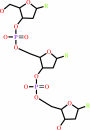
|
|
DNA(n) + a 2'-deoxyribonucleoside 5'-triphosphate = DNA(n+1) + diphosphate
|
|
|
|
|
|
 DNA(n)
|
+
|
2'-deoxyribonucleoside 5'-triphosphate
|
=
|
DNA(n+1)
|
+
|
 diphosphate
|
|
|
|
|
|
|
|
|
|
Enzyme class 3:
|
|
E.C.4.2.99.-
- ?????
|
|
|
|
|
|
|
|
|
|
Note, where more than one E.C. class is given (as above), each may
correspond to a different protein domain or, in the case of polyprotein
precursors, to a different mature protein.
|
|
|
|
Molecule diagrams generated from .mol files obtained from the
KEGG ftp site
|
|
|
|
|
|
|
|
|
|
|
|
|
|
 |
|
|
|
|
|
|
| |
|
|
| |
|
DOI no:
|
Mol Cell
13:561-572
(2004)
|
|
PubMed id:
|
|
|
|
|
|
| |
|
A structural solution for the DNA polymerase lambda-dependent repair of DNA gaps with minimal homology.
|
|
M.Garcia-Diaz,
K.Bebenek,
J.M.Krahn,
L.Blanco,
T.A.Kunkel,
L.C.Pedersen.
|
|
|
|
|
| |
ABSTRACT
|
|
|
|
| |
|
|
Human DNA polymerase lambda (Pol lambda) is a family X member with low
frameshift fidelity that has been suggested to perform gap-filling DNA synthesis
during base excision repair and during repair of broken ends with limited
homology. Here, we present a 2.1 A crystal structure of the catalytic core of
Pol lambda in complex with DNA containing a two nucleotide gap. Pol lambda makes
limited contacts with the template strand at the polymerase active site, and
superimposition with Pol beta in a ternary complex suggests a shift in the
position of the DNA at the active site that is reminiscent of a deletion
intermediate. Surprisingly, Pol lambda can adopt a closed conformation, even in
the absence of dNTP binding. These observations have implications for the
catalytic mechanism and putative DNA repair functions of Pol lambda.
|
|
|
|
|
|
| |
Selected figure(s)
|
|
|
|
| |
|
|

|
|

|
|
Figure 4.
Figure 4. Superimposition of Pol λ with the Open and
Closed Conformations of Pol βSuperimposition of the α carbon
trace of human Pol λ (red) with the structures of human Pol β
in an open (1BPX; yellow) and closed (1BPY; blue) conformation.
The roman numerals refer to different regions of the Pol λ
structure as indicated in the text. The rms deviation was 1.4
Å for 112 C-α atoms for 1BPX and 1.4 Å for 113 C-α
atoms for 1BPY.
|
|
Figure 7.
Figure 7. Biological Implications of the Pol λ
Structure(A) Stereo view of an overlay of the active site of Pol
λ with that of Pol β in a closed conformation (1BPY). The DNA
corresponds to the Pol λ structure, while the incoming ddCTP
(green) and metal ions (gray balls) correspond to Pol β 1BPY.
Relevant residues are shown in red (Pol λ) and blue (Pol β).
The template strand is gray and the primer terminus is
yellow.(B) Electrostatic surface potential of Pol λ and Pol β.
The DNA for each of the structures is shown in gray (template)
and yellow (primer and downstream primer). The potential ranges
from −8 kT/e (red) to 8 kT/e (blue).
|
|
|
|
|
|
| |
The above figures are
reprinted
by permission from Cell Press:
Mol Cell
(2004,
13,
561-572)
copyright 2004.
|
|
| |
Figures were
selected
by an automated process.
|
|
|
|
|
|
|
|
|
|
|
|
|
|
|
|
 |
 |
 |
|
Literature references that cite this PDB file's key reference
|
|
|
| |
PubMed id
|
|
Reference
|
|
|
|
|
|
K.Bebenek,
L.C.Pedersen,
and
T.A.Kunkel
(2011).
Replication infidelity via a mismatch with Watson-Crick geometry.
|
| |
Proc Natl Acad Sci U S A,
108,
1862-1867.
|
|
|
PDB codes:
|
|
|
|
|
|
|
|
P.Xie
(2011).
A model for the dynamics of mammalian family X DNA polymerases.
|
| |
J Theor Biol,
277,
111-122.
|
|
|
|
|
|
|
K.Bebenek,
M.Garcia-Diaz,
R.Z.Zhou,
L.F.Povirk,
and
T.A.Kunkel
(2010).
Loop 1 modulates the fidelity of DNA polymerase lambda.
|
| |
Nucleic Acids Res,
38,
5419-5431.
|
|
|
PDB codes:
|
|
|
|
|
|
|
|
K.Takakusagi,
Y.Takakusagi,
K.Ohta,
S.Aoki,
F.Sugawara,
and
K.Sakaguchi
(2010).
A sulfoglycolipid beta-sulfoquinovosyldiacylglycerol (betaSQDG) binds to Met1-Arg95 region of murine DNA polymerase lambda (Mmpol lambda) and inhibits its nuclear transit.
|
| |
Protein Eng Des Sel,
23,
51-60.
|
|
|
|
|
|
|
F.Romain,
I.Barbosa,
J.Gouge,
F.Rougeon,
and
M.Delarue
(2009).
Conferring a template-dependent polymerase activity to terminal deoxynucleotidyltransferase by mutations in the Loop1 region.
|
| |
Nucleic Acids Res,
37,
4642-4656.
|
|
|
|
|
|
|
G.Terrados,
J.P.Capp,
Y.Canitrot,
M.García-Díaz,
K.Bebenek,
T.Kirchhoff,
A.Villanueva,
F.Boudsocq,
V.Bergoglio,
C.Cazaux,
T.A.Kunkel,
J.S.Hoffmann,
and
L.Blanco
(2009).
Characterization of a natural mutator variant of human DNA polymerase lambda which promotes chromosomal instability by compromising NHEJ.
|
| |
PLoS One,
4,
e7290.
|
|
|
|
|
|
|
M.Garcia-Diaz,
K.Bebenek,
A.A.Larrea,
J.M.Havener,
L.Perera,
J.M.Krahn,
L.C.Pedersen,
D.A.Ramsden,
and
T.A.Kunkel
(2009).
Template strand scrunching during DNA gap repair synthesis by human polymerase lambda.
|
| |
Nat Struct Mol Biol,
16,
967-972.
|
|
|
|
|
|
|
M.W.Voehler,
R.L.Eoff,
W.H.McDonald,
F.P.Guengerich,
and
M.P.Stone
(2009).
Modulation of the structure, catalytic activity, and fidelity of african Swine Fever virus DNA polymerase x by a reversible disulfide switch.
|
| |
J Biol Chem,
284,
18434-18444.
|
|
|
|
|
|
|
J.M.Daley,
and
T.E.Wilson
(2008).
Evidence that base stacking potential in annealed 3' overhangs determines polymerase utilization in yeast nonhomologous end joining.
|
| |
DNA Repair (Amst),
7,
67-76.
|
|
|
|
|
|
|
R.E.London,
B.D.Wingad,
and
G.A.Mueller
(2008).
Dependence of amino acid side chain 13C shifts on dihedral angle: application to conformational analysis.
|
| |
J Am Chem Soc,
130,
11097-11105.
|
|
|
|
|
|
|
R.Z.Zhou,
L.Blanco,
M.Garcia-Diaz,
K.Bebenek,
T.A.Kunkel,
and
L.F.Povirk
(2008).
Tolerance for 8-oxoguanine but not thymine glycol in alignment-based gap filling of partially complementary double-strand break ends by DNA polymerase lambda in human nuclear extracts.
|
| |
Nucleic Acids Res,
36,
2895-2905.
|
|
|
|
|
|
|
U.Wimmer,
E.Ferrari,
P.Hunziker,
and
U.Hübscher
(2008).
Control of DNA polymerase lambda stability by phosphorylation and ubiquitination during the cell cycle.
|
| |
EMBO Rep,
9,
1027-1033.
|
|
|
|
|
|
|
A.F.Moon,
M.Garcia-Diaz,
K.Bebenek,
B.J.Davis,
X.Zhong,
D.A.Ramsden,
T.A.Kunkel,
and
L.C.Pedersen
(2007).
Structural insight into the substrate specificity of DNA Polymerase mu.
|
| |
Nat Struct Mol Biol,
14,
45-53.
|
|
|
PDB code:
|
|
|
|
|
|
|
|
A.F.Moon,
M.Garcia-Diaz,
V.K.Batra,
W.A.Beard,
K.Bebenek,
T.A.Kunkel,
S.H.Wilson,
and
L.C.Pedersen
(2007).
The X family portrait: structural insights into biological functions of X family polymerases.
|
| |
DNA Repair (Amst),
6,
1709-1725.
|
|
|
|
|
|
|
E.Crespan,
L.Alexandrova,
A.Khandazhinskaya,
M.Jasko,
M.Kukhanova,
G.Villani,
U.Hübscher,
S.Spadari,
and
G.Maga
(2007).
Expanding the repertoire of DNA polymerase substrates: template-instructed incorporation of non-nucleoside triphosphate analogues by DNA polymerases beta and lambda.
|
| |
Nucleic Acids Res,
35,
45-57.
|
|
|
|
|
|
|
E.Crespan,
U.Hübscher,
and
G.Maga
(2007).
Error-free bypass of 2-hydroxyadenine by human DNA polymerase lambda with Proliferating Cell Nuclear Antigen and Replication Protein A in different sequence contexts.
|
| |
Nucleic Acids Res,
35,
5173-5181.
|
|
|
|
|
|
|
G.C.Lin,
J.Jaeger,
and
J.B.Sweasy
(2007).
Loop II of DNA polymerase beta is important for polymerization activity and fidelity.
|
| |
Nucleic Acids Res,
35,
2924-2935.
|
|
|
|
|
|
|
M.Garcia-Diaz,
K.Bebenek,
J.M.Krahn,
L.C.Pedersen,
and
T.A.Kunkel
(2007).
Role of the catalytic metal during polymerization by DNA polymerase lambda.
|
| |
DNA Repair (Amst),
6,
1333-1340.
|
|
|
PDB codes:
|
|
|
|
|
|
|
|
M.Garcia-Diaz,
and
K.Bebenek
(2007).
Multiple functions of DNA polymerases.
|
| |
CRC Crit Rev Plant Sci,
26,
105-122.
|
|
|
|
|
|
|
R.S.Pitcher,
N.C.Brissett,
and
A.J.Doherty
(2007).
Nonhomologous end-joining in bacteria: a microbial perspective.
|
| |
Annu Rev Microbiol,
61,
259-282.
|
|
|
|
|
|
|
A.J.Picher,
M.García-Díaz,
K.Bebenek,
L.C.Pedersen,
T.A.Kunkel,
and
L.Blanco
(2006).
Promiscuous mismatch extension by human DNA polymerase lambda.
|
| |
Nucleic Acids Res,
34,
3259-3266.
|
|
|
PDB code:
|
|
|
|
|
|
|
|
B.A.Sampoli Benítez,
K.Arora,
and
T.Schlick
(2006).
In silico studies of the African swine fever virus DNA polymerase X support an induced-fit mechanism.
|
| |
Biophys J,
90,
42-56.
|
|
|
|
|
|
|
G.Maga,
I.Shevelev,
G.Villani,
S.Spadari,
and
U.Hübscher
(2006).
Human replication protein A can suppress the intrinsic in vitro mutator phenotype of human DNA polymerase lambda.
|
| |
Nucleic Acids Res,
34,
1405-1415.
|
|
|
|
|
|
|
K.A.Fiala,
W.W.Duym,
J.Zhang,
and
Z.Suo
(2006).
Up-regulation of the fidelity of human DNA polymerase lambda by its non-enzymatic proline-rich domain.
|
| |
J Biol Chem,
281,
19038-19044.
|
|
|
|
|
|
|
M.C.Foley,
K.Arora,
and
T.Schlick
(2006).
Sequential side-chain residue motions transform the binary into the ternary state of DNA polymerase lambda.
|
| |
Biophys J,
91,
3182-3195.
|
|
|
|
|
|
|
M.Garcia-Diaz,
K.Bebenek,
J.M.Krahn,
L.C.Pedersen,
and
T.A.Kunkel
(2006).
Structural analysis of strand misalignment during DNA synthesis by a human DNA polymerase.
|
| |
Cell,
124,
331-342.
|
|
|
PDB codes:
|
|
|
|
|
|
|
|
M.H.Lamers,
R.E.Georgescu,
S.G.Lee,
M.O'Donnell,
and
J.Kuriyan
(2006).
Crystal structure of the catalytic alpha subunit of E. coli replicative DNA polymerase III.
|
| |
Cell,
126,
881-892.
|
|
|
PDB codes:
|
|
|
|
|
|
|
|
P.Lin,
L.C.Pedersen,
V.K.Batra,
W.A.Beard,
S.H.Wilson,
and
L.G.Pedersen
(2006).
Energy analysis of chemistry for correct insertion by DNA polymerase beta.
|
| |
Proc Natl Acad Sci U S A,
103,
13294-13299.
|
|
|
|
|
|
|
R.Juárez,
J.F.Ruiz,
S.A.Nick McElhinny,
D.Ramsden,
and
L.Blanco
(2006).
A specific loop in human DNA polymerase mu allows switching between creative and DNA-instructed synthesis.
|
| |
Nucleic Acids Res,
34,
4572-4582.
|
|
|
|
|
|
|
T.Takeuchi,
T.Ishidoh,
H.Iijima,
I.Kuriyama,
N.Shimazaki,
O.Koiwai,
K.Kuramochi,
S.Kobayashi,
F.Sugawara,
K.Sakaguchi,
H.Yoshida,
and
Y.Mizushina
(2006).
Structural relationship of curcumin derivatives binding to the BRCT domain of human DNA polymerase lambda.
|
| |
Genes Cells,
11,
223-235.
|
|
|
|
|
|
|
W.W.Duym,
K.A.Fiala,
N.Bhatt,
and
Z.Suo
(2006).
Kinetic effect of a downstream strand and its 5'-terminal moieties on single nucleotide gap-filling synthesis catalyzed by human DNA polymerase lambda.
|
| |
J Biol Chem,
281,
35649-35655.
|
|
|
|
|
|
|
E.Crespan,
S.Zanoli,
A.Khandazhinskaya,
I.Shevelev,
M.Jasko,
L.Alexandrova,
M.Kukhanova,
G.Blanca,
G.Villani,
U.Hübscher,
S.Spadari,
and
G.Maga
(2005).
Incorporation of non-nucleoside triphosphate analogues opposite to an abasic site by human DNA polymerases beta and lambda.
|
| |
Nucleic Acids Res,
33,
4117-4127.
|
|
|
|
|
|
|
E.K.Braithwaite,
R.Prasad,
D.D.Shock,
E.W.Hou,
W.A.Beard,
and
S.H.Wilson
(2005).
DNA polymerase lambda mediates a back-up base excision repair activity in extracts of mouse embryonic fibroblasts.
|
| |
J Biol Chem,
280,
18469-18475.
|
|
|
|
|
|
|
G.Maga,
K.Ramadan,
G.A.Locatelli,
I.Shevelev,
S.Spadari,
and
U.Hübscher
(2005).
DNA elongation by the human DNA polymerase lambda polymerase and terminal transferase activities are differentially coordinated by proliferating cell nuclear antigen and replication protein A.
|
| |
J Biol Chem,
280,
1971-1981.
|
|
|
|
|
|
|
J.M.Daley,
P.L.Palmbos,
D.Wu,
and
T.E.Wilson
(2005).
Nonhomologous end joining in yeast.
|
| |
Annu Rev Genet,
39,
431-451.
|
|
|
|
|
|
|
J.M.Daley,
R.L.Laan,
A.Suresh,
and
T.E.Wilson
(2005).
DNA joint dependence of pol X family polymerase action in nonhomologous end joining.
|
| |
J Biol Chem,
280,
29030-29037.
|
|
|
|
|
|
|
K.Bebenek,
M.Garcia-Diaz,
S.R.Patishall,
and
T.A.Kunkel
(2005).
Biochemical properties of Saccharomyces cerevisiae DNA polymerase IV.
|
| |
J Biol Chem,
280,
20051-20058.
|
|
|
|
|
|
|
M.Garcia-Diaz,
K.Bebenek,
J.M.Krahn,
T.A.Kunkel,
and
L.C.Pedersen
(2005).
A closed conformation for the Pol lambda catalytic cycle.
|
| |
Nat Struct Mol Biol,
12,
97-98.
|
|
|
PDB codes:
|
|
|
|
|
|
|
|
N.Shimazaki,
T.Yazaki,
T.Kubota,
A.Sato,
A.Nakamura,
S.Kurei,
S.Toji,
K.Tamai,
and
O.Koiwai
(2005).
DNA polymerase lambda directly binds to proliferating cell nuclear antigen through its confined C-terminal region.
|
| |
Genes Cells,
10,
705-715.
|
|
|
|
|
|
|
S.A.Nick McElhinny,
J.M.Havener,
M.Garcia-Diaz,
R.Juárez,
K.Bebenek,
B.L.Kee,
L.Blanco,
T.A.Kunkel,
and
D.A.Ramsden
(2005).
A gradient of template dependence defines distinct biological roles for family X polymerases in nonhomologous end joining.
|
| |
Mol Cell,
19,
357-366.
|
|
|
|
|
|
|
S.González-Barrera,
A.Sánchez,
J.F.Ruiz,
R.Juárez,
A.J.Picher,
G.Terrados,
P.Andrade,
and
L.Blanco
(2005).
Characterization of SpPol4, a unique X-family DNA polymerase in Schizosaccharomyces pombe.
|
| |
Nucleic Acids Res,
33,
4762-4774.
|
|
|
|
|
|
|
J.F.Ruiz,
D.Lucas,
E.García-Palomero,
A.I.Saez,
M.A.González,
M.A.Piris,
A.Bernad,
and
L.Blanco
(2004).
Overexpression of human DNA polymerase mu (Pol mu) in a Burkitt's lymphoma cell line affects the somatic hypermutation rate.
|
| |
Nucleic Acids Res,
32,
5861-5873.
|
|
|
|
|
|
|
K.Ramadan,
I.Shevelev,
and
U.Hübscher
(2004).
The DNA-polymerase-X family: controllers of DNA quality?
|
| |
Nat Rev Mol Cell Biol,
5,
1038-1043.
|
|
|
|
|
|
|
M.Della,
P.L.Palmbos,
H.M.Tseng,
L.M.Tonkin,
J.M.Daley,
L.M.Topper,
R.S.Pitcher,
A.E.Tomkinson,
T.E.Wilson,
and
A.J.Doherty
(2004).
Mycobacterial Ku and ligase proteins constitute a two-component NHEJ repair machine.
|
| |
Science,
306,
683-685.
|
|
|
|
|
|
|
T.A.Kunkel
(2004).
DNA replication fidelity.
|
| |
J Biol Chem,
279,
16895-16898.
|
|
|
|
|
|
The most recent references are shown first.
Citation data come partly from CiteXplore and partly
from an automated harvesting procedure. Note that this is likely to be
only a partial list as not all journals are covered by
either method. However, we are continually building up the citation data
so more and more references will be included with time.
Where a reference describes a PDB structure, the PDB
codes are
shown on the right.
|
|


 Links
Links


