 |
PDBsum entry 2irf

|
|
|
|
|
|

|

|

|

|
|

|
|

|
|

|
|

|
|

|
|
|
 |

|

|
|
|
|
|
|
|
|
|
|
|
|
|
|
|
|
|
|
|
|
|
|
|
|
|
|
|
|
|
|
|
|
|
|
Gene regulation/DNA
|
PDB id
|
|
|
|
2irf
|
|
|
|
|
|
|
|
|
|
|
|
|
|
|

|

|

|
|
|
|
|
|
|
|
 |
Contents |
 |
|
|
|
|
|
|
|
|
|
|
|
|
|
|
* Residue conservation analysis
|
|
|
|
|
|
PDB id:
|
|
|
|
| Name: |
|
Gene regulation/DNA
|
|
|
Title:
|
|
Crystal structure of an irf-2/DNA complex.
|
|
Structure:
|
|
DNA (5'-d(p Ap Ap Gp Tp Gp Ap Ap Ap Gp (5Iu)p Gp A)-3'). Chain: a, b, c. Engineered: yes. DNA (5'-d( Tp Tp Cp Ap Cp Tp Tp Tp Cp Ap Cp (5Iu)p T)-3'). Chain: d, e, f. Engineered: yes. Interferon regulatory factor 2. Chain: g, h, i, j, k, l. Fragment: DNA-binding domain.
|
|
Source:
|
|
Synthetic: yes. Mus musculus. House mouse. Organism_taxid: 10090. Expressed in: escherichia coli bl21(de3). Expression_system_taxid: 469008.
|
|
Biol. unit:
|
|
Dodecamer (from
)
|
|
Resolution:
|
|
|
2.20Å
|
R-factor:
|
0.202
|
R-free:
|
0.243
|
|
|
Authors:
|
|
Y.Fujii,T.Shimizu,M.Kusumoto,Y.Kyogoku,T.Taniguchi,T.Hakoshima
|
Key ref:

|
|
Y.Fujii
et al.
(1999).
Crystal structure of an IRF-DNA complex reveals novel DNA recognition and cooperative binding to a tandem repeat of core sequences.
EMBO J,
18,
5028-5041.
PubMed id:
DOI:

|
|
|
Date:
|
|
|
30-May-99
|
Release date:
|
08-Oct-99
|
|
|
|
|
|
|
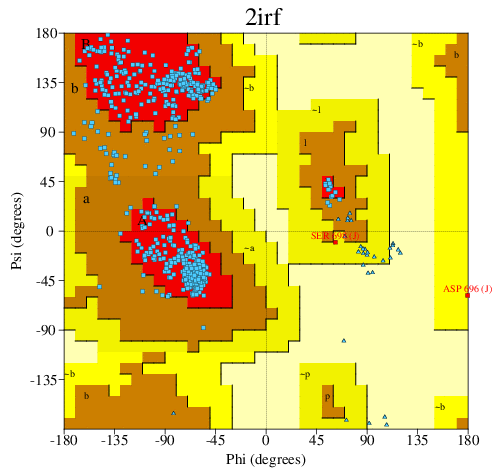
PROCHECK
|
|
|
|
|
|
Headers
|
|
|
|
References
|
|
|
|
|
|

|
|
P23906
(IRF2_MOUSE) -
Interferon regulatory factor 2 from Mus musculus
|
|
|
|
Seq:
Struc:
|
|
|
|
349 a.a.
109 a.a.
|
|

|

|

|
|
|
|
|
|
|
|
|
|
|
Key: |
 |
PfamA domain |
|
|
 |
Secondary structure |
|
 |
CATH domain |
|
|
|
|
|
|
|
|

|
|
|
|
A-A-G-T-G-A-A-A-G-5IU-G-A
12 bases
|
|
|
|
A-A-G-T-G-A-A-A-G-5IU-G-A
12 bases
|
|
|
|
A-A-G-T-G-A-A-A-G-5IU-G-A
12 bases
|
|
|
|
T-T-C-A-C-T-T-T-C-A-C-5IU-T
13 bases
|
|
|
|
T-C-A-C-T-T-T-C-A-C-5IU-T
12 bases
|
|
|
|
T-T-C-A-C-T-T-T-C-A-C-5IU-T
13 bases
|
|
|
|
|
|
|
|
|
|
|
|
|
|
|
|
|
|
 |
|
|
|
|
|
|
| |
|
DOI no:
|
EMBO J
18:5028-5041
(1999)
|
|
PubMed id:
|
|
|
|
|
|
| |
|
Crystal structure of an IRF-DNA complex reveals novel DNA recognition and cooperative binding to a tandem repeat of core sequences.
|
|
Y.Fujii,
T.Shimizu,
M.Kusumoto,
Y.Kyogoku,
T.Taniguchi,
T.Hakoshima.
|
|
|
|
|
| |
ABSTRACT
|
|
|
|
| |
|
|
There has been growing interest in the role of the IRF (interferon regulatory
factor) family of transcription factors in the regulation of immune responses,
cytokine signaling, and oncogenesis. These members are characterized by their
well-conserved DNA binding domains at the N-terminal regions. Here we report the
2.2 A resolution crystal structure of the DNA binding domain of one such family
member, IRF-2, bound to DNA. The structure reveals its recognition sequence,
AANNGAAA (here, recognized bases are underlined and in bold, and N indicates any
base), and its cooperative binding to a tandem repeat of the GAAA core sequence
induced by DNA structure distortions. These facts explain well the diverse
binding properties of the IRF family members, which bind to both single and
tandemly repeated sequences. Furthermore, we also identified the
'helix-hairpin-strand motif' at the C terminus of the recognition helix as a
metal binding site that is commonly found in certain classes of DNA-interactive
proteins. Our results provide new insights into the structure and function of
this family of transcription factors.
|
|
|
|
|
|
| |
Selected figure(s)
|
|
|
|
| |
|
|

|
|

|
|
Figure 6.
Figure 6 Model for PU.1 and IRF-4 bound to DNA. A side view of
surface representation showing the model for DNA binding domains
of PU.1 (green) and IRF-4 (purple) bound to DNA (light green)
containing the GGAANNGAAA motif in the  B
site of the enhancer of the immunoglobulin light chain gene. B
site of the enhancer of the immunoglobulin light chain gene.
|
|
Figure 7.
Figure 7 Possible synergistic bindings at enhancer elements. (A)
A side view of the surface representation of the IFN-  enhancer
with the DNA binding domains of the transcription factors; IRFs
(purple and wine red) bound to the PRD III and I sites, ATF-2
-c-Jun (blue and green) bound to the PRD IV, and NF- enhancer
with the DNA binding domains of the transcription factors; IRFs
(purple and wine red) bound to the PRD III and I sites, ATF-2
-c-Jun (blue and green) bound to the PRD IV, and NF-  B,
p65 (light green) -p50 (light blue) heterodimer bound to the PRD
I sites. The DNA sequence and the binding sites are indicated at
the top. Minor grooves of the HMG I(Y) binding sites are
indicated with labels. The N and C termini are indicated to show
the locations of their activation domains that link to the N
termini of ATF-2 -Jun and the C termini of IRF and p65. (B) A
side view of the surface representation showing the IRF-2 DNA
binding domains (purple and wine red) bound to the TATA-box
region of the VCAM-1 gene, together with bound TBP (light blue)
and the TFIIB core (green). An IRF-2 DNA binding domain (purple)
bound to the upstream GAAA core sequence contacts with the
N-terminal domain of the TFIIB core. B,
p65 (light green) -p50 (light blue) heterodimer bound to the PRD
I sites. The DNA sequence and the binding sites are indicated at
the top. Minor grooves of the HMG I(Y) binding sites are
indicated with labels. The N and C termini are indicated to show
the locations of their activation domains that link to the N
termini of ATF-2 -Jun and the C termini of IRF and p65. (B) A
side view of the surface representation showing the IRF-2 DNA
binding domains (purple and wine red) bound to the TATA-box
region of the VCAM-1 gene, together with bound TBP (light blue)
and the TFIIB core (green). An IRF-2 DNA binding domain (purple)
bound to the upstream GAAA core sequence contacts with the
N-terminal domain of the TFIIB core.
|
|
|
|
|
|
| |
The above figures are
reprinted
from an Open Access publication published by Macmillan Publishers Ltd:
EMBO J
(1999,
18,
5028-5041)
copyright 1999.
|
|
| |
Figures were
selected
by an automated process.
|
|
|
|
|
|
|
|
|
|
|
|
|
|
|
|
 |
 |
 |
|
Literature references that cite this PDB file's key reference
|
|
|
| |
PubMed id
|
|
Reference
|
|
|
|
|
|
M.Horiuchi,
A.Itoh,
D.Pleasure,
K.Ozato,
and
T.Itoh
(2011).
Cooperative contributions of Interferon regulatory factor 1 (IRF1) and IRF8 to interferon-γ-mediated cytotoxic effects on oligodendroglial progenitor cells.
|
| |
J Neuroinflammation,
8,
8.
|
|
|
|
|
|
|
D.A.Savitsky,
H.Yanai,
T.Tamura,
T.Taniguchi,
and
K.Honda
(2010).
Contribution of IRF5 in B cells to the development of murine SLE-like disease through its transcriptional control of the IgG2a locus.
|
| |
Proc Natl Acad Sci U S A,
107,
10154-10159.
|
|
|
|
|
|
|
D.Savitsky,
T.Tamura,
H.Yanai,
and
T.Taniguchi
(2010).
Regulation of immunity and oncogenesis by the IRF transcription factor family.
|
| |
Cancer Immunol Immunother,
59,
489-510.
|
|
|
|
|
|
|
G.M.Doody,
M.A.Care,
N.J.Burgoyne,
J.R.Bradford,
M.Bota,
C.Bonifer,
D.R.Westhead,
and
R.M.Tooze
(2010).
An extended set of PRDM1/BLIMP1 target genes links binding motif type to dynamic repression.
|
| |
Nucleic Acids Res,
38,
5336-5350.
|
|
|
|
|
|
|
R.Rohs,
X.Jin,
S.M.West,
R.Joshi,
B.Honig,
and
R.S.Mann
(2010).
Origins of specificity in protein-DNA recognition.
|
| |
Annu Rev Biochem,
79,
233-269.
|
|
|
|
|
|
|
H.J.Little,
N.K.Rorick,
L.I.Su,
C.Baldock,
S.Malhotra,
T.Jowitt,
L.Gakhar,
R.Subramanian,
B.C.Schutte,
M.J.Dixon,
and
P.Shore
(2009).
Missense mutations that cause Van der Woude syndrome and popliteal pterygium syndrome affect the DNA-binding and transcriptional activation functions of IRF6.
|
| |
Hum Mol Genet,
18,
535-545.
|
|
|
|
|
|
|
J.Nehyba,
R.Hrdlicková,
and
H.R.Bose
(2009).
Dynamic evolution of immune system regulators: the history of the interferon regulatory factor family.
|
| |
Mol Biol Evol,
26,
2539-2550.
|
|
|
|
|
|
|
L.Yang,
T.Zhao,
X.Shi,
P.Nakhaei,
Y.Wang,
Q.Sun,
J.Hiscott,
and
R.Lin
(2009).
Functional analysis of a dominant negative mutation of interferon regulatory factor 5.
|
| |
PLoS ONE,
4,
e5500.
|
|
|
|
|
|
|
M.Frontini,
M.Vijayakumar,
A.Garvin,
and
N.Clarke
(2009).
A ChIP-chip approach reveals a novel role for transcription factor IRF1 in the DNA damage response.
|
| |
Nucleic Acids Res,
37,
1073-1085.
|
|
|
|
|
|
|
P.Génin,
A.Vaccaro,
and
A.Civas
(2009).
The role of differential expression of human interferon--a genes in antiviral immunity.
|
| |
Cytokine Growth Factor Rev,
20,
283-295.
|
|
|
|
|
|
|
R.Hrdlicková,
J.Nehyba,
and
H.R.Bose
(2009).
Regulation of telomerase activity by interferon regulatory factors 4 and 8 in immune cells.
|
| |
Mol Cell Biol,
29,
929-941.
|
|
|
|
|
|
|
T.Decker,
M.Pasca di Magliano,
S.McManus,
Q.Sun,
C.Bonifer,
H.Tagoh,
and
M.Busslinger
(2009).
Stepwise activation of enhancer and promoter regions of the B cell commitment gene Pax5 in early lymphopoiesis.
|
| |
Immunity,
30,
508-520.
|
|
|
|
|
|
|
A.Takaoka,
T.Tamura,
and
T.Taniguchi
(2008).
Interferon regulatory factor family of transcription factors and regulation of oncogenesis.
|
| |
Cancer Sci,
99,
467-478.
|
|
|
|
|
|
|
T.Tamura,
H.Yanai,
D.Savitsky,
and
T.Taniguchi
(2008).
The IRF family transcription factors in immunity and oncogenesis.
|
| |
Annu Rev Immunol,
26,
535-584.
|
|
|
|
|
|
|
A.I.Dragan,
V.V.Hargreaves,
E.N.Makeyeva,
and
P.L.Privalov
(2007).
Mechanisms of activation of interferon regulator factor 3: the role of C-terminal domain phosphorylation in IRF-3 dimerization and DNA binding.
|
| |
Nucleic Acids Res,
35,
3525-3534.
|
|
|
|
|
|
|
A.Paun,
and
P.M.Pitha
(2007).
The IRF family, revisited.
|
| |
Biochimie,
89,
744-753.
|
|
|
|
|
|
|
C.R.Escalante,
E.Nistal-Villán,
L.Shen,
A.García-Sastre,
and
A.K.Aggarwal
(2007).
Structure of IRF-3 bound to the PRDIII-I regulatory element of the human interferon-beta enhancer.
|
| |
Mol Cell,
26,
703-716.
|
|
|
PDB code:
|
|
|
|
|
|
|
|
D.Panne,
T.Maniatis,
and
S.C.Harrison
(2007).
An atomic model of the interferon-beta enhanceosome.
|
| |
Cell,
129,
1111-1123.
|
|
|
PDB codes:
|
|
|
|
|
|
|
|
P.L.Privalov,
A.I.Dragan,
C.Crane-Robinson,
K.J.Breslauer,
D.P.Remeta,
and
C.A.Minetti
(2007).
What drives proteins into the major or minor grooves of DNA?
|
| |
J Mol Biol,
365,
1-9.
|
|
|
|
|
|
|
R.Joshi,
J.M.Passner,
R.Rohs,
R.Jain,
A.Sosinsky,
M.A.Crickmore,
V.Jacob,
A.K.Aggarwal,
B.Honig,
and
R.S.Mann
(2007).
Functional specificity of a Hox protein mediated by the recognition of minor groove structure.
|
| |
Cell,
131,
530-543.
|
|
|
PDB codes:
|
|
|
|
|
|
|
|
A.Civas,
P.Génin,
P.Morin,
R.Lin,
and
J.Hiscott
(2006).
Promoter organization of the interferon-A genes differentially affects virus-induced expression and responsiveness to TBK1 and IKKepsilon.
|
| |
J Biol Chem,
281,
4856-4866.
|
|
|
|
|
|
|
B.Akgül,
M.Cürten,
H.Haigis,
I.Rogosz,
and
H.Pfister
(2006).
Interferon regulatory factor 5.2 acts as a transcription repressor of Epidermodysplasia verruciformis-associated human papillomaviruses.
|
| |
Arch Virol,
151,
2461-2473.
|
|
|
|
|
|
|
G.Hu,
and
B.J.Barnes
(2006).
Interferon regulatory factor-5-regulated pathways as a target for colorectal cancer therapeutics.
|
| |
Expert Rev Anticancer Ther,
6,
775-784.
|
|
|
|
|
|
|
K.Honda,
A.Takaoka,
and
T.Taniguchi
(2006).
Type I interferon [corrected] gene induction by the interferon regulatory factor family of transcription factors.
|
| |
Immunity,
25,
349-360.
|
|
|
|
|
|
|
K.L.Tsai,
C.Y.Huang,
C.H.Chang,
Y.J.Sun,
W.J.Chuang,
and
C.D.Hsiao
(2006).
Crystal structure of the human FOXK1a-DNA complex and its implications on the diverse binding specificity of winged helix/forkhead proteins.
|
| |
J Biol Chem,
281,
17400-17409.
|
|
|
PDB code:
|
|
|
|
|
|
|
|
V.Bergan,
S.Steinsvik,
H.Xu,
Ã.˜.Kileng,
and
B.Robertsen
(2006).
Promoters of type I interferon genes from Atlantic salmon contain two main regulatory regions.
|
| |
FEBS J,
273,
3893-3906.
|
|
|
|
|
|
|
W.Zou,
and
D.E.Zhang
(2006).
The interferon-inducible ubiquitin-protein isopeptide ligase (E3) EFP also functions as an ISG15 E3 ligase.
|
| |
J Biol Chem,
281,
3989-3994.
|
|
|
|
|
|
|
M.Upreti,
and
P.C.Rath
(2005).
Expression and DNA binding activity of the recombinant interferon regulatory factor-1 (IRF-1) of mouse.
|
| |
Mol Biol Rep,
32,
103-116.
|
|
|
|
|
|
|
D.Panne,
T.Maniatis,
and
S.C.Harrison
(2004).
Crystal structure of ATF-2/c-Jun and IRF-3 bound to the interferon-beta enhancer.
|
| |
EMBO J,
23,
4384-4393.
|
|
|
PDB code:
|
|
|
|
|
|
|
|
G.A.Harrison,
K.A.McNicol,
and
E.M.Deane
(2004).
Type I interferon genes from the egg-laying mammal, Tachyglossus aculeatus (short-beaked echidna).
|
| |
Immunol Cell Biol,
82,
112-118.
|
|
|
|
|
|
|
K.I.Kim,
N.V.Giannakopoulos,
H.W.Virgin,
and
D.E.Zhang
(2004).
Interferon-inducible ubiquitin E2, Ubc8, is a conjugating enzyme for protein ISGylation.
|
| |
Mol Cell Biol,
24,
9592-9600.
|
|
|
|
|
|
|
N.Clarke,
A.M.Jimenez-Lara,
E.Voltz,
and
H.Gronemeyer
(2004).
Tumor suppressor IRF-1 mediates retinoid and interferon anticancer signaling to death ligand TRAIL.
|
| |
EMBO J,
23,
3051-3060.
|
|
|
|
|
|
|
A.Moustakas,
and
C.H.Heldin
(2003).
The nuts and bolts of IRF structure.
|
| |
Nat Struct Biol,
10,
874-876.
|
|
|
|
|
|
|
B.J.Barnes,
A.E.Field,
and
P.M.Pitha-Rowe
(2003).
Virus-induced heterodimer formation between IRF-5 and IRF-7 modulates assembly of the IFNA enhanceosome in vivo and transcriptional activity of IFNA genes.
|
| |
J Biol Chem,
278,
16630-16641.
|
|
|
|
|
|
|
B.Y.Qin,
C.Liu,
S.S.Lam,
H.Srinath,
R.Delston,
J.J.Correia,
R.Derynck,
and
K.Lin
(2003).
Crystal structure of IRF-3 reveals mechanism of autoinhibition and virus-induced phosphoactivation.
|
| |
Nat Struct Biol,
10,
913-921.
|
|
|
PDB code:
|
|
|
|
|
|
|
|
E.Balint,
D.Lapointe,
H.Drissi,
C.van der Meijden,
D.W.Young,
A.J.van Wijnen,
J.L.Stein,
G.S.Stein,
and
J.B.Lian
(2003).
Phenotype discovery by gene expression profiling: mapping of biological processes linked to BMP-2-mediated osteoblast differentiation.
|
| |
J Cell Biochem,
89,
401-426.
|
|
|
|
|
|
|
R.L.Xie,
S.Gupta,
A.Miele,
D.Shiffman,
J.L.Stein,
G.S.Stein,
and
A.J.van Wijnen
(2003).
The tumor suppressor interferon regulatory factor 1 interferes with SP1 activation to repress the human CDK2 promoter.
|
| |
J Biol Chem,
278,
26589-26596.
|
|
|
|
|
|
|
A.Kröger,
M.Köster,
K.Schroeder,
H.Hauser,
and
P.P.Mueller
(2002).
Activities of IRF-1.
|
| |
J Interferon Cytokine Res,
22,
5.
|
|
|
|
|
|
|
A.Verger,
and
M.Duterque-Coquillaud
(2002).
When Ets transcription factors meet their partners.
|
| |
Bioessays,
24,
362-370.
|
|
|
|
|
|
|
C.R.Escalante,
A.L.Brass,
J.M.Pongubala,
E.Shatova,
L.Shen,
H.Singh,
and
A.K.Aggarwal
(2002).
Crystal structure of PU.1/IRF-4/DNA ternary complex.
|
| |
Mol Cell,
10,
1097-1105.
|
|
|
|
|
|
|
E.Kanaya,
N.Nakajima,
and
K.Okada
(2002).
Non-sequence-specific DNA binding by the FILAMENTOUS FLOWER protein from Arabidopsis thaliana is reduced by EDTA.
|
| |
J Biol Chem,
277,
11957-11964.
|
|
|
|
|
|
|
F.F.Alcantara,
H.Tang,
and
A.McLachlan
(2002).
Functional characterization of the interferon regulatory element in the enhancer 1 region of the hepatitis B virus genome.
|
| |
Nucleic Acids Res,
30,
2068-2075.
|
|
|
|
|
|
|
M.Sgarbanti,
A.Borsetti,
N.Moscufo,
M.C.Bellocchi,
B.Ridolfi,
F.Nappi,
G.Marsili,
G.Marziali,
E.M.Coccia,
B.Ensoli,
and
A.Battistini
(2002).
Modulation of human immunodeficiency virus 1 replication by interferon regulatory factors.
|
| |
J Exp Med,
195,
1359-1370.
|
|
|
|
|
|
|
N.C.Reich
(2002).
Nuclear/cytoplasmic localization of IRFs in response to viral infection or interferon stimulation.
|
| |
J Interferon Cytokine Res,
22,
103-109.
|
|
|
|
|
|
|
T.Tamura,
and
K.Ozato
(2002).
ICSBP/IRF-8: its regulatory roles in the development of myeloid cells.
|
| |
J Interferon Cytokine Res,
22,
145-152.
|
|
|
|
|
|
|
A.Y.Karpova,
L.V.Ronco,
and
P.M.Howley
(2001).
Functional characterization of interferon regulatory factor 3a (IRF-3a), an alternative splice isoform of IRF-3.
|
| |
Mol Cell Biol,
21,
4169-4176.
|
|
|
|
|
|
|
B.J.Tura,
K.E.Bunyan,
and
D.J.Harrison
(2001).
The effect of IFNgamma on the hepatocyte: cell cycle and apoptosis.
|
| |
Int J Exp Pathol,
82,
317-326.
|
|
|
|
|
|
|
C.E.Samuel
(2001).
Antiviral actions of interferons.
|
| |
Clin Microbiol Rev,
14,
778.
|
|
|
|
|
|
|
F.Rastinejad
(2001).
Retinoid X receptor and its partners in the nuclear receptor family.
|
| |
Curr Opin Struct Biol,
11,
33-38.
|
|
|
|
|
|
|
M.Sato,
T.Taniguchi,
and
N.Tanaka
(2001).
The interferon system and interferon regulatory factor transcription factors -- studies from gene knockout mice.
|
| |
Cytokine Growth Factor Rev,
12,
133-142.
|
|
|
|
|
|
|
R.Hrdlicková,
J.Nehyba,
and
H.R.Bose
(2001).
Interferon regulatory factor 4 contributes to transformation of v-Rel-expressing fibroblasts.
|
| |
Mol Cell Biol,
21,
6369-6386.
|
|
|
|
|
|
|
T.Taniguchi,
K.Ogasawara,
A.Takaoka,
and
N.Tanaka
(2001).
IRF family of transcription factors as regulators of host defense.
|
| |
Annu Rev Immunol,
19,
623-655.
|
|
|
|
|
|
|
W.C.Au,
and
P.M.Pitha
(2001).
Recruitment of multiple interferon regulatory factors and histone acetyltransferase to the transcriptionally active interferon a promoters.
|
| |
J Biol Chem,
276,
41629-41637.
|
|
|
|
|
|
|
C.E.Grant,
D.L.May,
and
R.G.Deeley
(2000).
DNA binding and transcription activation by chicken interferon regulatory factor-3 (chIRF-3).
|
| |
Nucleic Acids Res,
28,
4790-4799.
|
|
|
|
|
|
|
F.Rastinejad,
T.Wagner,
Q.Zhao,
and
S.Khorasanizadeh
(2000).
Structure of the RXR-RAR DNA-binding complex on the retinoic acid response element DR1.
|
| |
EMBO J,
19,
1045-1054.
|
|
|
PDB code:
|
|
|
|
|
|
|
|
I.Marié,
E.Smith,
A.Prakash,
and
D.E.Levy
(2000).
Phosphorylation-induced dimerization of interferon regulatory factor 7 unmasks DNA binding and a bipartite transactivation domain.
|
| |
Mol Cell Biol,
20,
8803-8814.
|
|
|
|
|
|
|
J.V.Falvo,
B.S.Parekh,
C.H.Lin,
E.Fraenkel,
and
T.Maniatis
(2000).
Assembly of a functional beta interferon enhanceosome is dependent on ATF-2-c-jun heterodimer orientation.
|
| |
Mol Cell Biol,
20,
4814-4825.
|
|
|
|
|
|
|
K.Senger,
M.Merika,
T.Agalioti,
J.Yie,
C.R.Escalante,
G.Chen,
A.K.Aggarwal,
and
D.Thanos
(2000).
Gene repression by coactivator repulsion.
|
| |
Mol Cell,
6,
931-937.
|
|
|
|
|
|
|
R.Lin,
P.Génin,
Y.Mamane,
and
J.Hiscott
(2000).
Selective DNA binding and association with the CREB binding protein coactivator contribute to differential activation of alpha/beta interferon genes by interferon regulatory factors 3 and 7.
|
| |
Mol Cell Biol,
20,
6342-6353.
|
|
|
|
|
|
|
S.Kirchhoff,
A.Oumard,
M.Nourbakhsh,
B.Z.Levi,
and
H.Hauser
(2000).
Interplay between repressing and activating domains defines the transcriptional activity of IRF-1.
|
| |
Eur J Biochem,
267,
6753-6761.
|
|
|
|
|
|
|
T.Tamura,
T.Nagamura-Inoue,
Z.Shmeltzer,
T.Kuwata,
and
K.Ozato
(2000).
ICSBP directs bipotential myeloid progenitor cells to differentiate into mature macrophages.
|
| |
Immunity,
13,
155-165.
|
|
|
|
|
|
|
W.S.Yeow,
W.C.Au,
Y.T.Juang,
C.D.Fields,
C.L.Dent,
D.R.Gewert,
and
P.M.Pitha
(2000).
Reconstitution of virus-mediated expression of interferon alpha genes in human fibroblast cells by ectopic interferon regulatory factor-7.
|
| |
J Biol Chem,
275,
6313-6320.
|
|
|
|
|
|
The most recent references are shown first.
Citation data come partly from CiteXplore and partly
from an automated harvesting procedure. Note that this is likely to be
only a partial list as not all journals are covered by
either method. However, we are continually building up the citation data
so more and more references will be included with time.
Where a reference describes a PDB structure, the PDB
code is
shown on the right.
|
|


 Links
Links


