 |
PDBsum entry 1z1i

|
|
|
|
|
 |
Contents |
 |
|
|
|
|
|
|
|
|
|
|
* Residue conservation analysis
|
|
|
|
|
|
|
|
|
|
|
Enzyme class 2:
|
|
E.C.2.1.1.-
- ?????
|
|
|
|
|
|
|
Enzyme class 3:
|
|
E.C.2.1.1.56
- mRNA (guanine-N(7))-methyltransferase.
|
|
|
|
|
|
|
Reaction:
|
|
a 5'-end (5'-triphosphoguanosine)-ribonucleoside in mRNA + S-adenosyl-L- methionine = a 5'-end (N(7)-methyl 5'-triphosphoguanosine)-ribonucleoside in mRNA + S-adenosyl-L-homocysteine
|
|
|
|
|
|
5'-end (5'-triphosphoguanosine)-ribonucleoside in mRNA
|
+
|
 S-adenosyl-L- methionine
|
=
|
5'-end (N(7)-methyl 5'-triphosphoguanosine)-ribonucleoside in mRNA
|
+
|
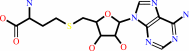 S-adenosyl-L-homocysteine
|
|
|
|
|
|
|
|
|
|
Enzyme class 4:
|
|
E.C.2.1.1.57
- methyltransferase cap1.
|
|
|
|
|
|
|
Reaction:
|
|
a 5'-end (N(7)-methyl 5'-triphosphoguanosine)-ribonucleoside in mRNA + S-adenosyl-L-methionine = a 5'-end (N(7)-methyl 5'-triphosphoguanosine)- (2'-O-methyl-ribonucleoside) in mRNA + S-adenosyl-L-homocysteine + H+
|
|
|
|
|
|
5'-end (N(7)-methyl 5'-triphosphoguanosine)-ribonucleoside in mRNA
|
+
|
S-adenosyl-L-methionine
|
=
|
5'-end (N(7)-methyl 5'-triphosphoguanosine)- (2'-O-methyl-ribonucleoside) in mRNA
|
+
|
S-adenosyl-L-homocysteine
|
+
|
H(+)
|
|
|
|
|
|
|
|
|
|
Enzyme class 5:
|
|
E.C.2.7.7.48
- RNA-directed Rna polymerase.
|
|
|
|
|
|
|
Reaction:
|
|
RNA(n) + a ribonucleoside 5'-triphosphate = RNA(n+1) + diphosphate
|
|
|
|
|
|
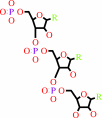 RNA(n)
|
+
|
ribonucleoside 5'-triphosphate
|
=
|
RNA(n+1)
|
+
|
 diphosphate
|
|
|
|
|
|
|
|
|
|
Enzyme class 6:
|
|
E.C.2.7.7.50
- mRNA guanylyltransferase.
|
|
|
|
|
|
|
Reaction:
|
|
a 5'-end diphospho-ribonucleoside in mRNA + GTP + H+ = a 5'-end (5'-triphosphoguanosine)-ribonucleoside in mRNA + diphosphate
|
|
|
|
|
|
5'-end diphospho-ribonucleoside in mRNA
|
+
|
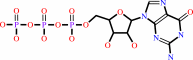 GTP
GTP
|
+
|
H(+)
|
=
|
5'-end (5'-triphosphoguanosine)-ribonucleoside in mRNA
|
+
|
diphosphate
|
|
|
|
|
|
|
|
|
|
Enzyme class 7:
|
|
E.C.3.1.13.-
- ?????
|
|
|
|
|
|
|
Enzyme class 8:
|
|
E.C.3.4.19.12
- ubiquitinyl hydrolase 1.
|
|
|
|
|
|
|
Reaction:
|
|
Thiol-dependent hydrolysis of ester, thiolester, amide, peptide and isopeptide bonds formed by the C-terminal Gly of ubiquitin (a 76-residue protein attached to proteins as an intracellular targeting signal).
|
|
|
|
|
|
Enzyme class 9:
|
|
E.C.3.4.22.-
- ?????
|
|
|
|
|
|
|
Enzyme class 10:
|
|
E.C.3.4.22.69
- Sars coronavirus main proteinase.
|
|
|
|
|
|
|
Enzyme class 11:
|
|
E.C.3.6.4.12
- Dna helicase.
|
|
|
|
|
|
|
Reaction:
|
|
ATP + H2O = ADP + phosphate + H+
|
|
|
|
|
|
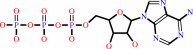 ATP
ATP
|
+
|
H2O
|
=
|
 ADP
ADP
|
+
|
 phosphate
|
+
|
H(+)
|
|
|
|
|
|
|
|
|
|
Enzyme class 12:
|
|
E.C.3.6.4.13
- Rna helicase.
|
|
|
|
|
|
|
Reaction:
|
|
ATP + H2O = ADP + phosphate + H+
|
|
|
|
|
|
ATP
|
+
|
H2O
|
=
|
ADP
|
+
|
phosphate
|
+
|
H(+)
|
|
|
|
|
|
|
|
|
|
Enzyme class 13:
|
|
E.C.4.6.1.-
- ?????
|
|
|
|
|
|
|
|
|
|
Note, where more than one E.C. class is given (as above), each may
correspond to a different protein domain or, in the case of polyprotein
precursors, to a different mature protein.
|
|
|
|
Molecule diagrams generated from .mol files obtained from the
KEGG ftp site
|
|
|
|
|
|
|
|
|
|
|
|
|
|
 |
|
|
|
|
|
|
| |
|
|
| |
|
DOI no:
|
J Biol Chem
280:31257-31266
(2005)
|
|
PubMed id:
|
|
|
|
|
|
| |
|
Mechanism of the maturation process of SARS-CoV 3CL protease.
|
|
M.F.Hsu,
C.J.Kuo,
K.T.Chang,
H.C.Chang,
C.C.Chou,
T.P.Ko,
H.L.Shr,
G.G.Chang,
A.H.Wang,
P.H.Liang.
|
|
|
|
|
| |
ABSTRACT
|
|
|
|
| |
|
|
Severe acute respiratory syndrome (SARS) is an emerging infectious disease
caused by a novel human coronavirus. Viral maturation requires a main protease
(3CL(pro)) to cleave the virus-encoded polyproteins. We report here that the
3CL(pro) containing additional N- and/or C-terminal segments of the polyprotein
sequences undergoes autoprocessing and yields the mature protease in vitro. The
dimeric three-dimensional structure of the C145A mutant protease shows that the
active site of one protomer binds with the C-terminal six amino acids of the
protomer from another asymmetric unit, mimicking the product-bound form and
suggesting a possible mechanism for maturation. The P1 pocket of the active site
binds the Gln side chain specifically, and the P2 and P4 sites are clustered
together to accommodate large hydrophobic side chains. The tagged C145A mutant
protein served as a substrate for the wild-type protease, and the N terminus was
first digested (55-fold faster) at the Gln(-1)-Ser1 site followed by the
C-terminal cleavage at the Gln306-Gly307 site. Analytical ultracentrifuge of the
quaternary structures of the tagged and mature proteases reveals the remarkably
tighter dimer formation for the mature enzyme (K(d) = 0.35 nm) than for the
mutant (C145A) containing 10 extra N-terminal (K(d) = 17.2 nM) or C-terminal
amino acids (K(d) = 5.6 nM). The data indicate that immature 3CL(pro) can form
dimer enabling it to undergo autoprocessing to yield the mature enzyme, which
further serves as a seed for facilitated maturation. Taken together, this study
provides insights into the maturation process of the SARS 3CL(pro) from the
polyprotein and design of new structure-based inhibitors.
|
|
|
|
|
|
| |
Selected figure(s)
|
|
|
|
| |
|
|

|
|

|
|
Figure 5.
FIG. 5. Molecular interactions of the active site residues
of protomer B with the C-terminal residues of protomer B'. A,
stereo view of the electron density map of the C-terminal region
(red stick) of protomer B' bound in the S pockets (cyan stick)
of protomer B. B, details of the molecular interactions between
the active site S1-S6 pockets of protomer B and the C-terminal
residues of protomer B'. H-bonds are shown as green broken lines.
|
|
Figure 6.
FIG. 6. Superposition of 3CLpro active sites and
inhibitors. A, superimposition of the active site of five 3CLpro
protease structures: cyan and blue, protomer A and B of C145A;
light green and gold, protomer A and B of the wild type,
respectively; crimson, HCoV 229E 3CLpro (1P9S); and pink, TGEV
3CLpro (1P9U). B, superimposition of the six C-terminal residues
of SARS 3CLpro (SGVTFQ) (cyan), the inhibitor of TGEV 3CLpro
(1P9U, pink), the inhibitor of TGEV 3CLpro (VNSTLQ) at the
active site of SARS 3CLpro (1UK4, gold), and the inhibitor of
Rhinovirus 3CLpro, AG7088 at the active site (1CQQ, green).
|
|
|
|
|
|
| |
The above figures are
reprinted
by permission from the ASBMB:
J Biol Chem
(2005,
280,
31257-31266)
copyright 2005.
|
|
| |
Figures were
selected
by an automated process.
|
|
|
|
|
|
|
|
|
|
|
|
|
|
|
|
 |
 |
 |
|
Literature references that cite this PDB file's key reference
|
|
|
| |
PubMed id
|
|
Reference
|
|
|
|
|
|
H.H.Liao,
Y.C.Wang,
M.C.Chen,
H.Y.Tsai,
J.Lin,
S.T.Chen,
G.J.Tsay,
and
S.L.Cheng
(2011).
Down-regulation of granulocyte-macrophage colony-stimulating factor by 3C-like proteinase in transfected A549 human lung carcinoma cells.
|
| |
BMC Immunol,
12,
16.
|
|
|
|
|
|
|
C.P.Chuck,
L.T.Chong,
C.Chen,
H.F.Chow,
D.C.Wan,
and
K.B.Wong
(2010).
Profiling of substrate specificity of SARS-CoV 3CL.
|
| |
PLoS One,
5,
e13197.
|
|
|
|
|
|
|
H.M.Wang,
and
P.H.Liang
(2010).
Picornaviral 3C protease inhibitors and the dual 3C protease/coronaviral 3C-like protease inhibitors.
|
| |
Expert Opin Ther Pat,
20,
59-71.
|
|
|
|
|
|
|
S.C.Cheng,
G.G.Chang,
and
C.Y.Chou
(2010).
Mutation of Glu-166 blocks the substrate-induced dimerization of SARS coronavirus main protease.
|
| |
Biophys J,
98,
1327-1336.
|
|
|
|
|
|
|
C.C.Lee,
C.J.Kuo,
T.P.Ko,
M.F.Hsu,
Y.C.Tsui,
S.C.Chang,
S.Yang,
S.J.Chen,
H.C.Chen,
M.C.Hsu,
S.R.Shih,
P.H.Liang,
and
A.H.Wang
(2009).
Structural basis of inhibition specificities of 3C and 3C-like proteases by zinc-coordinating and peptidomimetic compounds.
|
| |
J Biol Chem,
284,
7646-7655.
|
|
|
PDB codes:
|
|
|
|
|
|
|
|
J.Shi,
J.Sivaraman,
and
J.Song
(2008).
Mechanism for controlling the dimer-monomer switch and coupling dimerization to catalysis of the severe acute respiratory syndrome coronavirus 3C-like protease.
|
| |
J Virol,
82,
4620-4629.
|
|
|
PDB code:
|
|
|
|
|
|
|
|
U.Bacha,
J.Barrila,
S.B.Gabelli,
Y.Kiso,
L.Mario Amzel,
and
E.Freire
(2008).
Development of broad-spectrum halomethyl ketone inhibitors against coronavirus main protease 3CL(pro).
|
| |
Chem Biol Drug Des,
72,
34-49.
|
|
|
PDB code:
|
|
|
|
|
|
|
|
H.P.Chang,
C.Y.Chou,
and
G.G.Chang
(2007).
Reversible unfolding of the severe acute respiratory syndrome coronavirus main protease in guanidinium chloride.
|
| |
Biophys J,
92,
1374-1383.
|
|
|
|
|
|
|
M.S.Almeida,
M.A.Johnson,
T.Herrmann,
M.Geralt,
and
K.Wüthrich
(2007).
Novel beta-barrel fold in the nuclear magnetic resonance structure of the replicase nonstructural protein 1 from the severe acute respiratory syndrome coronavirus.
|
| |
J Virol,
81,
3151-3161.
|
|
|
PDB codes:
|
|
|
|
|
|
|
|
J.Barrila,
U.Bacha,
and
E.Freire
(2006).
Long-range cooperative interactions modulate dimerization in SARS 3CLpro.
|
| |
Biochemistry,
45,
14908-14916.
|
|
|
|
|
|
|
J.Shi,
and
J.Song
(2006).
The catalysis of the SARS 3C-like protease is under extensive regulation by its extra domain.
|
| |
FEBS J,
273,
1035-1045.
|
|
|
|
|
|
The most recent references are shown first.
Citation data come partly from CiteXplore and partly
from an automated harvesting procedure. Note that this is likely to be
only a partial list as not all journals are covered by
either method. However, we are continually building up the citation data
so more and more references will be included with time.
Where a reference describes a PDB structure, the PDB
codes are
shown on the right.
|
|


 Links
Links


