 |
PDBsum entry 1ysy

|
|
|
|
|
|

|

|

|

|
|

|
|

|
|

|
|
|
 |

|

|
|
|
|
|
|
|
|
|
|
|
|
|
|
|
|
|
|
|
|
|
|
|
|
|
|
|
|
|
|
|
|
Viral protein
|
PDB id
|
|
|
|
1ysy
|
|
|
|
|
|
|
|
|
|
|
|
|
|
|

|

|

|
|
|
|
|
|
|
|
 |
Contents |
 |
|
|
|
|
|
|
|
|
* Residue conservation analysis
|
|
|
|
|
|
|
|
|
|
|
Enzyme class 2:
|
|
E.C.2.1.1.-
- ?????
|
|
|
|
|
|
|
Enzyme class 3:
|
|
E.C.2.1.1.56
- mRNA (guanine-N(7))-methyltransferase.
|
|
|
|
|
|
|
Reaction:
|
|
a 5'-end (5'-triphosphoguanosine)-ribonucleoside in mRNA + S-adenosyl-L- methionine = a 5'-end (N(7)-methyl 5'-triphosphoguanosine)-ribonucleoside in mRNA + S-adenosyl-L-homocysteine
|
|
|
|
|
|
5'-end (5'-triphosphoguanosine)-ribonucleoside in mRNA
|
+
|
 S-adenosyl-L- methionine
|
=
|
5'-end (N(7)-methyl 5'-triphosphoguanosine)-ribonucleoside in mRNA
|
+
|
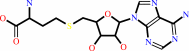 S-adenosyl-L-homocysteine
|
|
|
|
|
|
|
|
|
|
Enzyme class 4:
|
|
E.C.2.1.1.57
- methyltransferase cap1.
|
|
|
|
|
|
|
Reaction:
|
|
a 5'-end (N(7)-methyl 5'-triphosphoguanosine)-ribonucleoside in mRNA + S-adenosyl-L-methionine = a 5'-end (N(7)-methyl 5'-triphosphoguanosine)- (2'-O-methyl-ribonucleoside) in mRNA + S-adenosyl-L-homocysteine + H+
|
|
|
|
|
|
5'-end (N(7)-methyl 5'-triphosphoguanosine)-ribonucleoside in mRNA
|
+
|
S-adenosyl-L-methionine
|
=
|
5'-end (N(7)-methyl 5'-triphosphoguanosine)- (2'-O-methyl-ribonucleoside) in mRNA
|
+
|
S-adenosyl-L-homocysteine
|
+
|
H(+)
|
|
|
|
|
|
|
|
|
|
Enzyme class 5:
|
|
E.C.2.7.7.48
- RNA-directed Rna polymerase.
|
|
|
|
|
|
|
Reaction:
|
|
RNA(n) + a ribonucleoside 5'-triphosphate = RNA(n+1) + diphosphate
|
|
|
|
|
|
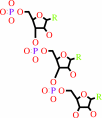 RNA(n)
|
+
|
ribonucleoside 5'-triphosphate
|
=
|
RNA(n+1)
|
+
|
 diphosphate
|
|
|
|
|
|
|
|
|
|
Enzyme class 6:
|
|
E.C.2.7.7.50
- mRNA guanylyltransferase.
|
|
|
|
|
|
|
Reaction:
|
|
a 5'-end diphospho-ribonucleoside in mRNA + GTP + H+ = a 5'-end (5'-triphosphoguanosine)-ribonucleoside in mRNA + diphosphate
|
|
|
|
|
|
5'-end diphospho-ribonucleoside in mRNA
|
+
|
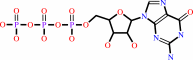 GTP
GTP
|
+
|
H(+)
|
=
|
5'-end (5'-triphosphoguanosine)-ribonucleoside in mRNA
|
+
|
diphosphate
|
|
|
|
|
|
|
|
|
|
Enzyme class 7:
|
|
E.C.3.1.13.-
- ?????
|
|
|
|
|
|
|
Enzyme class 8:
|
|
E.C.3.4.19.12
- ubiquitinyl hydrolase 1.
|
|
|
|
|
|
|
Reaction:
|
|
Thiol-dependent hydrolysis of ester, thiolester, amide, peptide and isopeptide bonds formed by the C-terminal Gly of ubiquitin (a 76-residue protein attached to proteins as an intracellular targeting signal).
|
|
|
|
|
|
Enzyme class 9:
|
|
E.C.3.4.22.-
- ?????
|
|
|
|
|
|
|
Enzyme class 10:
|
|
E.C.3.4.22.69
- Sars coronavirus main proteinase.
|
|
|
|
|
|
|
Enzyme class 11:
|
|
E.C.3.6.4.12
- Dna helicase.
|
|
|
|
|
|
|
Reaction:
|
|
ATP + H2O = ADP + phosphate + H+
|
|
|
|
|
|
 ATP
ATP
|
+
|
H2O
|
=
|
 ADP
ADP
|
+
|
 phosphate
|
+
|
H(+)
|
|
|
|
|
|
|
|
|
|
Enzyme class 12:
|
|
E.C.3.6.4.13
- Rna helicase.
|
|
|
|
|
|
|
Reaction:
|
|
ATP + H2O = ADP + phosphate + H+
|
|
|
|
|
|
ATP
|
+
|
H2O
|
=
|
ADP
|
+
|
phosphate
|
+
|
H(+)
|
|
|
|
|
|
|
|
|
|
Enzyme class 13:
|
|
E.C.4.6.1.-
- ?????
|
|
|
|
|
|
|
|
|
|
Note, where more than one E.C. class is given (as above), each may
correspond to a different protein domain or, in the case of polyprotein
precursors, to a different mature protein.
|
|
|
|
Molecule diagrams generated from .mol files obtained from the
KEGG ftp site
|
|
|
|
|
|
|
|
|
|
|
|
|
|
 |
|
|
|
|
|
|
| |
|
|
| |
|
|
J Virol
79:12905-12913
(2005)
|
|
PubMed id:
|
|
|
|
|
|
| |
|
Structural genomics of the severe acute respiratory syndrome coronavirus: nuclear magnetic resonance structure of the protein nsP7.
|
|
W.Peti,
M.A.Johnson,
T.Herrmann,
B.W.Neuman,
M.J.Buchmeier,
M.Nelson,
J.Joseph,
R.Page,
R.C.Stevens,
P.Kuhn,
K.Wüthrich.
|
|
|
|
|
| |
ABSTRACT
|
|
|
|
| |
|
|
Here, we report the three-dimensional structure of severe acute respiratory
syndrome coronavirus (SARS-CoV) nsP7, a component of the SARS-CoV replicase
polyprotein. The coronavirus replicase carries out regulatory tasks involved in
the maintenance, transcription, and replication of the coronavirus genome. nsP7
was found to assume a compact architecture in solution, which is comprised
primarily of helical secondary structures. Three helices (alpha2 to alpha4) form
a flat up-down-up antiparallel alpha-helix sheet. The N-terminal segment of
residues 1 to 22, containing two turns of alpha-helix and one turn of
3(10)-helix, is packed across the surface of alpha2 and alpha3 in the helix
sheet, with the alpha-helical region oriented at a 60 degrees angle relative to
alpha2 and alpha3. The surface charge distribution is pronouncedly asymmetrical,
with the flat surface of the helical sheet showing a large negatively charged
region adjacent to a large hydrophobic patch and the opposite side containing a
positively charged groove that extends along the helix alpha1. Each of these
three areas is thus implicated as a potential site for protein-protein
interactions.
|
|
|
|
|
|
|
|
|
|
|
|
|
|
|
|
|
|
 |
 |
 |
|
Literature references that cite this PDB file's key reference
|
|
|
| |
PubMed id
|
|
Reference
|
|
|
|
|
|
S.Perlman,
and
J.Netland
(2009).
Coronaviruses post-SARS: update on replication and pathogenesis.
|
| |
Nat Rev Microbiol,
7,
439-450.
|
|
|
|
|
|
|
B.Canard,
J.S.Joseph,
and
P.Kuhn
(2008).
International research networks in viral structural proteomics: again, lessons from SARS.
|
| |
Antiviral Res,
78,
47-50.
|
|
|
|
|
|
|
C.Zhang,
O.Crasta,
S.Cammer,
R.Will,
R.Kenyon,
D.Sullivan,
Q.Yu,
W.Sun,
R.Jha,
D.Liu,
T.Xue,
Y.Zhang,
M.Moore,
P.McGarvey,
H.Huang,
Y.Chen,
J.Zhang,
R.Mazumder,
C.Wu,
and
B.Sobral
(2008).
An emerging cyberinfrastructure for biodefense pathogen and pathogen-host data.
|
| |
Nucleic Acids Res,
36,
D884-D891.
|
|
|
|
|
|
|
J.Pan,
X.Peng,
Y.Gao,
Z.Li,
X.Lu,
Y.Chen,
M.Ishaq,
D.Liu,
M.L.Dediego,
L.Enjuanes,
and
D.Guo
(2008).
Genome-wide analysis of protein-protein interactions and involvement of viral proteins in SARS-CoV replication.
|
| |
PLoS ONE,
3,
e3299.
|
|
|
|
|
|
|
R.Züst,
T.B.Miller,
S.J.Goebel,
V.Thiel,
and
P.S.Masters
(2008).
Genetic interactions between an essential 3' cis-acting RNA pseudoknot, replicase gene products, and the extreme 3' end of the mouse coronavirus genome.
|
| |
J Virol,
82,
1214-1228.
|
|
|
|
|
|
|
E.F.Donaldson,
A.C.Sims,
R.L.Graham,
M.R.Denison,
and
R.S.Baric
(2007).
Murine hepatitis virus replicase protein nsp10 is a critical regulator of viral RNA synthesis.
|
| |
J Virol,
81,
6356-6368.
|
|
|
|
|
|
|
K.L.Maxwell,
and
L.Frappier
(2007).
Viral proteomics.
|
| |
Microbiol Mol Biol Rev,
71,
398-411.
|
|
|
|
|
|
|
M.Bartlam,
Y.Xu,
and
Z.Rao
(2007).
Structural proteomics of the SARS coronavirus: a model response to emerging infectious diseases.
|
| |
J Struct Funct Genomics,
8,
85-97.
|
|
|
|
|
|
|
M.S.Almeida,
M.A.Johnson,
T.Herrmann,
M.Geralt,
and
K.Wüthrich
(2007).
Novel beta-barrel fold in the nuclear magnetic resonance structure of the replicase nonstructural protein 1 from the severe acute respiratory syndrome coronavirus.
|
| |
J Virol,
81,
3151-3161.
|
|
|
PDB codes:
|
|
|
|
|
|
|
|
S.G.Sawicki,
D.L.Sawicki,
and
S.G.Siddell
(2007).
A contemporary view of coronavirus transcription.
|
| |
J Virol,
81,
20-29.
|
|
|
|
|
|
|
V.C.Cheng,
S.K.Lau,
P.C.Woo,
and
K.Y.Yuen
(2007).
Severe acute respiratory syndrome coronavirus as an agent of emerging and reemerging infection.
|
| |
Clin Microbiol Rev,
20,
660-694.
|
|
|
|
|
|
|
E.J.Snijder,
Y.van der Meer,
J.Zevenhoven-Dobbe,
J.J.Onderwater,
J.van der Meulen,
H.K.Koerten,
and
A.M.Mommaas
(2006).
Ultrastructure and origin of membrane vesicles associated with the severe acute respiratory syndrome coronavirus replication complex.
|
| |
J Virol,
80,
5927-5940.
|
|
|
|
|
|
|
J.S.Joseph,
K.S.Saikatendu,
V.Subramanian,
B.W.Neuman,
A.Brooun,
M.Griffith,
K.Moy,
M.K.Yadav,
J.Velasquez,
M.J.Buchmeier,
R.C.Stevens,
and
P.Kuhn
(2006).
Crystal structure of nonstructural protein 10 from the severe acute respiratory syndrome coronavirus reveals a novel fold with two zinc-binding motifs.
|
| |
J Virol,
80,
7894-7901.
|
|
|
PDB code:
|
|
|
|
|
|
|
|
E.Garman
(2005).
SARS proteomics reveals viral secrets.
|
| |
Structure,
13,
1582-1583.
|
|
|
|
|
|
The most recent references are shown first.
Citation data come partly from CiteXplore and partly
from an automated harvesting procedure. Note that this is likely to be
only a partial list as not all journals are covered by
either method. However, we are continually building up the citation data
so more and more references will be included with time.
Where a reference describes a PDB structure, the PDB
codes are
shown on the right.
|
|


 Links
Links


