 |
PDBsum entry 1uw7

|
|
|
|
|
|

|

|

|

|
|

|
|

|
|

|
|
|
 |

|

|
|
|
|
|
|
|
|
|
|
|
|
|
|
|
|
|
|
|
|
|
|
|
|
|
|
|
|
|
|
|
|
Viral protein
|
PDB id
|
|
|
|
1uw7
|
|
|
|
|
|
|
|
|
|
|
|
|
|
|

|

|

|
|
|
|
|
|
|
|
 |
Contents |
 |
|
|
|
|
|
|
|
|
* Residue conservation analysis
|
|
|
|
|
|
PDB id:
|
|
|
|
| Name: |
|
Viral protein
|
|
|
Title:
|
|
Nsp9 protein from sars-coronavirus.
|
|
Structure:
|
|
Nsp9. Chain: a. Fragment: nsp9, residues 3925-4037. Synonym: pp1ab, orf1ab, replicase polyprotein 1ab. Engineered: yes
|
|
Source:
|
|
Sars coronavirus hku-39849. Organism_taxid: 228404. Cell_line: vero e6. Expressed in: escherichia coli. Expression_system_taxid: 562.
|
|
Biol. unit:
|
|
 Dimer (from PDB file)
|
|
Resolution:
|
|
|
2.80Å
|
R-factor:
|
0.228
|
R-free:
|
0.314
|
|
|
Authors:
|
|
G.Sutton,E.Fry,L.Carter,S.Sainsbury,T.Walter,J.Nettleship,N.Berrow, R.Owens,R.Gilbert,A.Davidson,S.Siddell,L.L.M.Poon,J.Diprose, D.Alderton,M.Walsh,J.M.Grimes,D.I.Stuart
|
Key ref:

|
|
G.Sutton
et al.
(2004).
The nsp9 replicase protein of SARS-coronavirus, structure and functional insights.
Structure,
12,
341-353.
PubMed id:
DOI:

|
|
|
Date:
|
|
|
30-Jan-04
|
Release date:
|
20-Feb-04
|
|
|
|
|
|
|
PROCHECK
|

|
|
|
|
|
Headers
|
|
|
|
References
|
|
|
|
|
|

|
|
P0C6X7
(R1AB_CVHSA) -
Replicase polyprotein 1ab from Severe acute respiratory syndrome coronavirus
|
|
|
|
Seq:
Struc:
|
|
|
|
7073 a.a.
122 a.a.*
|
|

|

|
|
|
|
|
|
|
|
|
|
|
|
Key: |
 |
PfamA domain |
|
|
 |
Secondary structure |
|
 |
CATH domain |
|
|
*
PDB and UniProt seqs differ
at 9 residue positions (black
crosses)
|
|
|
|
|
|
|
|
|
|
|
|
|
Enzyme class 2:
|
|
E.C.2.1.1.-
- ?????
|
|
|
|
|
|
|
Enzyme class 3:
|
|
E.C.2.1.1.56
- mRNA (guanine-N(7))-methyltransferase.
|
|
|
|
|
|
|
Reaction:
|
|
a 5'-end (5'-triphosphoguanosine)-ribonucleoside in mRNA + S-adenosyl-L- methionine = a 5'-end (N(7)-methyl 5'-triphosphoguanosine)-ribonucleoside in mRNA + S-adenosyl-L-homocysteine
|
|
|
|
|
|
5'-end (5'-triphosphoguanosine)-ribonucleoside in mRNA
|
+
|
 S-adenosyl-L- methionine
|
=
|
5'-end (N(7)-methyl 5'-triphosphoguanosine)-ribonucleoside in mRNA
|
+
|
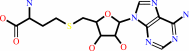 S-adenosyl-L-homocysteine
|
|
|
|
|
|
|
|
|
|
Enzyme class 4:
|
|
E.C.2.1.1.57
- methyltransferase cap1.
|
|
|
|
|
|
|
Reaction:
|
|
a 5'-end (N(7)-methyl 5'-triphosphoguanosine)-ribonucleoside in mRNA + S-adenosyl-L-methionine = a 5'-end (N(7)-methyl 5'-triphosphoguanosine)- (2'-O-methyl-ribonucleoside) in mRNA + S-adenosyl-L-homocysteine + H+
|
|
|
|
|
|
5'-end (N(7)-methyl 5'-triphosphoguanosine)-ribonucleoside in mRNA
|
+
|
S-adenosyl-L-methionine
|
=
|
5'-end (N(7)-methyl 5'-triphosphoguanosine)- (2'-O-methyl-ribonucleoside) in mRNA
|
+
|
S-adenosyl-L-homocysteine
|
+
|
H(+)
|
|
|
|
|
|
|
|
|
|
Enzyme class 5:
|
|
E.C.2.7.7.48
- RNA-directed Rna polymerase.
|
|
|
|
|
|
|
Reaction:
|
|
RNA(n) + a ribonucleoside 5'-triphosphate = RNA(n+1) + diphosphate
|
|
|
|
|
|
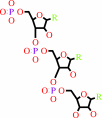 RNA(n)
|
+
|
ribonucleoside 5'-triphosphate
|
=
|
RNA(n+1)
|
+
|
 diphosphate
|
|
|
|
|
|
|
|
|
|
Enzyme class 6:
|
|
E.C.2.7.7.50
- mRNA guanylyltransferase.
|
|
|
|
|
|
|
Reaction:
|
|
a 5'-end diphospho-ribonucleoside in mRNA + GTP + H+ = a 5'-end (5'-triphosphoguanosine)-ribonucleoside in mRNA + diphosphate
|
|
|
|
|
|
5'-end diphospho-ribonucleoside in mRNA
|
+
|
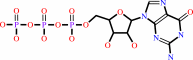 GTP
GTP
|
+
|
H(+)
|
=
|
5'-end (5'-triphosphoguanosine)-ribonucleoside in mRNA
|
+
|
diphosphate
|
|
|
|
|
|
|
|
|
|
Enzyme class 7:
|
|
E.C.3.1.13.-
- ?????
|
|
|
|
|
|
|
Enzyme class 8:
|
|
E.C.3.4.19.12
- ubiquitinyl hydrolase 1.
|
|
|
|
|
|
|
Reaction:
|
|
Thiol-dependent hydrolysis of ester, thiolester, amide, peptide and isopeptide bonds formed by the C-terminal Gly of ubiquitin (a 76-residue protein attached to proteins as an intracellular targeting signal).
|
|
|
|
|
|
Enzyme class 9:
|
|
E.C.3.4.22.-
- ?????
|
|
|
|
|
|
|
Enzyme class 10:
|
|
E.C.3.4.22.69
- Sars coronavirus main proteinase.
|
|
|
|
|
|
|
Enzyme class 11:
|
|
E.C.3.6.4.12
- Dna helicase.
|
|
|
|
|
|
|
Reaction:
|
|
ATP + H2O = ADP + phosphate + H+
|
|
|
|
|
|
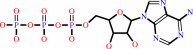 ATP
ATP
|
+
|
H2O
|
=
|
 ADP
ADP
|
+
|
 phosphate
|
+
|
H(+)
|
|
|
|
|
|
|
|
|
|
Enzyme class 12:
|
|
E.C.3.6.4.13
- Rna helicase.
|
|
|
|
|
|
|
Reaction:
|
|
ATP + H2O = ADP + phosphate + H+
|
|
|
|
|
|
ATP
|
+
|
H2O
|
=
|
ADP
|
+
|
phosphate
|
+
|
H(+)
|
|
|
|
|
|
|
|
|
|
Enzyme class 13:
|
|
E.C.4.6.1.-
- ?????
|
|
|
|
|
|
|
|
|
|
Note, where more than one E.C. class is given (as above), each may
correspond to a different protein domain or, in the case of polyprotein
precursors, to a different mature protein.
|
|
|
|
Molecule diagrams generated from .mol files obtained from the
KEGG ftp site
|
|
|
|
|
|
|
|
|
|
|
|
|
|
 |
|
|
|
|
|
|
| |
|
|
| |
|
DOI no:
|
Structure
12:341-353
(2004)
|
|
PubMed id:
|
|
|
|
|
|
| |
|
The nsp9 replicase protein of SARS-coronavirus, structure and functional insights.
|
|
G.Sutton,
E.Fry,
L.Carter,
S.Sainsbury,
T.Walter,
J.Nettleship,
N.Berrow,
R.Owens,
R.Gilbert,
A.Davidson,
S.Siddell,
L.L.Poon,
J.Diprose,
D.Alderton,
M.Walsh,
J.M.Grimes,
D.I.Stuart.
|
|
|
|
|
| |
ABSTRACT
|
|
|
|
| |
|
|
As part of a high-throughput structural analysis of SARS-coronavirus (SARS-CoV)
proteins, we have solved the structure of the non-structural protein 9 (nsp9).
This protein, encoded by ORF1a, has no designated function but is most likely
involved with viral RNA synthesis. The protein comprises a single beta-barrel
with a fold previously unseen in single domain proteins. The fold superficially
resembles an OB-fold with a C-terminal extension and is related to both of the
two subdomains of the SARS-CoV 3C-like protease (which belongs to the serine
protease superfamily). nsp9 has, presumably, evolved from a protease. The
crystal structure suggests that the protein is dimeric. This is confirmed by
analytical ultracentrifugation and dynamic light scattering. We show that nsp9
binds RNA and interacts with nsp8, activities that may be essential for its
function(s).
|
|
|
|
|
|
| |
Selected figure(s)
|
|
|
|
| |
|
|

|
|
Figure 1.
Figure 1. Structure of SARS-CoV nsp9(A) A stereo a carbon
trace colored blue to red from the N to the C terminus. The nine
residues of the N-terminal tag are shown dashed. Every tenth
residue is labeled.(B) A stereo ribbon depiction colored as in
(A) with the main secondary structure elements labeled according
to Figure 2C. The N-terminal tag residues are shown transparent.
Figures are produced using BOBSCRIPT (Esnouf, 1997) and RASTER3D
(Merrit and Murphy, 1994).(C) Stereo diagram of the 2F[o] - F[c]
electron density for the C-terminal a helix residues 101-111,
contoured at 1s. The electron density is shown as a green mesh
with the residues depicted in red ball-and-stick.
|
|
|
|
|
|
| |
The above figure is
reprinted
by permission from Cell Press:
Structure
(2004,
12,
341-353)
copyright 2004.
|
|
| |
Figure was
selected
by an automated process.
|
|
|
|
|
|
|
|
|
|
|
|
|
|
|
|
 |
 |
 |
|
Literature references that cite this PDB file's key reference
|
|
|
| |
PubMed id
|
|
Reference
|
|
|
|
|
|
M.C.Hagemeijer,
M.H.Verheije,
M.Ulasli,
I.A.Shaltiël,
L.A.de Vries,
F.Reggiori,
P.J.Rottier,
and
C.A.de Haan
(2010).
Dynamics of coronavirus replication-transcription complexes.
|
| |
J Virol,
84,
2134-2149.
|
|
|
|
|
|
|
S.Fang,
H.Shen,
J.Wang,
F.P.Tay,
and
D.X.Liu
(2010).
Functional and genetic studies of the substrate specificity of coronavirus infectious bronchitis virus 3C-like proteinase.
|
| |
J Virol,
84,
7325-7336.
|
|
|
|
|
|
|
Z.J.Miknis,
E.F.Donaldson,
T.C.Umland,
R.A.Rimmer,
R.S.Baric,
and
L.W.Schultz
(2009).
Severe acute respiratory syndrome coronavirus nsp9 dimerization is essential for efficient viral growth.
|
| |
J Virol,
83,
3007-3018.
|
|
|
PDB code:
|
|
|
|
|
|
|
|
B.Canard,
J.S.Joseph,
and
P.Kuhn
(2008).
International research networks in viral structural proteomics: again, lessons from SARS.
|
| |
Antiviral Res,
78,
47-50.
|
|
|
|
|
|
|
M.Bartlam,
X.Xue,
and
Z.Rao
(2008).
The search for a structural basis for therapeutic intervention against the SARS coronavirus.
|
| |
Acta Crystallogr A,
64,
204-213.
|
|
|
|
|
|
|
M.J.van Hemert,
S.H.van den Worm,
K.Knoops,
A.M.Mommaas,
A.E.Gorbalenya,
and
E.J.Snijder
(2008).
SARS-coronavirus replication/transcription complexes are membrane-protected and need a host factor for activity in vitro.
|
| |
PLoS Pathog,
4,
e1000054.
|
|
|
|
|
|
|
M.Oostra,
M.C.Hagemeijer,
M.van Gent,
C.P.Bekker,
E.G.te Lintelo,
P.J.Rottier,
and
C.A.de Haan
(2008).
Topology and membrane anchoring of the coronavirus replication complex: not all hydrophobic domains of nsp3 and nsp6 are membrane spanning.
|
| |
J Virol,
82,
12392-12405.
|
|
|
|
|
|
|
R.Assenberg,
O.Delmas,
S.C.Graham,
A.Verma,
N.Berrow,
D.I.Stuart,
R.J.Owens,
H.Bourhy,
and
J.M.Grimes
(2008).
Expression, purification and crystallization of a lyssavirus matrix (M) protein.
|
| |
Acta Crystallogr Sect F Struct Biol Cryst Commun,
64,
258-262.
|
|
|
|
|
|
|
R.L.Graham,
J.S.Sparks,
L.D.Eckerle,
A.C.Sims,
and
M.R.Denison
(2008).
SARS coronavirus replicase proteins in pathogenesis.
|
| |
Virus Res,
133,
88.
|
|
|
|
|
|
|
R.Züst,
T.B.Miller,
S.J.Goebel,
V.Thiel,
and
P.S.Masters
(2008).
Genetic interactions between an essential 3' cis-acting RNA pseudoknot, replicase gene products, and the extreme 3' end of the mouse coronavirus genome.
|
| |
J Virol,
82,
1214-1228.
|
|
|
|
|
|
|
A.von Brunn,
C.Teepe,
J.C.Simpson,
R.Pepperkok,
C.C.Friedel,
R.Zimmer,
R.Roberts,
R.Baric,
and
J.Haas
(2007).
Analysis of intraviral protein-protein interactions of the SARS coronavirus ORFeome.
|
| |
PLoS ONE,
2,
e459.
|
|
|
|
|
|
|
D.J.Deming,
R.L.Graham,
M.R.Denison,
and
R.S.Baric
(2007).
Processing of open reading frame 1a replicase proteins nsp7 to nsp10 in murine hepatitis virus strain A59 replication.
|
| |
J Virol,
81,
10280-10291.
|
|
|
|
|
|
|
E.F.Donaldson,
A.C.Sims,
R.L.Graham,
M.R.Denison,
and
R.S.Baric
(2007).
Murine hepatitis virus replicase protein nsp10 is a critical regulator of viral RNA synthesis.
|
| |
J Virol,
81,
6356-6368.
|
|
|
|
|
|
|
J.Ziebuhr,
B.Schelle,
N.Karl,
E.Minskaia,
S.Bayer,
S.G.Siddell,
A.E.Gorbalenya,
and
V.Thiel
(2007).
Human coronavirus 229E papain-like proteases have overlapping specificities but distinct functions in viral replication.
|
| |
J Virol,
81,
3922-3932.
|
|
|
|
|
|
|
K.L.Maxwell,
and
L.Frappier
(2007).
Viral proteomics.
|
| |
Microbiol Mol Biol Rev,
71,
398-411.
|
|
|
|
|
|
|
M.Bartlam,
Y.Xu,
and
Z.Rao
(2007).
Structural proteomics of the SARS coronavirus: a model response to emerging infectious diseases.
|
| |
J Struct Funct Genomics,
8,
85-97.
|
|
|
|
|
|
|
M.S.Almeida,
M.A.Johnson,
T.Herrmann,
M.Geralt,
and
K.Wüthrich
(2007).
Novel beta-barrel fold in the nuclear magnetic resonance structure of the replicase nonstructural protein 1 from the severe acute respiratory syndrome coronavirus.
|
| |
J Virol,
81,
3151-3161.
|
|
|
PDB codes:
|
|
|
|
|
|
|
|
S.G.Sawicki,
D.L.Sawicki,
and
S.G.Siddell
(2007).
A contemporary view of coronavirus transcription.
|
| |
J Virol,
81,
20-29.
|
|
|
|
|
|
|
V.C.Cheng,
S.K.Lau,
P.C.Woo,
and
K.Y.Yuen
(2007).
Severe acute respiratory syndrome coronavirus as an agent of emerging and reemerging infection.
|
| |
Clin Microbiol Rev,
20,
660-694.
|
|
|
|
|
|
|
A.E.Gorbalenya,
L.Enjuanes,
J.Ziebuhr,
and
E.J.Snijder
(2006).
Nidovirales: evolving the largest RNA virus genome.
|
| |
Virus Res,
117,
17-37.
|
|
|
|
|
|
|
A.Geerlof,
J.Brown,
B.Coutard,
M.P.Egloff,
F.J.Enguita,
M.J.Fogg,
R.J.Gilbert,
M.R.Groves,
A.Haouz,
J.E.Nettleship,
P.Nordlund,
R.J.Owens,
M.Ruff,
S.Sainsbury,
D.I.Svergun,
and
M.Wilmanns
(2006).
The impact of protein characterization in structural proteomics.
|
| |
Acta Crystallogr D Biol Crystallogr,
62,
1125-1136.
|
|
|
|
|
|
|
C.Meier,
A.R.Aricescu,
R.Assenberg,
R.T.Aplin,
R.J.Gilbert,
J.M.Grimes,
and
D.I.Stuart
(2006).
The crystal structure of ORF-9b, a lipid binding protein from the SARS coronavirus.
|
| |
Structure,
14,
1157-1165.
|
|
|
PDB code:
|
|
|
|
|
|
|
|
H.Schütze,
R.Ulferts,
B.Schelle,
S.Bayer,
H.Granzow,
B.Hoffmann,
T.C.Mettenleiter,
and
J.Ziebuhr
(2006).
Characterization of White bream virus reveals a novel genetic cluster of nidoviruses.
|
| |
J Virol,
80,
11598-11609.
|
|
|
|
|
|
|
J.R.Mesters,
J.Tan,
and
R.Hilgenfeld
(2006).
Viral enzymes.
|
| |
Curr Opin Struct Biol,
16,
776-786.
|
|
|
|
|
|
|
J.S.Joseph,
K.S.Saikatendu,
V.Subramanian,
B.W.Neuman,
A.Brooun,
M.Griffith,
K.Moy,
M.K.Yadav,
J.Velasquez,
M.J.Buchmeier,
R.C.Stevens,
and
P.Kuhn
(2006).
Crystal structure of nonstructural protein 10 from the severe acute respiratory syndrome coronavirus reveals a novel fold with two zinc-binding motifs.
|
| |
J Virol,
80,
7894-7901.
|
|
|
PDB code:
|
|
|
|
|
|
|
|
L.Enjuanes,
F.Almazán,
I.Sola,
and
S.Zuñiga
(2006).
Biochemical aspects of coronavirus replication and virus-host interaction.
|
| |
Annu Rev Microbiol,
60,
211-230.
|
|
|
|
|
|
|
M.J.Fogg,
P.Alzari,
M.Bahar,
I.Bertini,
J.M.Betton,
W.P.Burmeister,
C.Cambillau,
B.Canard,
M.A.Corrondo,
M.Carrondo,
M.Coll,
S.Daenke,
O.Dym,
M.P.Egloff,
F.J.Enguita,
A.Geerlof,
A.Haouz,
T.A.Jones,
Q.Ma,
S.N.Manicka,
M.Migliardi,
P.Nordlund,
R.J.Owens,
Y.Peleg,
G.Schneider,
R.Schnell,
D.I.Stuart,
N.Tarbouriech,
T.Unge,
A.J.Wilkinson,
M.Wilmanns,
K.S.Wilson,
O.Zimhony,
and
J.M.Grimes
(2006).
Application of the use of high-throughput technologies to the determination of protein structures of bacterial and viral pathogens.
|
| |
Acta Crystallogr D Biol Crystallogr,
62,
1196-1207.
|
|
|
|
|
|
|
S.Ricagno,
B.Coutard,
S.Grisel,
N.Brémond,
K.Dalle,
F.Tocque,
V.Campanacci,
J.Lichière,
V.Lantez,
C.Debarnot,
C.Cambillau,
B.Canard,
and
M.P.Egloff
(2006).
Crystallization and preliminary X-ray diffraction analysis of Nsp15 from SARS coronavirus.
|
| |
Acta Crystallogr Sect F Struct Biol Cryst Commun,
62,
409-411.
|
|
|
|
|
|
|
T.S.Walter,
C.Meier,
R.Assenberg,
K.F.Au,
J.Ren,
A.Verma,
J.E.Nettleship,
R.J.Owens,
D.I.Stuart,
and
J.M.Grimes
(2006).
Lysine methylation as a routine rescue strategy for protein crystallization.
|
| |
Structure,
14,
1617-1622.
|
|
|
|
|
|
|
H.Fan,
A.Ooi,
Y.W.Tan,
S.Wang,
S.Fang,
D.X.Liu,
and
J.Lescar
(2005).
The nucleocapsid protein of coronavirus infectious bronchitis virus: crystal structure of its N-terminal domain and multimerization properties.
|
| |
Structure,
13,
1859-1868.
|
|
|
PDB codes:
|
|
|
|
|
|
|
|
J.H.Lu,
D.M.Zhang,
G.L.Wang,
Z.M.Guo,
J.Li,
B.Y.Tan,
L.P.Ou-Yang,
W.H.Ling,
X.B.Yu,
and
N.S.Zhong
(2005).
Sequence analysis and structural prediction of the severe acute respiratory syndrome coronavirus nsp5.
|
| |
Acta Biochim Biophys Sin (Shanghai),
37,
473-479.
|
|
|
|
|
|
|
S.G.Sawicki,
D.L.Sawicki,
D.Younker,
Y.Meyer,
V.Thiel,
H.Stokes,
and
S.G.Siddell
(2005).
Functional and genetic analysis of coronavirus replicase-transcriptase proteins.
|
| |
PLoS Pathog,
1,
e39.
|
|
|
|
|
|
|
T.S.Walter,
J.M.Diprose,
C.J.Mayo,
C.Siebold,
M.G.Pickford,
L.Carter,
G.C.Sutton,
N.S.Berrow,
J.Brown,
I.M.Berry,
G.B.Stewart-Jones,
J.M.Grimes,
D.K.Stammers,
R.M.Esnouf,
E.Y.Jones,
R.J.Owens,
D.I.Stuart,
and
K.Harlos
(2005).
A procedure for setting up high-throughput nanolitre crystallization experiments. Crystallization workflow for initial screening, automated storage, imaging and optimization.
|
| |
Acta Crystallogr D Biol Crystallogr,
61,
651-657.
|
|
|
|
|
|
|
Y.Zhai,
F.Sun,
X.Li,
H.Pang,
X.Xu,
M.Bartlam,
and
Z.Rao
(2005).
Insights into SARS-CoV transcription and replication from the structure of the nsp7-nsp8 hexadecamer.
|
| |
Nat Struct Mol Biol,
12,
980-986.
|
|
|
PDB code:
|
|
|
|
|
|
|
|
K.Bhardwaj,
L.Guarino,
and
C.C.Kao
(2004).
The severe acute respiratory syndrome coronavirus Nsp15 protein is an endoribonuclease that prefers manganese as a cofactor.
|
| |
J Virol,
78,
12218-12224.
|
|
|
|
|
|
|
T.C.Terwilliger
(2004).
Structures and technology for biologists.
|
| |
Nat Struct Mol Biol,
11,
296-297.
|
|
|
|
|
|
The most recent references are shown first.
Citation data come partly from CiteXplore and partly
from an automated harvesting procedure. Note that this is likely to be
only a partial list as not all journals are covered by
either method. However, we are continually building up the citation data
so more and more references will be included with time.
Where a reference describes a PDB structure, the PDB
code is
shown on the right.
|
|


 Links
Links


