 |
PDBsum entry 2py5

|
|
|
|
|
|

|

|

|

|
|

|
|

|
|

|
|

|
|

|
|

|
|

|
|
|
 |

|

|
|
|
|
|
|
|
|
|
|
|
|
|
|
|
|
|
|
|
|
|
|
|
|
|
|
|
|
|
|
|
|
|
|
|
|
Replication, transferase/DNA
|
PDB id
|
|
|
|
2py5
|
|
|
|
|
|
|
|
|
|
|
|
|
|
|

|

|

|
|
|
|
|
|
|
|
 |
Contents |
 |
|
|
|
|
|
|
|
|
|
|
|
|
|
|
* Residue conservation analysis
|
|
|
|
|
|
PDB id:
|
|
|
|
| Name: |
|
Replication, transferase/DNA
|
|
|
Title:
|
|
Phi29 DNA polymerase complexed with single-stranded DNA
|
|
Structure:
|
|
5'-d(ggacttt)-3'. Chain: j, y, d, e, l. Engineered: yes. DNA polymerase. Chain: a, b. Synonym: early protein gp2. Engineered: yes. Mutation: yes
|
|
Source:
|
|
Synthetic: yes. Bacillus phage phi29. Organism_taxid: 10756. Gene: 2, gp2. Expressed in: escherichia coli. Expression_system_taxid: 562
|
|
Resolution:
|
|
|
1.60Å
|
R-factor:
|
0.165
|
R-free:
|
0.194
|
|
|
Authors:
|
|
A.J.Berman,S.Kamtekar,J.L.Goodman,J.M.Lazaro,M.De Vega,L.Blanco, M.Salas,T.A.Steitz
|
Key ref:

|
|
A.J.Berman
et al.
(2007).
Structures of phi29 DNA polymerase complexed with substrate: the mechanism of translocation in B-family polymerases.
EMBO J,
26,
3494-3505.
PubMed id:
DOI:

|
|
|
Date:
|
|
|
15-May-07
|
Release date:
|
17-Jul-07
|
|
|
|
|
|
|
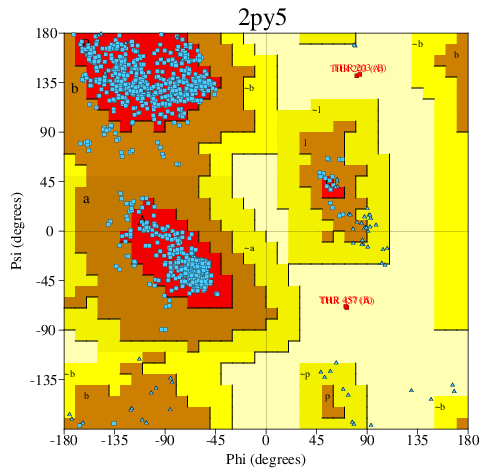
PROCHECK
|
|
|
|
|
|
Headers
|
|
|
|
References
|
|
|
|
|
|

|
|
P03680
(DPOL_BPPH2) -
DNA polymerase from Bacillus phage phi29
|
|
|
|
Seq:
Struc:
|
|
|
|
575 a.a.
564 a.a.*
|
|

|

|
|
|
|
|
|
|
|
|
|
|
|
Key: |
 |
PfamA domain |
|
|
 |
Secondary structure |
|
 |
CATH domain |
|
|
*
PDB and UniProt seqs differ
at 2 residue positions (black
crosses)
|
|
|
|
|
|
|
|

|
|
|
|
G-A-C-T-T-T
6 bases
|
|
|
|
G-G-A-C-T-T
6 bases
|
|
|
|
G-G-A-C-T-T
6 bases
|
|
|
|
G-G-A-C-T-T
6 bases
|
|
|
|
C-T-T-T
4 bases
|
|
|
|
|
|
|
|
|
|
|
|
|
|
Enzyme class 2:
|
|
E.C.2.7.7.7
- DNA-directed Dna polymerase.
|
|
|
|
|
|
|
Reaction:
|
|
DNA(n) + a 2'-deoxyribonucleoside 5'-triphosphate = DNA(n+1) + diphosphate
|
|
|
|
|
|
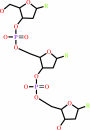 DNA(n)
|
+
|
2'-deoxyribonucleoside 5'-triphosphate
|
=
|
DNA(n+1)
|
+
|
 diphosphate
|
|
|
|
|
|
|
|
|
|
Enzyme class 3:
|
|
E.C.3.1.11.-
- ?????
|
|
|
|
|
|
|
|
|
|
Note, where more than one E.C. class is given (as above), each may
correspond to a different protein domain or, in the case of polyprotein
precursors, to a different mature protein.
|
|
|
|
Molecule diagrams generated from .mol files obtained from the
KEGG ftp site
|
|
|
|
|
|
|
|
|
|
|
|
|
|
 |
|
|
|
|
|
|
| |
|
|
| |
|
DOI no:
|
EMBO J
26:3494-3505
(2007)
|
|
PubMed id:
|
|
|
|
|
|
| |
|
Structures of phi29 DNA polymerase complexed with substrate: the mechanism of translocation in B-family polymerases.
|
|
A.J.Berman,
S.Kamtekar,
J.L.Goodman,
J.M.Lázaro,
M.de Vega,
L.Blanco,
M.Salas,
T.A.Steitz.
|
|
|
|
|
| |
ABSTRACT
|
|
|
|
| |
|
|
Replicative DNA polymerases (DNAPs) move along template DNA in a processive
manner. The structural basis of the mechanism of translocation has been better
studied in the A-family of polymerases than in the B-family of replicative
polymerases. To address this issue, we have determined the X-ray crystal
structures of phi29 DNAP, a member of the protein-primed subgroup of the
B-family of polymerases, complexed with primer-template DNA in the presence or
absence of the incoming nucleoside triphosphate, the pre- and post-translocated
states, respectively. Comparison of these structures reveals a mechanism of
translocation that appears to be facilitated by the coordinated movement of two
conserved tyrosine residues into the insertion site. This differs from the
mechanism employed by the A-family polymerases, in which a conserved tyrosine
moves into the templating and insertion sites during the translocation step.
Polymerases from the two families also interact with downstream single-stranded
template DNA in very different ways.
|
|
|
|
|
|
| |
Selected figure(s)
|
|
|
|
| |
|
|

|
|

|
|
Figure 3.
Figure 3 Water-mediated interactions maintain sequence
nonspecific binding. The C:G base pair is from the ternary1
complex, and the A:T base pair is from the ternary2 complex. Red
spheres are water molecules and black dashes are hydrogen bonds.
Amino acids are colored by subdomain as in Kamtekar et al (2004).
|
|
Figure 4.
Figure 4 The I/YxGG/A motif. (A) The primer and template strands
from the ternary complex are shown as yellow and gray sticks,
respectively. The template strand and the residues of the
I/YxGG/A motif are shown as spheres. (B) The two distinct
populations of Y226 are shown in sticks based on a superposition
of the palm subdomain. The residues are colored by crystal
structure.
|
|
|
|
|
|
| |
The above figures are
reprinted
by permission from Macmillan Publishers Ltd:
EMBO J
(2007,
26,
3494-3505)
copyright 2007.
|
|
| |
Figures were
selected
by an automated process.
|
|
|
|
|
|
|
|
|
|
|
|
|
|
|
|
 |
 |
 |
|
Literature references that cite this PDB file's key reference
|
|
|
| |
PubMed id
|
|
Reference
|
|
|
|
|
|
T.Nakamura,
Y.Zhao,
Y.Yamagata,
Y.J.Hua,
and
W.Yang
(2012).
Watching DNA polymerase η make a phosphodiester bond.
|
| |
Nature,
487,
196-201.
|
|
|
PDB codes:
|
|
|
|
|
|
|
|
D.A.Korona,
K.G.Lecompte,
and
Z.F.Pursell
(2011).
The high fidelity and unique error signature of human DNA polymerase epsilon.
|
| |
Nucleic Acids Res,
39,
1763-1773.
|
|
|
|
|
|
|
B.A.Flusberg,
D.R.Webster,
J.H.Lee,
K.J.Travers,
E.C.Olivares,
T.A.Clark,
J.Korlach,
and
S.W.Turner
(2010).
Direct detection of DNA methylation during single-molecule, real-time sequencing.
|
| |
Nat Methods,
7,
461-465.
|
|
|
|
|
|
|
B.Pan,
Y.Xiong,
and
T.A.Steitz
(2010).
How the CCA-adding enzyme selects adenine over cytosine at position 76 of tRNA.
|
| |
Science,
330,
937-940.
|
|
|
PDB codes:
|
|
|
|
|
|
|
|
J.D.Pata
(2010).
Structural diversity of the Y-family DNA polymerases.
|
| |
Biochim Biophys Acta,
1804,
1124-1135.
|
|
|
|
|
|
|
M.de Vega,
J.M.Lázaro,
M.Mencía,
L.Blanco,
and
M.Salas
(2010).
Improvement of φ29 DNA polymerase amplification performance by fusion of DNA binding motifs.
|
| |
Proc Natl Acad Sci U S A,
107,
16506-16511.
|
|
|
|
|
|
|
B.Ibarra,
Y.R.Chemla,
S.Plyasunov,
S.B.Smith,
J.M.Lázaro,
M.Salas,
and
C.Bustamante
(2009).
Proofreading dynamics of a processive DNA polymerase.
|
| |
EMBO J,
28,
2794-2802.
|
|
|
|
|
|
|
F.Wang,
and
W.Yang
(2009).
Structural insight into translesion synthesis by DNA Pol II.
|
| |
Cell,
139,
1279-1289.
|
|
|
PDB codes:
|
|
|
|
|
|
|
|
I.Rodríguez,
J.M.Lázaro,
M.Salas,
and
M.de Vega
(2009).
Involvement of the TPR2 subdomain movement in the activities of phi29 DNA polymerase.
|
| |
Nucleic Acids Res,
37,
193-203.
|
|
|
|
|
|
|
J.Eid,
A.Fehr,
J.Gray,
K.Luong,
J.Lyle,
G.Otto,
P.Peluso,
D.Rank,
P.Baybayan,
B.Bettman,
A.Bibillo,
K.Bjornson,
B.Chaudhuri,
F.Christians,
R.Cicero,
S.Clark,
R.Dalal,
A.Dewinter,
J.Dixon,
M.Foquet,
A.Gaertner,
P.Hardenbol,
C.Heiner,
K.Hester,
D.Holden,
G.Kearns,
X.Kong,
R.Kuse,
Y.Lacroix,
S.Lin,
P.Lundquist,
C.Ma,
P.Marks,
M.Maxham,
D.Murphy,
I.Park,
T.Pham,
M.Phillips,
J.Roy,
R.Sebra,
G.Shen,
J.Sorenson,
A.Tomaney,
K.Travers,
M.Trulson,
J.Vieceli,
J.Wegener,
D.Wu,
A.Yang,
D.Zaccarin,
P.Zhao,
F.Zhong,
J.Korlach,
and
S.Turner
(2009).
Real-time DNA sequencing from single polymerase molecules.
|
| |
Science,
323,
133-138.
|
|
|
|
|
|
|
R.Johne,
H.Müller,
A.Rector,
M.van Ranst,
and
H.Stevens
(2009).
Rolling-circle amplification of viral DNA genomes using phi29 polymerase.
|
| |
Trends Microbiol,
17,
205-211.
|
|
|
|
|
|
|
R.N.Veedu,
B.Vester,
and
J.Wengel
(2009).
Efficient enzymatic synthesis of LNA-modified DNA duplexes using KOD DNA polymerase.
|
| |
Org Biomol Chem,
7,
1404-1409.
|
|
|
|
|
|
|
C.A.Howell,
C.M.Kondratick,
and
M.T.Washington
(2008).
Substitution of a residue contacting the triphosphate moiety of the incoming nucleotide increases the fidelity of yeast DNA polymerase zeta.
|
| |
Nucleic Acids Res,
36,
1731-1740.
|
|
|
|
|
|
|
E.Longás,
L.Villar,
J.M.Lázaro,
M.de Vega,
and
M.Salas
(2008).
Phage phi29 and Nf terminal protein-priming domain specifies the internal template nucleotide to initiate DNA replication.
|
| |
Proc Natl Acad Sci U S A,
105,
18290-18295.
|
|
|
|
|
|
|
R.J.Evans,
D.R.Davies,
J.M.Bullard,
J.Christensen,
L.S.Green,
J.W.Guiles,
J.D.Pata,
W.K.Ribble,
N.Janjic,
and
T.C.Jarvis
(2008).
Structure of PolC reveals unique DNA binding and fidelity determinants.
|
| |
Proc Natl Acad Sci U S A,
105,
20695-20700.
|
|
|
PDB codes:
|
|
|
|
|
|
|
|
S.Broyde,
L.Wang,
O.Rechkoblit,
N.E.Geacintov,
and
D.J.Patel
(2008).
Lesion processing: high-fidelity versus lesion-bypass DNA polymerases.
|
| |
Trends Biochem Sci,
33,
209-219.
|
|
|
|
|
|
|
W.J.Allen,
P.J.Rothwell,
and
G.Waksman
(2008).
An intramolecular FRET system monitors fingers subdomain opening in Klentaq1.
|
| |
Protein Sci,
17,
401-408.
|
|
|
|
|
|
|
P.Pérez-Arnaiz,
E.Longás,
L.Villar,
J.M.Lázaro,
M.Salas,
and
M.de Vega
(2007).
Involvement of phage phi29 DNA polymerase and terminal protein subdomains in conferring specificity during initiation of protein-primed DNA replication.
|
| |
Nucleic Acids Res,
35,
7061-7073.
|
|
|
|
|
|
The most recent references are shown first.
Citation data come partly from CiteXplore and partly
from an automated harvesting procedure. Note that this is likely to be
only a partial list as not all journals are covered by
either method. However, we are continually building up the citation data
so more and more references will be included with time.
Where a reference describes a PDB structure, the PDB
codes are
shown on the right.
|
|


 Links
Links


