 |
PDBsum entry 3f2d

|
|
|
|
|
|

|

|

|

|
|

|
|

|
|

|
|

|
|

|
|

|
|

|
|
|
 |

|

|
|
|
|
|
|
|
|
|
|
|
|
|
|
|
|
|
|
|
|
|
|
|
|
|
|
|
|
|
|
|
|
|
|
|
|
Transferase/DNA
|
PDB id
|
|
|
|
3f2d
|
|
|
|
|
|
|
|
|
|
|
|
|
|
|

|

|

|
|
|
|
|
|
|
|
 |
Contents |
 |
|
|
|
|
|
|
|
|
|
|
|
|
|
|
|
|
* Residue conservation analysis
|
|
|
|
|
|
PDB id:
|
|
|
|
| Name: |
|
Transferase/DNA
|
|
|
Title:
|
|
DNA polymerase polc from geobacillus kaustophilus complex with DNA, dgtp, mn and zn
|
|
Structure:
|
|
5'-d( Dcp Dap Dgp Dtp Dgp Dap Dgp Dap Dcp Dgp Dgp Dgp Dcp D ap Dap Dcp Dc)-3'. Chain: p. Engineered: yes. Other_details: DNA primer strand. 5'-d( Dap Dtp Dap Dap Dcp Dgp Dgp Dtp Dtp Dgp Dcp Dcp Dcp D gp Dtp Dcp Dtp Dcp Dap Dcp Dtp Dg)-3'. Chain: t. Engineered: yes.
|
|
Source:
|
|
Synthetic: yes. Other_details: primer strand is synthetic oligonucleotide. Other_details: template strand is synthetic oligonucleotide. Geobacillus kaustophilus. Organism_taxid: 1462. Expressed in: escherichia coli. Expression_system_taxid: 562
|
|
Resolution:
|
|
|
2.51Å
|
R-factor:
|
0.218
|
R-free:
|
0.254
|
|
|
Authors:
|
|
D.R.Davies,R.J.Evans,J.M.Bullard,J.Christensen,L.S.Green,J.W.Guiles, W.K.Ribble,N.Janjic,T.C.Jarvis
|
Key ref:

|
|
R.J.Evans
et al.
(2008).
Structure of PolC reveals unique DNA binding and fidelity determinants.
Proc Natl Acad Sci U S A,
105,
20695-20700.
PubMed id:
DOI:

|
|
|
Date:
|
|
|
29-Oct-08
|
Release date:
|
20-Jan-09
|
|
|
|
|
|
|
PROCHECK
|

|
|
|
|
|
Headers
|
|
|
|
References
|
|
|
|
|
|

|
|
Q5L0J3
(Q5L0J3_GEOKA) -
DNA polymerase III PolC-type from Geobacillus kaustophilus (strain HTA426)
|
|
|
|
Seq:
Struc:
|
|
|
|
1444 a.a.
993 a.a.
|
|

|

|

|
|
|
|
|
|
|
|
|
|
|
Key: |
 |
PfamA domain |
|
|
 |
Secondary structure |
|
 |
CATH domain |
|
|
|
|
|
|
|
|

|
|
|
|
G-A-G-A-C-G-G-G-C-A-A-C-C
13 bases
|
|
|
|
A-T-A-A-C-G-G-T-T-G-C-C-C-G-T-C-T-C
18 bases
|
|
|
|
|
|
|
|
|
|
|
|
|
|
Enzyme class:
|
|
E.C.2.7.7.7
- DNA-directed Dna polymerase.
|
|
|
|
|
|
|
Reaction:
|
|
DNA(n) + a 2'-deoxyribonucleoside 5'-triphosphate = DNA(n+1) + diphosphate
|
|
|
|
|
|
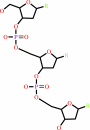 DNA(n)
|
+
|
2'-deoxyribonucleoside 5'-triphosphate
|
=
|
DNA(n+1)
Bound ligand (Het Group name = )
matches with 55.56% similarity
|
+
|
 diphosphate
|
|
|
|
|
|
|
|
|
|
|
|
|
Molecule diagrams generated from .mol files obtained from the
KEGG ftp site
|
|
|
|
|
|
|
|
|
|
|
|
|
|
 |
|
|
|
|
|
|
| |
|
|
| |
|
DOI no:
|
Proc Natl Acad Sci U S A
105:20695-20700
(2008)
|
|
PubMed id:
|
|
|
|
|
|
| |
|
Structure of PolC reveals unique DNA binding and fidelity determinants.
|
|
R.J.Evans,
D.R.Davies,
J.M.Bullard,
J.Christensen,
L.S.Green,
J.W.Guiles,
J.D.Pata,
W.K.Ribble,
N.Janjic,
T.C.Jarvis.
|
|
|
|
|
| |
ABSTRACT
|
|
|
|
| |
|
|
PolC is the polymerase responsible for genome duplication in many Gram-positive
bacteria and represents an attractive target for antibacterial development. We
have determined the 2.4-A resolution crystal structure of Geobacillus
kaustophilus PolC in a ternary complex with DNA and dGTP. The structure reveals
nascent base pair interactions that lead to highly accurate nucleotide
incorporation. A unique beta-strand motif in the PolC thumb domain contacts the
minor groove, allowing replication errors to be sensed up to 8 nt upstream of
the active site. PolC exhibits the potential for large-scale conformational
flexibility, which could encompass the catalytic residues. The structure
suggests a mechanism by which the active site can communicate with the rest of
the replisome to trigger proofreading after nucleotide misincorporation, leading
to an integrated model for controlling the dynamic switch between replicative
and repair polymerases. This ternary complex of a cellular replicative
polymerase affords insights into polymerase fidelity, evolution, and structural
diversity.
|
|
|
|
|
|
| |
Selected figure(s)
|
|
|
|
| |
|
|

|
|

|
|
Figure 2.
PHP β-barrel architecture. Schematic representations are
shown of canonical PHP (αβ)[7]-barrel (Left) (see Fig. S3),
the PolC PHP domain (Center), and the TaqDnaE PHP domain [Right,
based on Protein Data Bank (PDB) ID code 2HPI]. Red circles
indicate the locations of metal-chelating residues. Filled red
circles indicate the locations of metal-chelating residues that
are conserved between PolC and TaqDnaE, open circles indicate
the locations of metal-chelating residues in PolC and TaqDnaE
that are not conserved in EcoDnaE.
|
|
Figure 4.
Comparison of polymerase active sites from the β-NT and
classical superfamilies. The active sites and DNA substrates are
shown from PolC (colored as in Fig. 1) and TaqDnaE (white; PDB
ID code 3E0D) C family polymerases (A), Polβ (PDB ID code
2FMP), an X family polymerase (B), and RB69 (PDB ID code 1IG9),
a B family polymerase (C). (B and C) Palms are colored magenta,
and fingers are colored blue.
|
|
|
|
| |
Figures were
selected
by an automated process.
|
|
|
|
|
|
|
|
|
|
|
|
|
|
|
|
 |
 |
 |
|
Literature references that cite this PDB file's key reference
|
|
|
| |
PubMed id
|
|
Reference
|
|
|
|
|
|
T.Nakamura,
Y.Zhao,
Y.Yamagata,
Y.J.Hua,
and
W.Yang
(2012).
Watching DNA polymerase η make a phosphodiester bond.
|
| |
Nature,
487,
196-201.
|
|
|
PDB codes:
|
|
|
|
|
|
|
|
C.S.McHenry
(2011).
Breaking the rules: bacteria that use several DNA polymerase IIIs.
|
| |
EMBO Rep,
12,
408-414.
|
|
|
|
|
|
|
E.Johansson,
and
S.A.Macneill
(2010).
The eukaryotic replicative DNA polymerases take shape.
|
| |
Trends Biochem Sci,
35,
339-347.
|
|
|
|
|
|
|
J.D.Pata
(2010).
Structural diversity of the Y-family DNA polymerases.
|
| |
Biochim Biophys Acta,
1804,
1124-1135.
|
|
|
|
|
|
|
M.K.Swan,
R.E.Johnson,
L.Prakash,
S.Prakash,
and
A.K.Aggarwal
(2009).
Structural basis of high-fidelity DNA synthesis by yeast DNA polymerase delta.
|
| |
Nat Struct Mol Biol,
16,
979-986.
|
|
|
PDB code:
|
|
|
|
|
|
|
|
R.E.Georgescu,
I.Kurth,
N.Y.Yao,
J.Stewart,
O.Yurieva,
and
M.O'Donnell
(2009).
Mechanism of polymerase collision release from sliding clamps on the lagging strand.
|
| |
EMBO J,
28,
2981-2991.
|
|
|
|
|
|
|
M.H.Lamers,
and
M.O'Donnell
(2008).
A consensus view of DNA binding by the C family of replicative DNA polymerases.
|
| |
Proc Natl Acad Sci U S A,
105,
20565-20566.
|
|
|
|
|
|
The most recent references are shown first.
Citation data come partly from CiteXplore and partly
from an automated harvesting procedure. Note that this is likely to be
only a partial list as not all journals are covered by
either method. However, we are continually building up the citation data
so more and more references will be included with time.
Where a reference describes a PDB structure, the PDB
codes are
shown on the right.
|
|


 Links
Links


