|
PDBsum entry 3k5o

|
|
|
|
|
 |
Contents |
 |
|
|
|
|
|
|
|
|
|
|
* Residue conservation analysis
|
|
|
|
|
|
|
|
|
|
|
Enzyme class:
|
|
E.C.2.7.7.7
- DNA-directed Dna polymerase.
|
|
|
|
|
|
|
Reaction:
|
|
DNA(n) + a 2'-deoxyribonucleoside 5'-triphosphate = DNA(n+1) + diphosphate
|
|
|
|
|
|
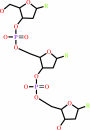 DNA(n)
|
+
|
2'-deoxyribonucleoside 5'-triphosphate
|
=
|
DNA(n+1)
|
+
|
 diphosphate
|
|
|
|
|
|
|
|
|
|
|
|
|
Molecule diagrams generated from .mol files obtained from the
KEGG ftp site
|
|
|
|
|
|
|
|
|
|
|
|
|
|
 |
|
|
|
|
|
|
| |
|
|
| |
|
|
Cell
139:1279-1289
(2009)
|
|
PubMed id:
|
|
|
|
|
|
| |
|
Structural insight into translesion synthesis by DNA Pol II.
|
|
F.Wang,
W.Yang.
|
|
|
|
|
| |
ABSTRACT
|
|
|
|
| |
|
|
E. coli DNA Pol II and eukaryotic Rev3 are B-family polymerases that can extend
primers past a damaged or mismatched site when the high-fidelity replicative
polymerases in the same family are ineffective. We report here the biochemical
and structural properties of DNA Pol II that facilitate this translesion
synthesis. DNA Pol II can extend primers past lesions either directly or by
template skipping, in which small protein cavities outside of the active site
accommodate looped-out template nucleotides 1 or 2 bp upstream. Because of
multiple looping-out alternatives, mutation spectra of bypass synthesis are
complicated. Moreover, translesion synthesis is enhanced by altered partitioning
of DNA substrate between the polymerase active site and the proofreading
exonuclease site. Compared to the replicative B family polymerases, DNA Pol II
has subtle amino acid changes remote from the active site that allow it to
replicate normal DNA with high efficiency yet conduct translesion synthesis when
needed.
|
|
|
|
|
|
|
|
|
|
|
|
|
|
|
|
|
|
 |
 |
 |
|
Literature references that cite this PDB file's key reference
|
|
|
| |
PubMed id
|
|
Reference
|
|
|
|
|
|
T.Nakamura,
Y.Zhao,
Y.Yamagata,
Y.J.Hua,
and
W.Yang
(2012).
Watching DNA polymerase η make a phosphodiester bond.
|
| |
Nature,
487,
196-201.
|
|
|
PDB codes:
|
|
|
|
|
|
|
|
C.Biertümpfel,
Y.Zhao,
Y.Kondo,
S.Ramón-Maiques,
M.Gregory,
J.Y.Lee,
C.Masutani,
A.R.Lehmann,
F.Hanaoka,
and
W.Yang
(2010).
Structure and mechanism of human DNA polymerase eta.
|
| |
Nature,
465,
1044-1048.
|
|
|
PDB codes:
|
|
|
|
|
|
|
|
K.Datta,
N.P.Johnson,
and
P.H.von Hippel
(2010).
DNA conformational changes at the primer-template junction regulate the fidelity of replication by DNA polymerase.
|
| |
Proc Natl Acad Sci U S A,
107,
17980-17985.
|
|
|
|
|
|
|
O.Rechkoblit,
A.Kolbanovskiy,
L.Malinina,
N.E.Geacintov,
S.Broyde,
and
D.J.Patel
(2010).
Mechanism of error-free and semitargeted mutagenic bypass of an aromatic amine lesion by Y-family polymerase Dpo4.
|
| |
Nat Struct Mol Biol,
17,
379-388.
|
|
|
PDB codes:
|
|
|
|
|
|
|
|
S.Chandani,
C.Jacobs,
and
E.L.Loechler
(2010).
Architecture of y-family DNA polymerases relevant to translesion DNA synthesis as revealed in structural and molecular modeling studies.
|
| |
J Nucleic Acids,
2010,
0.
|
|
|
|
|
|
|
S.J.Hyde,
B.E.Eckenroth,
B.A.Smith,
W.A.Eberley,
N.H.Heintz,
J.E.Jackman,
and
S.Doublié
(2010).
tRNA(His) guanylyltransferase (THG1), a unique 3'-5' nucleotidyl transferase, shares unexpected structural homology with canonical 5'-3' DNA polymerases.
|
| |
Proc Natl Acad Sci U S A,
107,
20305-20310.
|
|
|
PDB codes:
|
|
|
|
|
|
|
|
T.Narita,
T.Tsurimoto,
J.Yamamoto,
K.Nishihara,
K.Ogawa,
E.Ohashi,
T.Evans,
S.Iwai,
S.Takeda,
and
K.Hirota
(2010).
Human replicative DNA polymerase δ can bypass T-T (6-4) ultraviolet photoproducts on template strands.
|
| |
Genes Cells,
15,
1228-1239.
|
|
|
|
|
|
The most recent references are shown first.
Citation data come partly from CiteXplore and partly
from an automated harvesting procedure. Note that this is likely to be
only a partial list as not all journals are covered by
either method. However, we are continually building up the citation data
so more and more references will be included with time.
Where a reference describes a PDB structure, the PDB
codes are
shown on the right.
|
|


 Links
Links