 |
PDBsum entry 9icx

|
|
|
|
|
|

|

|

|

|
|

|
|

|
|

|
|

|
|

|
|
|
 |

|

|
|
|
|
|
|
|
|
|
|
|
|
|
|
|
|
|
|
|
|
|
|
|
|
|
|
|
|
|
|
|
|
|
|
Transferase/DNA
|
PDB id
|
|
|
|
9icx
|
|
|
|
|
|
|
|
|
|
|
|
|
|
|

|

|

|
|
|
|
|
|
|
|
 |
Contents |
 |
|
|
|
|
|
|
|
|
|
|
|
|
|
|
* Residue conservation analysis
|
|
|
|
|
|
|
|
|
|
|
Enzyme class 1:
|
|
E.C.2.7.7.7
- DNA-directed Dna polymerase.
|
|
|
|
|
|
|
Reaction:
|
|
DNA(n) + a 2'-deoxyribonucleoside 5'-triphosphate = DNA(n+1) + diphosphate
|
|
|
|
|
|
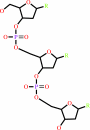 DNA(n)
|
+
|
2'-deoxyribonucleoside 5'-triphosphate
|
=
|
DNA(n+1)
|
+
|
 diphosphate
|
|
|
|
|
|
|
|
|
|
Enzyme class 2:
|
|
E.C.4.2.99.-
- ?????
|
|
|
|
|
|
|
Enzyme class 3:
|
|
E.C.4.2.99.18
- DNA-(apurinic or apyrimidinic site) lyase.
|
|
|
|
|
|
|
Reaction:
|
|
2'-deoxyribonucleotide-(2'-deoxyribose 5'-phosphate)- 2'-deoxyribonucleotide-DNA = a 3'-end 2'-deoxyribonucleotide-(2,3- dehydro-2,3-deoxyribose 5'-phosphate)-DNA + a 5'-end 5'-phospho- 2'-deoxyribonucleoside-DNA + H+
|
|
|
|
|
|
|
|
|
Note, where more than one E.C. class is given (as above), each may
correspond to a different protein domain or, in the case of polyprotein
precursors, to a different mature protein.
|
|
|
|
Molecule diagrams generated from .mol files obtained from the
KEGG ftp site
|
|
|
|
|
|
|
|
|
|
|
|
|
|
 |
|
|
|
|
|
|
| |
|
|
| |
|
DOI no:
|
Biochemistry
35:12742-12761
(1996)
|
|
PubMed id:
|
|
|
|
|
|
| |
|
Crystal structures of human DNA polymerase beta complexed with DNA: implications for catalytic mechanism, processivity, and fidelity.
|
|
H.Pelletier,
M.R.Sawaya,
W.Wolfle,
S.H.Wilson,
J.Kraut.
|
|
|
|
|
| |
ABSTRACT
|
|
|
|
| |
|
|
Mammalian DNA polymerase beta (pol beta) is a small (39 kDa) DNA gap-filling
enzyme that comprises an amino-terminal 8-kDa domain and a carboxy-terminal
31-kDa domain. In the work reported here, crystal structures of human pol beta
complexed with blunt-ended segments of DNA show that, although the crystals
belong to a different space group, the DNA is nevertheless bound in the pol beta
binding channel in the same way as the DNA in previously reported structures of
rat pol beta complexed with a template-primer and ddCTP [Pelletier, H., Sawaya,
M. R., Kumar, A., Wilson, S. H., & Kraut, J. (1994) Science 264, 1891-1903].
The 8-kDa domain is in one of three previously observed positions relative to
the 31-kDa domain, suggesting that the 8-kDa domain may assume only a small
number of stable conformations. The thumb subdomain is in a more open position
in the human pol beta-DNA binary complex than it is in the rat pol
beta-DNA-ddCTP ternary complex, and a closing thumb upon nucleotide binding
could represent the rate-limiting conformational change that has been observed
in pre-steady-state kinetic studies. Intermolecular contacts between the DNA and
the 8-kDa domain of a symmetry-related pol beta molecule reveal a plausible
binding site on the 8-kDa domain for the downstream oligonucleotide of a
gapped-DNA substrate; in addition to a lysine-rich binding pocket that
accommodates a 5'-PO4 end group, the 8-kDa domain also contains a newly
discovered helix-hairpin-helix (HhH) motif that binds to DNA in the same way as
does a structurally and sequentially homologous HhH motif in the 31-kDa domain.
DNA binding by both HhH motifs is facilitated by a metal ion. In that HhH motifs
have been identified in other DNA repair enzymes and DNA polymerases, the
HhH-DNA interactions observed in pol beta may be applicable to a broad range of
DNA binding proteins. The sequence similarity between the HhH motif of
endonuclease III from Escherichia coli and the HhH motif of the 8-kDa domain of
pol beta is particularly striking in that all of the conserved residues are
clustered in one short sequence segment, LPGVGXK, where LPGV corresponds to a
type II beta-turn (the hairpin turn), and GXK corresponds to a part of the HhH
motif that is proposed to be critical for DNA binding and catalysis for both
enzymes. These results suggest that endonuclease III and the 8-kDa domain of pol
beta may employ a similar mode of DNA binding and may have similar catalytic
mechanisms for their respective DNA lyase activities. A model for productive
binding of pol beta to a gapped-DNA substrate requires a 90 degrees bend in the
single-stranded template, which could enhance nucleotide selectivity during DNA
repair or replication.
|
|
|
|
|
|
|
|
|
|
|
|
|
|
|
|
|
|
 |
 |
 |
|
Literature references that cite this PDB file's key reference
|
|
|
| |
PubMed id
|
|
Reference
|
|
|
|
|
|
C.L.An,
D.Chen,
and
N.M.Makridakis
(2011).
Systematic biochemical analysis of somatic missense mutations in DNA polymerase β found in prostate cancer reveal alteration of enzymatic function.
|
| |
Hum Mutat,
32,
415-423.
|
|
|
|
|
|
|
J.Orans,
E.A.McSweeney,
R.R.Iyer,
M.A.Hast,
H.W.Hellinga,
P.Modrich,
and
L.S.Beese
(2011).
Structures of human exonuclease 1 DNA complexes suggest a unified mechanism for nuclease family.
|
| |
Cell,
145,
212-223.
|
|
|
PDB codes:
|
|
|
|
|
|
|
|
P.Xie
(2011).
A model for the dynamics of mammalian family X DNA polymerases.
|
| |
J Theor Biol,
277,
111-122.
|
|
|
|
|
|
|
E.A.Motea,
and
A.J.Berdis
(2010).
Terminal deoxynucleotidyl transferase: the story of a misguided DNA polymerase.
|
| |
Biochim Biophys Acta,
1804,
1151-1166.
|
|
|
|
|
|
|
J.Yamtich,
and
J.B.Sweasy
(2010).
DNA polymerase family X: function, structure, and cellular roles.
|
| |
Biochim Biophys Acta,
1804,
1136-1150.
|
|
|
|
|
|
|
R.D.Kuchta,
and
G.Stengel
(2010).
Mechanism and evolution of DNA primases.
|
| |
Biochim Biophys Acta,
1804,
1180-1189.
|
|
|
|
|
|
|
R.Rucker,
P.Oelschlaeger,
and
A.Warshel
(2010).
A binding free energy decomposition approach for accurate calculations of the fidelity of DNA polymerases.
|
| |
Proteins,
78,
671-680.
|
|
|
|
|
|
|
S.H.Wilson,
W.A.Beard,
D.D.Shock,
V.K.Batra,
N.A.Cavanaugh,
R.Prasad,
E.W.Hou,
Y.Liu,
K.Asagoshi,
J.K.Horton,
D.F.Stefanick,
P.S.Kedar,
M.J.Carrozza,
A.Masaoka,
and
M.L.Heacock
(2010).
Base excision repair and design of small molecule inhibitors of human DNA polymerase β.
|
| |
Cell Mol Life Sci,
67,
3633-3647.
|
|
|
|
|
|
|
C.Xu,
B.A.Maxwell,
J.A.Brown,
L.Zhang,
and
Z.Suo
(2009).
Global conformational dynamics of a Y-family DNA polymerase during catalysis.
|
| |
PLoS Biol,
7,
e1000225.
|
|
|
|
|
|
|
N.Leulliot,
L.Cladière,
F.Lecointe,
D.Durand,
U.Hübscher,
and
H.van Tilbeurgh
(2009).
The Family X DNA Polymerase from Deinococcus radiodurans Adopts a Non-standard Extended Conformation.
|
| |
J Biol Chem,
284,
11992-11999.
|
|
|
PDB code:
|
|
|
|
|
|
|
|
N.M.Makridakis,
L.F.Caldas Ferraz,
and
J.K.Reichardt
(2009).
Genomic analysis of cancer tissue reveals that somatic mutations commonly occur in a specific motif.
|
| |
Hum Mutat,
30,
39-48.
|
|
|
|
|
|
|
Y.C.Tsai,
Z.Jin,
and
K.A.Johnson
(2009).
Site-specific labeling of T7 DNA polymerase with a conformationally sensitive fluorophore and its use in detecting single-nucleotide polymorphisms.
|
| |
Anal Biochem,
384,
136-144.
|
|
|
|
|
|
|
G.T.Hwang,
and
F.E.Romesberg
(2008).
Unnatural substrate repertoire of A, B, and X family DNA polymerases.
|
| |
J Am Chem Soc,
130,
14872-14882.
|
|
|
|
|
|
|
K.H.Tang,
M.Niebuhr,
A.Aulabaugh,
and
M.D.Tsai
(2008).
Solution structures of 2 : 1 and 1 : 1 DNA polymerase-DNA complexes probed by ultracentrifugation and small-angle X-ray scattering.
|
| |
Nucleic Acids Res,
36,
849-860.
|
|
|
|
|
|
|
M.P.Roettger,
M.Bakhtina,
and
M.D.Tsai
(2008).
Mismatched and matched dNTP incorporation by DNA polymerase beta proceed via analogous kinetic pathways.
|
| |
Biochemistry,
47,
9718-9727.
|
|
|
|
|
|
|
S.Dalal,
D.Starcevic,
J.Jaeger,
and
J.B.Sweasy
(2008).
The I260Q variant of DNA polymerase beta extends mispaired primer termini due to its increased affinity for deoxynucleotide triphosphate substrates.
|
| |
Biochemistry,
47,
12118-12125.
|
|
|
|
|
|
|
A.F.Moon,
M.Garcia-Diaz,
K.Bebenek,
B.J.Davis,
X.Zhong,
D.A.Ramsden,
T.A.Kunkel,
and
L.C.Pedersen
(2007).
Structural insight into the substrate specificity of DNA Polymerase mu.
|
| |
Nat Struct Mol Biol,
14,
45-53.
|
|
|
PDB code:
|
|
|
|
|
|
|
|
A.J.Berman,
S.Kamtekar,
J.L.Goodman,
J.M.Lázaro,
M.de Vega,
L.Blanco,
M.Salas,
and
T.A.Steitz
(2007).
Structures of phi29 DNA polymerase complexed with substrate: the mechanism of translocation in B-family polymerases.
|
| |
EMBO J,
26,
3494-3505.
|
|
|
PDB codes:
|
|
|
|
|
|
|
|
G.C.Lin,
J.Jaeger,
and
J.B.Sweasy
(2007).
Loop II of DNA polymerase beta is important for polymerization activity and fidelity.
|
| |
Nucleic Acids Res,
35,
2924-2935.
|
|
|
|
|
|
|
J.Mrázek,
X.Guo,
and
A.Shah
(2007).
Simple sequence repeats in prokaryotic genomes.
|
| |
Proc Natl Acad Sci U S A,
104,
8472-8477.
|
|
|
|
|
|
|
J.Stagno,
I.Aphasizheva,
A.Rosengarth,
H.Luecke,
and
R.Aphasizhev
(2007).
UTP-bound and Apo structures of a minimal RNA uridylyltransferase.
|
| |
J Mol Biol,
366,
882-899.
|
|
|
PDB codes:
|
|
|
|
|
|
|
|
N.Z.Rudinger,
R.Kranaster,
and
A.Marx
(2007).
Hydrophobic amino acid and single-atom substitutions increase DNA polymerase selectivity.
|
| |
Chem Biol,
14,
185-194.
|
|
|
|
|
|
|
R.A.Perlow-Poehnelt,
I.Likhterov,
L.Wang,
D.A.Scicchitano,
N.E.Geacintov,
and
S.Broyde
(2007).
Increased flexibility enhances misincorporation: temperature effects on nucleotide incorporation opposite a bulky carcinogen-DNA adduct by a Y-family DNA polymerase.
|
| |
J Biol Chem,
282,
1397-1408.
|
|
|
|
|
|
|
S.Beetz,
D.Diekhoff,
and
L.A.Steiner
(2007).
Characterization of terminal deoxynucleotidyl transferase and polymerase mu in zebrafish.
|
| |
Immunogenetics,
59,
735-744.
|
|
|
|
|
|
|
Y.Zhu,
H.Li,
C.Long,
L.Hu,
H.Xu,
L.Liu,
S.Chen,
D.C.Wang,
and
F.Shao
(2007).
Structural insights into the enzymatic mechanism of the pathogenic MAPK phosphothreonine lyase.
|
| |
Mol Cell,
28,
899-913.
|
|
|
PDB codes:
|
|
|
|
|
|
|
|
E.Longás,
M.de Vega,
J.M.Lázaro,
and
M.Salas
(2006).
Functional characterization of highly processive protein-primed DNA polymerases from phages Nf and GA-1, endowed with a potent strand displacement capacity.
|
| |
Nucleic Acids Res,
34,
6051-6063.
|
|
|
|
|
|
|
L.Fan,
A.S.Arvai,
P.K.Cooper,
S.Iwai,
F.Hanaoka,
and
J.A.Tainer
(2006).
Conserved XPB core structure and motifs for DNA unwinding: implications for pathway selection of transcription or excision repair.
|
| |
Mol Cell,
22,
27-37.
|
|
|
PDB codes:
|
|
|
|
|
|
|
|
R.Juárez,
J.F.Ruiz,
S.A.Nick McElhinny,
D.Ramsden,
and
L.Blanco
(2006).
A specific loop in human DNA polymerase mu allows switching between creative and DNA-instructed synthesis.
|
| |
Nucleic Acids Res,
34,
4572-4582.
|
|
|
|
|
|
|
D.Starcevic,
S.Dalal,
J.Jaeger,
and
J.B.Sweasy
(2005).
The hydrophobic hinge region of rat DNA polymerase beta is critical for substrate binding pocket geometry.
|
| |
J Biol Chem,
280,
28388-28393.
|
|
|
|
|
|
|
E.Crespan,
S.Zanoli,
A.Khandazhinskaya,
I.Shevelev,
M.Jasko,
L.Alexandrova,
M.Kukhanova,
G.Blanca,
G.Villani,
U.Hübscher,
S.Spadari,
and
G.Maga
(2005).
Incorporation of non-nucleoside triphosphate analogues opposite to an abasic site by human DNA polymerases beta and lambda.
|
| |
Nucleic Acids Res,
33,
4117-4127.
|
|
|
|
|
|
|
J.B.Sweasy,
T.Lang,
D.Starcevic,
K.W.Sun,
C.C.Lai,
D.Dimaio,
and
S.Dalal
(2005).
Expression of DNA polymerase {beta} cancer-associated variants in mouse cells results in cellular transformation.
|
| |
Proc Natl Acad Sci U S A,
102,
14350-14355.
|
|
|
|
|
|
|
J.Chen,
and
J.Stubbe
(2005).
Bleomycins: towards better therapeutics.
|
| |
Nat Rev Cancer,
5,
102-112.
|
|
|
|
|
|
|
N.Kasai,
Y.Mizushina,
H.Murata,
T.Yamazaki,
T.Ohkubo,
K.Sakaguchi,
and
F.Sugawara
(2005).
Sulfoquinovosylmonoacylglycerol inhibitory mode analysis of rat DNA polymerase beta.
|
| |
FEBS J,
272,
4349-4361.
|
|
|
|
|
|
|
V.Sosunov,
S.Zorov,
E.Sosunova,
A.Nikolaev,
I.Zakeyeva,
I.Bass,
A.Goldfarb,
V.Nikiforov,
K.Severinov,
and
A.Mustaev
(2005).
The involvement of the aspartate triad of the active center in all catalytic activities of multisubunit RNA polymerase.
|
| |
Nucleic Acids Res,
33,
4202-4211.
|
|
|
|
|
|
|
W.Zheng,
B.R.Brooks,
S.Doniach,
and
D.Thirumalai
(2005).
Network of dynamically important residues in the open/closed transition in polymerases is strongly conserved.
|
| |
Structure,
13,
565-577.
|
|
|
|
|
|
|
Y.Shen,
N.L.Zhukovskaya,
Q.Guo,
J.Florián,
and
W.J.Tang
(2005).
Calcium-independent calmodulin binding and two-metal-ion catalytic mechanism of anthrax edema factor.
|
| |
EMBO J,
24,
929-941.
|
|
|
PDB codes:
|
|
|
|
|
|
|
|
D.W.Gohara,
J.J.Arnold,
and
C.E.Cameron
(2004).
Poliovirus RNA-dependent RNA polymerase (3Dpol): kinetic, thermodynamic, and structural analysis of ribonucleotide selection.
|
| |
Biochemistry,
43,
5149-5158.
|
|
|
|
|
|
|
D.Wong,
and
B.Demple
(2004).
Modulation of the 5'-deoxyribose-5-phosphate lyase and DNA synthesis activities of mammalian DNA polymerase beta by apurinic/apyrimidinic endonuclease 1.
|
| |
J Biol Chem,
279,
25268-25275.
|
|
|
|
|
|
|
H.P.Shanahan,
M.A.Garcia,
S.Jones,
and
J.M.Thornton
(2004).
Identifying DNA-binding proteins using structural motifs and the electrostatic potential.
|
| |
Nucleic Acids Res,
32,
4732-4741.
|
|
|
|
|
|
|
J.J.Arnold,
D.W.Gohara,
and
C.E.Cameron
(2004).
Poliovirus RNA-dependent RNA polymerase (3Dpol): pre-steady-state kinetic analysis of ribonucleotide incorporation in the presence of Mn2+.
|
| |
Biochemistry,
43,
5138-5148.
|
|
|
|
|
|
|
J.W.Lee,
L.Blanco,
T.Zhou,
M.Garcia-Diaz,
K.Bebenek,
T.A.Kunkel,
Z.Wang,
and
L.F.Povirk
(2004).
Implication of DNA polymerase lambda in alignment-based gap filling for nonhomologous DNA end joining in human nuclear extracts.
|
| |
J Biol Chem,
279,
805-811.
|
|
|
|
|
|
|
M.Garcia-Diaz,
K.Bebenek,
J.M.Krahn,
L.Blanco,
T.A.Kunkel,
and
L.C.Pedersen
(2004).
A structural solution for the DNA polymerase lambda-dependent repair of DNA gaps with minimal homology.
|
| |
Mol Cell,
13,
561-572.
|
|
|
PDB code:
|
|
|
|
|
|
|
|
R.A.Perlow-Poehnelt,
I.Likhterov,
D.A.Scicchitano,
N.E.Geacintov,
and
S.Broyde
(2004).
The spacious active site of a Y-family DNA polymerase facilitates promiscuous nucleotide incorporation opposite a bulky carcinogen-DNA adduct: elucidating the structure-function relationship through experimental and computational approaches.
|
| |
J Biol Chem,
279,
36951-36961.
|
|
|
|
|
|
|
S.Dalal,
J.L.Kosa,
and
J.B.Sweasy
(2004).
The D246V mutant of DNA polymerase beta misincorporates nucleotides: evidence for a role for the flexible loop in DNA positioning within the active site.
|
| |
J Biol Chem,
279,
577-584.
|
|
|
|
|
|
|
T.A.Steitz
(2004).
The structural basis of the transition from initiation to elongation phases of transcription, as well as translocation and strand separation, by T7 RNA polymerase.
|
| |
Curr Opin Struct Biol,
14,
4-9.
|
|
|
|
|
|
|
V.J.Cannistraro,
and
J.S.Taylor
(2004).
DNA-thumb interactions and processivity of T7 DNA polymerase in comparison to yeast polymerase eta.
|
| |
J Biol Chem,
279,
18288-18295.
|
|
|
|
|
|
|
Y.W.Yin,
and
T.A.Steitz
(2004).
The structural mechanism of translocation and helicase activity in T7 RNA polymerase.
|
| |
Cell,
116,
393-404.
|
|
|
PDB codes:
|
|
|
|
|
|
|
|
I.Shevelev,
G.Blanca,
G.Villani,
K.Ramadan,
S.Spadari,
U.Hübscher,
and
G.Maga
(2003).
Mutagenesis of human DNA polymerase lambda: essential roles of Tyr505 and Phe506 for both DNA polymerase and terminal transferase activities.
|
| |
Nucleic Acids Res,
31,
6916-6925.
|
|
|
|
|
|
|
K.E.McGinness,
and
G.F.Joyce
(2003).
In search of an RNA replicase ribozyme.
|
| |
Chem Biol,
10,
5.
|
|
|
|
|
|
|
R.C.Rittenhouse,
W.K.Apostoluk,
J.H.Miller,
and
T.P.Straatsma
(2003).
Characterization of the active site of DNA polymerase beta by molecular dynamics and quantum chemical calculation.
|
| |
Proteins,
53,
667-682.
|
|
|
|
|
|
|
S.J.Kim,
W.A.Beard,
J.Harvey,
D.D.Shock,
J.R.Knutson,
and
S.H.Wilson
(2003).
Rapid segmental and subdomain motions of DNA polymerase beta.
|
| |
J Biol Chem,
278,
5072-5081.
|
|
|
|
|
|
|
W.Yang
(2003).
Damage repair DNA polymerases Y.
|
| |
Curr Opin Struct Biol,
13,
23-30.
|
|
|
|
|
|
|
A.R.Pavlov,
G.I.Belova,
S.A.Kozyavkin,
and
A.I.Slesarev
(2002).
Helix-hairpin-helix motifs confer salt resistance and processivity on chimeric DNA polymerases.
|
| |
Proc Natl Acad Sci U S A,
99,
13510-13515.
|
|
|
|
|
|
|
C.A.Dunlap,
and
M.D.Tsai
(2002).
Use of 2-aminopurine and tryptophan fluorescence as probes in kinetic analyses of DNA polymerase beta.
|
| |
Biochemistry,
41,
11226-11235.
|
|
|
|
|
|
|
E.T.Kool
(2002).
Active site tightness and substrate fit in DNA replication.
|
| |
Annu Rev Biochem,
71,
191-219.
|
|
|
|
|
|
|
H.H.Gan,
R.A.Perlow,
S.Roy,
J.Ko,
M.Wu,
J.Huang,
S.Yan,
A.Nicoletta,
J.Vafai,
D.Sun,
L.Wang,
J.E.Noah,
S.Pasquali,
and
T.Schlick
(2002).
Analysis of protein sequence/structure similarity relationships.
|
| |
Biophys J,
83,
2781-2791.
|
|
|
|
|
|
|
L.K.Zerbe,
and
R.D.Kuchta
(2002).
The p58 subunit of human DNA primase is important for primer initiation, elongation, and counting.
|
| |
Biochemistry,
41,
4891-4900.
|
|
|
|
|
|
|
M.Delarue,
J.B.Boulé,
J.Lescar,
N.Expert-Bezançon,
N.Jourdan,
N.Sukumar,
F.Rougeon,
and
C.Papanicolaou
(2002).
Crystal structures of a template-independent DNA polymerase: murine terminal deoxynucleotidyltransferase.
|
| |
EMBO J,
21,
427-439.
|
|
|
PDB codes:
|
|
|
|
|
|
|
|
M.Maitra,
A.Gudzelak,
S.X.Li,
Y.Matsumoto,
K.A.Eckert,
J.Jager,
and
J.B.Sweasy
(2002).
Threonine 79 is a hinge residue that governs the fidelity of DNA polymerase beta by helping to position the DNA within the active site.
|
| |
J Biol Chem,
277,
35550-35560.
|
|
|
|
|
|
|
S.Bergqvist,
M.A.Williams,
R.O'Brien,
and
J.E.Ladbury
(2002).
Reversal of halophilicity in a protein-DNA interaction by limited mutation strategy.
|
| |
Structure,
10,
629-637.
|
|
|
|
|
|
|
Y.Mizushina,
S.Kamisuki,
N.Kasai,
N.Shimazaki,
M.Takemura,
H.Asahara,
S.Linn,
S.Yoshida,
A.Matsukage,
O.Koiwai,
F.Sugawara,
H.Yoshida,
and
K.Sakaguchi
(2002).
A plant phytotoxin, solanapyrone A, is an inhibitor of DNA polymerase beta and lambda.
|
| |
J Biol Chem,
277,
630-638.
|
|
|
|
|
|
|
A.J.Podlutsky,
I.I.Dianova,
S.H.Wilson,
V.A.Bohr,
and
G.L.Dianov
(2001).
DNA synthesis and dRPase activities of polymerase beta are both essential for single-nucleotide patch base excision repair in mammalian cell extracts.
|
| |
Biochemistry,
40,
809-813.
|
|
|
|
|
|
|
A.Skandalis,
and
L.A.Loeb
(2001).
Enzymatic properties of rat DNA polymerase beta mutants obtained by randomized mutagenesis.
|
| |
Nucleic Acids Res,
29,
2418-2426.
|
|
|
|
|
|
|
H.Ling,
F.Boudsocq,
R.Woodgate,
and
W.Yang
(2001).
Crystal structure of a Y-family DNA polymerase in action: a mechanism for error-prone and lesion-bypass replication.
|
| |
Cell,
107,
91.
|
|
|
PDB codes:
|
|
|
|
|
|
|
|
J.W.Arndt,
W.Gong,
X.Zhong,
A.K.Showalter,
J.Liu,
C.A.Dunlap,
Z.Lin,
C.Paxson,
M.D.Tsai,
and
M.K.Chan
(2001).
Insight into the catalytic mechanism of DNA polymerase beta: structures of intermediate complexes.
|
| |
Biochemistry,
40,
5368-5375.
|
|
|
PDB codes:
|
|
|
|
|
|
|
|
L.F.Silvian,
E.A.Toth,
P.Pham,
M.F.Goodman,
and
T.Ellenberger
(2001).
Crystal structure of a DinB family error-prone DNA polymerase from Sulfolobus solfataricus.
|
| |
Nat Struct Biol,
8,
984-989.
|
|
|
PDB codes:
|
|
|
|
|
|
|
|
O.N.Ozoline,
N.Fujita,
and
A.Ishihama
(2001).
Mode of DNA-protein interaction between the C-terminal domain of Escherichia coli RNA polymerase alpha subunit and T7D promoter UP element.
|
| |
Nucleic Acids Res,
29,
4909-4919.
|
|
|
|
|
|
|
S.Taladriz,
T.Hanke,
M.J.Ramiro,
M.García-Díaz,
M.García De Lacoba,
L.Blanco,
and
V.Larraga
(2001).
Nuclear DNA polymerase beta from Leishmania infantum. Cloning, molecular analysis and developmental regulation.
|
| |
Nucleic Acids Res,
29,
3822-3834.
|
|
|
|
|
|
|
W.A.Beard,
and
S.H.Wilson
(2001).
DNA lesion bypass polymerases open up.
|
| |
Structure,
9,
759-764.
|
|
|
|
|
|
|
W.Ross,
A.Ernst,
and
R.L.Gourse
(2001).
Fine structure of E. coli RNA polymerase-promoter interactions: alpha subunit binding to the UP element minor groove.
|
| |
Genes Dev,
15,
491-506.
|
|
|
|
|
|
|
B.Arezi,
and
R.D.Kuchta
(2000).
Eukaryotic DNA primase.
|
| |
Trends Biochem Sci,
25,
572-576.
|
|
|
|
|
|
|
H.Miller,
R.Prasad,
S.H.Wilson,
F.Johnson,
and
A.P.Grollman
(2000).
8-oxodGTP incorporation by DNA polymerase beta is modified by active-site residue Asn279.
|
| |
Biochemistry,
39,
1029-1033.
|
|
|
|
|
|
|
M.A.Keniry,
H.A.Berthon,
J.Y.Yang,
C.S.Miles,
and
N.E.Dixon
(2000).
NMR solution structure of the theta subunit of DNA polymerase III from Escherichia coli.
|
| |
Protein Sci,
9,
721-733.
|
|
|
PDB code:
|
|
|
|
|
|
|
|
P.L.Opresko,
R.Shiman,
and
K.A.Eckert
(2000).
Hydrophobic interactions in the hinge domain of DNA polymerase beta are important but not sufficient for maintaining fidelity of DNA synthesis.
|
| |
Biochemistry,
39,
11399-11407.
|
|
|
|
|
|
|
S.Ben-Yehuda,
C.S.Russell,
I.Dix,
J.D.Beggs,
and
M.Kupiec
(2000).
Extensive genetic interactions between PRP8 and PRP17/CDC40, two yeast genes involved in pre-mRNA splicing and cell cycle progression.
|
| |
Genetics,
154,
61-71.
|
|
|
|
|
|
|
S.R.Starck,
J.Z.Deng,
and
S.M.Hecht
(2000).
Naturally occurring alkylresorcinols that mediate DNA damage and inhibit its repair.
|
| |
Biochemistry,
39,
2413-2419.
|
|
|
|
|
|
|
S.S.Daube,
G.Arad,
and
Z.Livneh
(2000).
Translesion replication by DNA polymerase beta is modulated by sequence context and stimulated by fork-like flap structures in DNA.
|
| |
Biochemistry,
39,
397-405.
|
|
|
|
|
|
|
T.A.Kunkel,
and
K.Bebenek
(2000).
DNA replication fidelity.
|
| |
Annu Rev Biochem,
69,
497-529.
|
|
|
|
|
|
|
T.C.Umland,
S.Q.Wei,
R.Craigie,
and
D.R.Davies
(2000).
Structural basis of DNA bridging by barrier-to-autointegration factor.
|
| |
Biochemistry,
39,
9130-9138.
|
|
|
PDB code:
|
|
|
|
|
|
|
|
T.L.Ware,
H.Wang,
and
E.H.Blackburn
(2000).
Three telomerases with completely non-telomeric template replacements are catalytically active.
|
| |
EMBO J,
19,
3119-3131.
|
|
|
|
|
|
|
V.S.Kraynov,
A.K.Showalter,
J.Liu,
X.Zhong,
and
M.D.Tsai
(2000).
DNA polymerase beta: contributions of template-positioning and dNTP triphosphate-binding residues to catalysis and fidelity.
|
| |
Biochemistry,
39,
16008-16015.
|
|
|
|
|
|
|
X.Shao,
and
N.V.Grishin
(2000).
Common fold in helix-hairpin-helix proteins.
|
| |
Nucleic Acids Res,
28,
2643-2650.
|
|
|
|
|
|
|
Y.Mizushina,
T.Ohkubo,
F.Sugawara,
and
K.Sakaguchi
(2000).
Structure of lithocholic acid binding to the N-terminal 8-kDa domain of DNA polymerase beta.
|
| |
Biochemistry,
39,
12606-12613.
|
|
|
|
|
|
|
Y.Mizushina,
T.Ueno,
M.Oda,
T.Yamaguchi,
M.Saneyoshi,
and
K.Sakaguchi
(2000).
The biochemical mode of inhibition of DNA polymerase beta by alpha-rubromycin.
|
| |
Biochim Biophys Acta,
1523,
172-181.
|
|
|
|
|
|
|
C.D.Mol,
S.S.Parikh,
C.D.Putnam,
T.P.Lo,
and
J.A.Tainer
(1999).
DNA repair mechanisms for the recognition and removal of damaged DNA bases.
|
| |
Annu Rev Biophys Biomol Struct,
28,
101-128.
|
|
|
|
|
|
|
D.A.Lewis,
K.Bebenek,
W.A.Beard,
S.H.Wilson,
and
T.A.Kunkel
(1999).
Uniquely altered DNA replication fidelity conferred by an amino acid change in the nucleotide binding pocket of human immunodeficiency virus type 1 reverse transcriptase.
|
| |
J Biol Chem,
274,
32924-32930.
|
|
|
|
|
|
|
J.L.Kosa,
and
J.B.Sweasy
(1999).
The E249K mutator mutant of DNA polymerase beta extends mispaired termini.
|
| |
J Biol Chem,
274,
35866-35872.
|
|
|
|
|
|
|
L.L.Furge,
and
F.P.Guengerich
(1999).
Explanation of pre-steady-state kinetics and decreased burst amplitude of HIV-1 reverse transcriptase at sites of modified DNA bases with an additional, nonproductive enzyme-DNA-nucleotide complex.
|
| |
Biochemistry,
38,
4818-4825.
|
|
|
|
|
|
|
S.G.Sarafianos,
K.Das,
J.Ding,
P.L.Boyer,
S.H.Hughes,
and
E.Arnold
(1999).
Touching the heart of HIV-1 drug resistance: the fingers close down on the dNTP at the polymerase active site.
|
| |
Chem Biol,
6,
R137-R146.
|
|
|
|
|
|
|
S.X.Li,
J.A.Vaccaro,
and
J.B.Sweasy
(1999).
Involvement of phenylalanine 272 of DNA polymerase beta in discriminating between correct and incorrect deoxynucleoside triphosphates.
|
| |
Biochemistry,
38,
4800-4808.
|
|
|
|
|
|
|
W.P.Osheroff,
H.K.Jung,
W.A.Beard,
S.H.Wilson,
and
T.A.Kunkel
(1999).
The fidelity of DNA polymerase beta during distributive and processive DNA synthesis.
|
| |
J Biol Chem,
274,
3642-3650.
|
|
|
|
|
|
|
W.P.Osheroff,
W.A.Beard,
S.H.Wilson,
and
T.A.Kunkel
(1999).
Base substitution specificity of DNA polymerase beta depends on interactions in the DNA minor groove.
|
| |
J Biol Chem,
274,
20749-20752.
|
|
|
|
|
|
|
Y.Fujii,
T.Shimizu,
M.Kusumoto,
Y.Kyogoku,
T.Taniguchi,
and
T.Hakoshima
(1999).
Crystal structure of an IRF-DNA complex reveals novel DNA recognition and cooperative binding to a tandem repeat of core sequences.
|
| |
EMBO J,
18,
5028-5041.
|
|
|
PDB code:
|
|
|
|
|
|
|
|
Y.Mizushina,
T.Ohkubo,
T.Date,
T.Yamaguchi,
M.Saneyoshi,
F.Sugawara,
and
K.Sakaguchi
(1999).
Mode analysis of a fatty acid molecule binding to the N-terminal 8-kDa domain of DNA polymerase beta. A 1:1 complex and binding surface.
|
| |
J Biol Chem,
274,
25599-25607.
|
|
|
|
|
|
|
C.A.Brautigam,
and
T.A.Steitz
(1998).
Structural and functional insights provided by crystal structures of DNA polymerases and their substrate complexes.
|
| |
Curr Opin Struct Biol,
8,
54-63.
|
|
|
|
|
|
|
D.Hargreaves,
D.W.Rice,
S.E.Sedelnikova,
P.J.Artymiuk,
R.G.Lloyd,
and
J.B.Rafferty
(1998).
Crystal structure of E.coli RuvA with bound DNA Holliday junction at 6 A resolution.
|
| |
Nat Struct Biol,
5,
441-446.
|
|
|
PDB code:
|
|
|
|
|
|
|
|
D.J.Hosfield,
C.D.Mol,
B.Shen,
and
J.A.Tainer
(1998).
Structure of the DNA repair and replication endonuclease and exonuclease FEN-1: coupling DNA and PCNA binding to FEN-1 activity.
|
| |
Cell,
95,
135-146.
|
|
|
PDB code:
|
|
|
|
|
|
|
|
J.A.Feng,
C.J.Crasto,
and
Y.Matsumoto
(1998).
Deoxyribose phosphate excision by the N-terminal domain of the polymerase beta: the mechanism revisited.
|
| |
Biochemistry,
37,
9605-9611.
|
|
|
|
|
|
|
J.C.Morales,
and
E.T.Kool
(1998).
Efficient replication between non-hydrogen-bonded nucleoside shape analogs.
|
| |
Nat Struct Biol,
5,
950-954.
|
|
|
|
|
|
|
J.Singh,
and
E.T.Snow
(1998).
Chromium(III) decreases the fidelity of human DNA polymerase beta.
|
| |
Biochemistry,
37,
9371-9378.
|
|
|
|
|
|
|
M.J.Longley,
R.Prasad,
D.K.Srivastava,
S.H.Wilson,
and
W.C.Copeland
(1998).
Identification of 5'-deoxyribose phosphate lyase activity in human DNA polymerase gamma and its role in mitochondrial base excision repair in vitro.
|
| |
Proc Natl Acad Sci U S A,
95,
12244-12248.
|
|
|
|
|
|
|
P.L.Opresko,
J.B.Sweasy,
and
K.A.Eckert
(1998).
The mutator form of polymerase beta with amino acid substitution at tyrosine 265 in the hinge region displays an increase in both base substitution and frame shift errors.
|
| |
Biochemistry,
37,
2111-2119.
|
|
|
|
|
|
|
R.J.Sanderson,
and
D.W.Mosbaugh
(1998).
Fidelity and mutational specificity of uracil-initiated base excision DNA repair synthesis in human glioblastoma cell extracts.
|
| |
J Biol Chem,
273,
24822-24831.
|
|
|
|
|
|
|
R.Prasad,
W.A.Beard,
J.Y.Chyan,
M.W.Maciejewski,
G.P.Mullen,
and
S.H.Wilson
(1998).
Functional analysis of the amino-terminal 8-kDa domain of DNA polymerase beta as revealed by site-directed mutagenesis. DNA binding and 5'-deoxyribose phosphate lyase activities.
|
| |
J Biol Chem,
273,
11121-11126.
|
|
|
|
|
|
|
R.Prasad,
W.A.Beard,
P.R.Strauss,
and
S.H.Wilson
(1998).
Human DNA polymerase beta deoxyribose phosphate lyase. Substrate specificity and catalytic mechanism.
|
| |
J Biol Chem,
273,
15263-15270.
|
|
|
|
|
|
|
W.A.Beard,
and
S.H.Wilson
(1998).
Structural insights into DNA polymerase beta fidelity: hold tight if you want it right.
|
| |
Chem Biol,
5,
R7-13.
|
|
|
|
|
|
|
Y.Guan,
R.C.Manuel,
A.S.Arvai,
S.S.Parikh,
C.D.Mol,
J.H.Miller,
S.Lloyd,
and
J.A.Tainer
(1998).
MutY catalytic core, mutant and bound adenine structures define specificity for DNA repair enzyme superfamily.
|
| |
Nat Struct Biol,
5,
1058-1064.
|
|
|
PDB codes:
|
|
|
|
|
|
|
|
A.M.Chagovetz,
J.B.Sweasy,
and
B.D.Preston
(1997).
Increased activity and fidelity of DNA polymerase beta on single-nucleotide gapped DNA.
|
| |
J Biol Chem,
272,
27501-27504.
|
|
|
|
|
|
|
G.P.Mullen,
and
S.H.Wilson
(1997).
DNA polymerase beta in abasic site repair: a structurally conserved helix-hairpin-helix motif in lesion detection by base excision repair enzymes.
|
| |
Biochemistry,
36,
4713-4717.
|
|
|
|
|
|
|
M.F.Hashim,
N.Schnetz-Boutaud,
and
L.J.Marnett
(1997).
Replication of template-primers containing propanodeoxyguanosine by DNA polymerase beta. Induction of base pair substitution and frameshift mutations by template slippage and deoxynucleoside triphosphate stabilization.
|
| |
J Biol Chem,
272,
20205-20212.
|
|
|
|
|
|
|
M.Oliveros,
R.J.Yáñez,
M.L.Salas,
J.Salas,
E.Viñuela,
and
L.Blanco
(1997).
Characterization of an African swine fever virus 20-kDa DNA polymerase involved in DNA repair.
|
| |
J Biol Chem,
272,
30899-30910.
|
|
|
|
|
|
|
M.R.Sawaya,
R.Prasad,
S.H.Wilson,
J.Kraut,
and
H.Pelletier
(1997).
Crystal structures of human DNA polymerase beta complexed with gapped and nicked DNA: evidence for an induced fit mechanism.
|
| |
Biochemistry,
36,
11205-11215.
|
|
|
PDB codes:
|
|
|
|
|
|
|
|
S.L.Washington,
M.S.Yoon,
A.M.Chagovetz,
S.X.Li,
C.A.Clairmont,
B.D.Preston,
K.A.Eckert,
and
J.B.Sweasy
(1997).
A genetic system to identify DNA polymerase beta mutator mutants.
|
| |
Proc Natl Acad Sci U S A,
94,
1321-1326.
|
|
|
|
|
|
|
X.Zhong,
S.S.Patel,
B.G.Werneburg,
and
M.D.Tsai
(1997).
DNA polymerase beta: multiple conformational changes in the mechanism of catalysis.
|
| |
Biochemistry,
36,
11891-11900.
|
|
|
|
|
|
|
H.Pelletier,
M.R.Sawaya,
W.Wolfle,
S.H.Wilson,
and
J.Kraut
(1996).
A structural basis for metal ion mutagenicity and nucleotide selectivity in human DNA polymerase beta.
|
| |
Biochemistry,
35,
12762-12777.
|
|
|
PDB codes:
|
|
|
|
|
|
|
|
H.Pelletier,
and
M.R.Sawaya
(1996).
Characterization of the metal ion binding helix-hairpin-helix motifs in human DNA polymerase beta by X-ray structural analysis.
|
| |
Biochemistry,
35,
12778-12787.
|
|
|
PDB codes:
|
|
|
|
|
|
|
The most recent references are shown first.
Citation data come partly from CiteXplore and partly
from an automated harvesting procedure. Note that this is likely to be
only a partial list as not all journals are covered by
either method. However, we are continually building up the citation data
so more and more references will be included with time.
Where a reference describes a PDB structure, the PDB
codes are
shown on the right.
|
|


 Links
Links


