
|
|
|
|
|
 |
Contents |
 |
|
|
|
|
|
|
|
|
|
|
|


 (+ 0 more)
735 a.a.
(+ 0 more)
735 a.a.
|
|
|
|
|
|
|
|
|
|
|


 (+ 0 more)
146 a.a.
(+ 0 more)
146 a.a.
|
|
|
|
|
|
|
|
|
* Residue conservation analysis
|
|
|
|
|
|
PDB id:
|
|
|
|
| Name: |
|
Lyase/metal binding protein
|
|
|
Title:
|
|
Crystal structure of anthrax edema factor (ef) in complex with calmodulin in the presence of 10 millimolar exogenously added calcium chloride
|
|
Structure:
|
|
Calmodulin-sensitive adenylate cyclase. Chain: a, b, c, d, e, f. Synonym: atp pyrophosphate-lyase, adenylyl cyclase, edema factor, ef, anthrax edema toxin adenylate cyclase component. Engineered: yes. Calmodulin 2. Chain: o, p, q, r, s, t. Engineered: yes
|
|
Source:
|
|
Bacillus anthracis. Organism_taxid: 1392. Gene: cya. Expressed in: escherichia coli. Expression_system_taxid: 562. Homo sapiens. Human. Organism_taxid: 9606. Expression_system_taxid: 562
|
|
Biol. unit:
|
|
 Dimer (from
)
Dimer (from
)
|
|
Resolution:
|
|
|
3.20Å
|
R-factor:
|
0.262
|
R-free:
|
0.278
|
|
|
Authors:
|
|
Y.Shen,N.L.Zhukovskaya,Q.Guo,J.Florian,W.J.Tang
|
Key ref:

|
|
Y.Shen
et al.
(2005).
Calcium-independent calmodulin binding and two-metal-ion catalytic mechanism of anthrax edema factor.
EMBO J,
24,
929-941.
PubMed id:
DOI:

|
|
|
Date:
|
|
|
15-Sep-04
|
Release date:
|
03-May-05
|
|
|
|
|
|
|
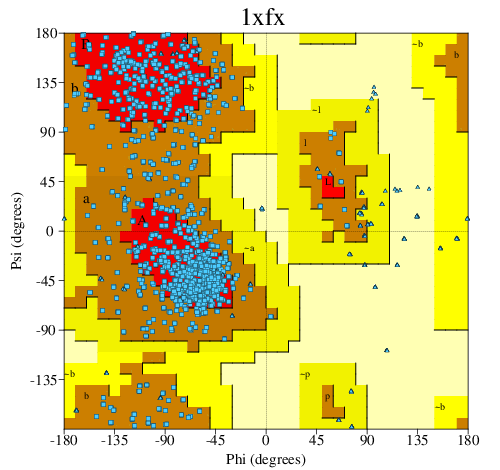
PROCHECK
|
|
|
|
|
|
Headers
|
|
|
|
References
|
|
|
|
|
|
|
|
|
|
|
|
Enzyme class:
|
|
Chains A, B, C, D, E, F:
E.C.4.6.1.1
- adenylate cyclase.
|
|
|
|
|
|
|
Reaction:
|
|
ATP = 3',5'-cyclic AMP + diphosphate
|
|
|
|
|
|
 ATP
ATP
|
=
|
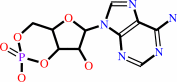 3',5'-cyclic AMP
|
+
|
 diphosphate
|
|
|
|
|
|
|
|
|
|
Cofactor:
|
|
Pyridoxal 5'-phosphate
|
|
|
|
|
|
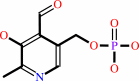 Pyridoxal 5'-phosphate
|
|
|
|
|
|
|
Molecule diagrams generated from .mol files obtained from the
KEGG ftp site
|
|
|
|
|
|
|
|
|
|
|
|
|
|
 |
|
|
|
|
|
|
| |
|
|
| |
|
DOI no:
|
EMBO J
24:929-941
(2005)
|
|
PubMed id:
|
|
|
|
|
|
| |
|
Calcium-independent calmodulin binding and two-metal-ion catalytic mechanism of anthrax edema factor.
|
|
Y.Shen,
N.L.Zhukovskaya,
Q.Guo,
J.Florián,
W.J.Tang.
|
|
|
|
|
| |
ABSTRACT
|
|
|
|
| |
|
|
Edema factor (EF), a key anthrax exotoxin, has an anthrax protective
antigen-binding domain (PABD) and a calmodulin (CaM)-activated adenylyl cyclase
domain. Here, we report the crystal structures of CaM-bound EF, revealing the
architecture of EF PABD. CaM has N- and C-terminal domains and each domain can
bind two calcium ions. Calcium binding induces the conformational change of CaM
from closed to open. Structures of the EF-CaM complex show how EF locks the
N-terminal domain of CaM into a closed conformation regardless of its
calcium-loading state. This represents a mechanism of how CaM effector alters
the calcium affinity of CaM and uncouples the conformational change of CaM from
calcium loading. Furthermore, structures of EF-CaM complexed with nucleotides
show that EF uses two-metal-ion catalysis, a prevalent mechanism in DNA and RNA
polymerases. A histidine (H351) further facilitates the catalysis of EF by
activating a water to deprotonate 3'OH of ATP. Mammalian adenylyl cyclases share
no structural similarity with EF and they also use two-metal-ion catalysis,
suggesting the catalytic mechanism-driven convergent evolution of two
structurally diverse adenylyl cyclases.
|
|
|
|
|
|
| |
Selected figure(s)
|
|
|
|
| |
|
|

|
|

|
|
Figure 1.
Figure 1 Structure of EF -CaM complex. (A) Ribbon diagram of EF
in complex with CaM and that of LF. Catalytic core domain,
helical domain, N-terminal PABD, and C-terminal PABD of EF are
colored in green, yellow, blue, and purple, respectively, and
CaM in red. N-terminal PABD, C-terminal PABD, and protease
domain of LF are in blue, purple and green, respectively. (B)
Comparison of PABDs of EF and LF. The similar secondary
structures of the N-terminal  / /
 sandwich
of PABDs of EF and LF are depicted in blue and dark blue,
respectively, and those of the C-terminal five-helix domain of
PABD of EF and LF are colored in purple and magenta,
respectively. Five loops, L1 -L5, which have significant
differences between EF-PABD and LF-PABD, are colored in cyan and
yellow, respectively. (C) Sequence alignment of PABD of EF and
LF. Identical sequences are colored in yellow and similar
sequences are in green. sandwich
of PABDs of EF and LF are depicted in blue and dark blue,
respectively, and those of the C-terminal five-helix domain of
PABD of EF and LF are colored in purple and magenta,
respectively. Five loops, L1 -L5, which have significant
differences between EF-PABD and LF-PABD, are colored in cyan and
yellow, respectively. (C) Sequence alignment of PABD of EF and
LF. Identical sequences are colored in yellow and similar
sequences are in green.
|
|
Figure 2.
Figure 2 Structures of N-CaM and its interaction with EF. (A)
Structures of N-CaM (red) in EF -CaM complex at 1  M
calcium, 1 mM calcium, 10 mM calcium concentrations in
comparison with the calcium-free N-CaM structure (left, PDB
code: 1CFD) and the crystal structure of four calcium-loaded CaM
(right, PDB code: 1CLL). Calcium ions are colored in orange. (B)
The interaction between N-CaM and the helical domain of EF. The
helical domains of EF and N-CaM of the EF -CaM complex at 10 mM
calcium concentration are colored in yellow and red,
respectively. For comparison, four calcium-loaded CaM is shown
in cyan. (C) Detailed hydrogen bonding and salt bridge formed at
the interface between helices I and II of N-CaM and helices L
and M of EF. M
calcium, 1 mM calcium, 10 mM calcium concentrations in
comparison with the calcium-free N-CaM structure (left, PDB
code: 1CFD) and the crystal structure of four calcium-loaded CaM
(right, PDB code: 1CLL). Calcium ions are colored in orange. (B)
The interaction between N-CaM and the helical domain of EF. The
helical domains of EF and N-CaM of the EF -CaM complex at 10 mM
calcium concentration are colored in yellow and red,
respectively. For comparison, four calcium-loaded CaM is shown
in cyan. (C) Detailed hydrogen bonding and salt bridge formed at
the interface between helices I and II of N-CaM and helices L
and M of EF.
|
|
|
|
|
|
| |
The above figures are
reprinted
from an Open Access publication published by Macmillan Publishers Ltd:
EMBO J
(2005,
24,
929-941)
copyright 2005.
|
|
| |
Figures were
selected
by the author.
|
|
|
|
|
|
|
|
|
|
|
|
|
|
|
|
 |
 |
 |
|
Literature references that cite this PDB file's key reference
|
|
|
| |
PubMed id
|
|
Reference
|
|
|
|
|
|
L.D.Jennings-Antipov,
L.Song,
and
R.J.Collier
(2011).
Interactions of anthrax lethal factor with protective antigen defined by site-directed spin labeling.
|
| |
Proc Natl Acad Sci U S A,
108,
1868-1873.
|
|
|
|
|
|
|
L.Martínez,
T.E.Malliavin,
and
A.Blondel
(2011).
Mechanism of reactant and product dissociation from the anthrax edema factor: A locally enhanced sampling and steered molecular dynamics study.
|
| |
Proteins,
79,
1649-1661.
|
|
|
|
|
|
|
E.Laine,
C.Goncalves,
J.C.Karst,
A.Lesnard,
S.Rault,
W.J.Tang,
T.E.Malliavin,
D.Ladant,
and
A.Blondel
(2010).
Use of allostery to identify inhibitors of calmodulin-induced activation of Bacillus anthracis edema factor.
|
| |
Proc Natl Acad Sci U S A,
107,
11277-11282.
|
|
|
|
|
|
|
I.Zornetta,
L.Brandi,
B.Janowiak,
F.Dal Molin,
F.Tonello,
R.J.Collier,
and
C.Montecucco
(2010).
Imaging the cell entry of the anthrax oedema and lethal toxins with fluorescent protein chimeras.
|
| |
Cell Microbiol,
12,
1435-1445.
|
|
|
|
|
|
|
E.Laine,
A.Blondel,
and
T.E.Malliavin
(2009).
Dynamics and energetics: a consensus analysis of the impact of calcium on EF-CaM protein complex.
|
| |
Biophys J,
96,
1249-1263.
|
|
|
|
|
|
|
H.M.Taha,
J.Schmidt,
M.Göttle,
S.Suryanarayana,
Y.Shen,
W.J.Tang,
A.Gille,
J.Geduhn,
B.König,
S.Dove,
and
R.Seifert
(2009).
Molecular analysis of the interaction of anthrax adenylyl cyclase toxin, edema factor, with 2'(3')-O-(N-(methyl)anthraniloyl)-substituted purine and pyrimidine nucleotides.
|
| |
Mol Pharmacol,
75,
693-703.
|
|
|
|
|
|
|
L.Martínez,
E.Laine,
T.E.Malliavin,
M.Nilges,
and
A.Blondel
(2009).
ATP conformations and ion binding modes in the active site of anthrax edema factor: a computational analysis.
|
| |
Proteins,
77,
971-983.
|
|
|
|
|
|
|
S.Rossi Paccani,
M.Benagiano,
N.Capitani,
I.Zornetta,
D.Ladant,
C.Montecucco,
M.M.D'Elios,
and
C.T.Baldari
(2009).
The adenylate cyclase toxins of Bacillus anthracis and Bordetella pertussis promote Th2 cell development by shaping T cell antigen receptor signaling.
|
| |
PLoS Pathog,
5,
e1000325.
|
|
|
|
|
|
|
W.J.Tang,
and
Q.Guo
(2009).
The adenylyl cyclase activity of anthrax edema factor.
|
| |
Mol Aspects Med,
30,
423-430.
|
|
|
|
|
|
|
Y.Zhou,
W.Yang,
M.M.Lurtz,
Y.Chen,
J.Jiang,
Y.Huang,
C.F.Louis,
and
J.J.Yang
(2009).
Calmodulin mediates the Ca2+-dependent regulation of Cx44 gap junctions.
|
| |
Biophys J,
96,
2832-2848.
|
|
|
|
|
|
|
Z.Chen,
M.Moayeri,
D.Crown,
S.Emerson,
I.Gorshkova,
P.Schuck,
S.H.Leppla,
and
R.H.Purcell
(2009).
Novel chimpanzee/human monoclonal antibodies that neutralize anthrax lethal factor, and evidence for possible synergy with anti-protective antigen antibody.
|
| |
Infect Immun,
77,
3902-3908.
|
|
|
|
|
|
|
D.Chen,
M.Misra,
L.Sower,
J.W.Peterson,
G.E.Kellogg,
and
C.H.Schein
(2008).
Novel inhibitors of anthrax edema factor.
|
| |
Bioorg Med Chem,
16,
7225-7233.
|
|
|
|
|
|
|
E.Laine,
J.D.Yoneda,
A.Blondel,
and
T.E.Malliavin
(2008).
The conformational plasticity of calmodulin upon calcium complexation gives a model of its interaction with the oedema factor of Bacillus anthracis.
|
| |
Proteins,
71,
1813-1829.
|
|
|
|
|
|
|
J.L.Larabee,
K.DeGiusti,
J.L.Regens,
and
J.D.Ballard
(2008).
Bacillus anthracis edema toxin activates nuclear glycogen synthase kinase 3beta.
|
| |
Infect Immun,
76,
4895-4904.
|
|
|
|
|
|
|
Q.Guo,
J.E.Jureller,
J.T.Warren,
E.Solomaha,
J.Florián,
and
W.J.Tang
(2008).
Protein-protein docking and analysis reveal that two homologous bacterial adenylyl cyclase toxins interact with calmodulin differently.
|
| |
J Biol Chem,
283,
23836-23845.
|
|
|
|
|
|
|
D.Chen,
G.Menche,
T.D.Power,
L.Sower,
J.W.Peterson,
and
C.H.Schein
(2007).
Accounting for ligand-bound metal ions in docking small molecules on adenylyl cyclase toxins.
|
| |
Proteins,
67,
593-605.
|
|
|
|
|
|
|
J.Mogridge
(2007).
Defensive strategies of Bacillus anthracis that promote a fatal disease.
|
| |
Drug Discov Today Dis Mech,
4,
253-258.
|
|
|
|
|
|
|
J.T.Warren,
Q.Guo,
and
W.J.Tang
(2007).
A 1.3-A structure of zinc-bound N-terminal domain of calmodulin elucidates potential early ion-binding step.
|
| |
J Mol Biol,
374,
517-527.
|
|
|
PDB code:
|
|
|
|
|
|
|
|
K.Sherer,
Y.Li,
X.Cui,
and
P.Q.Eichacker
(2007).
Lethal and edema toxins in the pathogenesis of Bacillus anthracis septic shock: implications for therapy.
|
| |
Am J Respir Crit Care Med,
175,
211-221.
|
|
|
|
|
|
|
Y.Li,
K.Sherer,
X.Cui,
and
P.Q.Eichacker
(2007).
New insights into the pathogenesis and treatment of anthrax toxin-induced shock.
|
| |
Expert Opin Biol Ther,
7,
843-854.
|
|
|
|
|
|
|
F.Dal Molin,
F.Tonello,
D.Ladant,
I.Zornetta,
I.Zamparo,
G.Di Benedetto,
M.Zaccolo,
and
C.Montecucco
(2006).
Cell entry and cAMP imaging of anthrax edema toxin.
|
| |
EMBO J,
25,
5405-5413.
|
|
|
|
|
|
|
P.Keim,
M.Mock,
J.Young,
and
T.M.Koehler
(2006).
The International Bacillus anthracis, B. cereus, and B. thuringiensis Conference, "Bacillus-ACT05".
|
| |
J Bacteriol,
188,
3433-3441.
|
|
|
|
|
|
|
D.B.Lacy,
H.C.Lin,
R.A.Melnyk,
O.Schueler-Furman,
L.Reither,
K.Cunningham,
D.Baker,
and
R.J.Collier
(2005).
A model of anthrax toxin lethal factor bound to protective antigen.
|
| |
Proc Natl Acad Sci U S A,
102,
16409-16414.
|
|
|
|
|
|
|
Q.Guo,
Y.Shen,
Y.S.Lee,
C.S.Gibbs,
M.Mrksich,
and
W.J.Tang
(2005).
Structural basis for the interaction of Bordetella pertussis adenylyl cyclase toxin with calmodulin.
|
| |
EMBO J,
24,
3190-3201.
|
|
|
PDB codes:
|
|
|
|
|
|
|
The most recent references are shown first.
Citation data come partly from CiteXplore and partly
from an automated harvesting procedure. Note that this is likely to be
only a partial list as not all journals are covered by
either method. However, we are continually building up the citation data
so more and more references will be included with time.
Where a reference describes a PDB structure, the PDB
code is
shown on the right.
|
 |


 Links
Links








