
|
|
|
|
|
 |
Contents |
 |
|
|
|
|
|
|
|
|
|
|
* Residue conservation analysis
|
|
|
|
|
|
|
|
|
|
Enzyme class 1:
|
|
Chains A, B:
E.C.2.7.7.-
- ?????
|
|
|
|
|
|
|
Enzyme class 2:
|
|
Chains A, B:
E.C.2.7.7.49
- RNA-directed Dna polymerase.
|
|
|
|
|
|
|
Reaction:
|
|
DNA(n) + a 2'-deoxyribonucleoside 5'-triphosphate = DNA(n+1) + diphosphate
|
|
|
|
|
|
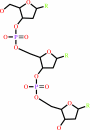 DNA(n)
|
+
|
2'-deoxyribonucleoside 5'-triphosphate
|
=
|
DNA(n+1)
|
+
|
 diphosphate
|
|
|
|
|
|
|
|
|
|
Enzyme class 3:
|
|
Chains A, B:
E.C.2.7.7.7
- DNA-directed Dna polymerase.
|
|
|
|
|
|
|
Reaction:
|
|
DNA(n) + a 2'-deoxyribonucleoside 5'-triphosphate = DNA(n+1) + diphosphate
|
|
|
|
|
|
DNA(n)
|
+
|
2'-deoxyribonucleoside 5'-triphosphate
|
=
|
DNA(n+1)
|
+
|
diphosphate
|
|
|
|
|
|
|
|
|
|
Enzyme class 4:
|
|
Chains A, B:
E.C.3.1.-.-
|
|
|
|
|
|
|
Enzyme class 5:
|
|
Chains A, B:
E.C.3.1.13.2
- exoribonuclease H.
|
|
|
|
|
|
|
Reaction:
|
|
Exonucleolytic cleavage to 5'-phosphomonoester oligonucleotides in both 5'- to 3'- and 3'- to 5'-directions.
|
|
|
|
|
|
Enzyme class 6:
|
|
Chains A, B:
E.C.3.1.26.13
- retroviral ribonuclease H.
|
|
|
|
|
|
|
Enzyme class 7:
|
|
Chains A, B:
E.C.3.4.23.16
- HIV-1 retropepsin.
|
|
|
|
|
|
|
Reaction:
|
|
Specific for a P1 residue that is hydrophobic, and P1' variable, but often Pro.
|
|
|
|
|
|
|
|
|
Note, where more than one E.C. class is given (as above), each may
correspond to a different protein domain or, in the case of polyprotein
precursors, to a different mature protein.
|
|
|
|
Molecule diagrams generated from .mol files obtained from the
KEGG ftp site
|
|
|
|
|
|
|
|
|
|
|
|
|
|
 |
|
|
|
|
|
|
| |
|
|
| |
|
DOI no:
|
Proc Natl Acad Sci U S A
95:9518-9523
(1998)
|
|
PubMed id:
|
|
|
|
|
|
| |
|
3'-Azido-3'-deoxythymidine drug resistance mutations in HIV-1 reverse transcriptase can induce long range conformational changes.
|
|
J.Ren,
R.M.Esnouf,
A.L.Hopkins,
E.Y.Jones,
I.Kirby,
J.Keeling,
C.K.Ross,
B.A.Larder,
D.I.Stuart,
D.K.Stammers.
|
|
|
|
|
| |
ABSTRACT
|
|
|
|
| |
|
|
HIV reverse transcriptase (RT) is one of the main targets for the action of
anti-AIDS drugs. Many of these drugs [e.g., 3'-azido-3'-deoxythymidine (AZT) and
2',3'-dideoxyinosine (ddI)] are analogues of the nucleoside substrates used by
the HIV RT. One of the main problems in anti-HIV therapy is the selection of a
mutant virus with reduced drug sensitivity. Drug resistance in HIV is generated
for nucleoside analogue inhibitors by mutations in HIV RT. However, most of
these mutations are situated some distance from the polymerase active site,
giving rise to questions concerning the mechanism of resistance. To understand
the possible structural bases for this, the crystal structures of AZT- and
ddI-resistant RTs have been determined. For the ddI-resistant RT with a mutation
at residue 74, no significant conformational changes were observed for the p66
subunit. In contrast, for the AZT-resistant RT (RTMC) bearing four mutations,
two of these (at 215 and 219) give rise to a conformational change that
propagates to the active site aspartate residues. Thus, these drug resistance
mutations produce an effect at the RT polymerase site mediated simply by the
protein. It is likely that such long-range effects could represent a common
mechanism for generating drug resistance in other systems.
|
|
|
|
|
|
| |
Selected figure(s)
|
|
|
|
| |
|
|

|
|

|
|
Figure 1.
Fig. 1. Overall structure and drug resistance mutation
sites of the RT heterodimer. (Top) The p66 subunit is drawn in
dark gray and p51 in light gray. NI resistance mutation sites
(26) are shown as green spheres, with RTMC and L74V sites
highlighted in yellow. In the p51 subunit, residues 215 and 219
are disordered; their positions are not shown. NNI resistance
mutation sites (27) are shown as blue spheres. The three
polymerase active site aspartate residues and the bound NNI are
shown in red and magenta, respectively. Double-stranded DNA
(shown as a spiral ladder with the template strand in green and
the primer in red) was modeled into our RT-nevirapine structure
(6) from the C  and
phosphate coordinates of the RT-DNA-Fab complex (5) by
superimposing the p66 palm domain of the two structures.
(Bottom) A close-up view of the polymerase active site and the
drug resistance mutation sites in the p66 subunit. The coloring
scheme is the same as in the top panel; however, the side chains
for mutated residues are shown in ball-and-stick representation
and the van der Waals surface for the bound NNI (nevirapine) is
shown semitransparent. and
phosphate coordinates of the RT-DNA-Fab complex (5) by
superimposing the p66 palm domain of the two structures.
(Bottom) A close-up view of the polymerase active site and the
drug resistance mutation sites in the p66 subunit. The coloring
scheme is the same as in the top panel; however, the side chains
for mutated residues are shown in ball-and-stick representation
and the van der Waals surface for the bound NNI (nevirapine) is
shown semitransparent.
|
|
Figure 3.
Fig. 3. The NNI binding site and polymerase active site.
(a) A stereodiagram showing the superposition of the NNI binding
site in RTMC and wild-type RT. The protein backbone is shown by
thin sticks. The NNIs (thick bonds) and side chains that have
contacts with the NNIs are shown as ball-and-stick
representations. The RTMC is colored in green with residue 181
and the bound 1051U91 highlighted in red. The wild-type RT is
colored in blue with residue 181 and bound 1051U91 highlighted
in yellow. (b) A stereodiagram of the superposition of the
active sites in RTMC (green), the wild type unliganded (red),
and six NNI-bound RT structures (blue for RT-1051U91, gray for
others) showing the structural changes at the active site in
RTMC caused by 215 and 219 mutations. The C trace and
side chains for residues 110, 185, 186, 215, and 219 are shown
for RTMC, wild-type unliganded RT, and RT-1051U91; the C traces only
are shown for RT-Cl-TIBO, RT-BHAP, RT-nevirapine, RT-MKC-442,
and RT- -APA. In
the p51 subunit, residues 215 and 219 are disordered whereas
residues 67 and 70 do not show significant rearrangement from
the wild-type p51.
|
|
|
|
| |
Figures were
selected
by an automated process.
|
|
|
|
|
|
|
|
|
|
|
|
|
|
|
|
 |
 |
 |
|
Literature references that cite this PDB file's key reference
|
|
|
| |
PubMed id
|
|
Reference
|
|
|
|
|
|
W.Li,
Y.Chang,
P.Zhan,
N.Zhang,
X.Liu,
C.Pannecouque,
and
E.De Clercq
(2010).
Synthesis, in vitro and in vivo release kinetics, and anti-HIV activity of a sustained-release prodrug (mPEG-AZT) of 3'-azido-3'-deoxythymidine (AZT, Zidovudine).
|
| |
ChemMedChem,
5,
1893-1898.
|
|
|
|
|
|
|
L.R.Miranda,
M.Götte,
F.Liang,
and
D.R.Kuritzkes
(2005).
The L74V mutation in human immunodeficiency virus type 1 reverse transcriptase counteracts enhanced excision of zidovudine monophosphate associated with thymidine analog resistance mutations.
|
| |
Antimicrob Agents Chemother,
49,
2648-2656.
|
|
|
|
|
|
|
N.Yahi,
J.Fantini,
M.Henry,
C.Tourrès,
and
C.Tamalet
(2005).
Structural analysis of reverse transcriptase mutations at codon 215 explains the predominance of T215Y over T215F in HIV-1 variants selected under antiretroviral therapy.
|
| |
J Biomed Sci,
12,
701-710.
|
|
|
|
|
|
|
G.Tachedjian,
and
A.Mijch
(2004).
Virological significance, prevalence and genetic basis of hypersusceptibility to nonnucleoside reverse transcriptase inhibitors.
|
| |
Sex Health,
1,
81-89.
|
|
|
|
|
|
|
J.D.Pata,
W.G.Stirtan,
S.W.Goldstein,
and
T.A.Steitz
(2004).
Structure of HIV-1 reverse transcriptase bound to an inhibitor active against mutant reverse transcriptases resistant to other nonnucleoside inhibitors.
|
| |
Proc Natl Acad Sci U S A,
101,
10548-10553.
|
|
|
PDB code:
|
|
|
|
|
|
|
|
D.A.Katzenstein,
R.J.Bosch,
N.Hellmann,
N.Wang,
L.Bacheler,
and
M.A.Albrecht
(2003).
Phenotypic susceptibility and virological outcome in nucleoside-experienced patients receiving three or four antiretroviral drugs.
|
| |
AIDS,
17,
821-830.
|
|
|
|
|
|
|
M.S.Hirsch,
F.Brun-Vézinet,
B.Clotet,
B.Conway,
D.R.Kuritzkes,
R.T.D'Aquila,
L.M.Demeter,
S.M.Hammer,
V.A.Johnson,
C.Loveday,
J.W.Mellors,
D.M.Jacobsen,
and
D.D.Richman
(2003).
Antiretroviral drug resistance testing in adults infected with human immunodeficiency virus type 1: 2003 recommendations of an International AIDS Society-USA Panel.
|
| |
Clin Infect Dis,
37,
113-128.
|
|
|
|
|
|
|
P.L.Boyer,
S.G.Sarafianos,
E.Arnold,
and
S.H.Hughes
(2002).
Nucleoside analog resistance caused by insertions in the fingers of human immunodeficiency virus type 1 reverse transcriptase involves ATP-mediated excision.
|
| |
J Virol,
76,
9143-9151.
|
|
|
|
|
|
|
P.P.Chamberlain,
J.Ren,
C.E.Nichols,
L.Douglas,
J.Lennerstrand,
B.A.Larder,
D.I.Stuart,
and
D.K.Stammers
(2002).
Crystal structures of Zidovudine- or Lamivudine-resistant human immunodeficiency virus type 1 reverse transcriptases containing mutations at codons 41, 184, and 215.
|
| |
J Virol,
76,
10015-10019.
|
|
|
PDB codes:
|
|
|
|
|
|
|
|
P.R.Meyer,
S.E.Matsuura,
A.A.Tolun,
I.Pfeifer,
A.G.So,
J.W.Mellors,
and
W.A.Scott
(2002).
Effects of specific zidovudine resistance mutations and substrate structure on nucleotide-dependent primer unblocking by human immunodeficiency virus type 1 reverse transcriptase.
|
| |
Antimicrob Agents Chemother,
46,
1540-1545.
|
|
|
|
|
|
|
R.W.Shafer
(2002).
Genotypic testing for human immunodeficiency virus type 1 drug resistance.
|
| |
Clin Microbiol Rev,
15,
247-277.
|
|
|
|
|
|
|
N.Koch,
N.Yahi,
J.Fantini,
and
C.Tamalet
(2001).
Mutations in HIV-1 gag cleavage sites and their association with protease mutations.
|
| |
AIDS,
15,
526-528.
|
|
|
|
|
|
|
A.Mas,
M.Parera,
C.Briones,
V.Soriano,
M.A.Martínez,
E.Domingo,
and
L.Menéndez-Arias
(2000).
Role of a dipeptide insertion between codons 69 and 70 of HIV-1 reverse transcriptase in the mechanism of AZT resistance.
|
| |
EMBO J,
19,
5752-5761.
|
|
|
|
|
|
|
J.Ren,
J.Milton,
K.L.Weaver,
S.A.Short,
D.I.Stuart,
and
D.K.Stammers
(2000).
Structural basis for the resilience of efavirenz (DMP-266) to drug resistance mutations in HIV-1 reverse transcriptase.
|
| |
Structure,
8,
1089-1094.
|
|
|
PDB codes:
|
|
|
|
|
|
|
|
Q.Meng,
D.M.Walker,
O.A.Olivero,
X.Shi,
B.B.Antiochos,
M.C.Poirier,
and
V.E.Walker
(2000).
Zidovudine-didanosine coexposure potentiates DNA incorporation of zidovudine and mutagenesis in human cells.
|
| |
Proc Natl Acad Sci U S A,
97,
12667-12671.
|
|
|
|
|
|
|
B.A.Larder,
S.Bloor,
S.D.Kemp,
K.Hertogs,
R.L.Desmet,
V.Miller,
M.Sturmer,
S.Staszewski,
J.Ren,
D.K.Stammers,
D.I.Stuart,
and
R.Pauwels
(1999).
A family of insertion mutations between codons 67 and 70 of human immunodeficiency virus type 1 reverse transcriptase confer multinucleoside analog resistance.
|
| |
Antimicrob Agents Chemother,
43,
1961-1967.
|
|
|
|
|
|
|
P.R.Meyer,
S.E.Matsuura,
A.M.Mian,
A.G.So,
and
W.A.Scott
(1999).
A mechanism of AZT resistance: an increase in nucleotide-dependent primer unblocking by mutant HIV-1 reverse transcriptase.
|
| |
Mol Cell,
4,
35-43.
|
|
|
|
|
|
The most recent references are shown first.
Citation data come partly from CiteXplore and partly
from an automated harvesting procedure. Note that this is likely to be
only a partial list as not all journals are covered by
either method. However, we are continually building up the citation data
so more and more references will be included with time.
Where a reference describes a PDB structure, the PDB
code is
shown on the right.
|
 |


 Links
Links


