
|
|
|
|
|
 |
Contents |
 |
|
|
|
|
|
|
|
|
|
|
* Residue conservation analysis
|
|
|
|
|
|
|
|
|
|
Enzyme class 1:
|
|
Chains A, B:
E.C.2.7.7.-
- ?????
|
|
|
|
|
|
|
Enzyme class 2:
|
|
Chains A, B:
E.C.2.7.7.49
- RNA-directed Dna polymerase.
|
|
|
|
|
|
|
Reaction:
|
|
DNA(n) + a 2'-deoxyribonucleoside 5'-triphosphate = DNA(n+1) + diphosphate
|
|
|
|
|
|
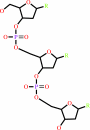 DNA(n)
|
+
|
2'-deoxyribonucleoside 5'-triphosphate
|
=
|
DNA(n+1)
|
+
|
 diphosphate
|
|
|
|
|
|
|
|
|
|
Enzyme class 3:
|
|
Chains A, B:
E.C.2.7.7.7
- DNA-directed Dna polymerase.
|
|
|
|
|
|
|
Reaction:
|
|
DNA(n) + a 2'-deoxyribonucleoside 5'-triphosphate = DNA(n+1) + diphosphate
|
|
|
|
|
|
DNA(n)
|
+
|
2'-deoxyribonucleoside 5'-triphosphate
|
=
|
DNA(n+1)
|
+
|
diphosphate
|
|
|
|
|
|
|
|
|
|
Enzyme class 4:
|
|
Chains A, B:
E.C.3.1.-.-
|
|
|
|
|
|
|
Enzyme class 5:
|
|
Chains A, B:
E.C.3.1.13.2
- exoribonuclease H.
|
|
|
|
|
|
|
Reaction:
|
|
Exonucleolytic cleavage to 5'-phosphomonoester oligonucleotides in both 5'- to 3'- and 3'- to 5'-directions.
|
|
|
|
|
|
Enzyme class 6:
|
|
Chains A, B:
E.C.3.1.26.13
- retroviral ribonuclease H.
|
|
|
|
|
|
|
Enzyme class 7:
|
|
Chains A, B:
E.C.3.4.23.16
- HIV-1 retropepsin.
|
|
|
|
|
|
|
Reaction:
|
|
Specific for a P1 residue that is hydrophobic, and P1' variable, but often Pro.
|
|
|
|
|
|
|
|
|
Note, where more than one E.C. class is given (as above), each may
correspond to a different protein domain or, in the case of polyprotein
precursors, to a different mature protein.
|
|
|
|
Molecule diagrams generated from .mol files obtained from the
KEGG ftp site
|
|
|
|
|
|
|
|
|
|
|
|
|
|
 |
|
|
|
|
|
|
| |
|
|
| |
|
DOI no:
|
Structure
8:1089-1094
(2000)
|
|
PubMed id:
|
|
|
|
|
|
| |
|
Structural basis for the resilience of efavirenz (DMP-266) to drug resistance mutations in HIV-1 reverse transcriptase.
|
|
J.Ren,
J.Milton,
K.L.Weaver,
S.A.Short,
D.I.Stuart,
D.K.Stammers.
|
|
|
|
|
| |
ABSTRACT
|
|
|
|
| |
|
|
BACKGROUND: Efavirenz is a second-generation non-nucleoside inhibitor of HIV-1
reverse transcriptase (RT) that has recently been approved for use against HIV-1
infection. Compared with first-generation drugs such as nevirapine, efavirenz
shows greater resilience to drug resistance mutations within HIV-1 RT. In order
to understand the basis for this resilience at the molecular level and to help
the design of further-improved anti-AIDS drugs, we have determined crystal
structures of efavirenz and nevirapine with wild-type RT and the clinically
important K103N mutant. RESULTS: The relatively compact efavirenz molecule
binds, as expected, within the non-nucleoside inhibitor binding pocket of RT.
There are significant rearrangements of the drug binding site within the mutant
RT compared with the wild-type enzyme. These changes, which lead to the
repositioning of the inhibitor, are not seen in the interaction with the
first-generation drug nevirapine. CONCLUSIONS: The repositioning of efavirenz
within the drug binding pocket of the mutant RT, together with conformational
rearrangements in the protein, could represent a general mechanism whereby
certain second-generation non-nucleoside inhibitors are able to reduce the
effect of drug-resistance mutations on binding potency.
|
|
|
|
|
|
| |
Selected figure(s)
|
|
|
|
| |
|
|

|
|
Figure 2.
Figure 2. Omit MapsSimulated-annealing omit electron
density maps for the inhibitors and certain sidechains: (a)
efavirenz-RT(wild-type); (b) efavirenz-RT(K103N), Asn103, and
Tyr181; (c) nevirapine-RT(K103N) and Asn103. The maps are
contoured at 4s

|
|
|
|
|
|
| |
The above figure is
reprinted
by permission from Cell Press:
Structure
(2000,
8,
1089-1094)
copyright 2000.
|
|
| |
Figure was
selected
by an automated process.
|
|
|
|
|
|
|
|
|
|
|
|
|
|
|
|
 |
 |
 |
|
Literature references that cite this PDB file's key reference
|
|
|
| |
PubMed id
|
|
Reference
|
|
|
|
|
|
M.Lapkouski,
L.Tian,
J.T.Miller,
S.F.Le Grice,
and
W.Yang
(2013).
Complexes of HIV-1 RT, NNRTI and RNA/DNA hybrid reveal a structure compatible with RNA degradation.
|
| |
Nat Struct Mol Biol,
20,
230-236.
|
|
|
PDB codes:
|
|
|
|
|
|
|
|
P.Decha,
P.Intharathep,
T.Udommaneethanakit,
P.Sompornpisut,
S.Hannongbua,
P.Wolschann,
and
V.Parasuk
(2011).
Theoretical studies on the molecular basis of HIV-1RT/NNRTIs interactions.
|
| |
J Enzyme Inhib Med Chem,
26,
29-36.
|
|
|
|
|
|
|
S.Ibe,
and
W.Sugiura
(2011).
Clinical significance of HIV reverse-transcriptase inhibitor-resistance mutations.
|
| |
Future Microbiol,
6,
295-315.
|
|
|
|
|
|
|
A.G.Marcelin,
P.Flandre,
D.Descamps,
L.Morand-Joubert,
C.Charpentier,
J.Izopet,
M.A.Trabaud,
H.Saoudin,
C.Delaugerre,
C.Tamalet,
J.Cottalorda,
M.Bouvier-Alias,
D.Bettinger,
G.Dos Santos,
A.Ruffault,
C.Alloui,
C.Henquell,
S.Rogez,
F.Barin,
A.Signori-Schmuck,
S.Vallet,
B.Masquelier,
V.Calvez,
C.Alloui,
D.Bettinger,
G.Anies,
B.Masquelier,
S.Vallet,
C.Henquell,
M.Bouvier-Alias,
G.Dos Santos,
A.Signori-Schmuck,
S.Rogez,
P.Andre,
J.C.Tardy,
M.A.Trabaud,
C.Tamalet,
B.Montes,
J.Cottalorda,
D.Descamps,
F.Brun-Vézinet,
C.Charpentier,
M.L.Chaix,
S.Fourati,
A.G.Marcelin,
V.Calvez,
P.Flandre,
L.Morand-Joubert,
C.Delaugerre,
A.Ruffault,
A.Maillard,
T.Bourlet,
H.Saoudin,
J.Izopet,
F.Barin,
O.Bouchaud,
B.Hoen,
M.Dupon,
P.Morlat,
D.Neau,
M.Garré,
V.Bellein,
C.Jacomet,
Y.Lévy,
S.Dominguez,
A.Cabié,
P.Leclercq,
P.Weinbreck,
L.Cotte,
I.Poizot-Martin,
I.Ravaud,
J.Reynes,
P.Dellamonica,
P.Yeni,
R.Landman,
L.Weiss,
C.Piketty,
J.P.Viard,
C.Katlama,
A.Simon,
P.M.Girard,
J.L.Meynard,
J.M.Molina,
M.T.Goeger-Sow,
I.Lamaury,
C.Michelet,
F.Lucht,
B.Marchou,
P.Massip,
and
J.M.Besnier
(2010).
Factors associated with virological response to etravirine in nonnucleoside reverse transcriptase inhibitor-experienced HIV-1-infected patients.
|
| |
Antimicrob Agents Chemother,
54,
72-77.
|
|
|
|
|
|
|
K.Singh,
B.Marchand,
K.A.Kirby,
E.Michailidis,
and
S.G.Sarafianos
(2010).
Structural Aspects of Drug Resistance and Inhibition of HIV-1 Reverse Transcriptase.
|
| |
Viruses,
2,
606-638.
|
|
|
|
|
|
|
M.E.Abram,
S.G.Sarafianos,
and
M.A.Parniak
(2010).
The mutation T477A in HIV-1 reverse transcriptase (RT) restores normal proteolytic processing of RT in virus with Gag-Pol mutated in the p51-RNH cleavage site.
|
| |
Retrovirology,
7,
6.
|
|
|
|
|
|
|
R.Sakuma,
T.Sakuma,
S.Ohmine,
R.H.Silverman,
and
Y.Ikeda
(2010).
Xenotropic murine leukemia virus-related virus is susceptible to AZT.
|
| |
Virology,
397,
1-6.
|
|
|
|
|
|
|
V.A.Braz,
L.A.Holladay,
and
M.D.Barkley
(2010).
Efavirenz binding to HIV-1 reverse transcriptase monomers and dimers.
|
| |
Biochemistry,
49,
601-610.
|
|
|
|
|
|
|
A.Carta,
S.Pricl,
S.Piras,
M.Fermeglia,
P.La Colla,
and
R.Loddo
(2009).
Activity and molecular modeling of a new small molecule active against NNRTI-resistant HIV-1 mutants.
|
| |
Eur J Med Chem,
44,
5117-5122.
|
|
|
|
|
|
|
S.E.Nichols,
R.A.Domaoal,
V.V.Thakur,
J.Tirado-Rives,
K.S.Anderson,
and
W.L.Jorgensen
(2009).
Discovery of wild-type and Y181C mutant non-nucleoside HIV-1 reverse transcriptase inhibitors using virtual screening with multiple protein structures.
|
| |
J Chem Inf Model,
49,
1272-1279.
|
|
|
|
|
|
|
Y.M.Loksha,
E.B.Pedersen,
R.Loddo,
and
P.La Colla
(2009).
Synthesis and anti-HIV-1 activity of 1-substiuted 6-(3-cyanobenzoyl) and [(3-cyanophenyl)fluoromethyl]-5-ethyl-uracils.
|
| |
Arch Pharm (Weinheim),
342,
501-506.
|
|
|
|
|
|
|
K.Deforche,
R.J.Camacho,
Z.Grossman,
M.A.Soares,
K.Van Laethem,
D.A.Katzenstein,
P.R.Harrigan,
R.Kantor,
R.Shafer,
A.M.Vandamme,
R.Kantor,
D.A.Katzenstein,
R.W.Shafer,
R.J.Camacho,
A.P.Carvalho,
B.Wynhoven,
P.R.Harrigan,
P.Cane,
J.Clarke,
J.Weber,
S.Sirivichayakul,
P.Phanuphak,
M.A.Soares,
A.Tanuri,
J.Snoeck,
A.M.Vandamme,
L.Morris,
H.Rudich,
Z.Grossman,
J.M.Schapiro,
R.Rodrigues,
L.F.Brigido,
A.Holguin,
V.Soriano,
K.Ariyoshi,
W.Sugiura,
M.B.Bouzas,
P.Cahn,
D.Pillay,
T.L.Katzenstein,
and
L.B.Jørgensen
(2008).
Bayesian network analyses of resistance pathways against efavirenz and nevirapine.
|
| |
AIDS,
22,
2107-2115.
|
|
|
|
|
|
|
P.Srivab,
and
S.Hannongbua
(2008).
A study of the binding energies of efavirenz to wild-type and K103N/Y181C HIV-1 reverse transcriptase based on the ONIOM method.
|
| |
ChemMedChem,
3,
803-811.
|
|
|
|
|
|
|
G.Barreiro,
C.R.Guimarães,
I.Tubert-Brohman,
T.M.Lyons,
J.Tirado-Rives,
and
W.L.Jorgensen
(2007).
Search for non-nucleoside inhibitors of HIV-1 reverse transcriptase using chemical similarity, molecular docking, and MM-GB/SA scoring.
|
| |
J Chem Inf Model,
47,
2416-2428.
|
|
|
|
|
|
|
R.K.Rawal,
A.Kumar,
M.I.Siddiqi,
and
S.B.Katti
(2007).
Molecular docking studies on 4-thiazolidinones as HIV-1 RT inhibitors.
|
| |
J Mol Model,
13,
155-161.
|
|
|
|
|
|
|
Y.El Safadi,
V.Vivet-Boudou,
and
R.Marquet
(2007).
HIV-1 reverse transcriptase inhibitors.
|
| |
Appl Microbiol Biotechnol,
75,
723-737.
|
|
|
|
|
|
|
Z.Zhang,
W.Xu,
Y.H.Koh,
J.H.Shim,
J.L.Girardet,
L.T.Yeh,
R.K.Hamatake,
and
Z.Hong
(2007).
A novel nonnucleoside analogue that inhibits human immunodeficiency virus type 1 isolates resistant to current nonnucleoside reverse transcriptase inhibitors.
|
| |
Antimicrob Agents Chemother,
51,
429-437.
|
|
|
|
|
|
|
J.Ren,
C.E.Nichols,
A.Stamp,
P.P.Chamberlain,
R.Ferris,
K.L.Weaver,
S.A.Short,
and
D.K.Stammers
(2006).
Structural insights into mechanisms of non-nucleoside drug resistance for HIV-1 reverse transcriptases mutated at codons 101 or 138.
|
| |
FEBS J,
273,
3850-3860.
|
|
|
PDB codes:
|
|
|
|
|
|
|
|
T.Billard
(2006).
Synthetic applications of beta-fluoroalkylated alpha,beta-unsaturated carbonyl compounds.
|
| |
Chemistry,
12,
974-979.
|
|
|
|
|
|
|
T.Maruyama,
S.Kozai,
Y.Demizu,
M.Witvrouw,
C.Pannecouque,
J.Balzarini,
R.Snoecks,
G.Andrei,
and
E.De Clercq
(2006).
Synthesis and anti-HIV-1 and anti-HCMV activity of 1-substituted 3-(3,5-dimethylbenzyl)uracil derivatives.
|
| |
Chem Pharm Bull (Tokyo),
54,
325-333.
|
|
|
|
|
|
|
Z.Zhang,
M.Zheng,
L.Du,
J.Shen,
X.Luo,
W.Zhu,
and
H.Jiang
(2006).
Towards discovering dual functional inhibitors against both wild type and K103N mutant HIV-1 reverse transcriptases: molecular docking and QSAR studies on 4,1-benzoxazepinone analogues.
|
| |
J Comput Aided Mol Des,
20,
281-293.
|
|
|
|
|
|
|
I.Oz Gleenberg,
O.Avidan,
Y.Goldgur,
A.Herschhorn,
and
A.Hizi
(2005).
Peptides derived from the reverse transcriptase of human immunodeficiency virus type 1 as novel inhibitors of the viral integrase.
|
| |
J Biol Chem,
280,
21987-21996.
|
|
|
|
|
|
|
J.L.Medina-Franco,
A.Golbraikh,
S.Oloff,
R.Castillo,
and
A.Tropsha
(2005).
Quantitative structure-activity relationship analysis of pyridinone HIV-1 reverse transcriptase inhibitors using the k nearest neighbor method and QSAR-based database mining.
|
| |
J Comput Aided Mol Des,
19,
229-242.
|
|
|
|
|
|
|
S.Roussel,
T.Billard,
B.R.Langlois,
and
L.Saint-James
(2005).
Towards enantioselective nucleophilic trifluoromethylation.
|
| |
Chemistry,
11,
939-944.
|
|
|
|
|
|
|
W.L.Jorgensen,
and
J.Tirado-Rives
(2005).
Molecular modeling of organic and biomolecular systems using BOSS and MCPRO.
|
| |
J Comput Chem,
26,
1689-1700.
|
|
|
|
|
|
|
X.He,
Y.Mei,
Y.Xiang,
D.W.Zhang,
and
J.Z.Zhang
(2005).
Quantum computational analysis for drug resistance of HIV-1 reverse transcriptase to nevirapine through point mutations.
|
| |
Proteins,
61,
423-432.
|
|
|
|
|
|
|
Y.Mei,
X.He,
Y.Xiang,
D.W.Zhang,
and
J.Z.Zhang
(2005).
Quantum study of mutational effect in binding of efavirenz to HIV-1 RT.
|
| |
Proteins,
59,
489-495.
|
|
|
|
|
|
|
F.Daeyaert,
M.de Jonge,
J.Heeres,
L.Koymans,
P.Lewi,
M.H.Vinkers,
and
P.A.Janssen
(2004).
A pharmacophore docking algorithm and its application to the cross-docking of 18 HIV-NNRTI's in their binding pockets.
|
| |
Proteins,
54,
526-533.
|
|
|
|
|
|
|
J.A.Olsen,
D.W.Banner,
P.Seiler,
B.Wagner,
T.Tschopp,
U.Obst-Sander,
M.Kansy,
K.Müller,
and
F.Diederich
(2004).
Fluorine interactions at the thrombin active site: protein backbone fragments H-C(alpha)-C=O comprise a favorable C-F environment and interactions of C-F with electrophiles.
|
| |
Chembiochem,
5,
666-675.
|
|
|
|
|
|
|
N.Sluis-Cremer,
N.A.Temiz,
and
I.Bahar
(2004).
Conformational changes in HIV-1 reverse transcriptase induced by nonnucleoside reverse transcriptase inhibitor binding.
|
| |
Curr HIV Res,
2,
323-332.
|
|
|
|
|
|
|
J.A.Turpin
(2003).
The next generation of HIV/AIDS drugs: novel and developmental antiHIV drugs and targets.
|
| |
Expert Rev Anti Infect Ther,
1,
97.
|
|
|
|
|
|
|
J.Lindberg,
S.Sigurdsson,
S.Löwgren,
H.O.Andersson,
C.Sahlberg,
R.Noréen,
K.Fridborg,
H.Zhang,
and
T.Unge
(2002).
Structural basis for the inhibitory efficacy of efavirenz (DMP-266), MSC194 and PNU142721 towards the HIV-1 RT K103N mutant.
|
| |
Eur J Biochem,
269,
1670-1677.
|
|
|
PDB codes:
|
|
|
|
|
|
|
|
J.Ren,
L.E.Bird,
P.P.Chamberlain,
G.B.Stewart-Jones,
D.I.Stuart,
and
D.K.Stammers
(2002).
Structure of HIV-2 reverse transcriptase at 2.35-A resolution and the mechanism of resistance to non-nucleoside inhibitors.
|
| |
Proc Natl Acad Sci U S A,
99,
14410-14415.
|
|
|
PDB code:
|
|
|
|
|
|
|
|
G.Tachedjian,
M.Orlova,
S.G.Sarafianos,
E.Arnold,
and
S.P.Goff
(2001).
Nonnucleoside reverse transcriptase inhibitors are chemical enhancers of dimerization of the HIV type 1 reverse transcriptase.
|
| |
Proc Natl Acad Sci U S A,
98,
7188-7193.
|
|
|
|
|
|
The most recent references are shown first.
Citation data come partly from CiteXplore and partly
from an automated harvesting procedure. Note that this is likely to be
only a partial list as not all journals are covered by
either method. However, we are continually building up the citation data
so more and more references will be included with time.
Where a reference describes a PDB structure, the PDB
codes are
shown on the right.
|
 |


 Links
Links


