
|
|
|
|
|
 |
Contents |
 |
|
|
|
|
|
|
|
|
|
|
|
|
* Residue conservation analysis
|
|
|
|
|
|
|
|
|
|
Enzyme class 1:
|
|
Chains A, B:
E.C.2.7.7.-
- ?????
|
|
|
|
|
|
|
Enzyme class 2:
|
|
Chains A, B:
E.C.2.7.7.49
- RNA-directed Dna polymerase.
|
|
|
|
|
|
|
Reaction:
|
|
DNA(n) + a 2'-deoxyribonucleoside 5'-triphosphate = DNA(n+1) + diphosphate
|
|
|
|
|
|
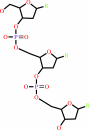 DNA(n)
|
+
|
2'-deoxyribonucleoside 5'-triphosphate
|
=
|
DNA(n+1)
Bound ligand (Het Group name = )
matches with 55.56% similarity
|
+
|
 diphosphate
|
|
|
|
|
|
|
|
|
|
Enzyme class 3:
|
|
Chains A, B:
E.C.2.7.7.7
- DNA-directed Dna polymerase.
|
|
|
|
|
|
|
Reaction:
|
|
DNA(n) + a 2'-deoxyribonucleoside 5'-triphosphate = DNA(n+1) + diphosphate
|
|
|
|
|
|
DNA(n)
|
+
|
2'-deoxyribonucleoside 5'-triphosphate
|
=
|
DNA(n+1)
Bound ligand (Het Group name = )
matches with 55.56% similarity
|
+
|
diphosphate
|
|
|
|
|
|
|
|
|
|
Enzyme class 4:
|
|
Chains A, B:
E.C.3.1.-.-
|
|
|
|
|
|
|
Enzyme class 5:
|
|
Chains A, B:
E.C.3.1.13.2
- exoribonuclease H.
|
|
|
|
|
|
|
Reaction:
|
|
Exonucleolytic cleavage to 5'-phosphomonoester oligonucleotides in both 5'- to 3'- and 3'- to 5'-directions.
|
|
|
|
|
|
Enzyme class 6:
|
|
Chains A, B:
E.C.3.1.26.13
- retroviral ribonuclease H.
|
|
|
|
|
|
|
Enzyme class 7:
|
|
Chains A, B:
E.C.3.4.23.16
- HIV-1 retropepsin.
|
|
|
|
|
|
|
Reaction:
|
|
Specific for a P1 residue that is hydrophobic, and P1' variable, but often Pro.
|
|
|
|
|
|
|
|
|
Note, where more than one E.C. class is given (as above), each may
correspond to a different protein domain or, in the case of polyprotein
precursors, to a different mature protein.
|
|
|
|
Molecule diagrams generated from .mol files obtained from the
KEGG ftp site
|
|
|
|
|
|
|
|
|
|
|
|
|
|
 |
|
|
|
|
|
|
| |
|
|
| |
|
|
J Virol
76:10015-10019
(2002)
|
|
PubMed id:
|
|
|
|
|
|
| |
|
Crystal structures of Zidovudine- or Lamivudine-resistant human immunodeficiency virus type 1 reverse transcriptases containing mutations at codons 41, 184, and 215.
|
|
P.P.Chamberlain,
J.Ren,
C.E.Nichols,
L.Douglas,
J.Lennerstrand,
B.A.Larder,
D.I.Stuart,
D.K.Stammers.
|
|
|
|
|
| |
ABSTRACT
|
|
|
|
| |
|
|
Six structures of human immunodeficiency virus type 1 (HIV-1) reverse
transcriptase (RT) containing combinations of resistance mutations for
zidovudine (AZT) (M41L and T215Y) or lamivudine (M184V) have been determined as
inhibitor complexes. Minimal conformational changes in the polymerase or
nonnucleoside RT inhibitor sites compared to the mutant RTMC (D67N, K70R, T215F,
and K219N) are observed, indicating that such changes may occur only with
certain combinations of mutations. Model building M41L and T215Y into HIV-1
RT-DNA and docking in ATP that is utilized in the pyrophosphorolysis reaction
for AZT resistance indicates that some conformational rearrangement appears
necessary in RT for ATP to interact simultaneously with the M41L and T215Y
mutations.
|
|
|
|
|
|
|
|
|
|
|
|
|
|
|
|
|
|
 |
 |
 |
|
Literature references that cite this PDB file's key reference
|
|
|
| |
PubMed id
|
|
Reference
|
|
|
|
|
|
A.J.Acosta-Hoyos,
and
W.A.Scott
(2010).
The Role of Nucleotide Excision by Reverse Transcriptase in HIV Drug Resistance.
|
| |
Viruses,
2,
372-394.
|
|
|
|
|
|
|
J.M.Doolittle,
and
S.M.Gomez
(2010).
Structural similarity-based predictions of protein interactions between HIV-1 and Homo sapiens.
|
| |
Virol J,
7,
82.
|
|
|
|
|
|
|
Y.Tojo,
Y.Koh,
M.Amano,
M.Aoki,
D.Das,
S.Kulkarni,
D.D.Anderson,
A.K.Ghosh,
and
H.Mitsuya
(2010).
Novel protease inhibitors (PIs) containing macrocyclic components and 3(R),3a(S),6a(R)-bis-tetrahydrofuranylurethane that are potent against multi-PI-resistant HIV-1 variants in vitro.
|
| |
Antimicrob Agents Chemother,
54,
3460-3470.
|
|
|
|
|
|
|
M.C.Huigen,
P.M.van Ham,
L.de Graaf,
R.M.Kagan,
C.A.Boucher,
and
M.Nijhuis
(2008).
Identification of a novel resistance (E40F) and compensatory (K43E) substitution in HIV-1 reverse transcriptase.
|
| |
Retrovirology,
5,
20.
|
|
|
|
|
|
|
N.Li,
Y.Wang,
A.Pothukuchy,
A.Syrett,
N.Husain,
S.Gopalakrisha,
P.Kosaraju,
and
A.D.Ellington
(2008).
Aptamers that recognize drug-resistant HIV-1 reverse transcriptase.
|
| |
Nucleic Acids Res,
36,
6739-6751.
|
|
|
|
|
|
|
J.Lennerstrand,
C.K.Chu,
and
R.F.Schinazi
(2007).
Biochemical studies on the mechanism of human immunodeficiency virus type 1 reverse transcriptase resistance to 1-(beta-D-dioxolane)thymine triphosphate.
|
| |
Antimicrob Agents Chemother,
51,
2078-2084.
|
|
|
|
|
|
|
P.R.Meyer,
A.J.Smith,
S.E.Matsuura,
and
W.A.Scott
(2006).
Chain-terminating dinucleoside tetraphosphates are substrates for DNA polymerization by human immunodeficiency virus type 1 reverse transcriptase with increased activity against thymidine analogue-resistant mutants.
|
| |
Antimicrob Agents Chemother,
50,
3607-3614.
|
|
|
|
|
|
|
U.M.Parikh,
L.Bacheler,
D.Koontz,
and
J.W.Mellors
(2006).
The K65R mutation in human immunodeficiency virus type 1 reverse transcriptase exhibits bidirectional phenotypic antagonism with thymidine analog mutations.
|
| |
J Virol,
80,
4971-4977.
|
|
|
|
|
|
|
Z.Hu,
F.Giguel,
H.Hatano,
P.Reid,
J.Lu,
and
D.R.Kuritzkes
(2006).
Fitness comparison of thymidine analog resistance pathways in human immunodeficiency virus type 1.
|
| |
J Virol,
80,
7020-7027.
|
|
|
|
|
|
|
Z.Zhang,
M.Zheng,
L.Du,
J.Shen,
X.Luo,
W.Zhu,
and
H.Jiang
(2006).
Towards discovering dual functional inhibitors against both wild type and K103N mutant HIV-1 reverse transcriptases: molecular docking and QSAR studies on 4,1-benzoxazepinone analogues.
|
| |
J Comput Aided Mol Des,
20,
281-293.
|
|
|
|
|
|
|
L.R.Miranda,
M.Götte,
F.Liang,
and
D.R.Kuritzkes
(2005).
The L74V mutation in human immunodeficiency virus type 1 reverse transcriptase counteracts enhanced excision of zidovudine monophosphate associated with thymidine analog resistance mutations.
|
| |
Antimicrob Agents Chemother,
49,
2648-2656.
|
|
|
|
|
|
|
N.Yahi,
J.Fantini,
M.Henry,
C.Tourrès,
and
C.Tamalet
(2005).
Structural analysis of reverse transcriptase mutations at codon 215 explains the predominance of T215Y over T215F in HIV-1 variants selected under antiretroviral therapy.
|
| |
J Biomed Sci,
12,
701-710.
|
|
|
|
|
|
|
J.D.Pata,
W.G.Stirtan,
S.W.Goldstein,
and
T.A.Steitz
(2004).
Structure of HIV-1 reverse transcriptase bound to an inhibitor active against mutant reverse transcriptases resistant to other nonnucleoside inhibitors.
|
| |
Proc Natl Acad Sci U S A,
101,
10548-10553.
|
|
|
PDB code:
|
|
|
|
|
|
|
|
P.L.Boyer,
T.Imamichi,
S.G.Sarafianos,
E.Arnold,
and
S.H.Hughes
(2004).
Effects of the Delta67 complex of mutations in human immunodeficiency virus type 1 reverse transcriptase on nucleoside analog excision.
|
| |
J Virol,
78,
9987-9997.
|
|
|
|
|
|
|
P.R.Meyer,
S.E.Matsuura,
D.Zonarich,
R.R.Chopra,
E.Pendarvis,
H.Z.Bazmi,
J.W.Mellors,
and
W.A.Scott
(2003).
Relationship between 3'-azido-3'-deoxythymidine resistance and primer unblocking activity in foscarnet-resistant mutants of human immunodeficiency virus type 1 reverse transcriptase.
|
| |
J Virol,
77,
6127-6137.
|
|
|
|
|
|
The most recent references are shown first.
Citation data come partly from CiteXplore and partly
from an automated harvesting procedure. Note that this is likely to be
only a partial list as not all journals are covered by
either method. However, we are continually building up the citation data
so more and more references will be included with time.
Where a reference describes a PDB structure, the PDB
code is
shown on the right.
|
 |


 Links
Links


















