 |
PDBsum entry 1qai

|
|
|
|
|
|

|

|

|

|
|

|
|

|
|

|
|

|
|

|
|
|
 |

|

|
|
|
|
|
|
|
|
|
|
|
|
|
|
|
|
|
|
|
|
|
|
|
|
|
|
|
|
|
|
|
|
|
|
Transferase/DNA
|
PDB id
|
|
|
|
1qai
|
|
|
|
|
|
|
|
|
|
|
|
|
|
|

|

|

|
|
|
|
|
|
|
|
 |
Contents |
 |
|
|
|
|
|
|
|
|
|
|
|
|
|
|
* Residue conservation analysis
|
|
|
|
|
|
PDB id:
|
|
|
|
| Name: |
|
Transferase/DNA
|
|
|
Title:
|
|
Crystal structures of the n-terminal fragment from moloney murine leukemia virus reverse transcriptase complexed with nucleic acid: functional implications for template-primer binding to the fingers domain
|
|
Structure:
|
|
DNA (5'-d( Cp Ap Tp Gp Cp Ap Tp G)-3'). Chain: c, d. Engineered: yes. Reverse transcriptase. Chain: a, b. Fragment: fingers and palm domains of the mmlv reverse transcriptase. Synonym: rt. Engineered: yes
|
|
Source:
|
|
Synthetic: yes. Moloney murine leukemia virus. Organism_taxid: 11801. Gene: mmlv-rt. Expressed in: escherichia coli. Expression_system_taxid: 562.
|
|
Biol. unit:
|
|
Tetramer (from
)
|
|
Resolution:
|
|
|
2.30Å
|
R-factor:
|
0.233
|
R-free:
|
0.296
|
|
|
Authors:
|
|
S.Najmudin,M.Cote,D.Sun,S.Yohannan,S.P.Montano,J.Gu,M.M.Georgiadis
|
Key ref:

|
|
S.Najmudin
et al.
(2000).
Crystal structures of an N-terminal fragment from Moloney murine leukemia virus reverse transcriptase complexed with nucleic acid: functional implications for template-primer binding to the fingers domain.
J Mol Biol,
296,
613-632.
PubMed id:
DOI:

|
|
|
Date:
|
|
|
12-Mar-99
|
Release date:
|
20-Mar-00
|
|
|
|
|
|
|
PROCHECK
|

|
|
|
|
|
Headers
|
|
|
|
References
|
|
|
|
|
|

|
|
P03355
(POL_MLVMS) -
Gag-Pol polyprotein from Moloney murine leukemia virus (isolate Shinnick)
|
|
|
|
Seq:
Struc:
|
|
|
|
1738 a.a.
251 a.a.
|
|

|

|
|
|
|
|
|
|
|
|
|
|
|
Key: |
|
 |
Secondary structure |
|
 |
CATH domain |
|
|
|
|
|
|
|
|

|
|
|
|
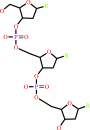
C-A-T-G-C-A-T-G
8 bases
|
|
|
|
C-A-T-G-C-A-T-G
8 bases
|
|
|
|
|
|
|
|
|
|
|
|
|
|
Enzyme class 2:
|
|
E.C.2.7.7.-
- ?????
|
|
|
|
|
|
|
Enzyme class 3:
|
|
E.C.2.7.7.49
- RNA-directed Dna polymerase.
|
|
|
|
|
|
|
Reaction:
|
|
DNA(n) + a 2'-deoxyribonucleoside 5'-triphosphate = DNA(n+1) + diphosphate
|
|
|
|
|
|
 DNA(n)
|
+
|
2'-deoxyribonucleoside 5'-triphosphate
|
=
|
DNA(n+1)
|
+
|
 diphosphate
|
|
|
|
|
|
|
|
|
|
Enzyme class 4:
|
|
E.C.2.7.7.7
- DNA-directed Dna polymerase.
|
|
|
|
|
|
|
Reaction:
|
|
DNA(n) + a 2'-deoxyribonucleoside 5'-triphosphate = DNA(n+1) + diphosphate
|
|
|
|
|
|
DNA(n)
|
+
|
2'-deoxyribonucleoside 5'-triphosphate
|
=
|
DNA(n+1)
|
+
|
diphosphate
|
|
|
|
|
|
|
|
|
|
Enzyme class 5:
|
|
E.C.3.1.-.-
|
|
|
|
|
|
|
Enzyme class 6:
|
|
E.C.3.1.26.4
- ribonuclease H.
|
|
|
|
|
|
|
Reaction:
|
|
Endonucleolytic cleavage to 5'-phosphomonoester.
|
|
|
|
|
|
Enzyme class 7:
|
|
E.C.3.4.23.-
- ?????
|
|
|
|
|
|
|
|
|
|
Note, where more than one E.C. class is given (as above), each may
correspond to a different protein domain or, in the case of polyprotein
precursors, to a different mature protein.
|
|
|
|
Molecule diagrams generated from .mol files obtained from the
KEGG ftp site
|
|
|
|
|
|
|
|
|
|
|
|
|
|
 |
|
|
|
|
|
|
| |
|
|
| |
|
DOI no:
|
J Mol Biol
296:613-632
(2000)
|
|
PubMed id:
|
|
|
|
|
|
| |
|
Crystal structures of an N-terminal fragment from Moloney murine leukemia virus reverse transcriptase complexed with nucleic acid: functional implications for template-primer binding to the fingers domain.
|
|
S.Najmudin,
M.L.Coté,
D.Sun,
S.Yohannan,
S.P.Montano,
J.Gu,
M.M.Georgiadis.
|
|
|
|
|
| |
ABSTRACT
|
|
|
|
| |
|
|
Reverse transcriptase (RT) serves as the replicative polymerase for retroviruses
by using RNA and DNA-directed DNA polymerase activities coupled with a
ribonuclease H activity to synthesize a double-stranded DNA copy of the
single-stranded RNA genome. In an effort to obtain detailed structural
information about nucleic acid interactions with reverse transcriptase, we have
determined crystal structures at 2.3 A resolution of an N-terminal fragment from
Moloney murine leukemia virus reverse transcriptase complexed to blunt-ended DNA
in three distinct lattices. This fragment includes the fingers and palm domains
from Moloney murine leukemia virus reverse transcriptase. We have also
determined the crystal structure at 3.0 A resolution of the fragment complexed
to DNA with a single-stranded template overhang resembling a template-primer
substrate. Protein-DNA interactions, which are nearly identical in each of the
three lattices, involve four conserved residues in the fingers domain, Asp114,
Arg116, Asn119 and Gly191. DNA atoms involved in the interactions include the
3'-OH group from the primer strand and minor groove base atoms and sugar atoms
from the n-2 and n-3 positions of the template strand, where n is the template
base that would pair with an incoming nucleotide. The single-stranded template
overhang adopts two different conformations in the asymmetric unit interacting
with residues in the beta4-beta5 loop (beta3-beta4 in HIV-1 RT). Our
fragment-DNA complexes are distinct from previously reported complexes of DNA
bound to HIV-1 RT but related in the types of interactions formed between
protein and DNA. In addition, the DNA in all of these complexes is bound in the
same cleft of the enzyme. Through site-directed mutagenesis, we have substituted
residues that are involved in binding DNA in our crystal structures and have
characterized the resulting enzymes. We now propose that nucleic acid binding to
the fingers domain may play a role in translocation of nucleic acid during
processive DNA synthesis and suggest that our complex may represent an
intermediate in this process.
|
|
|
|
|
|
| |
Selected figure(s)
|
|
|
|
| |
|
|

|
|

|
|
Figure 5.
Figure 5. Superpositionings of the higher-resolution
structures at the DNA binding site. In both views the
backgrounded DNA molecule is that of form IV, and the ion-pair
formed between Asp114 and Arg116 in form IV is shown with black
dashes. Both views also show smaller bonds and atoms for the
dual conformations of Tyr64 of form IV. Superpositionings were
done using the same subset of alpha-carbon atoms listed for
Figure 2. (a) The superpositioning of the A and B protein
molecules of form I onto that of form IV. The main-chains and
side-chains nearly superimpose with the exception of the
main-chain of the form I B molecule in the region of Tyr64. (b)
Superpositioning of the A and B protein molecules of form IIa
onto that of form IV. The main and side-chain superpositionings
are nearly identical for the residues shown, and there is an
exact mapping of the Asp114 side-chain of the form IIa A
molecule and that of form IV.
|
|
Figure 7.
Figure 7. Stereodiagrams of DNA bound to the fingers domain
of the MMLV RT fragment as modeled in the previously defined
binding cleft in HIV-1 RT. (a) A trace rendering shows the
fragment of MMLV RT in blue including the fingers and palm
domains superimposed on the fingers, palm, and thumb domains
from HIV-1 RT (2hmi structure) [Ding et al 1998]. DNA as bound
to the fingers domain in form IIb crystals is shown as a stick
model in red. The superpositioning of the fingers and palm
domains from MMLV RT and HIV-1 RT is based on the 160 most
similar residues as reported by [Georgiadis et al 1995] and
listed in the legend in Figure 2. (b) The same molecules are
superimposed as in (a). The DNA shown in red from the HIV-1
RT-DNA-Fab complex structure (2hmi) is shown for comparison in a
similar view along the cleft formed by the fingers, palm, and
thumb domains.
|
|
|
|
|
|
| |
The above figures are
reprinted
by permission from Elsevier:
J Mol Biol
(2000,
296,
613-632)
copyright 2000.
|
|
| |
Figures were
selected
by an automated process.
|
|
|
|
|
|
|
|
|
|
|
|
|
|
|
|
 |
 |
 |
|
Literature references that cite this PDB file's key reference
|
|
|
| |
PubMed id
|
|
Reference
|
|
|
|
|
|
J.Xie,
P.Zhang,
C.Li,
Q.Huang,
R.Zhou,
and
T.Peng
(2011).
Mechanistic insights into the roles of three linked single-stranded template binding residues of MMLV reverse transcriptase in misincorporation and mispair extension fidelity of DNA synthesis.
|
| |
Gene,
479,
47-56.
|
|
|
|
|
|
|
K.I.Lim,
R.Klimczak,
J.H.Yu,
and
D.V.Schaffer
(2010).
Specific insertions of zinc finger domains into Gag-Pol yield engineered retroviral vectors with selective integration properties.
|
| |
Proc Natl Acad Sci U S A,
107,
12475-12480.
|
|
|
|
|
|
|
L.Lu,
C.Yi,
X.Jian,
G.Zheng,
and
C.He
(2010).
Structure determination of DNA methylation lesions N1-meA and N3-meC in duplex DNA using a cross-linked protein-DNA system.
|
| |
Nucleic Acids Res,
38,
4415-4425.
|
|
|
PDB codes:
|
|
|
|
|
|
|
|
B.Arezi,
and
H.Hogrefe
(2009).
Novel mutations in Moloney Murine Leukemia Virus reverse transcriptase increase thermostability through tighter binding to template-primer.
|
| |
Nucleic Acids Res,
37,
473-481.
|
|
|
|
|
|
|
M.L.Coté,
and
M.J.Roth
(2008).
Murine leukemia virus reverse transcriptase: structural comparison with HIV-1 reverse transcriptase.
|
| |
Virus Res,
134,
186-202.
|
|
|
|
|
|
|
J.H.Yu,
and
D.V.Schaffer
(2006).
High-throughput, library-based selection of a murine leukemia virus variant to infect nondividing cells.
|
| |
J Virol,
80,
8981-8988.
|
|
|
|
|
|
|
K.D.Goodwin,
M.A.Lewis,
F.A.Tanious,
R.R.Tidwell,
W.D.Wilson,
M.M.Georgiadis,
and
E.C.Long
(2006).
A high-throughput, high-resolution strategy for the study of site-selective DNA binding agents: analysis of a "highly twisted" benzimidazole-diamidine.
|
| |
J Am Chem Soc,
128,
7846-7854.
|
|
|
PDB codes:
|
|
|
|
|
|
|
|
S.P.Montaño,
M.L.Coté,
M.J.Roth,
and
M.M.Georgiadis
(2006).
Crystal structures of oligonucleotides including the integrase processing site of the Moloney murine leukemia virus.
|
| |
Nucleic Acids Res,
34,
5353-5360.
|
|
|
PDB codes:
|
|
|
|
|
|
|
|
K.D.Goodwin,
E.C.Long,
and
M.M.Georgiadis
(2005).
A host-guest approach for determining drug-DNA interactions: an example using netropsin.
|
| |
Nucleic Acids Res,
33,
4106-4116.
|
|
|
PDB codes:
|
|
|
|
|
|
|
|
A.A.Thompson,
and
O.B.Peersen
(2004).
Structural basis for proteolysis-dependent activation of the poliovirus RNA-dependent RNA polymerase.
|
| |
EMBO J,
23,
3462-3471.
|
|
|
PDB codes:
|
|
|
|
|
|
|
|
C.L.Hendrickson,
K.G.Devine,
and
S.A.Benner
(2004).
Probing minor groove recognition contacts by DNA polymerases and reverse transcriptases using 3-deaza-2'-deoxyadenosine.
|
| |
Nucleic Acids Res,
32,
2241-2250.
|
|
|
|
|
|
|
D.Das,
and
M.M.Georgiadis
(2004).
The crystal structure of the monomeric reverse transcriptase from Moloney murine leukemia virus.
|
| |
Structure,
12,
819-829.
|
|
|
PDB codes:
|
|
|
|
|
|
|
|
J.Winshell,
B.A.Paulson,
B.D.Buelow,
and
J.J.Champoux
(2004).
Requirements for DNA unpairing during displacement synthesis by HIV-1 reverse transcriptase.
|
| |
J Biol Chem,
279,
52924-52933.
|
|
|
|
|
|
|
R.L.Crowther,
D.P.Remeta,
C.A.Minetti,
D.Das,
S.P.Montano,
and
M.M.Georgiadis
(2004).
Structural and energetic characterization of nucleic acid-binding to the fingers domain of Moloney murine leukemia virus reverse transcriptase.
|
| |
Proteins,
57,
15-26.
|
|
|
PDB code:
|
|
|
|
|
|
|
|
A.K.Showalter,
I.J.Byeon,
M.I.Su,
and
M.D.Tsai
(2001).
Solution structure of a viral DNA polymerase X and evidence for a mutagenic function.
|
| |
Nat Struct Biol,
8,
942-946.
|
|
|
PDB code:
|
|
|
|
|
|
|
|
D.Das,
and
M.M.Georgiadis
(2001).
A directed approach to improving the solubility of Moloney murine leukemia virus reverse transcriptase.
|
| |
Protein Sci,
10,
1936-1941.
|
|
|
|
|
|
|
K.Vastmans,
M.Froeyen,
L.Kerremans,
S.Pochet,
and
P.Herdewijn
(2001).
Reverse transcriptase incorporation of 1,5-anhydrohexitol nucleotides.
|
| |
Nucleic Acids Res,
29,
3154-3163.
|
|
|
|
|
|
|
M.L.Coté,
and
M.M.Georgiadis
(2001).
Structure of a pseudo-16-mer DNA with stacked guanines and two G-A mispairs complexed with the N-terminal fragment of Moloney murine leukemia virus reverse transcriptase.
|
| |
Acta Crystallogr D Biol Crystallogr,
57,
1238-1250.
|
|
|
PDB code:
|
|
|
|
|
|
|
|
W.A.Breyer,
and
B.W.Matthews
(2001).
A structural basis for processivity.
|
| |
Protein Sci,
10,
1699-1711.
|
|
|
|
|
|
|
E.K.Halvas,
E.S.Svarovskaia,
and
V.K.Pathak
(2000).
Role of murine leukemia virus reverse transcriptase deoxyribonucleoside triphosphate-binding site in retroviral replication and in vivo fidelity.
|
| |
J Virol,
74,
10349-10358.
|
|
|
|
|
|
|
J.K.Pfeiffer,
M.M.Georgiadis,
and
A.Telesnitsky
(2000).
Structure-based moloney murine leukemia virus reverse transcriptase mutants with altered intracellular direct-repeat deletion frequencies.
|
| |
J Virol,
74,
9629-9636.
|
|
|
|
|
|
|
M.L.Coté,
S.J.Yohannan,
and
M.M.Georgiadis
(2000).
Use of an N-terminal fragment from moloney murine leukemia virus reverse transcriptase to facilitate crystallization and analysis of a pseudo-16-mer DNA molecule containing G-A mispairs.
|
| |
Acta Crystallogr D Biol Crystallogr,
56,
1120-1131.
|
|
|
PDB code:
|
|
|
|
|
|
|
The most recent references are shown first.
Citation data come partly from CiteXplore and partly
from an automated harvesting procedure. Note that this is likely to be
only a partial list as not all journals are covered by
either method. However, we are continually building up the citation data
so more and more references will be included with time.
Where a reference describes a PDB structure, the PDB
codes are
shown on the right.
|
|


 Links
Links


