|
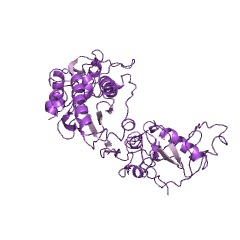
PDBsum entry 1rw3

|
|
|
|
|
|

|

|

|

|
|

|
|

|
|

|
|
|
 |

|

|
|
|
|
|
|
|
|
|
|
|
|
|
|
|
|
|
|
|
|
|
|
|
|
|
|
|
|
|
|
|
|
Transferase, replication
|
PDB id
|
|
|
|
1rw3
|
|
|
|
|
|
|
|
|
|
|
|
|
|
|

|

|

|
|
|
|
|
|
|
|
 |
Contents |
 |
|
|
|
|
|
|
|
|
* Residue conservation analysis
|
|
|
|
|
|
|
|
|
|
|
|
|
|
|
 |
|
|
|
|
|
|
| |
|
DOI no:
|
Structure
12:819-829
(2004)
|
|
PubMed id:
|
|
|
|
|
|
| |
|
The crystal structure of the monomeric reverse transcriptase from Moloney murine leukemia virus.
|
|
D.Das,
M.M.Georgiadis.
|
|
|
|
|
| |
ABSTRACT
|
|
|
|
| |
|
|
Reverse transcriptases (RTs) are multidomain enzymes of variable architecture
that couple both RNA- and DNA-directed DNA polymerase activities with an RNase H
activity specific for an RNA:DNA hybrid in order to replicate the
single-stranded RNA genome of the retrovirus. Previous structural work has been
reported for the heterodimeric HIV-1 and HIV-2 RTs. We now report the first
crystal structure of the full-length Moloney murine leukemia virus (MMLV) RT at
3.0 A resolution. The structure reveals a clamp-shaped molecule resulting from
the relative positions of the thumb, connection, and RNase H domains that is
strikingly different from the HIV-1 RT and provides the first example of a
monomeric reverse transcriptase. A comparative analysis with related DNA
polymerases suggests a unique trajectory for the template-primer exiting the
polymerase active site and provides insights regarding processive DNA synthesis
by MMLV RT.
|
|
|
|
|
|
| |
Selected figure(s)
|
|
|
|
| |
|
|

|
|
Figure 2.
Figure 2. The Crystal Structure of the MMLV RT and a
Comparison with the p66 Subunit of the HIV-1 RT(A) A ribbon
rendering of the MMLV RT is shown with the fingers domain in
red, palm in blue, thumb in green, connection in yellow, and the
RNase H in magenta.(B) A structural comparison of the MMLV RT
monomer is shown in the same color scheme as in (A) with the p66
subunit of HIV-1 RT shown in gray. The structures were
superimposed using the highly conserved structural elements in
the palm domains. In contrast to the rather extended p66 subunit
of HIV-1 RT, the MMLV RT is a far more clamp-shaped molecule.
|
|
|
|
|
|
| |
The above figure is
reprinted
by permission from Cell Press:
Structure
(2004,
12,
819-829)
copyright 2004.
|
|
| |
Figure was
selected
by an automated process.
|
|
|
|
|
|
|
|
|
|
|
|
|
|
|
|
 |
 |
 |
|
Literature references that cite this PDB file's key reference
|
|
|
| |
PubMed id
|
|
Reference
|
|
|
|
|
|
J.Xie,
P.Zhang,
C.Li,
Q.Huang,
R.Zhou,
and
T.Peng
(2011).
Mechanistic insights into the roles of three linked single-stranded template binding residues of MMLV reverse transcriptase in misincorporation and mispair extension fidelity of DNA synthesis.
|
| |
Gene,
479,
47-56.
|
|
|
|
|
|
|
A.Herschhorn,
and
A.Hizi
(2010).
Retroviral reverse transcriptases.
|
| |
Cell Mol Life Sci,
67,
2717-2747.
|
|
|
|
|
|
|
K.I.Lim,
R.Klimczak,
J.H.Yu,
and
D.V.Schaffer
(2010).
Specific insertions of zinc finger domains into Gag-Pol yield engineered retroviral vectors with selective integration properties.
|
| |
Proc Natl Acad Sci U S A,
107,
12475-12480.
|
|
|
|
|
|
|
K.Yasukawa,
A.Konishi,
and
K.Inouye
(2010).
Effects of organic solvents on the reverse transcription reaction catalyzed by reverse transcriptases from avian myeloblastosis virus and Moloney murine leukemia virus.
|
| |
Biosci Biotechnol Biochem,
74,
1925-1930.
|
|
|
|
|
|
|
M.Mizuno,
K.Yasukawa,
and
K.Inouye
(2010).
Insight into the mechanism of the stabilization of moloney murine leukaemia virus reverse transcriptase by eliminating RNase H activity.
|
| |
Biosci Biotechnol Biochem,
74,
440-442.
|
|
|
|
|
|
|
S.J.Schultz,
M.Zhang,
and
J.J.Champoux
(2010).
Multiple nucleotide preferences determine cleavage-site recognition by the HIV-1 and M-MuLV RNases H.
|
| |
J Mol Biol,
397,
161-178.
|
|
|
|
|
|
|
B.Arezi,
and
H.Hogrefe
(2009).
Novel mutations in Moloney Murine Leukemia Virus reverse transcriptase increase thermostability through tighter binding to template-primer.
|
| |
Nucleic Acids Res,
37,
473-481.
|
|
|
|
|
|
|
J.J.Champoux,
and
S.J.Schultz
(2009).
Ribonuclease H: properties, substrate specificity and roles in retroviral reverse transcription.
|
| |
FEBS J,
276,
1506-1516.
|
|
|
|
|
|
|
K.Ratcliff,
J.Corn,
and
S.Marqusee
(2009).
Structure, stability, and folding of ribonuclease H1 from the moderately thermophilic Chlorobium tepidum: comparison with thermophilic and mesophilic homologues.
|
| |
Biochemistry,
48,
5890-5898.
|
|
|
PDB code:
|
|
|
|
|
|
|
|
K.Yasukawa,
M.Mizuno,
and
K.Inouye
(2009).
Characterization of Moloney murine leukaemia virus/avian myeloblastosis virus chimeric reverse transcriptases.
|
| |
J Biochem,
145,
315-324.
|
|
|
|
|
|
|
S.J.Schultz,
M.Zhang,
and
J.J.Champoux
(2009).
Preferred sequences within a defined cleavage window specify DNA 3' end-directed cleavages by retroviral RNases H.
|
| |
J Biol Chem,
284,
32225-32238.
|
|
|
|
|
|
|
T.Tadokoro,
and
S.Kanaya
(2009).
Ribonuclease H: molecular diversities, substrate binding domains, and catalytic mechanism of the prokaryotic enzymes.
|
| |
FEBS J,
276,
1482-1493.
|
|
|
|
|
|
|
M.L.Coté,
and
M.J.Roth
(2008).
Murine leukemia virus reverse transcriptase: structural comparison with HIV-1 reverse transcriptase.
|
| |
Virus Res,
134,
186-202.
|
|
|
|
|
|
|
S.J.Schultz,
and
J.J.Champoux
(2008).
RNase H activity: structure, specificity, and function in reverse transcription.
|
| |
Virus Res,
134,
86.
|
|
|
|
|
|
|
B.A.Paulson,
M.Zhang,
S.J.Schultz,
and
J.J.Champoux
(2007).
Substitution of alanine for tyrosine-64 in the fingers subdomain of M-MuLV reverse transcriptase impairs strand displacement synthesis and blocks viral replication in vivo.
|
| |
Virology,
366,
361-376.
|
|
|
|
|
|
|
M.Nowotny,
S.A.Gaidamakov,
R.Ghirlando,
S.M.Cerritelli,
R.J.Crouch,
and
W.Yang
(2007).
Structure of human RNase H1 complexed with an RNA/DNA hybrid: insight into HIV reverse transcription.
|
| |
Mol Cell,
28,
264-276.
|
|
|
PDB codes:
|
|
|
|
|
|
|
|
D.Lim,
G.G.Gregorio,
C.Bingman,
E.Martinez-Hackert,
W.A.Hendrickson,
and
S.P.Goff
(2006).
Crystal structure of the moloney murine leukemia virus RNase H domain.
|
| |
J Virol,
80,
8379-8389.
|
|
|
PDB code:
|
|
|
|
|
|
|
|
M.S.Mitchell,
J.Tözsér,
G.Princler,
P.A.Lloyd,
A.Auth,
and
D.Derse
(2006).
Synthesis, processing, and composition of the virion-associated HTLV-1 reverse transcriptase.
|
| |
J Biol Chem,
281,
3964-3971.
|
|
|
|
|
|
|
A.Bibillo,
D.Lener,
A.Tewari,
and
S.F.Le Grice
(2005).
Interaction of the Ty3 reverse transcriptase thumb subdomain with template-primer.
|
| |
J Biol Chem,
280,
30282-30290.
|
|
|
|
|
|
|
G.Tachedjian,
J.Radzio,
and
N.Sluis-Cremer
(2005).
Relationship between enzyme activity and dimeric structure of recombinant HIV-1 reverse transcriptase.
|
| |
Proteins,
60,
5.
|
|
|
|
|
|
|
J.L.Mbisa,
G.N.Nikolenko,
and
V.K.Pathak
(2005).
Mutations in the RNase H primer grip domain of murine leukemia virus reverse transcriptase decrease efficiency and accuracy of plus-strand DNA transfer.
|
| |
J Virol,
79,
419-427.
|
|
|
|
|
|
|
R.L.Crowther,
D.P.Remeta,
C.A.Minetti,
D.Das,
S.P.Montano,
and
M.M.Georgiadis
(2004).
Structural and energetic characterization of nucleic acid-binding to the fingers domain of Moloney murine leukemia virus reverse transcriptase.
|
| |
Proteins,
57,
15-26.
|
|
|
PDB code:
|
|
|
|
|
|
|
The most recent references are shown first.
Citation data come partly from CiteXplore and partly
from an automated harvesting procedure. Note that this is likely to be
only a partial list as not all journals are covered by
either method. However, we are continually building up the citation data
so more and more references will be included with time.
Where a reference describes a PDB structure, the PDB
code is
shown on the right.
|
|


 Links
Links