 |
PDBsum entry 3h8x

|
|
|
|
|
|

|

|

|

|
|

|
|

|
|

|
|

|
|

|
|
|
 |

|

|
|
|
|
|
|
|
|
|
|
|
|
|
|
|
|
|
|
|
|
|
|
|
|
|
|
|
|
|
|
|
|
|
|
Oxidoreductase/DNA
|
PDB id
|
|
|
|
3h8x
|
|
|
|
|
|
|
|
|
|
|
|
|
|
|

|

|

|
|
|
|
|
|
|
|
 |
Contents |
 |
|
|
|
|
|
|
|
|
|
|
|
|
* Residue conservation analysis
|
|
|
|
|
|
|
|
|
|
|
Enzyme class:
|
|
E.C.1.14.11.33
- Dna oxidative demethylase.
|
|
|
|
|
|
|
Reaction:
|
|
a methylated nucleobase within DNA + 2-oxoglutarate + O2 = a nucleobase within DNA + formaldehyde + succinate + CO2
|
|
|
|
|
|
methylated nucleobase within DNA
|
+
|
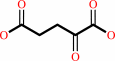 2-oxoglutarate
|
+
|
 O2
O2
|
=
|
nucleobase within DNA
|
+
|
 formaldehyde
|
+
|
 succinate
|
+
|
 CO2
CO2
|
|
|
|
|
|
|
|
|
|
Cofactor:
|
|
Fe cation
|
|
|
|
|
|
|
|
|
Molecule diagrams generated from .mol files obtained from the
KEGG ftp site
|
|
|
|
|
|
|
|
|
|
|
|
|
|
 |
|
|
|
|
|
|
| |
|
|
| |
|
|
Nucleic Acids Res
38:4415-4425
(2010)
|
|
PubMed id:
|
|
|
|
|
|
| |
|
Structure determination of DNA methylation lesions N1-meA and N3-meC in duplex DNA using a cross-linked protein-DNA system.
|
|
L.Lu,
C.Yi,
X.Jian,
G.Zheng,
C.He.
|
|
|
|
|
| |
ABSTRACT
|
|
|
|
| |
|
|
N(1)-meA and N(3)-meC are cytotoxic DNA base methylation lesions that can
accumulate in the genomes of various organisms in the presence of S(N)2 type
methylating agents. We report here the structural characterization of these base
lesions in duplex DNA using a cross-linked protein-DNA crystallization system.
The crystal structure of N(1)-meA:T pair shows an unambiguous Hoogsteen base
pair with a syn conformation adopted by N(1)-meA, which exhibits significant
changes in the opening, roll and twist angles as compared to the normal A:T base
pair. Unlike N(1)-meA, N(3)-meC does not establish any interaction with the
opposite G, but remains partially intrahelical. Also, structurally characterized
is the N(6)-meA base modification that forms a normal base pair with the
opposite T in duplex DNA. Structural characterization of these base methylation
modifications provides molecular level information on how they affect the
overall structure of duplex DNA. In addition, the base pairs containing N(1)-meA
or N(3)-meC do not share any specific characteristic properties except that both
lesions create thermodynamically unstable regions in a duplex DNA, a property
that may be explored by the repair proteins to locate these lesions.
|
|
|
|
|
|
|
|
|
|
|
|
|
|
|
|
|
|
 |
 |
 |
|
Literature references that cite this PDB file's key reference
|
|
|
| |
PubMed id
|
|
Reference
|
|
|
|
|
|
C.Yi,
B.Chen,
B.Qi,
W.Zhang,
G.Jia,
L.Zhang,
C.J.Li,
A.R.Dinner,
C.G.Yang,
and
C.He
(2012).
Duplex interrogation by a direct DNA repair protein in search of base damage.
|
| |
Nat Struct Mol Biol,
19,
671-676.
|
|
|
PDB codes:
|
|
|
|
|
|
|
|
E.N.Nikolova,
E.Kim,
A.A.Wise,
P.J.O'Brien,
I.Andricioaei,
and
H.M.Al-Hashimi
(2011).
Transient Hoogsteen base pairs in canonical duplex DNA.
|
| |
Nature,
470,
498-502.
|
|
|
|
|
|
The most recent references are shown first.
Citation data come partly from CiteXplore and partly
from an automated harvesting procedure. Note that this is likely to be
only a partial list as not all journals are covered by
either method. However, we are continually building up the citation data
so more and more references will be included with time.
Where a reference describes a PDB structure, the PDB
codes are
shown on the right.
|
|


 Links
Links


