 |
PDBsum entry 1nnd

|
|
|
|
|
 |
Contents |
 |
|
|
|
|
|
|
|
|
|
|
* Residue conservation analysis
|
|
|
|
|
|
|
|
|
|
|
Enzyme class 2:
|
|
E.C.2.7.7.-
- ?????
|
|
|
|
|
|
|
Enzyme class 3:
|
|
E.C.2.7.7.49
- RNA-directed Dna polymerase.
|
|
|
|
|
|
|
Reaction:
|
|
DNA(n) + a 2'-deoxyribonucleoside 5'-triphosphate = DNA(n+1) + diphosphate
|
|
|
|
|
|
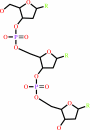 DNA(n)
|
+
|
2'-deoxyribonucleoside 5'-triphosphate
|
=
|
DNA(n+1)
|
+
|
 diphosphate
|
|
|
|
|
|
|
|
|
|
Enzyme class 4:
|
|
E.C.2.7.7.7
- DNA-directed Dna polymerase.
|
|
|
|
|
|
|
Reaction:
|
|
DNA(n) + a 2'-deoxyribonucleoside 5'-triphosphate = DNA(n+1) + diphosphate
|
|
|
|
|
|
DNA(n)
|
+
|
2'-deoxyribonucleoside 5'-triphosphate
|
=
|
DNA(n+1)
|
+
|
diphosphate
|
|
|
|
|
|
|
|
|
|
Enzyme class 5:
|
|
E.C.3.1.-.-
|
|
|
|
|
|
|
Enzyme class 6:
|
|
E.C.3.1.26.4
- ribonuclease H.
|
|
|
|
|
|
|
Reaction:
|
|
Endonucleolytic cleavage to 5'-phosphomonoester.
|
|
|
|
|
|
Enzyme class 7:
|
|
E.C.3.4.23.-
- ?????
|
|
|
|
|
|
|
|
|
|
Note, where more than one E.C. class is given (as above), each may
correspond to a different protein domain or, in the case of polyprotein
precursors, to a different mature protein.
|
|
|
|
Molecule diagrams generated from .mol files obtained from the
KEGG ftp site
|
|
|
|
|
|
|
|
|
|
|
|
|
|
 |
|
|
|
|
|
|
| |
|
|
| |
|
DOI no:
|
Proteins
57:15-26
(2004)
|
|
PubMed id:
|
|
|
|
|
|
| |
|
Structural and energetic characterization of nucleic acid-binding to the fingers domain of Moloney murine leukemia virus reverse transcriptase.
|
|
R.L.Crowther,
D.P.Remeta,
C.A.Minetti,
D.Das,
S.P.Montano,
M.M.Georgiadis.
|
|
|
|
|
| |
ABSTRACT
|
|
|
|
| |
|
|
Reverse transcriptase is an essential retroviral enzyme that replicates the
single-stranded RNA genome of the retrovirus producing a double-stranded DNA
copy, which is subsequently integrated into the host's genome. We have
previously reported that processive DNA synthesis of Moloney murine leukemia
virus reverse transcriptase (MMLV RT) is severely compromised by substitution of
an Ala for the fingers domain residue Arg 116. In order to further investigate
the role of Arg 116 in interactions of MMLV RT with nucleic acids, we have
determined the crystal structure of the R116A N-terminal fragment and
characterized the binding of two self-complementary DNA duplexes [d(CATGCATG)2
to both the wild-type and R116A fragments by isothermal
titration calorimetry. The resultant thermodynamic profiles extrapolated to 25
degrees C reveal that binding of the wild-type N-terminal fragment to both DNA
duplexes is enthalpy-driven and characterized by an unfavorable entropy.
Although the temperature dependence of the respective protein-DNA binding
enthalpies is markedly different reflecting distinct heat capacity changes, the
binding free energies are nearly identical and relatively invariant to
temperature (DeltaG approximately -6.0 kcal x mol(-1)). In contrast to the
wild-type fragment, the R116A fragment exhibits no measurable affinity for
either DNA duplex, yet its crystal structure reveals no significant changes when
compared to the wild-type structures. We suggest that hydrogen-bonding
interactions involving the fingers domain residue Arg 116 are critical for DNA
binding as well as processive DNA synthesis by MMLV RT.
|
|
|
|
|
|
| |
Selected figure(s)
|
|
|
|
| |
|
|

|
|

|
|
Figure 3.
Figure 3. Comparison of the d(CATGCATG)[2] and d(CGCGCGCG)[2]
structures depicted as block renderings. In contrast to the
structure of d(CATGCATG)[2] in Panel A, the d(CGCGCGCG)[2]
structure in Panel B exhibits significant deviations from ideal
B-form DNA.
|
|
Figure 5.
Figure 5. The electron density map for the R116A fragment as a
semi-transparent rendering is superimposed on an overlay of the
side chains of the R116A (blue) and wild-type (red) fragment
structures at residue 116. The positions of the atoms for
residue 116 are remarkably similar including the C  position
in the R116A fragment versus the wild-type structure.
Substitution of Arg for Ala at residue 116 in the N-terminal
fragment does not result in any conformational changes in the
fingers domain binding site nor anywhere else in the protein as
noted in Figure 4. position
in the R116A fragment versus the wild-type structure.
Substitution of Arg for Ala at residue 116 in the N-terminal
fragment does not result in any conformational changes in the
fingers domain binding site nor anywhere else in the protein as
noted in Figure 4.
|
|
|
|
|
|
| |
The above figures are
reprinted
by permission from John Wiley & Sons, Inc.:
Proteins
(2004,
57,
15-26)
copyright 2004.
|
|
| |
Figures were
selected
by an automated process.
|
|
|
|
|
|
|
|
|
|
|
|
|
|
|
|
 |
 |
 |
|
Literature references that cite this PDB file's key reference
|
|
|
| |
PubMed id
|
|
Reference
|
|
|
|
|
|
J.Xie,
P.Zhang,
C.Li,
Q.Huang,
R.Zhou,
and
T.Peng
(2011).
Mechanistic insights into the roles of three linked single-stranded template binding residues of MMLV reverse transcriptase in misincorporation and mispair extension fidelity of DNA synthesis.
|
| |
Gene,
479,
47-56.
|
|
|
|
|
|
|
A.Ababou,
and
J.E.Ladbury
(2006).
Survey of the year 2004: literature on applications of isothermal titration calorimetry.
|
| |
J Mol Recognit,
19,
79-89.
|
|
|
|
|
|
The most recent references are shown first.
Citation data come partly from CiteXplore and partly
from an automated harvesting procedure. Note that this is likely to be
only a partial list as not all journals are covered by
either method. However, we are continually building up the citation data
so more and more references will be included with time.
|
|


 Links
Links







