- Course overview
- Search within this course
- Introduction
- Real-time PCR
- Microarrays
- What is Next Generation DNA Sequencing?
- Biological interpretation of gene expression data
- Genotyping, epigenetic and DNA/RNA-protein interaction methods
- DNA/RNA-protein interactions
- Summary
- Quiz: Check your learning
- Your feedback
- Learn more
- References

All materials are free cultural works licensed under a Creative Commons Attribution 4.0 International (CC BY 4.0) license, except where further licensing details are provided.
Library preparation and sequencing approaches
Library preparation: a population of RNA (total or fractionated such as polyA+) is converted to a library of cDNA fragments with adapters (synthetic oligonucleotides of a known sequence) attached to one or both ends. Adapter-ligated cDNA fragments are then amplified in preparation for sequencing.
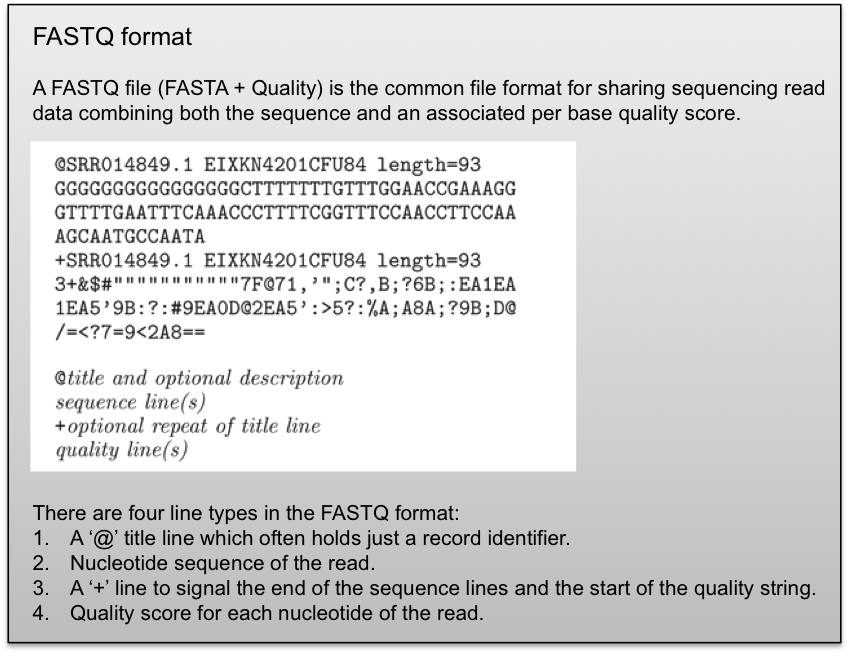
Sequencing and imaging: to obtain the nucleic acid sequence from the amplified library, each molecule is sequenced in a high throughput manner to obtain millions of short reads (sequences) from one end (single-end sequencing) or both ends (pair-end sequencing). Sequencing is usually performed by core facilities or external companies (using different platforms such as Illumina GA/HiSeq, Applied Biosystems SoLiD, Roche 454 Life Science). Although the platforms differ substantially in their chemistry and processing steps, the sequencing process usually generates millions of short (25-300 bp) reads with associated quality scores as FASTQ files (Box 1).