
|
|
|
|
|
 |
Contents |
 |
|
|
|
|
|
|
|
|
|
|
|
|
* Residue conservation analysis
|
|
|
|
|
|
PDB id:
|
|
|
|
| Name: |
|
Signaling protein/transferase
|
|
|
Title:
|
|
Crystal structure of the 14-3-3 zeta:serotonin n-acetyltransferase complex
|
|
Structure:
|
|
14-3-3 zeta isoform. Chain: a, b, c, d. Synonym: protein kinasE C inhibitor protein-1. Engineered: yes. Serotonin n-acetyltransferase. Chain: e, f, g, h. Synonym: aralkylamine n-acetyltransferase, aa-nat, serotonin acetylase. Engineered: yes
|
|
Source:
|
|
Homo sapiens. Human. Organism_taxid: 9606. Gene: ywhaz. Expressed in: escherichia coli bl21(de3). Expression_system_taxid: 469008. Ovis aries. Sheep. Organism_taxid: 9940.
|
|
Biol. unit:
|
|
 Tetramer (from
)
Tetramer (from
)
|
|
Resolution:
|
|
|
2.70Å
|
R-factor:
|
0.204
|
R-free:
|
0.228
|
|
|
Authors:
|
|
T.Obsil,R.Ghirlando,D.C.Klein,S.Ganguly,F.Dyda
|
Key ref:

|
|
T.Obsil
et al.
(2001).
Crystal structure of the 14-3-3zeta:serotonin N-acetyltransferase complex. a role for scaffolding in enzyme regulation.
Cell,
105,
257-267.
PubMed id:
DOI:

|
|
|
Date:
|
|
|
26-Mar-01
|
Release date:
|
02-May-01
|
|
|
|
|
|
|
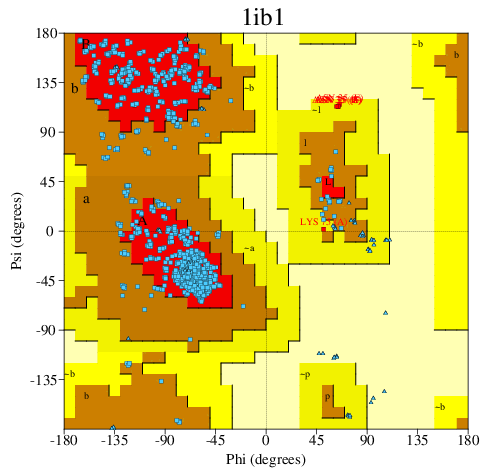
PROCHECK
|
|
|
|
|
|
Headers
|
|
|
|
References
|
|
|
|
|
|
|
|
|
|
|
|
Enzyme class:
|
|
Chains E, F, G, H:
E.C.2.3.1.87
- aralkylamine N-acetyltransferase.
|
|
|
|
|
|
|
Reaction:
|
|
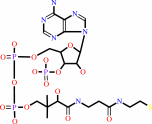
a 2-arylethylamine + acetyl-CoA = an N-acetyl-2-arylethylamine + CoA + H+
|
|
|
|
|
|
 2-arylethylamine
|
+
|
acetyl-CoA
Bound ligand (Het Group name = )
matches with 78.12% similarity
|
=
|
 N-acetyl-2-arylethylamine
|
+
|
 CoA
CoA
|
+
|
H(+)
|
|
|
|
|
|
|
|
|
|
|
|
|
Molecule diagrams generated from .mol files obtained from the
KEGG ftp site
|
|
|
|
|
|
|
|
|
|
|
|
|
|
 |
|
|
|
|
|
|
| |
|
|
| |
|
DOI no:
|
Cell
105:257-267
(2001)
|
|
PubMed id:
|
|
|
|
|
|
| |
|
Crystal structure of the 14-3-3zeta:serotonin N-acetyltransferase complex. a role for scaffolding in enzyme regulation.
|
|
T.Obsil,
R.Ghirlando,
D.C.Klein,
S.Ganguly,
F.Dyda.
|
|
|
|
|
| |
ABSTRACT
|
|
|
|
| |
|
|
Serotonin N-acetyltransferase (AANAT) controls the daily rhythm in melatonin
synthesis. When isolated from tissue, AANAT copurifies with isoforms epsilon and
zeta of 14-3-3. We have determined the structure of AANAT bound to 14-3-3zeta,
an association that is phosphorylation dependent. AANAT is bound in the central
channel of the 14-3-3zeta dimer, and is held in place by extensive interactions
both with the amphipathic phosphopeptide binding groove of 14-3-3zeta and with
other parts of the central channel. Thermodynamic and activity measurements,
together with crystallographic analysis, indicate that binding of AANAT by
14-3-3zeta modulates AANAT's activity and affinity for its substrates by
stabilizing a region of AANAT involved in substrate binding.
|
|
|
|
|
|
| |
Selected figure(s)
|
|
|
|
| |
|
|

|
|

|
|
Figure 1.
Figure 1. Structure of the 14-3-3ζ:pAANAT[1–201] Complex
|
|
Figure 2.
Figure 2. Interaction Between pAANAT[1–201] and a Monomer
of 14-3-3ζ
|
|
|
|
|
|
| |
The above figures are
reprinted
by permission from Cell Press:
Cell
(2001,
105,
257-267)
copyright 2001.
|
|
| |
Figures were
selected
by an automated process.
|
|
|
|
|
|
|
|
|
|
|
|
|
|
|
|
 |
 |
 |
|
Literature references that cite this PDB file's key reference
|
|
|
| |
PubMed id
|
|
Reference
|
|
|
|
|
|
J.J.Kerrigan,
Q.Xie,
R.S.Ames,
and
Q.Lu
(2011).
Production of protein complexes via co-expression.
|
| |
Protein Expr Purif,
75,
1.
|
|
|
|
|
|
|
P.Lee,
S.M.Paik,
C.S.Shin,
W.K.Huh,
and
J.S.Hahn
(2011).
Regulation of yeast Yak1 kinase by PKA and autophosphorylation-dependent 14-3-3 binding.
|
| |
Mol Microbiol,
79,
633-646.
|
|
|
|
|
|
|
S.Panni,
L.Montecchi-Palazzi,
L.Kiemer,
A.Cabibbo,
S.Paoluzi,
E.Santonico,
C.Landgraf,
R.Volkmer-Engert,
A.Bachi,
L.Castagnoli,
and
G.Cesareni
(2011).
Combining peptide recognition specificity and context information for the prediction of the 14-3-3-mediated interactome in S. cerevisiae and H. sapiens.
|
| |
Proteomics,
11,
128-143.
|
|
|
|
|
|
|
X.Li,
and
S.Dhaubhadel
(2011).
Soybean 14-3-3 gene family: identification and molecular characterization.
|
| |
Planta,
233,
569-582.
|
|
|
|
|
|
|
C.Johnson,
S.Crowther,
M.J.Stafford,
D.G.Campbell,
R.Toth,
and
C.MacKintosh
(2010).
Bioinformatic and experimental survey of 14-3-3-binding sites.
|
| |
Biochem J,
427,
69-78.
|
|
|
|
|
|
|
E.A.MacRobbie,
and
W.D.Smyth
(2010).
Effects of fusicoccin on ion fluxes in guard cells.
|
| |
New Phytol,
186,
636-647.
|
|
|
|
|
|
|
E.M.Ramser,
G.Wolters,
G.Dityateva,
A.Dityatev,
M.Schachner,
and
T.Tilling
(2010).
The 14-3-3ζ protein binds to the cell adhesion molecule L1, promotes L1 phosphorylation by CKII and influences L1-dependent neurite outgrowth.
|
| |
PLoS One,
5,
e13462.
|
|
|
|
|
|
|
G.Messaritou,
S.Grammenoudi,
and
E.M.Skoulakis
(2010).
Dimerization is essential for 14-3-3zeta stability and function in vivo.
|
| |
J Biol Chem,
285,
1692-1700.
|
|
|
|
|
|
|
M.Kaiser,
and
C.Ottmann
(2010).
The first small-molecule inhibitor of 14-3-3s: modulating the master regulator.
|
| |
Chembiochem,
11,
2085-2087.
|
|
|
|
|
|
|
R.P.Markus,
C.L.Silva,
D.G.Franco,
E.M.Barbosa,
and
Z.S.Ferreira
(2010).
Is modulation of nicotinic acetylcholine receptors by melatonin relevant for therapy with cholinergic drugs?
|
| |
Pharmacol Ther,
126,
251-262.
|
|
|
|
|
|
|
B.Diouf,
A.Collazos,
G.Labesse,
F.Macari,
A.Choquet,
P.Clair,
C.Gauthier-Rouvière,
N.C.Guérineau,
P.Jay,
F.Hollande,
and
D.Joubert
(2009).
A 20-Amino Acid Module of Protein Kinase C{epsilon} Involved in Translocation and Selective Targeting at Cell-Cell Contacts.
|
| |
J Biol Chem,
284,
18808-18815.
|
|
|
|
|
|
|
B.Kostelecky,
A.T.Saurin,
A.Purkiss,
P.J.Parker,
and
N.Q.McDonald
(2009).
Recognition of an intra-chain tandem 14-3-3 binding site within PKCepsilon.
|
| |
EMBO Rep,
10,
983-989.
|
|
|
PDB code:
|
|
|
|
|
|
|
|
C.A.Altar,
M.P.Vawter,
and
S.D.Ginsberg
(2009).
Target identification for CNS diseases by transcriptional profiling.
|
| |
Neuropsychopharmacology,
34,
18-54.
|
|
|
|
|
|
|
F.Dubois,
F.Vandermoere,
A.Gernez,
J.Murphy,
R.Toth,
S.Chen,
K.M.Geraghty,
N.A.Morrice,
and
C.MacKintosh
(2009).
Differential 14-3-3 affinity capture reveals new downstream targets of phosphatidylinositol 3-kinase signaling.
|
| |
Mol Cell Proteomics,
8,
2487-2499.
|
|
|
|
|
|
|
J.Silhan,
P.Vacha,
P.Strnadova,
J.Vecer,
P.Herman,
M.Sulc,
J.Teisinger,
V.Obsilova,
and
T.Obsil
(2009).
14-3-3 Protein Masks the DNA Binding Interface of Forkhead Transcription Factor FOXO4.
|
| |
J Biol Chem,
284,
19349-19360.
|
|
|
|
|
|
|
K.Panigrahi,
M.Eggen,
J.H.Maeng,
Q.Shen,
and
D.B.Berkowitz
(2009).
The alpha,alpha-difluorinated phosphonate L-pSer-analogue: an accessible chemical tool for studying kinase-dependent signal transduction.
|
| |
Chem Biol,
16,
928-936.
|
|
|
|
|
|
|
M.Gupta,
A.Sajid,
G.Arora,
V.Tandon,
and
Y.Singh
(2009).
Forkhead-associated domain-containing protein Rv0019c and polyketide-associated protein PapA5, from substrates of serine/threonine protein kinase PknB to interacting proteins of Mycobacterium tuberculosis.
|
| |
J Biol Chem,
284,
34723-34734.
|
|
|
|
|
|
|
S.Sun,
E.W.Wong,
M.W.Li,
W.M.Lee,
and
C.Y.Cheng
(2009).
14-3-3 and its binding partners are regulators of protein-protein interactions during spermatogenesis.
|
| |
J Endocrinol,
202,
327-336.
|
|
|
|
|
|
|
Z.Li,
J.Y.Liu,
and
J.T.Zhang
(2009).
14-3-3sigma, the double-edged sword of human cancers.
|
| |
Am J Transl Res,
1,
326-340.
|
|
|
|
|
|
|
Ã.˜.Halskau,
M.Ying,
A.Baumann,
R.Kleppe,
D.Rodriguez-Larrea,
B.Almås,
J.Haavik,
and
A.Martinez
(2009).
Three-way interaction between 14-3-3 proteins, the N-terminal region of tyrosine hydroxylase, and negatively charged membranes.
|
| |
J Biol Chem,
284,
32758-32769.
|
|
|
|
|
|
|
A.T.Saurin,
J.Durgan,
A.J.Cameron,
A.Faisal,
M.S.Marber,
and
P.J.Parker
(2008).
The regulated assembly of a PKCepsilon complex controls the completion of cytokinesis.
|
| |
Nat Cell Biol,
10,
891-901.
|
|
|
|
|
|
|
C.J.Oldfield,
J.Meng,
J.Y.Yang,
M.Q.Yang,
V.N.Uversky,
and
A.K.Dunker
(2008).
Flexible nets: disorder and induced fit in the associations of p53 and 14-3-3 with their partners.
|
| |
BMC Genomics,
9,
S1.
|
|
|
|
|
|
|
J.Kitchen,
R.E.Saunders,
and
J.Warwicker
(2008).
Charge environments around phosphorylation sites in proteins.
|
| |
BMC Struct Biol,
8,
19.
|
|
|
|
|
|
|
J.Stie,
and
D.Fox
(2008).
Calcineurin regulation in fungi and beyond.
|
| |
Eukaryot Cell,
7,
177-186.
|
|
|
|
|
|
|
L.M.Szewczuk,
M.K.Tarrant,
V.Sample,
W.J.Drury,
J.Zhang,
and
P.A.Cole
(2008).
Analysis of serotonin N-acetyltransferase regulation in vitro and in live cells using protein semisynthesis.
|
| |
Biochemistry,
47,
10407-10419.
|
|
|
|
|
|
|
M.Koch,
I.Habazettl,
F.Dehghani,
and
H.W.Korf
(2008).
The rat pineal gland comprises an endocannabinoid system.
|
| |
J Pineal Res,
45,
351-360.
|
|
|
|
|
|
|
S.Panni,
C.Landgraf,
R.Volkmer-Engert,
G.Cesareni,
and
L.Castagnoli
(2008).
Role of 14-3-3 proteins in the regulation of neutral trehalase in the yeast Saccharomyces cerevisiae.
|
| |
FEMS Yeast Res,
8,
53-63.
|
|
|
|
|
|
|
T.Obsil,
and
V.Obsilova
(2008).
Structure/function relationships underlying regulation of FOXO transcription factors.
|
| |
Oncogene,
27,
2263-2275.
|
|
|
|
|
|
|
C.Ottmann,
L.Yasmin,
M.Weyand,
J.L.Veesenmeyer,
M.H.Diaz,
R.H.Palmer,
M.S.Francis,
A.R.Hauser,
A.Wittinghofer,
and
B.Hallberg
(2007).
Phosphorylation-independent interaction between 14-3-3 and exoenzyme S: from structure to pathogenesis.
|
| |
EMBO J,
26,
902-913.
|
|
|
PDB code:
|
|
|
|
|
|
|
|
C.Ottmann,
S.Marco,
N.Jaspert,
C.Marcon,
N.Schauer,
M.Weyand,
C.Vandermeeren,
G.Duby,
M.Boutry,
A.Wittinghofer,
J.L.Rigaud,
and
C.Oecking
(2007).
Structure of a 14-3-3 coordinated hexamer of the plant plasma membrane H+ -ATPase by combining X-ray crystallography and electron cryomicroscopy.
|
| |
Mol Cell,
25,
427-440.
|
|
|
PDB code:
|
|
|
|
|
|
|
|
D.C.Klein
(2007).
Arylalkylamine N-acetyltransferase: "the Timezyme".
|
| |
J Biol Chem,
282,
4233-4237.
|
|
|
|
|
|
|
E.Boura,
J.Silhan,
P.Herman,
J.Vecer,
M.Sulc,
J.Teisinger,
V.Obsilova,
and
T.Obsil
(2007).
Both the N-terminal loop and wing W2 of the forkhead domain of transcription factor Foxo4 are important for DNA binding.
|
| |
J Biol Chem,
282,
8265-8275.
|
|
|
|
|
|
|
J.Li,
M.Tewari,
M.Vidal,
and
S.S.Lee
(2007).
The 14-3-3 protein FTT-2 regulates DAF-16 in Caenorhabditis elegans.
|
| |
Dev Biol,
301,
82-91.
|
|
|
|
|
|
|
J.S.Kim,
B.A.Diebold,
B.M.Babior,
U.G.Knaus,
and
G.M.Bokoch
(2007).
Regulation of Nox1 activity via protein kinase A-mediated phosphorylation of NoxA1 and 14-3-3 binding.
|
| |
J Biol Chem,
282,
34787-34800.
|
|
|
|
|
|
|
L.M.Szewczuk,
S.A.Saldanha,
S.Ganguly,
E.M.Bowers,
M.Javoroncov,
B.Karanam,
J.C.Culhane,
M.A.Holbert,
D.C.Klein,
R.Abagyan,
and
P.A.Cole
(2007).
De novo discovery of serotonin N-acetyltransferase inhibitors.
|
| |
J Med Chem,
50,
5330-5338.
|
|
|
|
|
|
|
M.Alvarez,
X.Altafaj,
S.Aranda,
and
S.de la Luna
(2007).
DYRK1A autophosphorylation on serine residue 520 modulates its kinase activity via 14-3-3 binding.
|
| |
Mol Biol Cell,
18,
1167-1178.
|
|
|
|
|
|
|
O.Gileadi,
S.Knapp,
W.H.Lee,
B.D.Marsden,
S.Müller,
F.H.Niesen,
K.L.Kavanagh,
L.J.Ball,
F.von Delft,
D.A.Doyle,
U.C.Oppermann,
and
M.Sundström
(2007).
The scientific impact of the Structural Genomics Consortium: a protein family and ligand-centered approach to medically-relevant human proteins.
|
| |
J Struct Funct Genomics,
8,
107-119.
|
|
|
|
|
|
|
P.Luhn,
H.Wang,
A.I.Marcus,
and
H.Fu
(2007).
Identification of FAKTS as a novel 14-3-3-associated nuclear protein.
|
| |
Proteins,
67,
479-489.
|
|
|
|
|
|
|
T.D.Kim,
K.C.Woo,
S.Cho,
D.C.Ha,
S.K.Jang,
and
K.T.Kim
(2007).
Rhythmic control of AANAT translation by hnRNP Q in circadian melatonin production.
|
| |
Genes Dev,
21,
797-810.
|
|
|
|
|
|
|
A.Aitken
(2006).
14-3-3 proteins: a historic overview.
|
| |
Semin Cancer Biol,
16,
162-172.
|
|
|
|
|
|
|
A.K.Gardino,
S.J.Smerdon,
and
M.B.Yaffe
(2006).
Structural determinants of 14-3-3 binding specificities and regulation of subcellular localization of 14-3-3-ligand complexes: a comparison of the X-ray crystal structures of all human 14-3-3 isoforms.
|
| |
Semin Cancer Biol,
16,
173-182.
|
|
|
|
|
|
|
D.M.Bustos,
and
A.A.Iglesias
(2006).
Intrinsic disorder is a key characteristic in partners that bind 14-3-3 proteins.
|
| |
Proteins,
63,
35-42.
|
|
|
|
|
|
|
G.P.van Heusden,
and
H.Y.Steensma
(2006).
Yeast 14-3-3 proteins.
|
| |
Yeast,
23,
159-171.
|
|
|
|
|
|
|
G.W.Porter,
F.R.Khuri,
and
H.Fu
(2006).
Dynamic 14-3-3/client protein interactions integrate survival and apoptotic pathways.
|
| |
Semin Cancer Biol,
16,
193-202.
|
|
|
|
|
|
|
J.J.Lundquist,
and
S.M.Dudek
(2006).
Differential activation of extracellular signal-regulated kinase 1 and a related complex in neuronal nuclei.
|
| |
Brain Cell Biol,
35,
267-281.
|
|
|
|
|
|
|
J.M.Lau,
C.Wu,
and
A.J.Muslin
(2006).
Differential role of 14-3-3 family members in Xenopus development.
|
| |
Dev Dyn,
235,
1761-1776.
|
|
|
|
|
|
|
L.Yasmin,
A.L.Jansson,
T.Panahandeh,
R.H.Palmer,
M.S.Francis,
and
B.Hallberg
(2006).
Delineation of exoenzyme S residues that mediate the interaction with 14-3-3 and its biological activity.
|
| |
FEBS J,
273,
638-646.
|
|
|
|
|
|
|
M.Hekman,
S.Albert,
A.Galmiche,
U.E.Rennefahrt,
J.Fueller,
A.Fischer,
D.Puehringer,
S.Wiese,
and
U.R.Rapp
(2006).
Reversible membrane interaction of BAD requires two C-terminal lipid binding domains in conjunction with 14-3-3 protein binding.
|
| |
J Biol Chem,
281,
17321-17336.
|
|
|
|
|
|
|
M.Koch,
F.Dehghani,
I.Habazettl,
C.Schomerus,
and
H.W.Korf
(2006).
Cannabinoids attenuate norepinephrine-induced melatonin biosynthesis in the rat pineal gland by reducing arylalkylamine N-acetyltransferase activity without involvement of cannabinoid receptors.
|
| |
J Neurochem,
98,
267-278.
|
|
|
|
|
|
|
M.Yano,
S.Nakamuta,
X.Wu,
Y.Okumura,
and
H.Kido
(2006).
A novel function of 14-3-3 protein: 14-3-3zeta is a heat-shock-related molecular chaperone that dissolves thermal-aggregated proteins.
|
| |
Mol Biol Cell,
17,
4769-4779.
|
|
|
|
|
|
|
S.L.Coon,
and
D.C.Klein
(2006).
Evolution of arylalkylamine N-acetyltransferase: emergence and divergence.
|
| |
Mol Cell Endocrinol,
252,
2.
|
|
|
|
|
|
|
S.Shikano,
B.Coblitz,
M.Wu,
and
M.Li
(2006).
14-3-3 proteins: regulation of endoplasmic reticulum localization and surface expression of membrane proteins.
|
| |
Trends Cell Biol,
16,
370-375.
|
|
|
|
|
|
|
X.Yang,
W.H.Lee,
F.Sobott,
E.Papagrigoriou,
C.V.Robinson,
J.G.Grossmann,
M.Sundström,
D.A.Doyle,
and
J.M.Elkins
(2006).
Structural basis for protein-protein interactions in the 14-3-3 protein family.
|
| |
Proc Natl Acad Sci U S A,
103,
17237-17242.
|
|
|
PDB codes:
|
|
|
|
|
|
|
|
E.W.Wilker,
R.A.Grant,
S.C.Artim,
and
M.B.Yaffe
(2005).
A structural basis for 14-3-3sigma functional specificity.
|
| |
J Biol Chem,
280,
18891-18898.
|
|
|
PDB code:
|
|
|
|
|
|
|
|
K.Briknarová,
F.Nasertorabi,
M.L.Havert,
E.Eggleston,
D.W.Hoyt,
C.Li,
A.J.Olson,
K.Vuori,
and
K.R.Ely
(2005).
The serine-rich domain from Crk-associated substrate (p130cas) is a four-helix bundle.
|
| |
J Biol Chem,
280,
21908-21914.
|
|
|
PDB code:
|
|
|
|
|
|
|
|
M.Inoue,
Y.Nakamura,
K.Yasuda,
N.Yasaka,
T.Hara,
A.Schnaufer,
K.Stuart,
and
T.Fukuma
(2005).
The 14-3-3 proteins of Trypanosoma brucei function in motility, cytokinesis, and cell cycle.
|
| |
J Biol Chem,
280,
14085-14096.
|
|
|
|
|
|
|
M.P.Sinnige,
I.Roobeek,
T.D.Bunney,
A.J.Visser,
J.N.Mol,
and
A.H.de Boer
(2005).
Single amino acid variation in barley 14-3-3 proteins leads to functional isoform specificity in the regulation of nitrate reductase.
|
| |
Plant J,
44,
1001-1009.
|
|
|
|
|
|
|
N.Macdonald,
J.P.Welburn,
M.E.Noble,
A.Nguyen,
M.B.Yaffe,
D.Clynes,
J.G.Moggs,
G.Orphanides,
S.Thomson,
J.W.Edmunds,
A.L.Clayton,
J.A.Endicott,
and
L.C.Mahadevan
(2005).
Molecular basis for the recognition of phosphorylated and phosphoacetylated histone h3 by 14-3-3.
|
| |
Mol Cell,
20,
199-211.
|
|
|
PDB codes:
|
|
|
|
|
|
|
|
P.M.Iuvone,
G.Tosini,
N.Pozdeyev,
R.Haque,
D.C.Klein,
and
S.S.Chaurasia
(2005).
Circadian clocks, clock networks, arylalkylamine N-acetyltransferase, and melatonin in the retina.
|
| |
Prog Retin Eye Res,
24,
433-456.
|
|
|
|
|
|
|
S.Ganguly,
J.L.Weller,
A.Ho,
P.Chemineau,
B.Malpaux,
and
D.C.Klein
(2005).
Melatonin synthesis: 14-3-3-dependent activation and inhibition of arylalkylamine N-acetyltransferase mediated by phosphoserine-205.
|
| |
Proc Natl Acad Sci U S A,
102,
1222-1227.
|
|
|
|
|
|
|
W.Zheng,
D.Schwarzer,
A.Lebeau,
J.L.Weller,
D.C.Klein,
and
P.A.Cole
(2005).
Cellular stability of serotonin N-acetyltransferase conferred by phosphonodifluoromethylene alanine (Pfa) substitution for Ser-205.
|
| |
J Biol Chem,
280,
10462-10467.
|
|
|
|
|
|
|
Z.Huang,
J.Deng,
and
J.Borjigin
(2005).
A novel H28Y mutation in LEC rats leads to decreased NAT protein stability in vivo and in vitro.
|
| |
J Pineal Res,
39,
84-90.
|
|
|
|
|
|
|
A.Kato,
and
E.A.Groisman
(2004).
Connecting two-component regulatory systems by a protein that protects a response regulator from dephosphorylation by its cognate sensor.
|
| |
Genes Dev,
18,
2302-2313.
|
|
|
|
|
|
|
J.Silhan,
V.Obsilova,
J.Vecer,
P.Herman,
M.Sulc,
J.Teisinger,
and
T.Obsil
(2004).
14-3-3 protein C-terminal stretch occupies ligand binding groove and is displaced by phosphopeptide binding.
|
| |
J Biol Chem,
279,
49113-49119.
|
|
|
|
|
|
|
M.A.Davare,
T.Saneyoshi,
E.S.Guire,
S.C.Nygaard,
and
T.R.Soderling
(2004).
Inhibition of calcium/calmodulin-dependent protein kinase kinase by protein 14-3-3.
|
| |
J Biol Chem,
279,
52191-52199.
|
|
|
|
|
|
|
M.B.Yaffe,
and
S.J.Smerdon
(2004).
The use of in vitro peptide-library screens in the analysis of phosphoserine/threonine-binding domain structure and function.
|
| |
Annu Rev Biophys Biomol Struct,
33,
225-244.
|
|
|
|
|
|
|
N.O.Ku,
H.Fu,
and
M.B.Omary
(2004).
Raf-1 activation disrupts its binding to keratins during cell stress.
|
| |
J Cell Biol,
166,
479-485.
|
|
|
|
|
|
|
R.J.Ferl
(2004).
14-3-3 proteins: regulation of signal-induced events.
|
| |
Physiol Plant,
120,
173-178.
|
|
|
|
|
|
|
S.Giacometti,
L.Camoni,
C.Albumi,
S.Visconti,
M.I.De Michelis,
and
P.Aducci
(2004).
Tyrosine phosphorylation inhibits the interaction of 14-3-3 proteins with the plant plasma membrane H+-ATPase.
|
| |
Plant Biol (Stuttg),
6,
422-431.
|
|
|
|
|
|
|
T.A.Gould,
H.P.Schweizer,
and
M.E.Churchill
(2004).
Structure of the Pseudomonas aeruginosa acyl-homoserinelactone synthase LasI.
|
| |
Mol Microbiol,
53,
1135-1146.
|
|
|
PDB code:
|
|
|
|
|
|
|
|
V.Obsilova,
P.Herman,
J.Vecer,
M.Sulc,
J.Teisinger,
and
T.Obsil
(2004).
14-3-3zeta C-terminal stretch changes its conformation upon ligand binding and phosphorylation at Thr232.
|
| |
J Biol Chem,
279,
4531-4540.
|
|
|
|
|
|
|
A.T.Fuglsang,
J.Borch,
K.Bych,
T.P.Jahn,
P.Roepstorff,
and
M.G.Palmgren
(2003).
The binding site for regulatory 14-3-3 protein in plant plasma membrane H+-ATPase: involvement of a region promoting phosphorylation-independent interaction in addition to the phosphorylation-dependent C-terminal end.
|
| |
J Biol Chem,
278,
42266-42272.
|
|
|
|
|
|
|
D.C.Klein,
S.Ganguly,
S.L.Coon,
Q.Shi,
P.Gaildrat,
F.Morin,
J.L.Weller,
T.Obsil,
A.Hickman,
and
F.Dyda
(2003).
14-3-3 proteins in pineal photoneuroendocrine transduction: how many roles?
|
| |
J Neuroendocrinol,
15,
370-377.
|
|
|
|
|
|
|
H.Hermeking
(2003).
The 14-3-3 cancer connection.
|
| |
Nat Rev Cancer,
3,
931-943.
|
|
|
|
|
|
|
J.M.Woodcock,
J.Murphy,
F.C.Stomski,
M.C.Berndt,
and
A.F.Lopez
(2003).
The dimeric versus monomeric status of 14-3-3zeta is controlled by phosphorylation of Ser58 at the dimer interface.
|
| |
J Biol Chem,
278,
36323-36327.
|
|
|
|
|
|
|
M.J.van Hemert,
A.M.Deelder,
C.Molenaar,
H.Y.Steensma,
and
G.P.van Heusden
(2003).
Self-association of the spindle pole body-related intermediate filament protein Fin1p and its phosphorylation-dependent interaction with 14-3-3 proteins in yeast.
|
| |
J Biol Chem,
278,
15049-15055.
|
|
|
|
|
|
|
M.Pozuelo Rubio,
M.Peggie,
B.H.Wong,
N.Morrice,
and
C.MacKintosh
(2003).
14-3-3s regulate fructose-2,6-bisphosphate levels by binding to PKB-phosphorylated cardiac fructose-2,6-bisphosphate kinase/phosphatase.
|
| |
EMBO J,
22,
3514-3523.
|
|
|
|
|
|
|
M.S.Chen,
C.E.Ryan,
and
H.Piwnica-Worms
(2003).
Chk1 kinase negatively regulates mitotic function of Cdc25A phosphatase through 14-3-3 binding.
|
| |
Mol Cell Biol,
23,
7488-7497.
|
|
|
|
|
|
|
M.Würtele,
C.Jelich-Ottmann,
A.Wittinghofer,
and
C.Oecking
(2003).
Structural view of a fungal toxin acting on a 14-3-3 regulatory complex.
|
| |
EMBO J,
22,
987-994.
|
|
|
PDB codes:
|
|
|
|
|
|
|
|
T.Obsil,
R.Ghirlando,
D.E.Anderson,
A.B.Hickman,
and
F.Dyda
(2003).
Two 14-3-3 binding motifs are required for stable association of Forkhead transcription factor FOXO4 with 14-3-3 proteins and inhibition of DNA binding.
|
| |
Biochemistry,
42,
15264-15272.
|
|
|
|
|
|
|
W.Shen,
A.C.Clark,
and
S.C.Huber
(2003).
The C-terminal tail of Arabidopsis 14-3-3omega functions as an autoinhibitor and may contain a tenth alpha-helix.
|
| |
Plant J,
34,
473-484.
|
|
|
|
|
|
|
W.Zheng,
Z.Zhang,
S.Ganguly,
J.L.Weller,
D.C.Klein,
and
P.A.Cole
(2003).
Cellular stabilization of the melatonin rhythm enzyme induced by nonhydrolyzable phosphonate incorporation.
|
| |
Nat Struct Biol,
10,
1054-1057.
|
|
|
|
|
|
|
Y.H.Shen,
J.Godlewski,
A.Bronisz,
J.Zhu,
M.J.Comb,
J.Avruch,
and
G.Tzivion
(2003).
Significance of 14-3-3 self-dimerization for phosphorylation-dependent target binding.
|
| |
Mol Biol Cell,
14,
4721-4733.
|
|
|
|
|
|
|
A.B.Truong,
S.C.Masters,
H.Yang,
and
H.Fu
(2002).
Role of the 14-3-3 C-terminal loop in ligand interaction.
|
| |
Proteins,
49,
321-325.
|
|
|
|
|
|
|
A.Kagan,
Y.F.Melman,
A.Krumerman,
and
T.V.McDonald
(2002).
14-3-3 amplifies and prolongs adrenergic stimulation of HERG K+ channel activity.
|
| |
EMBO J,
21,
1889-1898.
|
|
|
|
|
|
|
G.Tzivion,
and
J.Avruch
(2002).
14-3-3 proteins: active cofactors in cellular regulation by serine/threonine phosphorylation.
|
| |
J Biol Chem,
277,
3061-3064.
|
|
|
|
|
|
|
K.A.Scheibner,
J.De Angelis,
S.K.Burley,
and
P.A.Cole
(2002).
Investigation of the roles of catalytic residues in serotonin N-acetyltransferase.
|
| |
J Biol Chem,
277,
18118-18126.
|
|
|
PDB code:
|
|
|
|
|
|
|
|
S.Rajan,
R.Preisig-Müller,
E.Wischmeyer,
R.Nehring,
P.J.Hanley,
V.Renigunta,
B.Musset,
G.Schlichthörl,
C.Derst,
A.Karschin,
and
J.Daut
(2002).
Interaction with 14-3-3 proteins promotes functional expression of the potassium channels TASK-1 and TASK-3.
|
| |
J Physiol,
545,
13-26.
|
|
|
|
|
|
|
S.Tsuboi,
Y.Kotani,
K.Ogawa,
T.Hatanaka,
S.Yatsushiro,
M.Otsuka,
and
Y.Moriyama
(2002).
An intramolecular disulfide bridge as a catalytic switch for serotonin N-acetyltransferase.
|
| |
J Biol Chem,
277,
44229-44235.
|
|
|
|
|
|
|
T.Ichimura,
A.Wakamiya-Tsuruta,
C.Itagaki,
M.Taoka,
T.Hayano,
T.Natsume,
and
T.Isobe
(2002).
Phosphorylation-dependent interaction of kinesin light chain 2 and the 14-3-3 protein.
|
| |
Biochemistry,
41,
5566-5572.
|
|
|
|
|
|
|
W.T.Watson,
T.D.Minogue,
D.L.Val,
S.B.von Bodman,
and
M.E.Churchill
(2002).
Structural basis and specificity of acyl-homoserine lactone signal production in bacterial quorum sensing.
|
| |
Mol Cell,
9,
685-694.
|
|
|
PDB codes:
|
|
|
|
|
|
|
|
S.Ganguly,
J.A.Gastel,
J.L.Weller,
C.Schwartz,
H.Jaffe,
M.A.Namboodiri,
S.L.Coon,
A.B.Hickman,
M.Rollag,
T.Obsil,
P.Beauverger,
G.Ferry,
J.A.Boutin,
and
D.C.Klein
(2001).
Role of a pineal cAMP-operated arylalkylamine N-acetyltransferase/14-3-3-binding switch in melatonin synthesis.
|
| |
Proc Natl Acad Sci U S A,
98,
8083-8088.
|
|
|
|
|
|
|
S.Ganguly,
P.Mummaneni,
P.J.Steinbach,
D.C.Klein,
and
S.L.Coon
(2001).
Characterization of the Saccharomyces cerevisiae homolog of the melatonin rhythm enzyme arylalkylamine N-acetyltransferase (EC 2.3.1.87).
|
| |
J Biol Chem,
276,
47239-47247.
|
|
|
|
|
|
The most recent references are shown first.
Citation data come partly from CiteXplore and partly
from an automated harvesting procedure. Note that this is likely to be
only a partial list as not all journals are covered by
either method. However, we are continually building up the citation data
so more and more references will be included with time.
Where a reference describes a PDB structure, the PDB
code is
shown on the right.
|
 |


 Links
Links


