|
PDBsum entry 1b9f

|
|
|
|
|
 |
Contents |
 |
|
|
|
|
|
|
|
|
|
|
|
|
* Residue conservation analysis
|
|
|
|
|
|
|
|
|
|
|
Enzyme class 1:
|
|
E.C.2.7.7.-
- ?????
|
|
|
|
|
|
|
Enzyme class 2:
|
|
E.C.2.7.7.49
- RNA-directed Dna polymerase.
|
|
|
|
|
|
|
Reaction:
|
|
DNA(n) + a 2'-deoxyribonucleoside 5'-triphosphate = DNA(n+1) + diphosphate
|
|
|
|
|
|
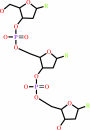 DNA(n)
|
+
|
2'-deoxyribonucleoside 5'-triphosphate
|
=
|
DNA(n+1)
|
+
|
 diphosphate
|
|
|
|
|
|
|
|
|
|
Enzyme class 3:
|
|
E.C.2.7.7.7
- DNA-directed Dna polymerase.
|
|
|
|
|
|
|
Reaction:
|
|
DNA(n) + a 2'-deoxyribonucleoside 5'-triphosphate = DNA(n+1) + diphosphate
|
|
|
|
|
|
DNA(n)
|
+
|
2'-deoxyribonucleoside 5'-triphosphate
|
=
|
DNA(n+1)
|
+
|
diphosphate
|
|
|
|
|
|
|
|
|
|
Enzyme class 4:
|
|
E.C.3.1.-.-
|
|
|
|
|
|
|
Enzyme class 5:
|
|
E.C.3.1.13.2
- exoribonuclease H.
|
|
|
|
|
|
|
Reaction:
|
|
Exonucleolytic cleavage to 5'-phosphomonoester oligonucleotides in both 5'- to 3'- and 3'- to 5'-directions.
|
|
|
|
|
|
Enzyme class 6:
|
|
E.C.3.1.26.13
- retroviral ribonuclease H.
|
|
|
|
|
|
|
Enzyme class 7:
|
|
E.C.3.4.23.16
- HIV-1 retropepsin.
|
|
|
|
|
|
|
Reaction:
|
|
Specific for a P1 residue that is hydrophobic, and P1' variable, but often Pro.
|
|
|
|
|
|
|
|
|
Note, where more than one E.C. class is given (as above), each may
correspond to a different protein domain or, in the case of polyprotein
precursors, to a different mature protein.
|
|
|
|
Molecule diagrams generated from .mol files obtained from the
KEGG ftp site
|
|
|
|
|
|
|
|
|
|
|
|
|
|
 |
|
|
|
|
|
|
| |
|
|
| |
|
DOI no:
|
Biochemistry
38:8892-8898
(1999)
|
|
PubMed id:
|
|
|
|
|
|
| |
|
The mobility of an HIV-1 integrase active site loop is correlated with catalytic activity.
|
|
J.Greenwald,
V.Le,
S.L.Butler,
F.D.Bushman,
S.Choe.
|
|
|
|
|
| |
ABSTRACT
|
|
|
|
| |
|
|
Replication of HIV-1 requires the covalent integration of the viral cDNA into
the host chromosomal DNA directed by the virus-encoded integrase protein. Here
we explore the importance of a protein surface loop near the integrase active
site using protein engineering and X-ray crystallography. We have redetermined
the structure of the integrase catalytic domain (residues 50-212) using an
independent phase set at 1.7 A resolution. The structure extends helix alpha4 on
its N-terminal side (residues 149-154), thus defining the position of the three
conserved active site residues. Evident in this and in previous structures is a
conformationally flexible loop composed of residues 141-148. To probe the role
of flexibility in this loop, we replaced Gly 140 and Gly 149, residues that
appear to act as conformational hinges, with Ala residues. X-ray structures of
the catalytic domain mutants G149A and G140A/G149A show further rigidity of
alpha4 and the adjoining loop. Activity assays in vitro revealed that these
mutants are impaired in catalysis. The DNA binding affinity, however, is
minimally affected by these mutants as assayed by UV cross-linking. We propose
that the conformational flexibility of this active site loop is important for a
postbinding catalytic step.
|
|
|
|
|
|
|
|
|
|
|
|
|
|
|
|
|
|
 |
 |
 |
|
Literature references that cite this PDB file's key reference
|
|
|
| |
PubMed id
|
|
Reference
|
|
|
|
|
|
M.Huang,
G.H.Grant,
and
W.G.Richards
(2011).
Binding modes of diketo-acid inhibitors of HIV-1 integrase: A comparative molecular dynamics simulation study.
|
| |
J Mol Graph Model,
29,
956-964.
|
|
|
|
|
|
|
N.C.Fitzkee,
D.A.Torchia,
and
A.Bax
(2011).
Measuring rapid hydrogen exchange in the homodimeric 36 kDa HIV-1 integrase catalytic core domain.
|
| |
Protein Sci,
20,
500-512.
|
|
|
|
|
|
|
A.Hoffmeier,
H.Betat,
A.Bluschke,
R.Günther,
S.Junghanns,
H.J.Hofmann,
and
M.Mörl
(2010).
Unusual evolution of a catalytic core element in CCA-adding enzymes.
|
| |
Nucleic Acids Res,
38,
4436-4447.
|
|
|
|
|
|
|
A.L.Perryman,
S.Forli,
G.M.Morris,
C.Burt,
Y.Cheng,
M.J.Palmer,
K.Whitby,
J.A.McCammon,
C.Phillips,
and
A.J.Olson
(2010).
A dynamic model of HIV integrase inhibition and drug resistance.
|
| |
J Mol Biol,
397,
600-615.
|
|
|
|
|
|
|
I.V.Nesmelova,
and
P.B.Hackett
(2010).
DDE transposases: Structural similarity and diversity.
|
| |
Adv Drug Deliv Rev,
62,
1187-1195.
|
|
|
|
|
|
|
M.Métifiot,
C.Marchand,
K.Maddali,
and
Y.Pommier
(2010).
Resistance to Integrase Inhibitors.
|
| |
Viruses,
2,
1347-1366.
|
|
|
|
|
|
|
M.Métifiot,
K.Maddali,
A.Naumova,
X.Zhang,
C.Marchand,
and
Y.Pommier
(2010).
Biochemical and pharmacological analyses of HIV-1 integrase flexible loop mutants resistant to raltegravir.
|
| |
Biochemistry,
49,
3715-3722.
|
|
|
|
|
|
|
A.Alian,
S.L.Griner,
V.Chiang,
M.Tsiang,
G.Jones,
G.Birkus,
R.Geleziunas,
A.D.Leavitt,
and
R.M.Stroud
(2009).
Catalytically-active complex of HIV-1 integrase with a viral DNA substrate binds anti-integrase drugs.
|
| |
Proc Natl Acad Sci U S A,
106,
8192-8197.
|
|
|
|
|
|
|
H.Merad,
H.Porumb,
L.Zargarian,
B.René,
Z.Hobaika,
R.G.Maroun,
O.Mauffret,
and
S.Fermandjian
(2009).
An unusual helix turn helix motif in the catalytic core of HIV-1 integrase binds viral DNA and LEDGF.
|
| |
PLoS ONE,
4,
e4081.
|
|
|
|
|
|
|
M.A.Brooks,
R.B.Ravelli,
A.A.McCarthy,
K.Strub,
and
S.Cusack
(2009).
Structure of SRP14 from the Schizosaccharomyces pombe signal recognition particle.
|
| |
Acta Crystallogr D Biol Crystallogr,
65,
421-433.
|
|
|
PDB code:
|
|
|
|
|
|
|
|
M.Jaskolski,
J.N.Alexandratos,
G.Bujacz,
and
A.Wlodawer
(2009).
Piecing together the structure of retroviral integrase, an important target in AIDS therapy.
|
| |
FEBS J,
276,
2926-2946.
|
|
|
|
|
|
|
M.L.Barreca,
N.Iraci,
L.De Luca,
and
A.Chimirri
(2009).
Induced-fit docking approach provides insight into the binding mode and mechanism of action of HIV-1 integrase inhibitors.
|
| |
ChemMedChem,
4,
1446-1456.
|
|
|
|
|
|
|
M.Liu,
X.J.Cong,
P.Li,
J.J.Tan,
W.Z.Chen,
and
C.X.Wang
(2009).
Study on the inhibitory mechanism and binding mode of the hydroxycoumarin compound NSC158393 to HIV-1 integrase by molecular modeling.
|
| |
Biopolymers,
91,
700-709.
|
|
|
|
|
|
|
O.Delelis,
I.Malet,
L.Na,
L.Tchertanov,
V.Calvez,
A.G.Marcelin,
F.Subra,
E.Deprez,
and
J.F.Mouscadet
(2009).
The G140S mutation in HIV integrases from raltegravir-resistant patients rescues catalytic defect due to the resistance Q148H mutation.
|
| |
Nucleic Acids Res,
37,
1193-1201.
|
|
|
|
|
|
|
J.A.Winger,
E.R.Derbyshire,
M.H.Lamers,
M.A.Marletta,
and
J.Kuriyan
(2008).
The crystal structure of the catalytic domain of a eukaryotic guanylate cyclase.
|
| |
BMC Struct Biol,
8,
42.
|
|
|
PDB code:
|
|
|
|
|
|
|
|
K.Shimura,
E.Kodama,
Y.Sakagami,
Y.Matsuzaki,
W.Watanabe,
K.Yamataka,
Y.Watanabe,
Y.Ohata,
S.Doi,
M.Sato,
M.Kano,
S.Ikeda,
and
M.Matsuoka
(2008).
Broad antiretroviral activity and resistance profile of the novel human immunodeficiency virus integrase inhibitor elvitegravir (JTK-303/GS-9137).
|
| |
J Virol,
82,
764-774.
|
|
|
|
|
|
|
O.Goethals,
R.Clayton,
M.Van Ginderen,
I.Vereycken,
E.Wagemans,
P.Geluykens,
K.Dockx,
R.Strijbos,
V.Smits,
A.Vos,
G.Meersseman,
D.Jochmans,
K.Vermeire,
D.Schols,
S.Hallenberger,
and
K.Hertogs
(2008).
Resistance mutations in human immunodeficiency virus type 1 integrase selected with elvitegravir confer reduced susceptibility to a wide range of integrase inhibitors.
|
| |
J Virol,
82,
10366-10374.
|
|
|
|
|
|
|
R.Dayam,
R.Gundla,
L.Q.Al-Mawsawi,
and
N.Neamati
(2008).
HIV-1 integrase inhibitors: 2005-2006 update.
|
| |
Med Res Rev,
28,
118-154.
|
|
|
|
|
|
|
I.B.Dicker,
H.K.Samanta,
Z.Li,
Y.Hong,
Y.Tian,
J.Banville,
R.R.Remillard,
M.A.Walker,
D.R.Langley,
and
M.Krystal
(2007).
Changes to the HIV long terminal repeat and to HIV integrase differentially impact HIV integrase assembly, activity, and the binding of strand transfer inhibitors.
|
| |
J Biol Chem,
282,
31186-31196.
|
|
|
|
|
|
|
V.Nair,
and
G.Chi
(2007).
HIV integrase inhibitors as therapeutic agents in AIDS.
|
| |
Rev Med Virol,
17,
277-295.
|
|
|
|
|
|
|
A.A.Johnson,
J.M.Sayer,
H.Yagi,
S.S.Patil,
F.Debart,
M.A.Maier,
D.R.Corey,
J.J.Vasseur,
T.R.Burke,
V.E.Marquez,
D.M.Jerina,
and
Y.Pommier
(2006).
Effect of DNA modifications on DNA processing by HIV-1 integrase and inhibitor binding: role of DNA backbone flexibility and an open catalytic site.
|
| |
J Biol Chem,
281,
32428-32438.
|
|
|
|
|
|
|
A.A.Johnson,
W.Santos,
G.C.Pais,
C.Marchand,
R.Amin,
T.R.Burke,
G.Verdine,
and
Y.Pommier
(2006).
Integration requires a specific interaction of the donor DNA terminal 5'-cytosine with glutamine 148 of the HIV-1 integrase flexible loop.
|
| |
J Biol Chem,
281,
461-467.
|
|
|
|
|
|
|
D.J.Lee,
and
W.E.Robinson
(2006).
Preliminary mapping of a putative inhibitor-binding pocket for human immunodeficiency virus type 1 integrase inhibitors.
|
| |
Antimicrob Agents Chemother,
50,
134-142.
|
|
|
|
|
|
|
J.Puglia,
T.Wang,
C.Smith-Snyder,
M.Cote,
M.Scher,
J.N.Pelletier,
S.John,
C.B.Jonsson,
and
M.J.Roth
(2006).
Revealing domain structure through linker-scanning analysis of the murine leukemia virus (MuLV) RNase H and MuLV and human immunodeficiency virus type 1 integrase proteins.
|
| |
J Virol,
80,
9497-9510.
|
|
|
|
|
|
|
R.Di Santo,
R.Costi,
A.Roux,
M.Artico,
A.Lavecchia,
L.Marinelli,
E.Novellino,
L.Palmisano,
M.Andreotti,
R.Amici,
C.M.Galluzzo,
L.Nencioni,
A.T.Palamara,
Y.Pommier,
and
C.Marchand
(2006).
Novel bifunctional quinolonyl diketo acid derivatives as HIV-1 integrase inhibitors: design, synthesis, biological activities, and mechanism of action.
|
| |
J Med Chem,
49,
1939-1945.
|
|
|
|
|
|
|
A.Brigo,
K.W.Lee,
F.Fogolari,
G.I.Mustata,
and
J.M.Briggs
(2005).
Comparative molecular dynamics simulations of HIV-1 integrase and the T66I/M154I mutant: binding modes and drug resistance to a diketo acid inhibitor.
|
| |
Proteins,
59,
723-741.
|
|
|
|
|
|
|
A.Brigo,
K.W.Lee,
G.Iurcu Mustata,
and
J.M.Briggs
(2005).
Comparison of multiple molecular dynamics trajectories calculated for the drug-resistant HIV-1 integrase T66I/M154I catalytic domain.
|
| |
Biophys J,
88,
3072-3082.
|
|
|
|
|
|
|
J.Snásel,
Z.Krejcík,
V.Jencová,
I.Rosenberg,
T.Ruml,
J.Alexandratos,
A.Gustchina,
and
I.Pichová
(2005).
Integrase of Mason-Pfizer monkey virus.
|
| |
FEBS J,
272,
203-216.
|
|
|
|
|
|
|
J.Wielens,
I.T.Crosby,
and
D.K.Chalmers
(2005).
A three-dimensional model of the human immunodeficiency virus type 1 integration complex.
|
| |
J Comput Aided Mol Des,
19,
301-317.
|
|
|
PDB code:
|
|
|
|
|
|
|
|
M.C.Lee,
J.Deng,
J.M.Briggs,
and
Y.Duan
(2005).
Large-scale conformational dynamics of the HIV-1 integrase core domain and its catalytic loop mutants.
|
| |
Biophys J,
88,
3133-3146.
|
|
|
|
|
|
|
M.Li,
and
R.Craigie
(2005).
Processing of viral DNA ends channels the HIV-1 integration reaction to concerted integration.
|
| |
J Biol Chem,
280,
29334-29339.
|
|
|
|
|
|
|
P.Retailleau,
N.Colloc'h,
D.Vivarès,
F.Bonneté,
B.Castro,
M.El Hajji,
and
T.Prangé
(2005).
Urate oxidase from Aspergillus flavus: new crystal-packing contacts in relation to the content of the active site.
|
| |
Acta Crystallogr D Biol Crystallogr,
61,
218-229.
|
|
|
PDB codes:
|
|
|
|
|
|
|
|
R.Lu,
A.Limón,
H.Z.Ghory,
and
A.Engelman
(2005).
Genetic analyses of DNA-binding mutants in the catalytic core domain of human immunodeficiency virus type 1 integrase.
|
| |
J Virol,
79,
2493-2505.
|
|
|
|
|
|
|
T.L.Diamond,
and
F.D.Bushman
(2005).
Division of labor within human immunodeficiency virus integrase complexes: determinants of catalysis and target DNA capture.
|
| |
J Virol,
79,
15376-15387.
|
|
|
|
|
|
|
W.Ma,
C.Tang,
and
L.Lai
(2005).
Specificity of trypsin and chymotrypsin: loop-motion-controlled dynamic correlation as a determinant.
|
| |
Biophys J,
89,
1183-1193.
|
|
|
|
|
|
|
D.J.Lee,
and
W.E.Robinson
(2004).
Human immunodeficiency virus type 1 (HIV-1) integrase: resistance to diketo acid integrase inhibitors impairs HIV-1 replication and integration and confers cross-resistance to L-chicoric acid.
|
| |
J Virol,
78,
5835-5847.
|
|
|
|
|
|
|
K.Gao,
S.Wong,
and
F.Bushman
(2004).
Metal binding by the D,DX35E motif of human immunodeficiency virus type 1 integrase: selective rescue of Cys substitutions by Mn2+ in vitro.
|
| |
J Virol,
78,
6715-6722.
|
|
|
|
|
|
|
L.Zargarian,
M.S.Benleumi,
J.G.Renisio,
H.Merad,
R.G.Maroun,
F.Wieber,
O.Mauffret,
H.Porumb,
F.Troalen,
and
S.Fermandjian
(2003).
Strategy to discriminate between high and low affinity bindings of human immunodeficiency virus, type 1 integrase to viral DNA.
|
| |
J Biol Chem,
278,
19966-19973.
|
|
|
|
|
|
|
M.L.Barreca,
K.W.Lee,
A.Chimirri,
and
J.M.Briggs
(2003).
Molecular dynamics studies of the wild-type and double mutant HIV-1 integrase complexed with the 5CITEP inhibitor: mechanism for inhibition and drug resistance.
|
| |
Biophys J,
84,
1450-1463.
|
|
|
|
|
|
|
P.Retailleau,
and
T.Prangé
(2003).
Phasing power at the K absorption edge of organic arsenic.
|
| |
Acta Crystallogr D Biol Crystallogr,
59,
887-896.
|
|
|
PDB code:
|
|
|
|
|
|
|
|
V.Nair
(2002).
HIV integrase as a target for antiviral chemotherapy.
|
| |
Rev Med Virol,
12,
179-193.
|
|
|
|
|
|
|
C.J.Falzone,
Y.Wang,
B.C.Vu,
N.L.Scott,
S.Bhattacharya,
and
J.T.Lecomte
(2001).
Structural and dynamic perturbations induced by heme binding in cytochrome b5.
|
| |
Biochemistry,
40,
4879-4891.
|
|
|
PDB codes:
|
|
|
|
|
|
|
|
C.Laboulais,
E.Deprez,
H.Leh,
J.F.Mouscadet,
J.C.Brochon,
and
M.Le Bret
(2001).
HIV-1 integrase catalytic core: molecular dynamics and simulated fluorescence decays.
|
| |
Biophys J,
81,
473-489.
|
|
|
|
|
|
|
K.Gao,
S.L.Butler,
and
F.Bushman
(2001).
Human immunodeficiency virus type 1 integrase: arrangement of protein domains in active cDNA complexes.
|
| |
EMBO J,
20,
3565-3576.
|
|
|
|
|
|
|
K.O.Alper,
M.Singla,
J.L.Stone,
and
C.K.Bagdassarian
(2001).
Correlated conformational fluctuations during enzymatic catalysis: Implications for catalytic rate enhancement.
|
| |
Protein Sci,
10,
1319-1330.
|
|
|
|
|
|
|
V.Molteni,
J.Greenwald,
D.Rhodes,
Y.Hwang,
W.Kwiatkowski,
F.D.Bushman,
J.S.Siegel,
and
S.Choe
(2001).
Identification of a small-molecule binding site at the dimer interface of the HIV integrase catalytic domain.
|
| |
Acta Crystallogr D Biol Crystallogr,
57,
536-544.
|
|
|
PDB codes:
|
|
|
|
|
|
|
|
E.Deprez,
P.Tauc,
H.Leh,
J.F.Mouscadet,
C.Auclair,
and
J.C.Brochon
(2000).
Oligomeric states of the HIV-1 integrase as measured by time-resolved fluorescence anisotropy.
|
| |
Biochemistry,
39,
9275-9284.
|
|
|
|
|
|
|
J.C.Chen,
J.Krucinski,
L.J.Miercke,
J.S.Finer-Moore,
A.H.Tang,
A.D.Leavitt,
and
R.M.Stroud
(2000).
Crystal structure of the HIV-1 integrase catalytic core and C-terminal domains: a model for viral DNA binding.
|
| |
Proc Natl Acad Sci U S A,
97,
8233-8238.
|
|
|
PDB codes:
|
|
|
|
|
|
|
|
R.D.Lins,
T.P.Straatsma,
and
J.M.Briggs
(2000).
Similarities in the HIV-1 and ASV integrase active sites upon metal cofactor binding.
|
| |
Biopolymers,
53,
308-315.
|
|
|
|
|
|
|
R.G.Maroun,
D.Krebs,
S.El Antri,
A.Deroussent,
E.Lescot,
F.Troalen,
H.Porumb,
M.E.Goldberg,
and
S.Fermandjian
(1999).
Self-association and domains of interactions of an amphipathic helix peptide inhibitor of HIV-1 integrase assessed by analytical ultracentrifugation and NMR experiments in trifluoroethanol/H(2)O mixtures.
|
| |
J Biol Chem,
274,
34174-34185.
|
|
|
|
|
|
The most recent references are shown first.
Citation data come partly from CiteXplore and partly
from an automated harvesting procedure. Note that this is likely to be
only a partial list as not all journals are covered by
either method. However, we are continually building up the citation data
so more and more references will be included with time.
Where a reference describes a PDB structure, the PDB
code is
shown on the right.
|
|


 Links
Links