|
PDBsum entry 1b9f

|
|
|
|
|
 |
Contents |
 |
|
|
|
|
|
|
|
|
|
|
|
|
* Residue conservation analysis
|
|
|
|
|
References listed in PDB file
|
|
|
Key reference
|
|
|
Title
|
|
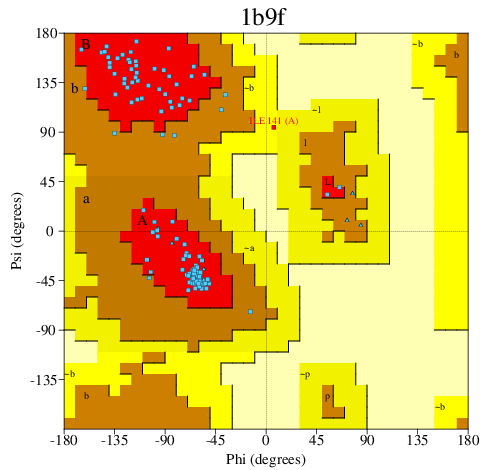
The mobility of an HIV-1 integrase active site loop is correlated with catalytic activity.
|
|
|
Authors
|
|
J.Greenwald,
V.Le,
S.L.Butler,
F.D.Bushman,
S.Choe.
|
|
|
Ref.
|
|
Biochemistry, 1999,
38,
8892-8898.
[DOI no: ]
|
|
|
PubMed id
|
|
|
|
|
|
Abstract
|
|
|
Replication of HIV-1 requires the covalent integration of the viral cDNA into
the host chromosomal DNA directed by the virus-encoded integrase protein. Here
we explore the importance of a protein surface loop near the integrase active
site using protein engineering and X-ray crystallography. We have redetermined
the structure of the integrase catalytic domain (residues 50-212) using an
independent phase set at 1.7 A resolution. The structure extends helix alpha4 on
its N-terminal side (residues 149-154), thus defining the position of the three
conserved active site residues. Evident in this and in previous structures is a
conformationally flexible loop composed of residues 141-148. To probe the role
of flexibility in this loop, we replaced Gly 140 and Gly 149, residues that
appear to act as conformational hinges, with Ala residues. X-ray structures of
the catalytic domain mutants G149A and G140A/G149A show further rigidity of
alpha4 and the adjoining loop. Activity assays in vitro revealed that these
mutants are impaired in catalysis. The DNA binding affinity, however, is
minimally affected by these mutants as assayed by UV cross-linking. We propose
that the conformational flexibility of this active site loop is important for a
postbinding catalytic step.
|
|
|
|
|
|
|