
A post-antibiotic era looms
Antimicrobial Resistance (AMR) is a slow-burning global catastrophe. It occurs when pathogens; bacteria, viruses, fungi, and parasites; evolve to survive the very medicines designed to kill them. This isn't a future problem; it's already here. When pathogens become drug-resistant, common infections can become untreatable, escalating the risk of disease transmission, severe illness, and death.
The scale of this crisis is staggering. A landmark 2024 analysis from the Global Research on Antimicrobial Resistance (GRAM) Project established the sheer burden: in 2021, 4.71 million deaths were associated with bacterial AMR, including 1.14 million deaths directly attributable to it (Naghavi et al. 2024). This systematic analysis indicates that antimicrobial resistance has claimed at least one million lives annually since 1990.
The crisis is also undergoing concerning demographic shifts. While deaths from AMR decreased by more than 50% among children younger than 5 years between 1990 and 2021, they increased by over 80% for adults 70 years and older in the same period. This is particularly alarming because patients over 70 often have underlying comorbidities and frequently receive care in hospitals or long-term facilities, environments where multidrug-resistant pathogens are highly prevalent. Furthermore, resistance to carbapenems in Gram-negative bacteria, a crucial antibiotic class, rose alarmingly, rising from 127,000 attributable deaths in 1990 to 216,000 attributable deaths in 2021. This rapid increase is highly alarming, as carbapenems are often considered last-resort drugs; their rising failure rate signals the dwindling effectiveness of our most critical pharmaceutical defenses.
Looking ahead, the projections are dire: the GRAM study forecasts that an estimated 1.91 million deaths attributable to AMR and 8.22 million deaths associated with AMR could occur globally in 2050. This drastic increase highlights the urgent need for structural intervention and new therapeutic strategies.

Figure 1. The mechanism of antimicrobial resistance. When antibiotics are applied, susceptible bacteria (blue) are eliminated, leaving resistant bacteria (purple) to multiply. These resistant strains can then transfer their resistance genes to other bacteria, accelerating the spread.
While this evolutionary process is natural, human activity has dramatically accelerated its pace. The misuse and overuse of antimicrobials in human medicine, animal husbandry, and agriculture, compounded by inadequate access to clean water and sanitation, have created a perfect storm for selecting and proliferating these "superbugs".
The molecular battlefield: How antibiotics work
To understand resistance, we must first understand the battle at the molecular level. Effective antibiotics function by exploiting the structural and biochemical differences between bacterial and human cells, precisely targeting a molecular machine that exists in the pathogen but is absent in the host. This understanding of molecular targets is precisely where structural biology, the elucidation of a molecule's three-dimensional shape, begins its vital contribution to drug design.
Most clinically vital antibiotics fall into three major classes based on their molecular target:
- Attacking the cell wall (β-Lactams): These drugs inhibit the final step of peptidoglycan layer construction. They mimic the natural building blocks of the wall, forming a covalent bond with the bacterial enzymes (Penicillin-Binding Proteins or PBPs) responsible for cross-linking the wall. Without a rigid, complete cell wall, the bacterium lyses.
- Inhibiting protein synthesis (Macrolides): Macrolides inhibit the synthesis of essential bacterial proteins. They bind to the bacterial ribosome, specifically occluding the nascent peptide chain exit tunnel. This action prevents the elongation of polypeptide chains, thereby disrupting the bacteria's ability to grow and survive.
- Sabotaging DNA replication (Fluoroquinolones): These agents target and disrupt bacterial enzymes such as DNA Gyrase and Topoisomerase IV, which are essential for unwinding and re-ligation of the massive bacterial chromosome during cell division. By stabilising the cleavable complex, the drug causes catastrophic double-strand breaks in the bacterium's genetic material.
The bacterial "defense"
Bacteria have evolved sophisticated, interconnected strategies to counter pharmaceutical agents. These resistance mechanisms can be intrinsic to the species or acquired from other bacteria via horizontal gene transfer.
The primary counter-strategies include:
- Limiting drug uptake (decreased influx): this typically involves structural changes, such as reduced permeability of the outer membrane, particularly in Gram-negative bacteria where the lipopolysaccharide (LPS) layer acts as a primary barrier.
- Target modification: the bacterium alters the structural geometry of the drug's intended target site (e.g., mutations in ribosomal components or DNA gyrase). This structural alteration reduces the drug's binding affinity, preventing effective inhibition of the target enzyme.
- Active efflux: multidrug efflux pumps, such as the AcrAB-TolC system, are transmembrane complexes that actively recognize and expel antibiotics, biocides, and toxic metals from the cell, often faster than they can enter, thus reducing the intracellular concentration to sub-inhibitory levels.
- Drug inactivation: the bacterium produces dedicated enzymes whose sole purpose is to find the antibiotic molecule and destroy or chemically alter it. This is achieved either through hydrolysis of the functional group or by transferring a chemical moiety to the antibiotic, preventing its subsequent interaction with the cellular target.
Case Study: The molecular dexterity of NDM-1
The drug inactivation strategy is one of the most common and structurally compelling challenges. β-lactam antibiotics are currently the most commonly prescribed class, and their effectiveness is being nullified by metallo-β-lactamases (MBLs), bacterial defensive enzymes that use catalytic zinc ions to hydrolyse the β-lactam ring, rendering the antibiotic harmless.

Figure 2: The core chemical structures of common β-lactam antibiotics. The four-membered $\beta$-lactam ring (highlighted) is the reactive moiety that binds to bacterial PBP enzymes and is the target of resistance enzymes.
A specific MBL, New Delhi metallo-B-lactamase-1 (NDM-1), poses a grave public health threat. First identified in 2008, NDM-1 is especially dangerous because it can hydrolyse nearly all β-lactam antibiotics, including the "last-resort" carbapenems, and is not deactivated by standard MBL inhibitors. In addition, the gene for NDM-1 spreads easily between bacteria on mobile genetic elements called plasmids.
Structural studies, primarily through X-ray crystallography and captured in the Protein Data Bank (PDB), have revealed the key to NDM-1’s broad-spectrum activity. The structure adopts a characteristic αβ/βα fold. Its active site is located in a deep cavity, enabling it to tightly bind and activate the catalytic zinc ions.
Crucially, PDB structures (e.g., PDB ID 5zge) revealed that NDM-1's active site is an unusually deep and flexible cavity. This large catalytic core, formed by the loop regions between β5-α 2 and β10-α4, enables the tight coordination and activation of the catalytic zinc ions. The structural elucidation indicates that the active site’s size is significantly larger than in similar enzymes, which begins to explain its high efficacy against numerous antibiotics.
Figure 3. Crystal structure of NDM-1 (PDB ID: 5zge). The enzyme, shown in a ribbon representation (green) with a hydrolysed ampicillin antibiotic (ball-and-stick model) bound in its deep active site. The molecular surface (spacefill) is colored by Solvent Accessible Surface Area. Yellow/pale colours represent areas with low ASA, while blue/dark colours represents areas with high ASA.
However, the most revealing insight is the conformational flexibility of the active site region. Structures solved in different states (including its apo, or metal-free, form and its mono-zinc-bound form, PDB entries 3sfp and 3rkj) demonstrate that the enzyme is highly adaptable. This enlarged and flexible active site allows NDM-1 to accommodate a diverse range of β-lactam substrates, fully explaining its extended catalytic capability.
The intense research focus on this enzyme is clear: as of November 2025, over 150 structures related to NDM-1 are available in the PDB, including 130 for "Metallo-β-lactamase NDM" and 26 for "New Delhi metallo-β-lactamase".
While the PDB provides precise experimental structures, the AlphaFold Protein Structure Database (AFDB) offers a critical advantage in terms of breadth. Recognising the urgency of the AMR crisis, a pivotal strategic decision was made to include the complete predicted proteomes of key organisms important for global health in the AFDB.
This comprehensive structural coverage includes nearly all of the WHO priority pathogens, particularly the notorious ESKAPE bacteria (Enterococcus faecium, Staphylococcus aureus, Klebsiella pneumoniae, Acinetobacter baumannii, Pseudomonas aeruginosa, and Enterobacter spp.), which are known for their multi-drug resistance. While predicted models naturally lack the experimental detail of PDB entries, the AFDB provides structural models for millions of proteins and their variants for which no empirical structure exists. For researchers, the immediate availability of a predicted structural model for a resistance protein from a newly emerging strain is an invaluable head start for computational drug design and target validation.
A call to action: What can we do?
The molecular arms race against AMR requires a unified, two-pronged approach: developing new therapeutic agents (informed by structural biology) and preserving the efficacy of existing ones. The latter involves a global effort in antibiotic stewardship and public health.
We must aggressively address the misuse and overuse of antibiotics. This requires rigorous medical education for providers and better patient awareness.
- Do not use antibacterial agents for viral infections.
- If antibiotics are prescribed, ensure the complete treatment course is followed to prevent the selection of partially resistant strains.
- Implement stricter controls on antibiotic use in agriculture, especially for "last resort" human drugs.
Finally, fundamental public health measures, including ensuring global access to clean water, sanitation, and hygiene (WASH), must be prioritised to reduce the initial incidence of infection and subsequently limit the proliferation of drug-resistant bacteria.
About the artwork
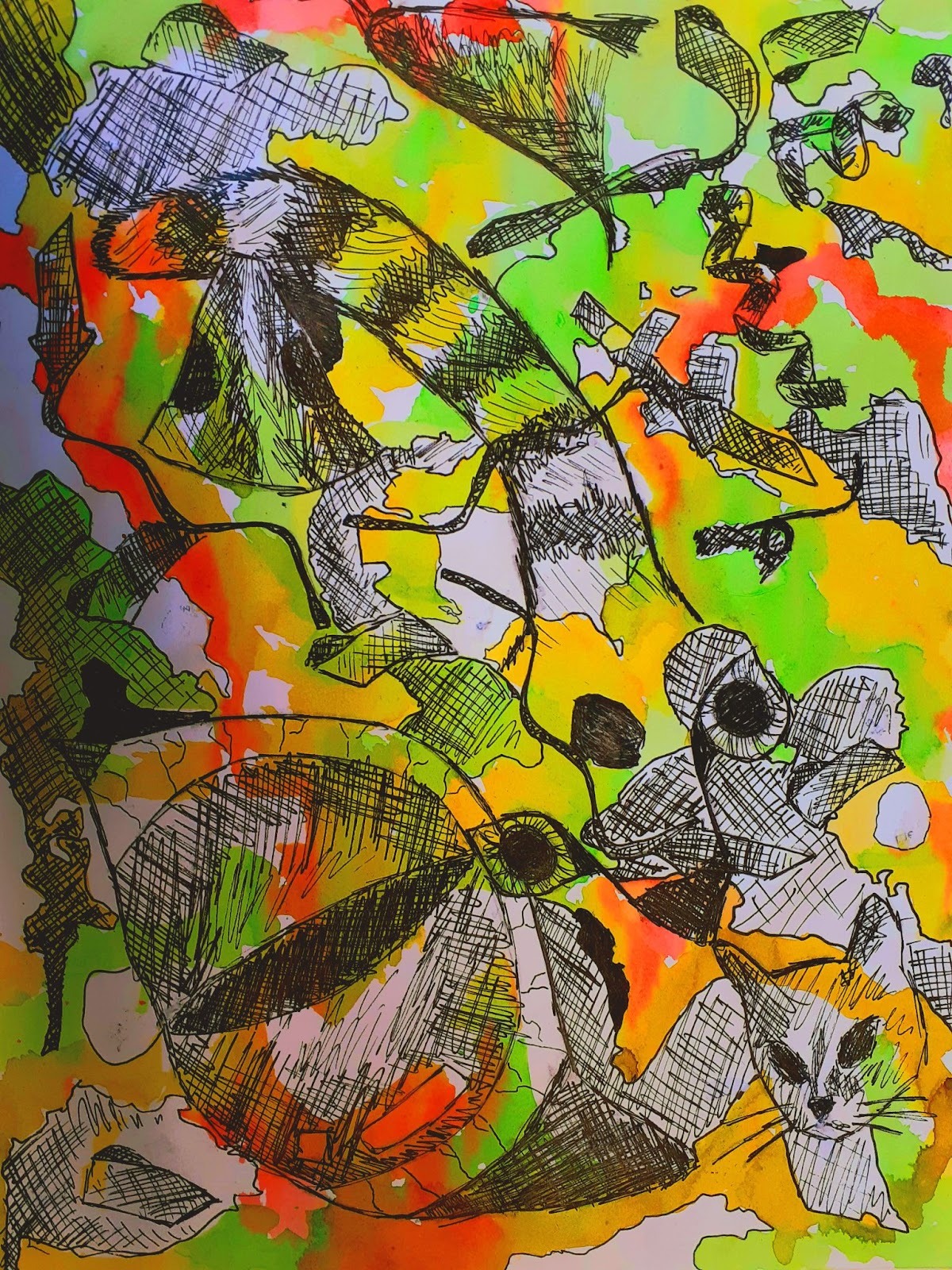
This stunning depiction of a protein structure was created by Magnus Pringle-Green, a Year 8 student from Thomas Gainsburough School. Magnus's inspiration for the piece was two-fold: a fascination with the "windy and spindly" nature of proteins, and his personal preference for cats. The resulting artwork is a vibrant, intricate piece where the scientific subject matter is brought to life through "random and bright colourful colours."
As pet owners, this reminds us of the importance of caring for the health of our animal companions. When a veterinarian prescribes antibiotics for a pet, it is crucial to complete the entire course of medication. We have a limited number of antibiotics available in veterinary medicine, so it’s very important to use them correctly to preserve their efficacy and make sure that we and our pets will have medicines to control bacterial infections in the future.
References and further reading:
- Naghavi, Mohsen, Stein Emil Vollset, Kevin S. Ikuta, Lucien R. Swetschinski, Authia P. Gray, Eve E. Wool, Gisela Robles Aguilar, et al. (2024). ‘Global Burden of Bacterial Antimicrobial Resistance 1990–2021: A Systematic Analysis with Forecasts to 2050’. The Lancet 404 (10459): 1199–226. https://doi.org/10.1016/S0140-6736(24)01867-1.
- Jin, M. et al. (2023) ‘Evidence for the transmission of antimicrobial resistant bacteria between humans and companion animals: A scoping review’, One Health, 17, p. 100593. doi:10.1016/j.onehlt.2023.100593.
- Aithal, S., Guo, H., Teo, B. H., Chua, T., Hildon, Z. J., & Chow, A. (2025). Pet Owners' Knowledge of Antibiotic Use and Antimicrobial Resistance and Their Antibiotic Practices: Comparison Between Contexts of Self and Pet. Antibiotics (Basel, Switzerland), 14(2), 158. https://doi.org/10.3390/antibiotics14020158