 |
PDBsum entry 2phk

|
|
|
|
|
|

|

|

|

|
|

|
|

|
|

|
|

|
|

|
|

|
|
|
 |

|

|
|
|
|
|
|
|
|
|
|
|
|
|
|
|
|
|
|
|
|
|
|
|
|
|
|
|
|
|
|
|
|
|
|
|
Complex (transferase/peptide)
|
PDB id
|
|
|
|
2phk
|
|
|
|
|
|
|
|
|
|
|
|
|
|
|

|

|

|
|
|
|
|
|
|
|
 |
Contents |
 |
|
|
|
|
|
|
|
|
|
|
|
|
|
|
* Residue conservation analysis
|
|
|
|
|
|
|
|
|
|
|
Enzyme class 1:
|
|
E.C.2.7.11.1
- non-specific serine/threonine protein kinase.
|
|
|
|
|
|
|
Reaction:
|
|
|
1.
|
L-seryl-[protein] + ATP = O-phospho-L-seryl-[protein] + ADP + H+
|
|
2.
|
L-threonyl-[protein] + ATP = O-phospho-L-threonyl-[protein] + ADP + H+
|
|
|
|
|
|
|
L-seryl-[protein]
Bound ligand (Het Group name = )
corresponds exactly
|
+
|
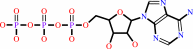 ATP
ATP
|
=
|
O-phospho-L-seryl-[protein]
|
+
|
 ADP
ADP
|
+
|
H(+)
|
|
|
|
|
|
|
L-threonyl-[protein]
Bound ligand (Het Group name = )
corresponds exactly
|
+
|
ATP
|
=
|
O-phospho-L-threonyl-[protein]
|
+
|
ADP
|
+
|
H(+)
|
|
|
|
|
|
|
|
|
|
Enzyme class 2:
|
|
E.C.2.7.11.19
- phosphorylase kinase.
|
|
|
|
|
|
|
Reaction:
|
|
2 ATP + phosphorylase b = 2 ADP + phosphorylase a
|
|
|
|
|
|
2
×
ATP
Bound ligand (Het Group name = )
corresponds exactly
|
+
|
phosphorylase b
|
=
|
2
×
ADP
|
+
|
phosphorylase a
|
|
|
|
|
|
|
|
|
|
Cofactor:
|
|
Ca(2+)
|
|
|
|
|
|
Enzyme class 3:
|
|
E.C.2.7.11.26
- [tau protein] kinase.
|
|
|
|
|
|
|
Reaction:
|
|
|
1.
|
L-seryl-[tau protein] + ATP = O-phospho-L-seryl-[tau protein] + ADP + H+
|
|
2.
|
L-threonyl-[tau protein] + ATP = O-phospho-L-threonyl-[tau protein] + ADP + H+
|
|
|
|
|
|
|
2
×
L-seryl-[tau protein]
Bound ligand (Het Group name = )
corresponds exactly
|
+
|
ATP
|
=
|
2
×
O-phospho-L-seryl-[tau protein]
|
+
|
ADP
|
+
|
H(+)
|
|
|
|
|
|
|
L-threonyl-[tau protein]
Bound ligand (Het Group name = )
corresponds exactly
|
+
|
ATP
|
=
|
O-phospho-L-threonyl-[tau protein]
|
+
|
ADP
|
+
|
H(+)
|
|
|
|
|
|
|
|
|
|
|
|
|
Note, where more than one E.C. class is given (as above), each may
correspond to a different protein domain or, in the case of polyprotein
precursors, to a different mature protein.
|
|
|
|
Molecule diagrams generated from .mol files obtained from the
KEGG ftp site
|
|
|
|
|
|
|
|
|
|
|
|
|
|
 |
|
|
|
|
|
|
| |
|
|
| |
|
DOI no:
|
EMBO J
16:6646-6658
(1997)
|
|
PubMed id:
|
|
|
|
|
|
| |
|
The crystal structure of a phosphorylase kinase peptide substrate complex: kinase substrate recognition.
|
|
E.D.Lowe,
M.E.Noble,
V.T.Skamnaki,
N.G.Oikonomakos,
D.J.Owen,
L.N.Johnson.
|
|
|
|
|
| |
ABSTRACT
|
|
|
|
| |
|
|
The structure of a truncated form of the gamma-subunit of phosphorylase kinase
(PHKgammat) has been solved in a ternary complex with a non-hydrolysable ATP
analogue (adenylyl imidodiphosphate, AMPPNP) and a heptapeptide substrate
related in sequence to both the natural substrate and to the optimal peptide
substrate. Kinetic characterization of the phosphotransfer reaction confirms the
peptide to be a good substrate, and the structure allows identification of key
features responsible for its high affinity. Unexpectedly, the substrate peptide
forms a short anti-parallel beta-sheet with the kinase activation segment, the
region which in other kinases plays an important role in regulation of enzyme
activity. This anchoring of the main chain of the substrate peptide at a fixed
distance from the gamma-phosphate of ATP explains the selectivity of PHK for
serine/threonine over tyrosine as a substrate. The catalytic core of PHK exists
as a dimer in crystals of the ternary complex, and the relevance of this
phenomenon to its in vivo recognition of dimeric glycogen phosphorylase b is
considered.
|
|
|
|
|
|
| |
Selected figure(s)
|
|
|
|
| |
|
|

|
|

|
|
Figure 3.
Figure 3 Conformations of kinase inhibitor and substrate
peptides. (A) Conformation of residues 11 -17 of GPa. (B)
Conformation of residues 11 -17 of GPb. (C) Conformation of the
MC-peptide, as observed in complex with PHK  [t].
(D) Conformation of the equivalent part of the protein kinase
inhibitor peptide, as observed in complex with cAPK. [t].
(D) Conformation of the equivalent part of the protein kinase
inhibitor peptide, as observed in complex with cAPK.
|
|
Figure 6.
Figure 6 Interactions of nucleophile, base and phosphate group.
Interactions which might occur in a general base-catalysed
reaction mechanism via: (A) the observed structure of the
ternary complex and (B) an alternative conformation modelled by
giving the attacking serine residue a  1
angle of -60°. 1
angle of -60°.
|
|
|
|
|
|
| |
The above figures are
reprinted
from an Open Access publication published by Macmillan Publishers Ltd:
EMBO J
(1997,
16,
6646-6658)
copyright 1997.
|
|
| |
Figures were
selected
by an automated process.
|
|
|
|
|
|
|
|
|
|
|
|
|
|
|
|
 |
 |
 |
|
Literature references that cite this PDB file's key reference
|
|
|
| |
PubMed id
|
|
Reference
|
|
|
|
|
|
D.Barford,
and
D.I.Stuart
(2012).
Louise N. Johnson 1940-2012.
|
| |
Nat Struct Mol Biol,
19,
1216-1217.
|
|
|
|
|
|
|
M.S.Stark,
S.L.Woods,
M.G.Gartside,
V.F.Bonazzi,
K.Dutton-Regester,
L.G.Aoude,
D.Chow,
C.Sereduk,
N.M.Niemi,
N.Tang,
J.J.Ellis,
J.Reid,
V.Zismann,
S.Tyagi,
D.Muzny,
I.Newsham,
Y.Wu,
J.M.Palmer,
T.Pollak,
D.Youngkin,
B.R.Brooks,
C.Lanagan,
C.W.Schmidt,
B.Kobe,
J.P.MacKeigan,
H.Yin,
K.M.Brown,
R.Gibbs,
J.Trent,
and
N.K.Hayward
(2012).
Frequent somatic mutations in MAP3K5 and MAP3K9 in metastatic melanoma identified by exome sequencing.
|
| |
Nat Genet,
44,
165-169.
|
|
|
|
|
|
|
S.Liokatis,
A.Stützer,
S.J.Elsässer,
F.X.Theillet,
R.Klingberg,
B.van Rossum,
D.Schwarzer,
C.D.Allis,
W.Fischle,
and
P.Selenko
(2012).
Phosphorylation of histone H3 Ser10 establishes a hierarchy for subsequent intramolecular modification events.
|
| |
Nat Struct Mol Biol,
19,
819-823.
|
|
|
|
|
|
|
J.M.Hayes,
V.T.Skamnaki,
G.Archontis,
C.Lamprakis,
J.Sarrou,
N.Bischler,
A.L.Skaltsounis,
S.E.Zographos,
and
N.G.Oikonomakos
(2011).
Kinetics, in silico docking, molecular dynamics, and MM-GBSA binding studies on prototype indirubins, KT5720, and staurosporine as phosphorylase kinase ATP-binding site inhibitors: the role of water molecules examined.
|
| |
Proteins,
79,
703-719.
|
|
|
|
|
|
|
S.Kostenko,
M.T.Khan,
I.Sylte,
and
U.Moens
(2011).
The diterpenoid alkaloid noroxoaconitine is a Mapkap kinase 5 (MK5/PRAK) inhibitor.
|
| |
Cell Mol Life Sci,
68,
289-301.
|
|
|
|
|
|
|
J.Mok,
P.M.Kim,
H.Y.Lam,
S.Piccirillo,
X.Zhou,
G.R.Jeschke,
D.L.Sheridan,
S.A.Parker,
V.Desai,
M.Jwa,
E.Cameroni,
H.Niu,
M.Good,
A.Remenyi,
J.L.Ma,
Y.J.Sheu,
H.E.Sassi,
R.Sopko,
C.S.Chan,
C.De Virgilio,
N.M.Hollingsworth,
W.A.Lim,
D.F.Stern,
B.Stillman,
B.J.Andrews,
M.B.Gerstein,
M.Snyder,
and
B.E.Turk
(2010).
Deciphering protein kinase specificity through large-scale analysis of yeast phosphorylation site motifs.
|
| |
Sci Signal,
3,
ra12.
|
|
|
|
|
|
|
K.Hong Lim,
C.K.Hsu,
and
S.Park
(2010).
Flow cytometric analysis of genetic FRET detectors containing variable substrate sequences.
|
| |
Biotechnol Prog,
26,
1765-1771.
|
|
|
|
|
|
|
L.H.Chao,
P.Pellicena,
S.Deindl,
L.A.Barclay,
H.Schulman,
and
J.Kuriyan
(2010).
Intersubunit capture of regulatory segments is a component of cooperative CaMKII activation.
|
| |
Nat Struct Mol Biol,
17,
264-272.
|
|
|
PDB codes:
|
|
|
|
|
|
|
|
M.J.Hernández-López,
J.A.Prieto,
and
F.Randez-Gil
(2010).
Isolation and characterization of the carbon catabolite-derepressing protein kinase Snf1 from the stress tolerant yeast Torulaspora delbrueckii.
|
| |
Yeast,
27,
1061-1069.
|
|
|
|
|
|
|
M.Rabiller,
M.Getlik,
S.Klüter,
A.Richters,
S.Tückmantel,
J.R.Simard,
and
D.Rauh
(2010).
Proteus in the world of proteins: conformational changes in protein kinases.
|
| |
Arch Pharm (Weinheim),
343,
193-206.
|
|
|
|
|
|
|
N.Kumar,
and
D.Mohanty
(2010).
Identification of substrates for Ser/Thr kinases using residue-based statistical pair potentials.
|
| |
Bioinformatics,
26,
189-197.
|
|
|
|
|
|
|
S.Prisic,
S.Dankwa,
D.Schwartz,
M.F.Chou,
J.W.Locasale,
C.M.Kang,
G.Bemis,
G.M.Church,
H.Steen,
and
R.N.Husson
(2010).
Extensive phosphorylation with overlapping specificity by Mycobacterium tuberculosis serine/threonine protein kinases.
|
| |
Proc Natl Acad Sci U S A,
107,
7521-7526.
|
|
|
|
|
|
|
C.Vénien-Bryan,
S.Jonic,
V.Skamnaki,
N.Brown,
N.Bischler,
N.G.Oikonomakos,
N.Boisset,
and
L.N.Johnson
(2009).
The structure of phosphorylase kinase holoenzyme at 9.9 a resolution and location of the catalytic subunit and the substrate glycogen phosphorylase.
|
| |
Structure,
17,
117-127.
|
|
|
|
|
|
|
L.K.McNamara,
D.M.Watterson,
and
J.S.Brunzelle
(2009).
Structural insight into nucleotide recognition by human death-associated protein kinase.
|
| |
Acta Crystallogr D Biol Crystallogr,
65,
241-248.
|
|
|
PDB codes:
|
|
|
|
|
|
|
|
B.E.Turk
(2008).
Understanding and exploiting substrate recognition by protein kinases.
|
| |
Curr Opin Chem Biol,
12,
4.
|
|
|
|
|
|
|
J.A.Ubersax,
and
J.E.Ferrell
(2007).
Mechanisms of specificity in protein phosphorylation.
|
| |
Nat Rev Mol Cell Biol,
8,
530-541.
|
|
|
|
|
|
|
J.S.Winchester,
E.C.Rouchka,
N.S.Rowland,
and
N.A.Rice
(2007).
In Silico characterization of phosphorylase kinase: evidence for an alternate intronic polyadenylation site in PHKG1.
|
| |
Mol Genet Metab,
92,
234-242.
|
|
|
|
|
|
|
N.J.Beauchamp,
J.Taybert,
M.P.Champion,
V.Layet,
P.Heinz-Erian,
A.Dalton,
M.S.Tanner,
E.Pronicka,
and
M.J.Sharrard
(2007).
High frequency of missense mutations in glycogen storage disease type VI.
|
| |
J Inherit Metab Dis,
30,
722-734.
|
|
|
|
|
|
|
O.W.Nadeau,
D.W.Anderson,
Q.Yang,
A.Artigues,
J.E.Paschall,
G.J.Wyckoff,
J.L.McClintock,
and
G.M.Carlson
(2007).
Evidence for the location of the allosteric activation switch in the multisubunit phosphorylase kinase complex from mass spectrometric identification of chemically crosslinked peptides.
|
| |
J Mol Biol,
365,
1429-1445.
|
|
|
|
|
|
|
A.Marx,
C.Nugoor,
J.Müller,
S.Panneerselvam,
T.Timm,
M.Bilang,
E.Mylonas,
D.I.Svergun,
E.M.Mandelkow,
and
E.Mandelkow
(2006).
Structural variations in the catalytic and ubiquitin-associated domains of microtubule-associated protein/microtubule affinity regulating kinase (MARK) 1 and MARK2.
|
| |
J Biol Chem,
281,
27586-27599.
|
|
|
PDB code:
|
|
|
|
|
|
|
|
H.Remaut,
and
G.Waksman
(2006).
Protein-protein interaction through beta-strand addition.
|
| |
Trends Biochem Sci,
31,
436-444.
|
|
|
|
|
|
|
M.A.Bogoyevitch,
and
B.Kobe
(2006).
Uses for JNK: the many and varied substrates of the c-Jun N-terminal kinases.
|
| |
Microbiol Mol Biol Rev,
70,
1061-1095.
|
|
|
|
|
|
|
M.A.Shakir,
J.S.Gill,
and
E.A.Lundquist
(2006).
Interactions of UNC-34 Enabled with Rac GTPases and the NIK kinase MIG-15 in Caenorhabditis elegans axon pathfinding and neuronal migration.
|
| |
Genetics,
172,
893-913.
|
|
|
|
|
|
|
P.Pellicena,
and
J.Kuriyan
(2006).
Protein-protein interactions in the allosteric regulation of protein kinases.
|
| |
Curr Opin Struct Biol,
16,
702-709.
|
|
|
|
|
|
|
Y.Cheng,
Y.Zhang,
and
J.A.McCammon
(2006).
How does activation loop phosphorylation modulate catalytic activity in the cAMP-dependent protein kinase: a theoretical study.
|
| |
Protein Sci,
15,
672-683.
|
|
|
|
|
|
|
A.C.Dar,
T.E.Dever,
and
F.Sicheri
(2005).
Higher-order substrate recognition of eIF2alpha by the RNA-dependent protein kinase PKR.
|
| |
Cell,
122,
887-900.
|
|
|
PDB codes:
|
|
|
|
|
|
|
|
A.G.Cook,
L.N.Johnson,
and
J.M.McDonnell
(2005).
Structural characterization of Ca2+/CaM in complex with the phosphorylase kinase PhK5 peptide.
|
| |
FEBS J,
272,
1511-1522.
|
|
|
|
|
|
|
A.N.Bullock,
J.Debreczeni,
A.L.Amos,
S.Knapp,
and
B.E.Turk
(2005).
Structure and substrate specificity of the Pim-1 kinase.
|
| |
J Biol Chem,
280,
41675-41682.
|
|
|
|
|
|
|
B.Lu,
C.F.Wong,
and
J.A.McCammon
(2005).
Release of ADP from the catalytic subunit of protein kinase A: a molecular dynamics simulation study.
|
| |
Protein Sci,
14,
159-168.
|
|
|
|
|
|
|
D.Komander,
G.Kular,
M.Deak,
D.R.Alessi,
and
D.M.van Aalten
(2005).
Role of T-loop phosphorylation in PDK1 activation, stability, and substrate binding.
|
| |
J Biol Chem,
280,
18797-18802.
|
|
|
PDB code:
|
|
|
|
|
|
|
|
G.Zhu,
K.Fujii,
N.Belkina,
Y.Liu,
M.James,
J.Herrero,
and
S.Shaw
(2005).
Exceptional disfavor for proline at the P + 1 position among AGC and CAMK kinases establishes reciprocal specificity between them and the proline-directed kinases.
|
| |
J Biol Chem,
280,
10743-10748.
|
|
|
|
|
|
|
M.Lei,
M.A.Robinson,
and
S.C.Harrison
(2005).
The active conformation of the PAK1 kinase domain.
|
| |
Structure,
13,
769-778.
|
|
|
PDB codes:
|
|
|
|
|
|
|
|
M.R.Stegert,
A.Hergovich,
R.Tamaskovic,
S.J.Bichsel,
and
B.A.Hemmings
(2005).
Regulation of NDR protein kinase by hydrophobic motif phosphorylation mediated by the mammalian Ste20-like kinase MST3.
|
| |
Mol Cell Biol,
25,
11019-11029.
|
|
|
|
|
|
|
N.Yokoyama,
J.Lougheed,
and
W.T.Miller
(2005).
Phosphorylation of WASP by the Cdc42-associated kinase ACK1: dual hydroxyamino acid specificity in a tyrosine kinase.
|
| |
J Biol Chem,
280,
42219-42226.
|
|
|
|
|
|
|
O.S.Rosenberg,
S.Deindl,
R.J.Sung,
A.C.Nairn,
and
J.Kuriyan
(2005).
Structure of the autoinhibited kinase domain of CaMKII and SAXS analysis of the holoenzyme.
|
| |
Cell,
123,
849-860.
|
|
|
PDB code:
|
|
|
|
|
|
|
|
R.Zhang,
C.K.Nickl,
A.Mamai,
S.Flemer,
A.Natarajan,
W.R.Dostmann,
and
J.S.Madalengoitia
(2005).
Poly-L-proline type II peptide mimics as probes of the active site occupancy requirements of cGMP-dependent protein kinase.
|
| |
J Pept Res,
66,
151-159.
|
|
|
|
|
|
|
L.M.Iakoucheva,
P.Radivojac,
C.J.Brown,
T.R.O'Connor,
J.G.Sikes,
Z.Obradovic,
and
A.K.Dunker
(2004).
The importance of intrinsic disorder for protein phosphorylation.
|
| |
Nucleic Acids Res,
32,
1037-1049.
|
|
|
|
|
|
|
M.Y.Niv,
H.Rubin,
J.Cohen,
L.Tsirulnikov,
T.Licht,
A.Peretzman-Shemer,
E.Cna'an,
A.Tartakovsky,
I.Stein,
S.Albeck,
I.Weinstein,
M.Goldenberg-Furmanov,
D.Tobi,
E.Cohen,
M.Laster,
S.A.Ben-Sasson,
and
H.Reuveni
(2004).
Sequence-based design of kinase inhibitors applicable for therapeutics and target identification.
|
| |
J Biol Chem,
279,
1242-1255.
|
|
|
|
|
|
|
N.Kannan,
and
A.F.Neuwald
(2004).
Evolutionary constraints associated with functional specificity of the CMGC protein kinases MAPK, CDK, GSK, SRPK, DYRK, and CK2alpha.
|
| |
Protein Sci,
13,
2059-2077.
|
|
|
|
|
|
|
A.Nayeem,
S.Krystek,
and
T.Stouch
(2003).
An assessment of protein-ligand binding site polarizability.
|
| |
Biopolymers,
70,
201-211.
|
|
|
|
|
|
|
N.Rekha,
and
N.Srinivasan
(2003).
Structural basis of regulation and substrate specificity of protein kinase CK2 deduced from the modeling of protein-protein interactions.
|
| |
BMC Struct Biol,
3,
4.
|
|
|
|
|
|
|
R.I.Brinkworth,
R.A.Breinl,
and
B.Kobe
(2003).
Structural basis and prediction of substrate specificity in protein serine/threonine kinases.
|
| |
Proc Natl Acad Sci U S A,
100,
74-79.
|
|
|
|
|
|
|
A.Cook,
E.D.Lowe,
E.D.Chrysina,
V.T.Skamnaki,
N.G.Oikonomakos,
and
L.N.Johnson
(2002).
Structural studies on phospho-CDK2/cyclin A bound to nitrate, a transition state analogue: implications for the protein kinase mechanism.
|
| |
Biochemistry,
41,
7301-7311.
|
|
|
PDB code:
|
|
|
|
|
|
|
|
A.M.Schumacher,
A.V.Velentza,
and
D.M.Watterson
(2002).
Death-associated protein kinase as a potential therapeutic target.
|
| |
Expert Opin Ther Targets,
6,
497-506.
|
|
|
|
|
|
|
B.M.Collins,
A.J.McCoy,
H.M.Kent,
P.R.Evans,
and
D.J.Owen
(2002).
Molecular architecture and functional model of the endocytic AP2 complex.
|
| |
Cell,
109,
523-535.
|
|
|
PDB codes:
|
|
|
|
|
|
|
|
B.Zhao,
M.J.Bower,
P.J.McDevitt,
H.Zhao,
S.T.Davis,
K.O.Johanson,
S.M.Green,
N.O.Concha,
and
B.B.Zhou
(2002).
Structural basis for Chk1 inhibition by UCN-01.
|
| |
J Biol Chem,
277,
46609-46615.
|
|
|
PDB codes:
|
|
|
|
|
|
|
|
C.Vénien-Bryan,
E.M.Lowe,
N.Boisset,
K.W.Traxler,
L.N.Johnson,
and
G.M.Carlson
(2002).
Three-dimensional structure of phosphorylase kinase at 22 A resolution and its complex with glycogen phosphorylase b.
|
| |
Structure,
10,
33-41.
|
|
|
|
|
|
|
E.A.Campbell,
S.Masuda,
J.L.Sun,
O.Muzzin,
C.A.Olson,
S.Wang,
and
S.A.Darst
(2002).
Crystal structure of the Bacillus stearothermophilus anti-sigma factor SpoIIAB with the sporulation sigma factor sigmaF.
|
| |
Cell,
108,
795-807.
|
|
|
PDB code:
|
|
|
|
|
|
|
|
J.Yang,
P.Cron,
V.M.Good,
V.Thompson,
B.A.Hemmings,
and
D.Barford
(2002).
Crystal structure of an activated Akt/protein kinase B ternary complex with GSK3-peptide and AMP-PNP.
|
| |
Nat Struct Biol,
9,
940-944.
|
|
|
PDB codes:
|
|
|
|
|
|
|
|
R.I.Brinkworth,
J.Horne,
and
B.Kobe
(2002).
A computational analysis of substrate binding strength by phosphorylase kinase and protein kinase A.
|
| |
J Mol Recognit,
15,
104-111.
|
|
|
|
|
|
|
T.O'Neill,
L.Giarratani,
P.Chen,
L.Iyer,
C.H.Lee,
M.Bobiak,
F.Kanai,
B.B.Zhou,
J.H.Chung,
and
G.A.Rathbun
(2002).
Determination of substrate motifs for human Chk1 and hCds1/Chk2 by the oriented peptide library approach.
|
| |
J Biol Chem,
277,
16102-16115.
|
|
|
|
|
|
|
A.J.Ablooglu,
M.Frankel,
E.Rusinova,
J.B.Ross,
and
R.A.Kohanski
(2001).
Multiple activation loop conformations and their regulatory properties in the insulin receptor's kinase domain.
|
| |
J Biol Chem,
276,
46933-46940.
|
|
|
|
|
|
|
A.V.Velentza,
A.M.Schumacher,
C.Weiss,
M.Egli,
and
D.M.Watterson
(2001).
A protein kinase associated with apoptosis and tumor suppression: structure, activity, and discovery of peptide substrates.
|
| |
J Biol Chem,
276,
38956-38965.
|
|
|
|
|
|
|
G.Shani,
S.Henis-Korenblit,
G.Jona,
O.Gileadi,
M.Eisenstein,
T.Ziv,
A.Admon,
and
A.Kimchi
(2001).
Autophosphorylation restrains the apoptotic activity of DRP-1 kinase by controlling dimerization and calmodulin binding.
|
| |
EMBO J,
20,
1099-1113.
|
|
|
|
|
|
|
G.Shohat,
T.Spivak-Kroizman,
O.Cohen,
S.Bialik,
G.Shani,
H.Berrisi,
M.Eisenstein,
and
A.Kimchi
(2001).
The pro-apoptotic function of death-associated protein kinase is controlled by a unique inhibitory autophosphorylation-based mechanism.
|
| |
J Biol Chem,
276,
47460-47467.
|
|
|
|
|
|
|
R.Dajani,
E.Fraser,
S.M.Roe,
N.Young,
V.Good,
T.C.Dale,
and
L.H.Pearl
(2001).
Crystal structure of glycogen synthase kinase 3 beta: structural basis for phosphate-primed substrate specificity and autoinhibition.
|
| |
Cell,
105,
721-732.
|
|
|
PDB code:
|
|
|
|
|
|
|
|
V.Tereshko,
M.Teplova,
J.Brunzelle,
D.M.Watterson,
and
M.Egli
(2001).
Crystal structures of the catalytic domain of human protein kinase associated with apoptosis and tumor suppression.
|
| |
Nat Struct Biol,
8,
899-907.
|
|
|
PDB codes:
|
|
|
|
|
|
|
|
A.C.Biorn,
C.Bartleson,
and
D.J.Graves
(2000).
Site-directed mutants of glycogen phosphorylase are altered in their interaction with phosphorylase kinase.
|
| |
Biochemistry,
39,
15887-15894.
|
|
|
|
|
|
|
C.Bartleson,
S.Luo,
D.J.Graves,
and
B.L.Martin
(2000).
Arginine to citrulline replacement in substrates of phosphorylase kinase.
|
| |
Biochim Biophys Acta,
1480,
23-28.
|
|
|
|
|
|
|
K.A.Denessiouk,
and
M.S.Johnson
(2000).
When fold is not important: a common structural framework for adenine and AMP binding in 12 unrelated protein families.
|
| |
Proteins,
38,
310-326.
|
|
|
|
|
|
|
L.Konkol,
T.J.Hirai,
and
J.A.Adams
(2000).
Substrate specificity of the oncoprotein v-Fps: site-specific mutagenesis of the putative P+1 pocket.
|
| |
Biochemistry,
39,
255-262.
|
|
|
|
|
|
|
P.Chen,
C.Luo,
Y.Deng,
K.Ryan,
J.Register,
S.Margosiak,
A.Tempczyk-Russell,
B.Nguyen,
P.Myers,
K.Lundgren,
C.C.Kan,
and
P.M.O'Connor
(2000).
The 1.7 A crystal structure of human cell cycle checkpoint kinase Chk1: implications for Chk1 regulation.
|
| |
Cell,
100,
681-692.
|
|
|
PDB code:
|
|
|
|
|
|
|
|
S.Himpel,
W.Tegge,
R.Frank,
S.Leder,
H.G.Joost,
and
W.Becker
(2000).
Specificity determinants of substrate recognition by the protein kinase DYRK1A.
|
| |
J Biol Chem,
275,
2431-2438.
|
|
|
|
|
|
|
A.G.Ryazanov,
K.S.Pavur,
and
M.V.Dorovkov
(1999).
Alpha-kinases: a new class of protein kinases with a novel catalytic domain.
|
| |
Curr Biol,
9,
R43-R45.
|
|
|
|
|
|
|
D.Graves,
C.Bartleson,
A.Biorn,
and
M.Pete
(1999).
Substrate and inhibitor recognition of protein kinases: what is known about the catalytic subunit of phosphorylase kinase?
|
| |
Pharmacol Ther,
82,
143-155.
|
|
|
|
|
|
|
M.Gautel,
A.Mues,
and
P.Young
(1999).
Control of sarcomeric assembly: the flow of information on titin.
|
| |
Rev Physiol Biochem Pharmacol,
138,
97.
|
|
|
|
|
|
|
N.R.Brown,
M.E.Noble,
A.M.Lawrie,
M.C.Morris,
P.Tunnah,
G.Divita,
L.N.Johnson,
and
J.A.Endicott
(1999).
Effects of phosphorylation of threonine 160 on cyclin-dependent kinase 2 structure and activity.
|
| |
J Biol Chem,
274,
8746-8756.
|
|
|
PDB codes:
|
|
|
|
|
|
|
|
P.Sharma,
P.J.Steinbach,
M.Sharma,
N.D.Amin,
J.J.Barchi,
and
H.C.Pant
(1999).
Identification of substrate binding site of cyclin-dependent kinase 5.
|
| |
J Biol Chem,
274,
9600-9606.
|
|
|
|
|
|
|
V.T.Skamnaki,
D.J.Owen,
M.E.Noble,
E.D.Lowe,
G.Lowe,
N.G.Oikonomakos,
and
L.N.Johnson
(1999).
Catalytic mechanism of phosphorylase kinase probed by mutational studies.
|
| |
Biochemistry,
38,
14718-14730.
|
|
|
PDB code:
|
|
|
|
|
|
|
|
D.J.Owen,
and
P.R.Evans
(1998).
A structural explanation for the recognition of tyrosine-based endocytotic signals.
|
| |
Science,
282,
1327-1332.
|
|
|
PDB codes:
|
|
|
|
|
|
|
|
K.Niefind,
B.Guerra,
L.A.Pinna,
O.G.Issinger,
and
D.Schomburg
(1998).
Crystal structure of the catalytic subunit of protein kinase CK2 from Zea mays at 2.1 A resolution.
|
| |
EMBO J,
17,
2451-2462.
|
|
|
PDB code:
|
|
|
|
|
|
|
|
M.Matsushita,
and
A.C.Nairn
(1998).
Characterization of the mechanism of regulation of Ca2+/ calmodulin-dependent protein kinase I by calmodulin and by Ca2+/calmodulin-dependent protein kinase kinase.
|
| |
J Biol Chem,
273,
21473-21481.
|
|
|
|
|
|
The most recent references are shown first.
Citation data come partly from CiteXplore and partly
from an automated harvesting procedure. Note that this is likely to be
only a partial list as not all journals are covered by
either method. However, we are continually building up the citation data
so more and more references will be included with time.
Where a reference describes a PDB structure, the PDB
codes are
shown on the right.
|
|


 Links
Links


