
|
|
|
|
|
 |
Contents |
 |
|
|
|
|
|
|
|
|
|
|
|
 165 a.a.
|
|
|
|
|
|
|
|
|
|
|
 264 a.a.
|
|
|
|
|
|
|
|
|
|
|
 203 a.a.
|
|
|
|
|
|
|
|
|
|
|
|
|
* Residue conservation analysis
|
|
|
|
|
|
PDB id:
|
|
|
|
| Name: |
|
Protein synthesis/transferase
|
|
|
Title:
|
|
Pkr kinase domain- eif2alpha- amp-pnp complex.
|
|
Structure:
|
|
Eukaryotic translation initiation factor 2 alpha subunit. Chain: a. Fragment: eif2alpha. Synonym: eif-2- alpha. Engineered: yes. Mutation: yes. Interferon-induced, double-stranded RNA-activated protein kinase. Chain: b, c.
|
|
Source:
|
|
Saccharomyces cerevisiae. Baker's yeast. Organism_taxid: 4932. Gene: sui2, tif211. Expressed in: escherichia coli. Expression_system_taxid: 562. Homo sapiens. Human. Organism_taxid: 9606.
|
|
Biol. unit:
|
|
Trimer (from
)
|
|
Resolution:
|
|
|
2.50Å
|
R-factor:
|
0.234
|
R-free:
|
0.286
|
|
|
Authors:
|
|
A.C.Dar,T.E.Dever,F.Sicheri
|
Key ref:

|
|
A.C.Dar
et al.
(2005).
Higher-order substrate recognition of eIF2alpha by the RNA-dependent protein kinase PKR.
Cell,
122,
887-900.
PubMed id:
DOI:

|
|
|
Date:
|
|
|
19-Jun-05
|
Release date:
|
27-Sep-05
|
|
|
|
|
|
|
PROCHECK
|

|
|
|
|
|
Headers
|
|
|
|
References
|
|
|
|
|
|

|
|
P20459
(IF2A_YEAST) -
Eukaryotic translation initiation factor 2 subunit alpha from Saccharomyces cerevisiae (strain ATCC 204508 / S288c)
|
|
|
|
Seq:
Struc:
|
|
|
|
304 a.a.
165 a.a.*
|
|

|

|

|
|
|
|
|
|
|
|
|
|
|
|
|
|
|
|
|
Enzyme class 2:
|
|
Chains B, C:
E.C.2.7.10.2
- non-specific protein-tyrosine kinase.
|
|
|
|
|
|
|
Reaction:
|
|
L-tyrosyl-[protein] + ATP = O-phospho-L-tyrosyl-[protein] + ADP + H+
|
|
|
|
|
|
L-tyrosyl-[protein]
|
+
|
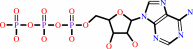 ATP
ATP
|
=
|
O-phospho-L-tyrosyl-[protein]
Bound ligand (Het Group name = )
matches with 81.25% similarity
|
+
|
 ADP
ADP
|
+
|
H(+)
|
|
|
|
|
|
|
|
|
|
Enzyme class 3:
|
|
Chains B, C:
E.C.2.7.11.1
- non-specific serine/threonine protein kinase.
|
|
|
|
|
|
|
Reaction:
|
|
|
1.
|
L-seryl-[protein] + ATP = O-phospho-L-seryl-[protein] + ADP + H+
|
|
2.
|
L-threonyl-[protein] + ATP = O-phospho-L-threonyl-[protein] + ADP + H+
|
|
|
|
|
|
|
L-seryl-[protein]
|
+
|
ATP
|
=
|
O-phospho-L-seryl-[protein]
Bound ligand (Het Group name = )
matches with 81.25% similarity
|
+
|
ADP
|
+
|
H(+)
|
|
|
|
|
|
|
L-threonyl-[protein]
|
+
|
ATP
|
=
|
O-phospho-L-threonyl-[protein]
Bound ligand (Het Group name = )
matches with 81.25% similarity
|
+
|
ADP
|
+
|
H(+)
|
|
|
|
|
|
|
|
|
|
|
|
|
Note, where more than one E.C. class is given (as above), each may
correspond to a different protein domain or, in the case of polyprotein
precursors, to a different mature protein.
|
|
|
|
Molecule diagrams generated from .mol files obtained from the
KEGG ftp site
|
|
|
|
|
|
|
|
|
|
|
|
|
|
 |
|
|
|
|
|
|
| |
|
|
| |
|
DOI no:
|
Cell
122:887-900
(2005)
|
|
PubMed id:
|
|
|
|
|
|
| |
|
Higher-order substrate recognition of eIF2alpha by the RNA-dependent protein kinase PKR.
|
|
A.C.Dar,
T.E.Dever,
F.Sicheri.
|
|
|
|
|
| |
ABSTRACT
|
|
|
|
| |
|
|
In response to binding viral double-stranded RNA byproducts within a cell, the
RNA-dependent protein kinase PKR phosphorylates the alpha subunit of the
translation initiation factor eIF2 on a regulatory site, Ser51. This triggers
the general shutdown of protein synthesis and inhibition of viral propagation.
To understand the basis for substrate recognition by and the regulation of PKR,
we determined X-ray crystal structures of the catalytic domain of PKR in complex
with eIF2alpha. The structures reveal that eIF2alpha binds to the C-terminal
catalytic lobe while catalytic-domain dimerization is mediated by the N-terminal
lobe. In addition to inducing a local unfolding of the Ser51 acceptor site in
eIF2alpha, its mode of binding to PKR affords the Ser51 site full access to the
catalytic cleft of PKR. The generality and implications of the structural
mechanisms uncovered for PKR to the larger family of four human eIF2alpha
protein kinases are discussed.
|
|
|
|
|
|
| |
Selected figure(s)
|
|
|
|
| |
|
|

|
|

|
|
Figure 1.
Figure 1. Structure of the PKR-eIF2α Complex
|
|
Figure 2.
Figure 2. Active-Site Structure of PKR
|
|
|
|
|
|
| |
The above figures are
reprinted
by permission from Cell Press:
Cell
(2005,
122,
887-900)
copyright 2005.
|
|
| |
Figures were
selected
by an automated process.
|
|
|
|
|
|
|
|
|
|
|
|
|
|
|
|
 |
 |
 |
|
Literature references that cite this PDB file's key reference
|
|
|
| |
PubMed id
|
|
Reference
|
|
|
|
|
|
B.Lu,
T.Nakamura,
K.Inouye,
J.Li,
Y.Tang,
P.Lundbäck,
S.I.Valdes-Ferrer,
P.S.Olofsson,
T.Kalb,
J.Roth,
Y.Zou,
H.Erlandsson-Harris,
H.Yang,
J.P.Ting,
H.Wang,
U.Andersson,
D.J.Antoine,
S.S.Chavan,
G.S.Hotamisligil,
and
K.J.Tracey
(2012).
Novel role of PKR in inflammasome activation and HMGB1 release.
|
| |
Nature,
488,
670-674.
|
|
|
|
|
|
|
A.Pindel,
and
A.Sadler
(2011).
The role of protein kinase R in the interferon response.
|
| |
J Interferon Cytokine Res,
31,
59-70.
|
|
|
|
|
|
|
C.J.Wong,
K.Launer-Felty,
and
J.L.Cole
(2011).
Analysis of PKR-RNA interactions by sedimentation velocity.
|
| |
Methods Enzymol,
488,
59-79.
|
|
|
|
|
|
|
E.A.Stolboushkina,
and
M.B.Garber
(2011).
Eukaryotic type translation initiation factor 2: structure-functional aspects.
|
| |
Biochemistry (Mosc),
76,
283-294.
|
|
|
|
|
|
|
E.Domingo-Gil,
R.Toribio,
J.L.Nájera,
M.Esteban,
and
I.Ventoso
(2011).
Diversity in viral anti-PKR mechanisms: a remarkable case of evolutionary convergence.
|
| |
PLoS One,
6,
e16711.
|
|
|
|
|
|
|
M.Dey,
A.Velyvis,
J.J.Li,
E.Chiu,
D.Chiovitti,
L.E.Kay,
F.Sicheri,
and
T.E.Dever
(2011).
Requirement for kinase-induced conformational change in eukaryotic initiation factor 2alpha (eIF2alpha) restricts phosphorylation of Ser51.
|
| |
Proc Natl Acad Sci U S A,
108,
4316-4321.
|
|
|
|
|
|
|
S.R.Nallagatla,
R.Toroney,
and
P.C.Bevilacqua
(2011).
Regulation of innate immunity through RNA structure and the protein kinase PKR.
|
| |
Curr Opin Struct Biol,
21,
119-127.
|
|
|
|
|
|
|
S.Rothenburg,
V.G.Chinchar,
and
T.E.Dever
(2011).
Characterization of a ranavirus inhibitor of the antiviral protein kinase PKR.
|
| |
BMC Microbiol,
11,
56.
|
|
|
|
|
|
|
S.S.Taylor,
and
A.P.Kornev
(2011).
Protein kinases: evolution of dynamic regulatory proteins.
|
| |
Trends Biochem Sci,
36,
65-77.
|
|
|
|
|
|
|
W.Cui,
J.Li,
D.Ron,
and
B.Sha
(2011).
The structure of the PERK kinase domain suggests the mechanism for its activation.
|
| |
Acta Crystallogr D Biol Crystallogr,
67,
423-428.
|
|
|
PDB code:
|
|
|
|
|
|
|
|
A.J.Sadler
(2010).
Orchestration of the activation of protein kinase R by the RNA-binding motif.
|
| |
J Interferon Cytokine Res,
30,
195-204.
|
|
|
|
|
|
|
E.Anderson,
C.Quartararo,
R.S.Brown,
Y.Shi,
X.Yao,
and
J.L.Cole
(2010).
Analysis of monomeric and dimeric phosphorylated forms of protein kinase R.
|
| |
Biochemistry,
49,
1217-1225.
|
|
|
|
|
|
|
E.Zeqiraj,
and
D.M.van Aalten
(2010).
Pseudokinases-remnants of evolution or key allosteric regulators?
|
| |
Curr Opin Struct Biol,
20,
772-781.
|
|
|
|
|
|
|
J.E.Dayhoff,
B.A.Shoemaker,
S.H.Bryant,
and
A.R.Panchenko
(2010).
Evolution of protein binding modes in homooligomers.
|
| |
J Mol Biol,
395,
860-870.
|
|
|
|
|
|
|
J.L.Cole
(2010).
Analysis of PKR activation using analytical ultracentrifugation.
|
| |
Macromol Biosci,
10,
703-713.
|
|
|
|
|
|
|
J.Zheng,
and
Z.Jia
(2010).
Structure of the bifunctional isocitrate dehydrogenase kinase/phosphatase.
|
| |
Nature,
465,
961-965.
|
|
|
PDB codes:
|
|
|
|
|
|
|
|
K.Launer-Felty,
C.J.Wong,
A.M.Wahid,
G.L.Conn,
and
J.L.Cole
(2010).
Magnesium-dependent interaction of PKR with adenovirus VAI.
|
| |
J Mol Biol,
402,
638-644.
|
|
|
|
|
|
|
M.Mihailovich,
C.Militti,
T.Gabaldón,
and
F.Gebauer
(2010).
Eukaryotic cold shock domain proteins: highly versatile regulators of gene expression.
|
| |
Bioessays,
32,
109-118.
|
|
|
|
|
|
|
M.Zhang,
C.Fennell,
L.Ranford-Cartwright,
R.Sakthivel,
P.Gueirard,
S.Meister,
A.Caspi,
C.Doerig,
R.S.Nussenzweig,
R.Tuteja,
W.J.Sullivan,
D.S.Roos,
B.M.Fontoura,
R.Ménard,
E.A.Winzeler,
and
V.Nussenzweig
(2010).
The Plasmodium eukaryotic initiation factor-2alpha kinase IK2 controls the latency of sporozoites in the mosquito salivary glands.
|
| |
J Exp Med,
207,
1465-1474.
|
|
|
|
|
|
|
N.Arnaud,
S.Dabo,
P.Maillard,
A.Budkowska,
K.I.Kalliampakou,
P.Mavromara,
D.Garcin,
J.Hugon,
A.Gatignol,
D.Akazawa,
T.Wakita,
and
E.F.Meurs
(2010).
Hepatitis C virus controls interferon production through PKR activation.
|
| |
PLoS One,
5,
e10575.
|
|
|
|
|
|
|
O.Doppelt-Azeroual,
F.Delfaud,
F.Moriaud,
and
A.G.de Brevern
(2010).
Fast and automated functional classification with MED-SuMo: an application on purine-binding proteins.
|
| |
Protein Sci,
19,
847-867.
|
|
|
|
|
|
|
T.N.Lombana,
N.Echols,
M.C.Good,
N.D.Thomsen,
H.L.Ng,
A.E.Greenstein,
A.M.Falick,
D.S.King,
and
T.Alber
(2010).
Allosteric activation mechanism of the Mycobacterium tuberculosis receptor Ser/Thr protein kinase, PknB.
|
| |
Structure,
18,
1667-1677.
|
|
|
PDB codes:
|
|
|
|
|
|
|
|
A.Gárriz,
H.Qiu,
M.Dey,
E.J.Seo,
T.E.Dever,
and
A.G.Hinnebusch
(2009).
A network of hydrophobic residues impeding helix alphaC rotation maintains latency of kinase Gcn2, which phosphorylates the alpha subunit of translation initiation factor 2.
|
| |
Mol Cell Biol,
29,
1592-1607.
|
|
|
|
|
|
|
C.Fennell,
S.Babbitt,
I.Russo,
J.Wilkes,
L.Ranford-Cartwright,
D.E.Goldberg,
and
C.Doerig
(2009).
PfeIK1, a eukaryotic initiation factor 2alpha kinase of the human malaria parasite Plasmodium falciparum, regulates stress-response to amino-acid starvation.
|
| |
Malar J,
8,
99.
|
|
|
|
|
|
|
E.Zeqiraj,
B.M.Filippi,
M.Deak,
D.R.Alessi,
and
D.M.van Aalten
(2009).
Structure of the LKB1-STRAD-MO25 complex reveals an allosteric mechanism of kinase activation.
|
| |
Science,
326,
1707-1711.
|
|
|
PDB code:
|
|
|
|
|
|
|
|
F.D.Silva,
C.A.Rezende,
D.C.Rossi,
E.Esteves,
F.H.Dyszy,
S.Schreier,
F.Gueiros-Filho,
C.B.Campos,
J.R.Pires,
and
S.Daffre
(2009).
Structure and mode of action of microplusin, a copper II-chelating antimicrobial peptide from the cattle tick Rhipicephalus (Boophilus) microplus.
|
| |
J Biol Chem,
284,
34735-34746.
|
|
|
PDB code:
|
|
|
|
|
|
|
|
F.Villa,
P.Capasso,
M.Tortorici,
F.Forneris,
A.de Marco,
A.Mattevi,
and
A.Musacchio
(2009).
Crystal structure of the catalytic domain of Haspin, an atypical kinase implicated in chromatin organization.
|
| |
Proc Natl Acad Sci U S A,
106,
20204-20209.
|
|
|
PDB code:
|
|
|
|
|
|
|
|
J.VanOudenhove,
E.Anderson,
S.Krueger,
and
J.L.Cole
(2009).
Analysis of PKR structure by small-angle scattering.
|
| |
J Mol Biol,
387,
910-920.
|
|
|
|
|
|
|
K.Dev,
T.J.Santangelo,
S.Rothenburg,
D.Neculai,
M.Dey,
F.Sicheri,
T.E.Dever,
J.N.Reeve,
and
A.G.Hinnebusch
(2009).
Archaeal aIF2B interacts with eukaryotic translation initiation factors eIF2alpha and eIF2Balpha: Implications for aIF2B function and eIF2B regulation.
|
| |
J Mol Biol,
392,
701-722.
|
|
|
|
|
|
|
K.Fukuda,
S.Gupta,
K.Chen,
C.Wu,
and
J.Qin
(2009).
The pseudoactive site of ILK is essential for its binding to alpha-Parvin and localization to focal adhesions.
|
| |
Mol Cell,
36,
819-830.
|
|
|
PDB codes:
|
|
|
|
|
|
|
|
L.A.Heinicke,
C.J.Wong,
J.Lary,
S.R.Nallagatla,
A.Diegelman-Parente,
X.Zheng,
J.L.Cole,
and
P.C.Bevilacqua
(2009).
RNA dimerization promotes PKR dimerization and activation.
|
| |
J Mol Biol,
390,
319-338.
|
|
|
|
|
|
|
N.C.Elde,
and
H.S.Malik
(2009).
The evolutionary conundrum of pathogen mimicry.
|
| |
Nat Rev Microbiol,
7,
787-797.
|
|
|
|
|
|
|
N.C.Elde,
S.J.Child,
A.P.Geballe,
and
H.S.Malik
(2009).
Protein kinase R reveals an evolutionary model for defeating viral mimicry.
|
| |
Nature,
457,
485-489.
|
|
|
|
|
|
|
N.M.Kaye,
K.J.Emmett,
W.C.Merrick,
and
E.Jankowsky
(2009).
Intrinsic RNA binding by the eukaryotic initiation factor 4F depends on a minimal RNA length but not on the m7G cap.
|
| |
J Biol Chem,
284,
17742-17750.
|
|
|
|
|
|
|
N.Sonenberg,
and
A.G.Hinnebusch
(2009).
Regulation of translation initiation in eukaryotes: mechanisms and biological targets.
|
| |
Cell,
136,
731-745.
|
|
|
|
|
|
|
S.J.Deminoff,
V.Ramachandran,
and
P.K.Herman
(2009).
Distal recognition sites in substrates are required for efficient phosphorylation by the cAMP-dependent protein kinase.
|
| |
Genetics,
182,
529-539.
|
|
|
|
|
|
|
S.Rothenburg,
E.J.Seo,
J.S.Gibbs,
T.E.Dever,
and
K.Dittmar
(2009).
Rapid evolution of protein kinase PKR alters sensitivity to viral inhibitors.
|
| |
Nat Struct Mol Biol,
16,
63-70.
|
|
|
|
|
|
|
T.Rajakulendran,
M.Sahmi,
M.Lefrançois,
F.Sicheri,
and
M.Therrien
(2009).
A dimerization-dependent mechanism drives RAF catalytic activation.
|
| |
Nature,
461,
542-545.
|
|
|
|
|
|
|
T.S.Lee,
W.Ma,
X.Zhang,
H.Kantarjian,
and
M.Albitar
(2009).
Structural effects of clinically observed mutations in JAK2 exons 13-15: comparison with V617F and exon 12 mutations.
|
| |
BMC Struct Biol,
9,
58.
|
|
|
|
|
|
|
A.J.Sadler,
and
B.R.Williams
(2008).
Interferon-inducible antiviral effectors.
|
| |
Nat Rev Immunol,
8,
559-568.
|
|
|
|
|
|
|
A.Torkamani,
N.Kannan,
S.S.Taylor,
and
N.J.Schork
(2008).
Congenital disease SNPs target lineage specific structural elements in protein kinases.
|
| |
Proc Natl Acad Sci U S A,
105,
9011-9016.
|
|
|
|
|
|
|
C.Mieczkowski,
A.T.Iavarone,
and
T.Alber
(2008).
Auto-activation mechanism of the Mycobacterium tuberculosis PknB receptor Ser/Thr kinase.
|
| |
EMBO J,
27,
3186-3197.
|
|
|
PDB codes:
|
|
|
|
|
|
|
|
D.Komander,
R.Garg,
P.T.Wan,
A.J.Ridley,
and
D.Barford
(2008).
Mechanism of multi-site phosphorylation from a ROCK-I:RhoE complex structure.
|
| |
EMBO J,
27,
3175-3185.
|
|
|
PDB code:
|
|
|
|
|
|
|
|
D.Y.Mao,
D.F.Ceccarelli,
and
F.Sicheri
(2008).
"Unraveling the tail" of how SRPK1 phosphorylates ASF/SF2.
|
| |
Mol Cell,
29,
535-537.
|
|
|
|
|
|
|
D.Y.Mao,
D.Neculai,
M.Downey,
S.Orlicky,
Y.Z.Haffani,
D.F.Ceccarelli,
J.S.Ho,
R.K.Szilard,
W.Zhang,
C.S.Ho,
L.Wan,
C.Fares,
S.Rumpel,
I.Kurinov,
C.H.Arrowsmith,
D.Durocher,
and
F.Sicheri
(2008).
Atomic structure of the KEOPS complex: an ancient protein kinase-containing molecular machine.
|
| |
Mol Cell,
32,
259-275.
|
|
|
PDB codes:
|
|
|
|
|
|
|
|
E.Anderson,
and
J.L.Cole
(2008).
Domain stabilities in protein kinase R (PKR): evidence for weak interdomain interactions.
|
| |
Biochemistry,
47,
4887-4897.
|
|
|
|
|
|
|
E.J.Seo,
F.Liu,
M.Kawagishi-Kobayashi,
T.L.Ung,
C.Cao,
A.C.Dar,
F.Sicheri,
and
T.E.Dever
(2008).
Protein kinase PKR mutants resistant to the poxvirus pseudosubstrate K3L protein.
|
| |
Proc Natl Acad Sci U S A,
105,
16894-16899.
|
|
|
|
|
|
|
J.C.Ngo,
K.Giang,
S.Chakrabarti,
C.T.Ma,
N.Huynh,
J.C.Hagopian,
P.C.Dorrestein,
X.D.Fu,
J.A.Adams,
and
G.Ghosh
(2008).
A sliding docking interaction is essential for sequential and processive phosphorylation of an SR protein by SRPK1.
|
| |
Mol Cell,
29,
563-576.
|
|
|
PDB code:
|
|
|
|
|
|
|
|
J.Igarashi,
M.Murase,
A.Iizuka,
F.Pichierri,
M.Martinkova,
and
T.Shimizu
(2008).
Elucidation of the heme binding site of heme-regulated eukaryotic initiation factor 2alpha kinase and the role of the regulatory motif in heme sensing by spectroscopic and catalytic studies of mutant proteins.
|
| |
J Biol Chem,
283,
18782-18791.
|
|
|
|
|
|
|
J.Narasimhan,
B.R.Joyce,
A.Naguleswaran,
A.T.Smith,
M.R.Livingston,
S.E.Dixon,
I.Coppens,
R.C.Wek,
and
W.J.Sullivan
(2008).
Translation regulation by eukaryotic initiation factor-2 kinases in the development of latent cysts in Toxoplasma gondii.
|
| |
J Biol Chem,
283,
16591-16601.
|
|
|
|
|
|
|
M.Costa-Mattioli,
M.Bidinosti,
and
T.E.Dever
(2008).
Getting the message in protein synthesis. Keystone Symposium on Translational Regulatory Mechanisms.
|
| |
EMBO Rep,
9,
954-959.
|
|
|
|
|
|
|
P.A.Lemaire,
E.Anderson,
J.Lary,
and
J.L.Cole
(2008).
Mechanism of PKR Activation by dsRNA.
|
| |
J Mol Biol,
381,
351-360.
|
|
|
|
|
|
|
Q.Su,
S.Wang,
H.Q.Gao,
S.Kazemi,
H.P.Harding,
D.Ron,
and
A.E.Koromilas
(2008).
Modulation of the eukaryotic initiation factor 2 alpha-subunit kinase PERK by tyrosine phosphorylation.
|
| |
J Biol Chem,
283,
469-475.
|
|
|
|
|
|
|
S.Rothenburg,
N.Deigendesch,
M.Dey,
T.E.Dever,
and
L.Tazi
(2008).
Double-stranded RNA-activated protein kinase PKR of fishes and amphibians: varying the number of double-stranded RNA binding domains and lineage-specific duplications.
|
| |
BMC Biol,
6,
12.
|
|
|
|
|
|
|
A.E.Greenstein,
N.Echols,
T.N.Lombana,
D.S.King,
and
T.Alber
(2007).
Allosteric activation by dimerization of the PknD receptor Ser/Thr protein kinase from Mycobacterium tuberculosis.
|
| |
J Biol Chem,
282,
11427-11435.
|
|
|
|
|
|
|
J.L.Cole
(2007).
Activation of PKR: an open and shut case?
|
| |
Trends Biochem Sci,
32,
57-62.
|
|
|
|
|
|
|
K.D.Smith,
M.Y.Shao,
M.C.Posner,
and
R.R.Weichselbaum
(2007).
Tumor genotype determines susceptibility to oncolytic herpes simplex virus mutants: strategies for clinical application.
|
| |
Future Oncol,
3,
545-556.
|
|
|
|
|
|
|
M.C.Moraes,
T.C.Jesus,
N.N.Hashimoto,
M.Dey,
K.J.Schwartz,
V.S.Alves,
C.C.Avila,
J.D.Bangs,
T.E.Dever,
S.Schenkman,
and
B.A.Castilho
(2007).
Novel membrane-bound eIF2alpha kinase in the flagellar pocket of Trypanosoma brucei.
|
| |
Eukaryot Cell,
6,
1979-1991.
|
|
|
|
|
|
|
M.Dey,
C.Cao,
F.Sicheri,
and
T.E.Dever
(2007).
Conserved intermolecular salt bridge required for activation of protein kinases PKR, GCN2, and PERK.
|
| |
J Biol Chem,
282,
6653-6660.
|
|
|
|
|
|
|
M.Kalai,
V.Suin,
N.Festjens,
A.Meeus,
A.Bernis,
X.M.Wang,
X.Saelens,
and
P.Vandenabeele
(2007).
The caspase-generated fragments of PKR cooperate to activate full-length PKR and inhibit translation.
|
| |
Cell Death Differ,
14,
1050-1059.
|
|
|
|
|
|
|
N.Kannan,
S.S.Taylor,
Y.Zhai,
J.C.Venter,
and
G.Manning
(2007).
Structural and functional diversity of the microbial kinome.
|
| |
PLoS Biol,
5,
e17.
|
|
|
|
|
|
|
N.Sonenberg,
and
A.G.Hinnebusch
(2007).
New modes of translational control in development, behavior, and disease.
|
| |
Mol Cell,
28,
721-729.
|
|
|
|
|
|
|
R.C.Wek,
and
D.R.Cavener
(2007).
Translational control and the unfolded protein response.
|
| |
Antioxid Redox Signal,
9,
2357-2371.
|
|
|
|
|
|
|
R.Linding,
L.J.Jensen,
G.J.Ostheimer,
M.A.van Vugt,
C.Jørgensen,
I.M.Miron,
F.Diella,
K.Colwill,
L.Taylor,
K.Elder,
P.Metalnikov,
V.Nguyen,
A.Pasculescu,
J.Jin,
J.G.Park,
L.D.Samson,
J.R.Woodgett,
R.B.Russell,
P.Bork,
M.B.Yaffe,
and
T.Pawson
(2007).
Systematic discovery of in vivo phosphorylation networks.
|
| |
Cell,
129,
1415-1426.
|
|
|
|
|
|
|
S.A.McKenna,
D.A.Lindhout,
I.Kim,
C.W.Liu,
V.M.Gelev,
G.Wagner,
and
J.D.Puglisi
(2007).
Molecular framework for the activation of RNA-dependent protein kinase.
|
| |
J Biol Chem,
282,
11474-11486.
|
|
|
|
|
|
|
S.R.Nallagatla,
J.Hwang,
R.Toroney,
X.Zheng,
C.E.Cameron,
and
P.C.Bevilacqua
(2007).
5'-triphosphate-dependent activation of PKR by RNAs with short stem-loops.
|
| |
Science,
318,
1455-1458.
|
|
|
|
|
|
|
M.A.Bogoyevitch,
and
B.Kobe
(2006).
Uses for JNK: the many and varied substrates of the c-Jun N-terminal kinases.
|
| |
Microbiol Mol Biol Rev,
70,
1061-1095.
|
|
|
|
|
|
|
M.A.García,
J.Gil,
I.Ventoso,
S.Guerra,
E.Domingo,
C.Rivas,
and
M.Esteban
(2006).
Impact of protein kinase PKR in cell biology: from antiviral to antiproliferative action.
|
| |
Microbiol Mol Biol Rev,
70,
1032-1060.
|
|
|
|
|
|
|
M.Hakki,
E.E.Marshall,
K.L.De Niro,
and
A.P.Geballe
(2006).
Binding and nuclear relocalization of protein kinase R by human cytomegalovirus TRS1.
|
| |
J Virol,
80,
11817-11826.
|
|
|
|
|
|
|
P.A.Lemaire,
I.Tessmer,
R.Craig,
D.A.Erie,
and
J.L.Cole
(2006).
Unactivated PKR exists in an open conformation capable of binding nucleotides.
|
| |
Biochemistry,
45,
9074-9084.
|
|
|
|
|
|
|
P.Pellicena,
and
J.Kuriyan
(2006).
Protein-protein interactions in the allosteric regulation of protein kinases.
|
| |
Curr Opin Struct Biol,
16,
702-709.
|
|
|
|
|
|
|
Q.Su,
S.Wang,
D.Baltzis,
L.K.Qu,
A.H.Wong,
and
A.E.Koromilas
(2006).
Tyrosine phosphorylation acts as a molecular switch to full-scale activation of the eIF2alpha RNA-dependent protein kinase.
|
| |
Proc Natl Acad Sci U S A,
103,
63-68.
|
|
|
|
|
|
|
R.Jauch,
M.K.Cho,
S.Jäkel,
C.Netter,
K.Schreiter,
B.Aicher,
M.Zweckstetter,
H.Jäckle,
and
M.C.Wahl
(2006).
Mitogen-activated protein kinases interacting kinases are autoinhibited by a reprogrammed activation segment.
|
| |
EMBO J,
25,
4020-4032.
|
|
|
PDB codes:
|
|
|
|
|
|
|
|
S.Li,
G.A.Peters,
K.Ding,
X.Zhang,
J.Qin,
and
G.C.Sen
(2006).
Molecular basis for PKR activation by PACT or dsRNA.
|
| |
Proc Natl Acad Sci U S A,
103,
10005-10010.
|
|
|
|
|
|
|
S.Puthenveetil,
L.Whitby,
J.Ren,
K.Kelnar,
J.F.Krebs,
and
P.A.Beal
(2006).
Controlling activation of the RNA-dependent protein kinase by siRNAs using site-specific chemical modification.
|
| |
Nucleic Acids Res,
34,
4900-4911.
|
|
|
|
|
|
|
Z.Shi,
K.A.Resing,
and
N.G.Ahn
(2006).
Networks for the allosteric control of protein kinases.
|
| |
Curr Opin Struct Biol,
16,
686-692.
|
|
|
|
|
|
|
A.G.Hinnebusch
(2005).
eIF2alpha kinases provide a new solution to the puzzle of substrate specificity.
|
| |
Nat Struct Mol Biol,
12,
835-838.
|
|
|
|
|
|
|
M.Dey,
C.Cao,
A.C.Dar,
T.Tamura,
K.Ozato,
F.Sicheri,
and
T.E.Dever
(2005).
Mechanistic link between PKR dimerization, autophosphorylation, and eIF2alpha substrate recognition.
|
| |
Cell,
122,
901-913.
|
|
|
|
|
|
|
S.S.Taylor,
N.M.Haste,
and
G.Ghosh
(2005).
PKR and eIF2alpha: integration of kinase dimerization, activation, and substrate docking.
|
| |
Cell,
122,
823-825.
|
|
|
|
|
|
The most recent references are shown first.
Citation data come partly from CiteXplore and partly
from an automated harvesting procedure. Note that this is likely to be
only a partial list as not all journals are covered by
either method. However, we are continually building up the citation data
so more and more references will be included with time.
Where a reference describes a PDB structure, the PDB
code is
shown on the right.
|
 |
|


 Links
Links


