 |
PDBsum entry 2jlx

|
|
|
|
|
|

|

|

|

|
|

|
|

|
|

|
|

|
|

|
|

|
|

|
|

|
|
|
 |

|

|
|
|
|
|
|
|
|
|
|
|
|
|
|
|
|
|
|
|
|
|
|
|
|
|
|
|
|
|
|
|
|
|
|
|
|
|
Hydrolase/RNA
|
PDB id
|
|
|
|
2jlx
|
|
|
|
|
|
|
|
|
|
|
|
|
|
|

|

|

|
|
|
|
|
|
|
|
 |
Contents |
 |
|
|
|
|
|
|
|
|
|
|
|
|
|
|
|
|
* Residue conservation analysis
|
|
|
|
|
|
PDB id:
|
|
|
|
| Name: |
|
Hydrolase/RNA
|
|
|
Title:
|
|
Dengue virus 4 ns3 helicase in complex with ssrna and adp-vanadate
|
|
Structure:
|
|
Serine protease subunit ns3. Chain: a, b. Fragment: residues 1646-2092. Synonym: denv4 ns3 helicase, non-structural protein 3. Engineered: yes. 5'-r( Ap Gp Ap Cp Up Ap Ap Cp Ap Ap Cp U)-3'. Chain: c, d. Engineered: yes
|
|
Source:
|
|
Dengue virus 4. Organism_taxid: 408688. Strain: thailand/0348/1991. Expressed in: escherichia coli. Expression_system_taxid: 562. Synthetic: yes
|
|
Resolution:
|
|
|
2.20Å
|
R-factor:
|
0.198
|
R-free:
|
0.245
|
|
|
Authors:
|
|
D.H.Luo,T.Xu,R.P.Watson,D.S.Becker,A.Sampath,W.Jahnke,S.S.Yeong, C.H.Wang,S.P.Lim,S.G.Vasudevan,J.Lescar
|
|
Key ref:
|
|
D.Luo
et al.
(2008).
Insights into RNA unwinding and ATP hydrolysis by the flavivirus NS3 protein.
Embo J,
27,
3209-3219.
PubMed id:
|
|
|
Date:
|
|
|
15-Sep-08
|
Release date:
|
25-Nov-08
|
|
|
|
|
|
|
PROCHECK
|

|
|
|
|
|
Headers
|
|
|
|
References
|
|
|
|
|
|

|
|
Q2YHF0
(POLG_DEN4T) -
Genome polyprotein from Dengue virus type 4 (strain Thailand/0348/1991)
|
|
|
|
Seq:
Struc:
|
|
|
|
3387 a.a.
451 a.a.*
|
|

|

|

|
|
|
|
|
|
|
|
|
|
|
Key: |
 |
PfamA domain |
|
|
 |
Secondary structure |
|
 |
CATH domain |
|
|
*
PDB and UniProt seqs differ
at 10 residue positions (black
crosses)
|
|
|
|
|
|
|
|

|
|
|
|
A-G-A-C-U-A-A-C
8 bases
|
|
|
|
A-G-A-C-U-A-A-C
8 bases
|
|
|
|
|
|
|
|
|
|
|
|
|
|
Enzyme class 1:
|
|
E.C.2.1.1.56
- mRNA (guanine-N(7))-methyltransferase.
|
|
|
|
|
|
|
Reaction:
|
|
a 5'-end (5'-triphosphoguanosine)-ribonucleoside in mRNA + S-adenosyl-L- methionine = a 5'-end (N(7)-methyl 5'-triphosphoguanosine)-ribonucleoside in mRNA + S-adenosyl-L-homocysteine
|
|
|
|
|
|
5'-end (5'-triphosphoguanosine)-ribonucleoside in mRNA
|
+
|
 S-adenosyl-L- methionine
|
=
|
5'-end (N(7)-methyl 5'-triphosphoguanosine)-ribonucleoside in mRNA
|
+
|
S-adenosyl-L-homocysteine
Bound ligand (Het Group name = )
matches with 51.43% similarity
|
|
|
|
|
|
|
|
|
|
Enzyme class 2:
|
|
E.C.2.1.1.57
- methyltransferase cap1.
|
|
|
|
|
|
|
Reaction:
|
|
a 5'-end (N(7)-methyl 5'-triphosphoguanosine)-ribonucleoside in mRNA + S-adenosyl-L-methionine = a 5'-end (N(7)-methyl 5'-triphosphoguanosine)- (2'-O-methyl-ribonucleoside) in mRNA + S-adenosyl-L-homocysteine + H+
|
|
|
|
|
|
5'-end (N(7)-methyl 5'-triphosphoguanosine)-ribonucleoside in mRNA
|
+
|
S-adenosyl-L-methionine
|
=
|
5'-end (N(7)-methyl 5'-triphosphoguanosine)- (2'-O-methyl-ribonucleoside) in mRNA
|
+
|
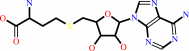 S-adenosyl-L-homocysteine
|
+
|
H(+)
Bound ligand (Het Group name = )
matches with 51.43% similarity
|
|
|
|
|
|
|
|
|
|
Enzyme class 3:
|
|
E.C.2.7.7.48
- RNA-directed Rna polymerase.
|
|
|
|
|
|
|
Reaction:
|
|
RNA(n) + a ribonucleoside 5'-triphosphate = RNA(n+1) + diphosphate
|
|
|
|
|
|
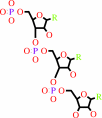 RNA(n)
|
+
|
ribonucleoside 5'-triphosphate
|
=
|
RNA(n+1)
|
+
|
 diphosphate
|
|
|
|
|
|
|
|
|
|
Enzyme class 4:
|
|
E.C.3.4.21.91
- flavivirin.
|
|
|
|
|
|
|
Reaction:
|
|
Selective hydrolysis of Xaa-Xaa-|-Xbb bonds in which each of the Xaa can be either Arg or Lys and Xbb can be either Ser or Ala.
|
|
|
|
|
|
Enzyme class 5:
|
|
E.C.3.6.1.15
- nucleoside-triphosphate phosphatase.
|
|
|
|
|
|
|
Reaction:
|
|
a ribonucleoside 5'-triphosphate + H2O = a ribonucleoside 5'-diphosphate + phosphate + H+
|
|
|
|
|
|
ribonucleoside 5'-triphosphate
|
+
|
H2O
|
=
|
ribonucleoside 5'-diphosphate
|
+
|
 phosphate
|
+
|
H(+)
|
|
|
|
|
|
|
|
|
|
Enzyme class 6:
|
|
E.C.3.6.4.13
- Rna helicase.
|
|
|
|
|
|
|
Reaction:
|
|
ATP + H2O = ADP + phosphate + H+
|
|
|
|
|
|
 ATP
ATP
|
+
|
H2O
|
=
|
ADP
Bound ligand (Het Group name = )
corresponds exactly
|
+
|
phosphate
|
+
|
H(+)
|
|
|
|
|
|
|
|
|
|
|
|
|
Note, where more than one E.C. class is given (as above), each may
correspond to a different protein domain or, in the case of polyprotein
precursors, to a different mature protein.
|
|
|
|
Molecule diagrams generated from .mol files obtained from the
KEGG ftp site
|
|
|
|
|
|
|
|
|
|
|
|
|
|
 |
|
|
|
|
|
|
| |
|
|
| |
|
|
Embo J
27:3209-3219
(2008)
|
|
PubMed id:
|
|
|
|
|
|
| |
|
Insights into RNA unwinding and ATP hydrolysis by the flavivirus NS3 protein.
|
|
D.Luo,
T.Xu,
R.P.Watson,
D.Scherer-Becker,
A.Sampath,
W.Jahnke,
S.S.Yeong,
C.H.Wang,
S.P.Lim,
A.Strongin,
S.G.Vasudevan,
J.Lescar.
|
|
|
|
|
| |
ABSTRACT
|
|
|
|
| |
|
|
Together with the NS5 polymerase, the NS3 helicase has a pivotal function in
flavivirus RNA replication and constitutes an important drug target. We captured
the dengue virus NS3 helicase at several stages along the catalytic pathway
including bound to single-stranded (ss) RNA, to an ATP analogue, to a
transition-state analogue and to ATP hydrolysis products. RNA recognition
appears largely sequence independent in a way remarkably similar to eukaryotic
DEAD box proteins Vasa and eIF4AIII. On ssRNA binding, the NS3 enzyme switches
to a catalytic-competent state imparted by an inward movement of the P-loop,
interdomain closure and a change in the divalent metal coordination shell,
providing a structural basis for RNA-stimulated ATP hydrolysis. These structures
demonstrate for the first time large quaternary changes in the flaviviridae
helicase, identify the catalytic water molecule and point to a beta-hairpin that
protrudes from subdomain 2, as a critical element for dsRNA unwinding. They also
suggest how NS3 could exert an effect as an RNA-anchoring device and thus
participate both in flavivirus RNA replication and assembly.
|
|
|
|
|
|
|
|
|
|
|
|
|
|
|
|
|
|
 |
 |
 |
|
Literature references that cite this PDB file's key reference
|
|
|
| |
PubMed id
|
|
Reference
|
|
|
|
|
|
E.Decroly,
F.Ferron,
J.Lescar,
and
B.Canard
(2012).
Conventional and unconventional mechanisms for capping viral mRNA.
|
| |
Nat Rev Microbiol,
10,
51-65.
|
|
|
|
|
|
|
B.Selisko,
F.F.Peyrane,
B.Canard,
K.Alvarez,
and
E.Decroly
(2010).
Biochemical characterization of the (nucleoside-2'O)-methyltransferase activity of dengue virus protein NS5 using purified capped RNA oligonucleotides (7Me)GpppAC(n) and GpppAC(n).
|
| |
J Gen Virol,
91,
112-121.
|
|
|
|
|
|
|
C.A.Belon,
Y.D.High,
T.I.Lin,
F.Pauwels,
and
D.N.Frick
(2010).
Mechanism and specificity of a symmetrical benzimidazolephenylcarboxamide helicase inhibitor.
|
| |
Biochemistry,
49,
1822-1832.
|
|
|
|
|
|
|
H.Walbott,
S.Mouffok,
R.Capeyrou,
S.Lebaron,
O.Humbert,
H.van Tilbeurgh,
Y.Henry,
and
N.Leulliot
(2010).
Prp43p contains a processive helicase structural architecture with a specific regulatory domain.
|
| |
EMBO J,
29,
2194-2204.
|
|
|
PDB code:
|
|
|
|
|
|
|
|
L.J.Yap,
D.Luo,
K.Y.Chung,
S.P.Lim,
C.Bodenreider,
C.Noble,
P.Y.Shi,
and
J.Lescar
(2010).
Crystal structure of the dengue virus methyltransferase bound to a 5'-capped octameric RNA.
|
| |
PLoS One,
5,
0.
|
|
|
PDB code:
|
|
|
|
|
|
|
|
M.Gu,
and
C.M.Rice
(2010).
Three conformational snapshots of the hepatitis C virus NS3 helicase reveal a ratchet translocation mechanism.
|
| |
Proc Natl Acad Sci U S A,
107,
521-528.
|
|
|
PDB codes:
|
|
|
|
|
|
|
|
N.J.Moreland,
M.Y.Tay,
E.Lim,
P.N.Paradkar,
D.N.Doan,
Y.H.Yau,
S.Geifman Shochat,
and
S.G.Vasudevan
(2010).
High affinity human antibody fragments to dengue virus non-structural protein 3.
|
| |
PLoS Negl Trop Dis,
4,
e881.
|
|
|
|
|
|
|
S.A.Shiryaev,
and
A.Y.Strongin
(2010).
Structural and functional parameters of the flaviviral protease: a promising antiviral drug target.
|
| |
Future Virol,
5,
593-606.
|
|
|
|
|
|
|
S.Despins,
M.Issur,
I.Bougie,
and
M.Bisaillon
(2010).
Deciphering the molecular basis for nucleotide selection by the West Nile virus RNA helicase.
|
| |
Nucleic Acids Res,
38,
5493-5506.
|
|
|
|
|
|
|
W.Yang
(2010).
Lessons learned from UvrD helicase: mechanism for directional movement.
|
| |
Annu Rev Biophys,
39,
367-385.
|
|
|
|
|
|
|
Y.He,
G.R.Andersen,
and
K.H.Nielsen
(2010).
Structural basis for the function of DEAH helicases.
|
| |
EMBO Rep,
11,
180-186.
|
|
|
PDB code:
|
|
|
|
|
|
|
|
B.J.Geiss,
H.Stahla,
A.M.Hannah,
H.H.Gari,
and
S.M.Keenan
(2009).
Focus on flaviviruses: current and future drug targets.
|
| |
Future Med Chem,
1,
327.
|
|
|
|
|
|
|
C.A.Belon,
and
D.N.Frick
(2009).
Fuel specificity of the hepatitis C virus NS3 helicase.
|
| |
J Mol Biol,
388,
851-864.
|
|
|
|
|
|
|
C.A.Belon,
and
D.N.Frick
(2009).
Helicase inhibitors as specifically targeted antiviral therapy for hepatitis C.
|
| |
Future Virol,
4,
277-293.
|
|
|
|
|
|
|
D.Vlachakis
(2009).
Theoretical study of the Usutu virus helicase 3D structure, by means of computer-aided homology modelling.
|
| |
Theor Biol Med Model,
6,
9.
|
|
|
|
|
|
|
M.Del Campo,
and
A.M.Lambowitz
(2009).
Structure of the Yeast DEAD box protein Mss116p reveals two wedges that crimp RNA.
|
| |
Mol Cell,
35,
598-609.
|
|
|
PDB codes:
|
|
|
|
|
|
|
|
R.A.Agis-Juárez,
I.Galván,
F.Medina,
T.Daikoku,
R.Padmanabhan,
J.E.Ludert,
and
R.M.del Angel
(2009).
Polypyrimidine tract-binding protein is relocated to the cytoplasm and is required during dengue virus infection in Vero cells.
|
| |
J Gen Virol,
90,
2893-2901.
|
|
|
|
|
|
|
R.Assenberg,
E.Mastrangelo,
T.S.Walter,
A.Verma,
M.Milani,
R.J.Owens,
D.I.Stuart,
J.M.Grimes,
and
E.J.Mancini
(2009).
Crystal structure of a novel conformational state of the flavivirus NS3 protein: implications for polyprotein processing and viral replication.
|
| |
J Virol,
83,
12895-12906.
|
|
|
PDB code:
|
|
|
|
|
|
|
|
S.A.Shiryaev,
A.V.Chernov,
A.E.Aleshin,
T.N.Shiryaeva,
and
A.Y.Strongin
(2009).
NS4A regulates the ATPase activity of the NS3 helicase: a novel cofactor role of the non-structural protein NS4A from West Nile virus.
|
| |
J Gen Virol,
90,
2081-2085.
|
|
|
|
|
|
The most recent references are shown first.
Citation data come partly from CiteXplore and partly
from an automated harvesting procedure. Note that this is likely to be
only a partial list as not all journals are covered by
either method. However, we are continually building up the citation data
so more and more references will be included with time.
Where a reference describes a PDB structure, the PDB
code is
shown on the right.
|
|


 Links
Links


