 |
PDBsum entry 3kqh

|
|
|
|
|
|

|

|

|

|
|

|
|

|
|

|
|

|
|

|
|

|
|
|
 |

|

|
|
|
|
|
|
|
|
|
|
|
|
|
|
|
|
|
|
|
|
|
|
|
|
|
|
|
|
|
|
|
|
|
|
|
Hydrolase/DNA
|
PDB id
|
|
|
|
3kqh
|
|
|
|
|
|
|
|
|
|
|
|
|
|
|

|

|

|
|
|
|
|
|
|
|
 |
Contents |
 |
|
|
|
|
|
|
|
|
|
|
|
|
* Residue conservation analysis
|
|
|
|
|
|
PDB id:
|
|
|
|
| Name: |
|
Hydrolase/DNA
|
|
|
Title:
|
|
Three conformational snapshots of the hepatitis c virus ns3 helicase reveal a ratchet translocation mechanism
|
|
Structure:
|
|
Serine protease/ntpase/helicase ns3. Chain: a, b. Synonym: core protein p21, capsid protein c, p21, core protein p19, envelope glycoprotein e1, gp32, gp35, envelope glycoprotein e2, ns1, gp68, gp70, p7, protease ns2-3, p23, serine protease/ntpase/helicase ns3, hepacivirin, ns3p, p70, non-structural protein 4a, ns4a, p8, non-structural protein 4b, ns4b, p27, non-structural protein 5a, ns5a, p56, RNA-directed RNA polymerase, ns5b, p68. Engineered: yes.
|
|
Source:
|
|
Hepatitis c virus. Hcv. Organism_taxid: 333284. Strain: con1. Gene: ns3. Expressed in: escherichia coli. Expression_system_taxid: 469008. Synthetic: yes
|
|
Resolution:
|
|
|
2.40Å
|
R-factor:
|
0.226
|
R-free:
|
0.258
|
|
|
Authors:
|
|
M.Gu,C.M.Rice
|
Key ref:

|
|
M.Gu
and
C.M.Rice
(2010).
Three conformational snapshots of the hepatitis C virus NS3 helicase reveal a ratchet translocation mechanism.
Proc Natl Acad Sci U S A,
107,
521-528.
PubMed id:
DOI:

|
|
|
Date:
|
|
|
17-Nov-09
|
Release date:
|
26-Jan-10
|
|
|
|
|
|
|
PROCHECK
|

|
|
|
|
|
Headers
|
|
|
|
References
|
|
|
|
|
|

|
|
Q9WMX2
(POLG_HCVCO) -
Genome polyprotein from Hepatitis C virus genotype 1b (isolate Con1)
|
|
|
|
Seq:
Struc:
|
|
|
|
3010 a.a.
436 a.a.
|
|

|

|

|
|
|
|
|
|
|
|
|
|
|
Key: |
 |
PfamA domain |
|
|
 |
Secondary structure |
|
 |
CATH domain |
|
|
|
|
|
|
|
|

|
|
|
|
A-A-A-A-A-A
6 bases
|
|
|
|
A-A-A-A-A-A
6 bases
|
|
|
|
|
|
|
|
|
|
|
|
|
|
Enzyme class 1:
|
|
E.C.2.7.7.48
- RNA-directed Rna polymerase.
|
|
|
|
|
|
|
Reaction:
|
|
RNA(n) + a ribonucleoside 5'-triphosphate = RNA(n+1) + diphosphate
|
|
|
|
|
|
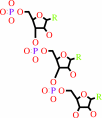 RNA(n)
|
+
|
ribonucleoside 5'-triphosphate
|
=
|
RNA(n+1)
|
+
|
 diphosphate
|
|
|
|
|
|
|
|
|
|
Enzyme class 2:
|
|
E.C.3.4.21.98
- hepacivirin.
|
|
|
|
|
|
|
Reaction:
|
|
Hydrolysis of four peptide bonds in the viral precursor polyprotein, commonly with Asp or Glu in the P6 position, Cys or Thr in P1 and Ser or Ala in P1'.
|
|
|
|
|
|
Enzyme class 3:
|
|
E.C.3.4.22.-
- ?????
|
|
|
|
|
|
|
Enzyme class 4:
|
|
E.C.3.6.1.15
- nucleoside-triphosphate phosphatase.
|
|
|
|
|
|
|
Reaction:
|
|
a ribonucleoside 5'-triphosphate + H2O = a ribonucleoside 5'-diphosphate + phosphate + H+
|
|
|
|
|
|
ribonucleoside 5'-triphosphate
|
+
|
H2O
|
=
|
ribonucleoside 5'-diphosphate
|
+
|
 phosphate
|
+
|
H(+)
|
|
|
|
|
|
|
|
|
|
Enzyme class 5:
|
|
E.C.3.6.4.13
- Rna helicase.
|
|
|
|
|
|
|
Reaction:
|
|
ATP + H2O = ADP + phosphate + H+
|
|
|
|
|
|
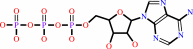 ATP
ATP
|
+
|
H2O
|
=
|
 ADP
ADP
|
+
|
phosphate
|
+
|
H(+)
|
|
|
|
|
|
|
|
|
|
|
|
|
Note, where more than one E.C. class is given (as above), each may
correspond to a different protein domain or, in the case of polyprotein
precursors, to a different mature protein.
|
|
|
|
Molecule diagrams generated from .mol files obtained from the
KEGG ftp site
|
|
|
|
|
|
|
|
|
|
|
|
|
|
 |
|
|
|
|
|
|
| |
|
|
| |
|
DOI no:
|
Proc Natl Acad Sci U S A
107:521-528
(2010)
|
|
PubMed id:
|
|
|
|
|
|
| |
|
Three conformational snapshots of the hepatitis C virus NS3 helicase reveal a ratchet translocation mechanism.
|
|
M.Gu,
C.M.Rice.
|
|
|
|
|
| |
ABSTRACT
|
|
|
|
| |
|
|
A virally encoded superfamily-2 (SF2) helicase (NS3h) is essential for the
replication of hepatitis C virus, a leading cause of liver disease worldwide.
Efforts to elucidate the function of NS3h and to develop inhibitors against it,
however, have been hampered by limited understanding of its molecular mechanism.
Here we show x-ray crystal structures for a set of NS3h complexes, including
ground-state and transition-state ternary complexes captured with ATP mimics
(ADP.BeF(3) and ). These structures provide, for the first time, three
conformational snapshots demonstrating the molecular basis of action for a SF2
helicase. Upon nucleotide binding, overall domain rotation along with structural
transitions in motif V and the bound DNA leads to the release of one base from
the substrate base-stacking row and the loss of several interactions between
NS3h and the 3' DNA segment. As nucleotide hydrolysis proceeds into the
transition state, stretching of a "spring" helix and another overall
conformational change couples rearrangement of the (d)NTPase active site to
additional hydrogen-bonding between NS3h and DNA. Together with biochemistry,
these results demonstrate a "ratchet" mechanism involved in the unidirectional
translocation and define the step size of NS3h as one base per nucleotide
hydrolysis cycle. These findings suggest feasible strategies for developing
specific inhibitors to block the action of this attractive, yet largely
unexplored drug target.
|
|
|
|
|
|
| |
Selected figure(s)
|
|
|
|
| |
|
|

|
|

|
|
Figure 1.
Crystal Structures of NS3h Complexes. (A) NS3h in complex
with ssDNA (dA[6]). (B) NS3h in complex with ADP·BeF[3]
and ssDNA (dT[12], with five deoxynucleosides presented for
clarity). (C) NS3h in complex with  and
ssDNA (dT[6]). The structures are represented by ribbons and
transparent surfaces. The DNA bases and deoxyribose groups are
shown with sticks and numerically labeled. The DNA
phosphodiester backbones are simplified as orange tubes. The DNA
atoms are color coded according to elements. The helicase motifs
are color coded in the surface and ribbon respectively in (B)
and (C). The distances between the Cα atoms of K244 (domain 1)
and S403 (domain 2) are noted. ADP·BeF[3] and and
ssDNA (dT[6]). The structures are represented by ribbons and
transparent surfaces. The DNA bases and deoxyribose groups are
shown with sticks and numerically labeled. The DNA
phosphodiester backbones are simplified as orange tubes. The DNA
atoms are color coded according to elements. The helicase motifs
are color coded in the surface and ribbon respectively in (B)
and (C). The distances between the Cα atoms of K244 (domain 1)
and S403 (domain 2) are noted. ADP·BeF[3] and  are
shown with sticks and color coded. are
shown with sticks and color coded.
|
|
Figure 6.
Schematic Presentation of Helicase Motion. (A) Schematic view
of conformational changes between NS3h subdomains. The NS3h
complexes are simplified as spherical modules (NS3h) and black
lines (ssDNA). The two DNA-binding surfaces (NABS1 and NABS2)
are noted. The yellow dots represent the sites involved in the
coordination of phosphate groups of ssDNA. The W501 side chain
is simplified as a black line. Nucleotides are noted as red
letters. (B) Schematic view of ssDNA in the substrate-binding
groove. Individual DNA residues are presented. The deoxyribose
groups in C2′-endo pucker are labeled B, whereas the others in
C3′-endo pucker are labeled A. The solid-black DNA bases are
in syn orientation. The two DNA-binding surfaces are simplified
as blue and pink modules. The black dashed lines represent
hydrogen bonds between NS3h and the phosphodiester backbone of
DNA, whereas the gray dashed lines are water-mediated
interactions. (C) Fluorescence anisotropy titration in the
absence and presence of ATP mimics. Data were fit to a quadratic
equation to obtain dissociation constants (Kd).
|
|
|
|
| |
Figures were
selected
by an automated process.
|
|
|
|
|
|
|
|
|
|
|
|
|
|
|
|
 |
 |
 |
|
Literature references that cite this PDB file's key reference
|
|
|
| |
PubMed id
|
|
Reference
|
|
|
|
|
|
E.Jankowsky
(2011).
RNA helicases at work: binding and rearranging.
|
| |
Trends Biochem Sci,
36,
19-29.
|
|
|
|
|
|
|
F.Jiang,
A.Ramanathan,
M.T.Miller,
G.Q.Tang,
M.Gale,
S.S.Patel,
and
J.Marcotrigiano
(2011).
Structural basis of RNA recognition and activation by innate immune receptor RIG-I.
|
| |
Nature,
479,
423-427.
|
|
|
PDB codes:
|
|
|
|
|
|
|
|
K.Morikawa,
C.M.Lange,
J.Gouttenoire,
E.Meylan,
V.Brass,
F.Penin,
and
D.Moradpour
(2011).
Nonstructural protein 3-4A: the Swiss army knife of hepatitis C virus.
|
| |
J Viral Hepat,
18,
305-315.
|
|
|
|
|
|
|
S.Chakrabarti,
U.Jayachandran,
F.Bonneau,
F.Fiorini,
C.Basquin,
S.Domcke,
H.Le Hir,
and
E.Conti
(2011).
Molecular mechanisms for the RNA-dependent ATPase activity of Upf1 and its regulation by Upf2.
|
| |
Mol Cell,
41,
693-703.
|
|
|
PDB codes:
|
|
|
|
|
|
|
|
H.Flechsig,
and
A.S.Mikhailov
(2010).
Tracing entire operation cycles of molecular motor hepatitis C virus helicase in structurally resolved dynamical simulations.
|
| |
Proc Natl Acad Sci U S A,
107,
20875-20880.
|
|
|
|
|
|
|
M.Gyimesi,
K.Sarlós,
and
M.Kovács
(2010).
Processive translocation mechanism of the human Bloom's syndrome helicase along single-stranded DNA.
|
| |
Nucleic Acids Res,
38,
4404-4414.
|
|
|
|
|
|
|
P.Schütz,
T.Karlberg,
S.van den Berg,
R.Collins,
L.Lehtiö,
M.Högbom,
L.Holmberg-Schiavone,
W.Tempel,
H.W.Park,
M.Hammarström,
M.Moche,
A.G.Thorsell,
and
H.Schüler
(2010).
Comparative structural analysis of human DEAD-box RNA helicases.
|
| |
PLoS One,
5,
0.
|
|
|
PDB codes:
|
|
|
|
|
|
|
The most recent references are shown first.
Citation data come partly from CiteXplore and partly
from an automated harvesting procedure. Note that this is likely to be
only a partial list as not all journals are covered by
either method. However, we are continually building up the citation data
so more and more references will be included with time.
Where a reference describes a PDB structure, the PDB
codes are
shown on the right.
|
|


 Links
Links


