
|
|
|
|
|
 |
Contents |
 |
|
|
|
|
|
|
|
|
|
|
|
 558 a.a.
|
|
|
|
|
|
|
|
|
|
|
 429 a.a.
|
|
|
|
|
|
|
|
|
|
|
 211 a.a.
|
|
|
|
|
|
|
|
|
|
|
 225 a.a.
|
|
|
|
|
|
|
|
|
|
|
* Residue conservation analysis
|
|
|
|
|
|
PDB id:
|
|
|
|
| Name: |
|
Transferase/antibody/DNA
|
|
|
Title:
|
|
HIV-1 reverse transcriptase crosslinked to tenofovir terminated template-primer (complex p)
|
|
Structure:
|
|
Synthetic oligonucleotide template. Chain: t. Engineered: yes. Synthetic oligonucleotide primer. Chain: p. Engineered: yes. Pol polyprotein. Chain: a. Fragment: reverse transcriptase, p66 subunit.
|
|
Source:
|
|
Synthetic: yes. Human immunodeficiency virus 1. Organism_taxid: 11676. Gene: pol. Expressed in: escherichia coli. Expression_system_taxid: 562. Mus musculus. House mouse. Organism_taxid: 10090.
|
|
Biol. unit:
|
|
 Dimer (from
)
Dimer (from
)
|
|
Resolution:
|
|
|
3.10Å
|
R-factor:
|
0.256
|
R-free:
|
0.295
|
|
|
Authors:
|
|
S.Tuske,S.G.Sarafianos,J.Ding,E.Arnold
|
Key ref:

|
|
S.Tuske
et al.
(2004).
Structures of HIV-1 RT-DNA complexes before and after incorporation of the anti-AIDS drug tenofovir.
Nat Struct Mol Biol,
11,
469-474.
PubMed id:
DOI:

|
|
|
Date:
|
|
|
07-Apr-04
|
Release date:
|
11-May-04
|
|
|
|
|
|
|
PROCHECK
|

|
|
|
|
|
Headers
|
|
|
|
References
|
|
|
|
|
|

|
|
P03366
(POL_HV1B1) -
Gag-Pol polyprotein from Human immunodeficiency virus type 1 group M subtype B (isolate BH10)
|
|
|
|
Seq:
Struc:
|
|
|
|
1447 a.a.
558 a.a.*
|
|

|

|

|
|
|
|
|
|
|
|
|
|
|
|

|
|
P03366
(POL_HV1B1) -
Gag-Pol polyprotein from Human immunodeficiency virus type 1 group M subtype B (isolate BH10)
|
|
|
|
Seq:
Struc:
|
|
|
|
1447 a.a.
429 a.a.*
|
|
|

|

|
|
|
|
|
|
|
|
|
|
|
|
|
|
|
|
|
Enzyme class 2:
|
|
Chains A, B:
E.C.2.7.7.-
- ?????
|
|
|
|
|
|
|
Enzyme class 3:
|
|
Chains A, B:
E.C.2.7.7.49
- RNA-directed Dna polymerase.
|
|
|
|
|
|
|
Reaction:
|
|
DNA(n) + a 2'-deoxyribonucleoside 5'-triphosphate = DNA(n+1) + diphosphate
|
|
|
|
|
|
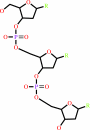 DNA(n)
|
+
|
2'-deoxyribonucleoside 5'-triphosphate
|
=
|
DNA(n+1)
|
+
|
 diphosphate
|
|
|
|
|
|
|
|
|
|
Enzyme class 4:
|
|
Chains A, B:
E.C.2.7.7.7
- DNA-directed Dna polymerase.
|
|
|
|
|
|
|
Reaction:
|
|
DNA(n) + a 2'-deoxyribonucleoside 5'-triphosphate = DNA(n+1) + diphosphate
|
|
|
|
|
|
DNA(n)
|
+
|
2'-deoxyribonucleoside 5'-triphosphate
|
=
|
DNA(n+1)
|
+
|
diphosphate
|
|
|
|
|
|
|
|
|
|
Enzyme class 5:
|
|
Chains A, B:
E.C.3.1.-.-
|
|
|
|
|
|
|
Enzyme class 6:
|
|
Chains A, B:
E.C.3.1.13.2
- exoribonuclease H.
|
|
|
|
|
|
|
Reaction:
|
|
Exonucleolytic cleavage to 5'-phosphomonoester oligonucleotides in both 5'- to 3'- and 3'- to 5'-directions.
|
|
|
|
|
|
Enzyme class 7:
|
|
Chains A, B:
E.C.3.1.26.13
- retroviral ribonuclease H.
|
|
|
|
|
|
|
Enzyme class 8:
|
|
Chains A, B:
E.C.3.4.23.16
- HIV-1 retropepsin.
|
|
|
|
|
|
|
Reaction:
|
|
Specific for a P1 residue that is hydrophobic, and P1' variable, but often Pro.
|
|
|
|
|
|
|
|
|
Note, where more than one E.C. class is given (as above), each may
correspond to a different protein domain or, in the case of polyprotein
precursors, to a different mature protein.
|
|
|
|
Molecule diagrams generated from .mol files obtained from the
KEGG ftp site
|
|
|
|
|
|
|
|
|
|
|
|
|
|
 |
|
|
|
|
|
|
| |
|
|
| |
|
DOI no:
|
Nat Struct Mol Biol
11:469-474
(2004)
|
|
PubMed id:
|
|
|
|
|
|
| |
|
Structures of HIV-1 RT-DNA complexes before and after incorporation of the anti-AIDS drug tenofovir.
|
|
S.Tuske,
S.G.Sarafianos,
A.D.Clark,
J.Ding,
L.K.Naeger,
K.L.White,
M.D.Miller,
C.S.Gibbs,
P.L.Boyer,
P.Clark,
G.Wang,
B.L.Gaffney,
R.A.Jones,
D.M.Jerina,
S.H.Hughes,
E.Arnold.
|
|
|
|
|
| |
ABSTRACT
|
|
|
|
| |
|
|
Tenofovir, also known as PMPA, R-9-(2-(phosphonomethoxypropyl)adenine, is a
nucleotide reverse transcriptase (RT) inhibitor. We have determined the crystal
structures of two related complexes of HIV-1 RT with template primer and
tenofovir: (i) a ternary complex at a resolution of 3.0 A of RT crosslinked to a
dideoxy-terminated DNA with tenofovir-diphosphate bound as the incoming
substrate; and (ii) a RT-DNA complex at a resolution of 3.1 A with tenofovir at
the 3' primer terminus. The tenofovir nucleotide in the tenofovir-terminated
structure seems to adopt multiple conformations. Some nucleoside reverse
transcriptase inhibitors, including 3TC and AZT, have elements ('handles') that
project beyond the corresponding elements on normal dNTPs (the 'substrate
envelope'). HIV-1 RT resistance mechanisms to AZT and 3TC take advantage of
these handles; tenofovir's structure lacks handles that could protrude through
the substrate envelope to cause resistance.
|
|
|
|
|
|
| |
Selected figure(s)
|
|
|
|
| |
|
|

|
|

|
|
Figure 1.
Figure 1. Comparison of the chemical structures of tenofovir,
dTMP and the NRTIs 3TCMP and AZTMP. The azido group of AZTMP
and the sulfur of the L-  -oxathialone
ring of 3TCMP protrude through the envelope of normal substrates
and can serve as handles for the development of NRTI resistance. -oxathialone
ring of 3TCMP protrude through the envelope of normal substrates
and can serve as handles for the development of NRTI resistance.
|
|
Figure 4.
Figure 4. The active site of the RT(P) -tenofovir complex with
tenofovir in two conformations. In one conformation
(tenofovir I), tenofovir stacks with the penultimate primer
residue but does not engage in Watson-Crick base-pairing with
the template dTMP. The dashed lines for the two base pairs
upstream of the 3' terminus are labeled 1 -3 and 1' -3' for the
template and primer strands, respectively. In the second
conformation (tenofovir II), the adenine of tenofovir is flipped
out by ~180° relative to the position of adenine in the first
conformation.
|
|
|
|
|
|
| |
The above figures are
reprinted
by permission from Macmillan Publishers Ltd:
Nat Struct Mol Biol
(2004,
11,
469-474)
copyright 2004.
|
|
| |
Figures were
selected
by an automated process.
|
|
|
|
|
|
|
|
|
|
|
|
|
|
|
|
 |
 |
 |
|
Literature references that cite this PDB file's key reference
|
|
|
| |
PubMed id
|
|
Reference
|
|
|
|
|
|
M.Lapkouski,
L.Tian,
J.T.Miller,
S.F.Le Grice,
and
W.Yang
(2013).
Complexes of HIV-1 RT, NNRTI and RNA/DNA hybrid reveal a structure compatible with RNA degradation.
|
| |
Nat Struct Mol Biol,
20,
230-236.
|
|
|
PDB codes:
|
|
|
|
|
|
|
|
K.Das,
S.E.Martinez,
J.D.Bauman,
and
E.Arnold
(2012).
HIV-1 reverse transcriptase complex with DNA and nevirapine reveals non-nucleoside inhibition mechanism.
|
| |
Nat Struct Mol Biol,
19,
253-259.
|
|
|
PDB codes:
|
|
|
|
|
|
|
|
A.Hachiya,
E.N.Kodama,
M.M.Schuckmann,
K.A.Kirby,
E.Michailidis,
Y.Sakagami,
S.Oka,
K.Singh,
and
S.G.Sarafianos
(2011).
K70Q adds high-level tenofovir resistance to "Q151M complex" HIV reverse transcriptase through the enhanced discrimination mechanism.
|
| |
PLoS One,
6,
e16242.
|
|
|
|
|
|
|
S.Ibe,
and
W.Sugiura
(2011).
Clinical significance of HIV reverse-transcriptase inhibitor-resistance mutations.
|
| |
Future Microbiol,
6,
295-315.
|
|
|
|
|
|
|
A.J.Acosta-Hoyos,
and
W.A.Scott
(2010).
The Role of Nucleotide Excision by Reverse Transcriptase in HIV Drug Resistance.
|
| |
Viruses,
2,
372-394.
|
|
|
|
|
|
|
K.Singh,
B.Marchand,
K.A.Kirby,
E.Michailidis,
and
S.G.Sarafianos
(2010).
Structural Aspects of Drug Resistance and Inhibition of HIV-1 Reverse Transcriptase.
|
| |
Viruses,
2,
606-638.
|
|
|
|
|
|
|
M.Götte,
J.W.Rausch,
B.Marchand,
S.Sarafianos,
and
S.F.Le Grice
(2010).
Reverse transcriptase in motion: conformational dynamics of enzyme-substrate interactions.
|
| |
Biochim Biophys Acta,
1804,
1202-1212.
|
|
|
|
|
|
|
P.R.Daga,
J.Duan,
and
R.J.Doerksen
(2010).
Computational model of hepatitis B virus DNA polymerase: molecular dynamics and docking to understand resistant mutations.
|
| |
Protein Sci,
19,
796-807.
|
|
|
|
|
|
|
D.M.Jesus,
L.T.Costa,
D.L.Gonçalves,
C.A.Achete,
M.Attias,
N.Moussatché,
and
C.R.Damaso
(2009).
Cidofovir inhibits genome encapsidation and affects morphogenesis during the replication of vaccinia virus.
|
| |
J Virol,
83,
11477-11490.
|
|
|
|
|
|
|
E.Michailidis,
B.Marchand,
E.N.Kodama,
K.Singh,
M.Matsuoka,
K.A.Kirby,
E.M.Ryan,
A.M.Sawani,
E.Nagy,
N.Ashida,
H.Mitsuya,
M.A.Parniak,
and
S.G.Sarafianos
(2009).
Mechanism of inhibition of HIV-1 reverse transcriptase by 4'-Ethynyl-2-fluoro-2'-deoxyadenosine triphosphate, a translocation-defective reverse transcriptase inhibitor.
|
| |
J Biol Chem,
284,
35681-35691.
|
|
|
|
|
|
|
E.P.Tchesnokov,
A.Obikhod,
I.Massud,
A.Lisco,
C.Vanpouille,
B.Brichacek,
J.Balzarini,
C.McGuigan,
M.Derudas,
L.Margolis,
R.F.Schinazi,
and
M.Götte
(2009).
Mechanisms Associated with HIV-1 Resistance to Acyclovir by the V75I Mutation in Reverse Transcriptase.
|
| |
J Biol Chem,
284,
21496-21504.
|
|
|
|
|
|
|
J.M.Seckler,
K.J.Howard,
M.D.Barkley,
and
P.L.Wintrode
(2009).
Solution structural dynamics of HIV-1 reverse transcriptase heterodimer.
|
| |
Biochemistry,
48,
7646-7655.
|
|
|
|
|
|
|
K.Das,
R.P.Bandwar,
K.L.White,
J.Y.Feng,
S.G.Sarafianos,
S.Tuske,
X.Tu,
A.D.Clark,
P.L.Boyer,
X.Hou,
B.L.Gaffney,
R.A.Jones,
M.D.Miller,
S.H.Hughes,
and
E.Arnold
(2009).
Structural basis for the role of the K65r mutation in HIV-1 reverse transcriptase polymerization, excision antagonism, and tenofovir resistance.
|
| |
J Biol Chem,
284,
35092-35100.
|
|
|
PDB codes:
|
|
|
|
|
|
|
|
M.S.Palombo,
Y.Singh,
and
P.J.Sinko
(2009).
Prodrug and conjugate drug delivery strategies for improving HIV/AIDS therapy.
|
| |
J Drug Deliv Sci Technol,
19,
3.
|
|
|
|
|
|
|
X.Hou,
G.Wang,
B.L.Gaffney,
and
R.A.Jones
(2009).
Synthesis of guanosine and deoxyguanosine phosphoramidites with cross-linkable thioalkyl tethers for direct incorporation into RNA and DNA.
|
| |
Nucleosides Nucleotides Nucleic Acids,
28,
1076-1094.
|
|
|
|
|
|
|
A.Hachiya,
E.N.Kodama,
S.G.Sarafianos,
M.M.Schuckmann,
Y.Sakagami,
M.Matsuoka,
M.Takiguchi,
H.Gatanaga,
and
S.Oka
(2008).
Amino acid mutation N348I in the connection subdomain of human immunodeficiency virus type 1 reverse transcriptase confers multiclass resistance to nucleoside and nonnucleoside reverse transcriptase inhibitors.
|
| |
J Virol,
82,
3261-3270.
|
|
|
|
|
|
|
A.J.Berdis
(2008).
DNA polymerases as therapeutic targets.
|
| |
Biochemistry,
47,
8253-8260.
|
|
|
|
|
|
|
D.Michalowski,
R.Chitima-Matsiga,
D.M.Held,
and
D.H.Burke
(2008).
Novel bimodular DNA aptamers with guanosine quadruplexes inhibit phylogenetically diverse HIV-1 reverse transcriptases.
|
| |
Nucleic Acids Res,
36,
7124-7135.
|
|
|
|
|
|
|
M.D.Altman,
E.A.Nalivaika,
M.Prabu-Jeyabalan,
C.A.Schiffer,
and
B.Tidor
(2008).
Computational design and experimental study of tighter binding peptides to an inactivated mutant of HIV-1 protease.
|
| |
Proteins,
70,
678-694.
|
|
|
PDB codes:
|
|
|
|
|
|
|
|
M.Ehteshami,
B.J.Scarth,
E.P.Tchesnokov,
C.Dash,
S.F.Le Grice,
S.Hallenberger,
D.Jochmans,
and
M.Götte
(2008).
Mutations M184V and Y115F in HIV-1 Reverse Transcriptase Discriminate against "Nucleotide-competing Reverse Transcriptase Inhibitors".
|
| |
J Biol Chem,
283,
29904-29911.
|
|
|
|
|
|
|
M.L.Coté,
and
M.J.Roth
(2008).
Murine leukemia virus reverse transcriptase: structural comparison with HIV-1 reverse transcriptase.
|
| |
Virus Res,
134,
186-202.
|
|
|
|
|
|
|
W.Rutvisuttinunt,
P.R.Meyer,
and
W.A.Scott
(2008).
Interactions between HIV-1 reverse transcriptase and the downstream template strand in stable complexes with primer-template.
|
| |
PLoS ONE,
3,
e3561.
|
|
|
|
|
|
|
A.Frangeul,
K.Barral,
K.Alvarez,
and
B.Canard
(2007).
In vitro suppression of K65R reverse transcriptase-mediated tenofovir- and adefovir-5'-diphosphate resistance conferred by the boranophosphonate derivatives.
|
| |
Antimicrob Agents Chemother,
51,
3162-3167.
|
|
|
|
|
|
|
B.Marchand,
K.L.White,
J.K.Ly,
N.A.Margot,
R.Wang,
M.McDermott,
M.D.Miller,
and
M.Götte
(2007).
Effects of the translocation status of human immunodeficiency virus type 1 reverse transcriptase on the efficiency of excision of tenofovir.
|
| |
Antimicrob Agents Chemother,
51,
2911-2919.
|
|
|
|
|
|
|
D.M.Held,
J.D.Kissel,
S.J.Thacker,
D.Michalowski,
D.Saran,
J.Ji,
R.W.Hardy,
J.J.Rossi,
and
D.H.Burke
(2007).
Cross-clade inhibition of recombinant human immunodeficiency virus type 1 (HIV-1), HIV-2, and simian immunodeficiency virus SIVcpz reverse transcriptases by RNA pseudoknot aptamers.
|
| |
J Virol,
81,
5375-5384.
|
|
|
|
|
|
|
N.Sluis-Cremer,
C.W.Sheen,
S.Zelina,
P.S.Torres,
U.M.Parikh,
and
J.W.Mellors
(2007).
Molecular mechanism by which the K70E mutation in human immunodeficiency virus type 1 reverse transcriptase confers resistance to nucleoside reverse transcriptase inhibitors.
|
| |
Antimicrob Agents Chemother,
51,
48-53.
|
|
|
|
|
|
|
P.R.Meyer,
W.Rutvisuttinunt,
S.E.Matsuura,
A.G.So,
and
W.A.Scott
(2007).
Stable complexes formed by HIV-1 reverse transcriptase at distinct positions on the primer-template controlled by binding deoxynucleoside triphosphates or foscarnet.
|
| |
J Mol Biol,
369,
41-54.
|
|
|
|
|
|
|
U.M.Parikh,
S.Zelina,
N.Sluis-Cremer,
and
J.W.Mellors
(2007).
Molecular mechanisms of bidirectional antagonism between K65R and thymidine analog mutations in HIV-1 reverse transcriptase.
|
| |
AIDS,
21,
1405-1414.
|
|
|
|
|
|
|
P.L.Boyer,
S.G.Sarafianos,
P.K.Clark,
E.Arnold,
and
S.H.Hughes
(2006).
Why do HIV-1 and HIV-2 use different pathways to develop AZT resistance?
|
| |
PLoS Pathog,
2,
e10.
|
|
|
|
|
|
|
E.De Clercq,
and
A.Holý
(2005).
Acyclic nucleoside phosphonates: a key class of antiviral drugs.
|
| |
Nat Rev Drug Discov,
4,
928-940.
|
|
|
|
|
|
|
J.Ren,
and
D.K.Stammers
(2005).
HIV reverse transcriptase structures: designing new inhibitors and understanding mechanisms of drug resistance.
|
| |
Trends Pharmacol Sci,
26,
4-7.
|
|
|
|
|
|
|
W.C.Magee,
K.Y.Hostetler,
and
D.H.Evans
(2005).
Mechanism of inhibition of vaccinia virus DNA polymerase by cidofovir diphosphate.
|
| |
Antimicrob Agents Chemother,
49,
3153-3162.
|
|
|
|
|
|
|
P.L.Boyer,
T.Imamichi,
S.G.Sarafianos,
E.Arnold,
and
S.H.Hughes
(2004).
Effects of the Delta67 complex of mutations in human immunodeficiency virus type 1 reverse transcriptase on nucleoside analog excision.
|
| |
J Virol,
78,
9987-9997.
|
|
|
|
|
|
The most recent references are shown first.
Citation data come partly from CiteXplore and partly
from an automated harvesting procedure. Note that this is likely to be
only a partial list as not all journals are covered by
either method. However, we are continually building up the citation data
so more and more references will be included with time.
Where a reference describes a PDB structure, the PDB
codes are
shown on the right.
|

| |


 Links
Links


