 |
PDBsum entry 1im4

|
|
|
|
|
 |
Contents |
 |
|
|
|
|
|
|
|
|
|
|
|
|
* Residue conservation analysis
|
|
|
|
|
|
|
|
|
|
|
Enzyme class:
|
|
E.C.2.7.7.7
- DNA-directed Dna polymerase.
|
|
|
|
|
|
|
Reaction:
|
|
DNA(n) + a 2'-deoxyribonucleoside 5'-triphosphate = DNA(n+1) + diphosphate
|
|
|
|
|
|
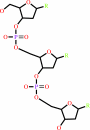 DNA(n)
|
+
|
2'-deoxyribonucleoside 5'-triphosphate
|
=
|
DNA(n+1)
|
+
|
 diphosphate
|
|
|
|
|
|
|
|
|
|
|
|
|
Molecule diagrams generated from .mol files obtained from the
KEGG ftp site
|
|
|
|
|
|
|
|
|
|
|
|
|
|
 |
|
|
|
|
|
|
| |
|
|
| |
|
DOI no:
|
Mol Cell
8:427-437
(2001)
|
|
PubMed id:
|
|
|
|
|
|
| |
|
Crystal structure of a DinB lesion bypass DNA polymerase catalytic fragment reveals a classic polymerase catalytic domain.
|
|
B.L.Zhou,
J.D.Pata,
T.A.Steitz.
|
|
|
|
|
| |
ABSTRACT
|
|
|
|
| |
|
|
The UmuC/DinB family of bypass polymerases is responsible for translesion DNA
synthesis and includes the human polymerases eta, iota, and kappa. We determined
the 2.3 A resolution crystal structure of a catalytic fragment of the DinB
homolog (Dbh) polymerase from Sulfolobus solfataricus and show that it is
nonprocessive and can bypass an abasic site. The structure of the catalytic
domain is nearly identical to those of most other polymerase families. Homology
modeling suggests that there is minimal contact between protein and DNA, that
the nascent base pair binding pocket is quite accessible, and that the enzyme is
already in a closed conformation characteristic of ternary polymerase complexes.
These observations afford insights into the sources of low fidelity and low
processivity of the UmuC/DinB polymerases.
|
|
|
|
|
|
| |
Selected figure(s)
|
|
|
|
| |
|
|

|
|

|
|
Figure 2.
Figure 2. Homology Modeling of DNA from the T7 DNAP Ternary
Complex onto the Molecular Surface of Dbh(A) Superposition of
the palm domains of Dbh (colored as in Figure 1A) and T7 DNAP
(colored in dark gray). The T7 DNAP catalytic aspartates (D475
and D654) and the residues that function as the steric gate
(E480) and bind the 3′ terminal phosphorous of the primer
strand (H704) are shown in stick representation, as are the
corresponding residues from Dbh (D7, D105, F12, and K153). The
Mg^2+ ions from the T7 DNAP ternary complex are shown as yellow
spheres. Cα atoms used in the superposition were 1–21,
77–95, 97–112, 118–137, and 138–153 from Dbh and
469–487, 614–632, 646–661, 662–681, and 689–704 from
T7 DNAP ternary complex (Protein Data Bank code 1T7P;
Doublié et al., 1998). Only the structurally aligned core
of the palm domains is shown.(B) View looking down onto the Dbh
active site. Primer and template DNA (light and dark gray,
respectively), incoming nucleotide, and magnesium ions (yellow
spheres) from the T7DNAP ternary complex structure
(Doublié et al., 1998) were modeled onto the molecular
surface of Dbh. Substrate molecules from the T7 DNAP ternary
complex structure were positioned onto the Dbh surface based on
the superposition of the palm domains shown in (A). The flexible
loop and N-terminal His[6]-tag are not shown in surface
representation and are, instead, shown with transparent and gray
lines, respectively. The molecular surface of Dbh was calculated
using a 1.4 Å radius probe in SPOCK (Christopher, 1998)
and is colored according to conserved motifs I-V as in Figure
1A.(C) Closer view of the active site with surface colored
according to electrostatic potential, with positively charged
areas in blue and negatively charged areas in red. The thumb
domain has been omitted for clarity, and the molecule has been
rotated slightly to show the surface of the nascent base pair
binding pocket more clearly. Surface areas contributed by some
of the residues discussed in the text are labeled
|
|
Figure 3.
Figure 3. Polymerase Active Site of DbhResidues discussed
in the text are shown in stick representation together with a
ribbons diagram of Dbh. Coloring of conserved motifs is as
described in Figure 1A. Hydrogen bonds discussed are indicated
with dotted lines
|
|
|
|
|
|
| |
The above figures are
reprinted
by permission from Cell Press:
Mol Cell
(2001,
8,
427-437)
copyright 2001.
|
|
| |
Figures were
selected
by an automated process.
|
|
|
|
|
|
|
|
|
|
|
|
|
|
|
|
 |
 |
 |
|
Literature references that cite this PDB file's key reference
|
|
|
| |
PubMed id
|
|
Reference
|
|
|
|
|
|
R.Vasquez-Del Carpio,
T.D.Silverstein,
S.Lone,
R.E.Johnson,
L.Prakash,
S.Prakash,
and
A.K.Aggarwal
(2011).
Role of human DNA polymerase κ in extension opposite from a cis-syn thymine dimer.
|
| |
J Mol Biol,
408,
252-261.
|
|
|
PDB code:
|
|
|
|
|
|
|
|
Y.W.Yin
(2011).
Structural insight on processivity, human disease and antiviral drug toxicity.
|
| |
Curr Opin Struct Biol,
21,
83-91.
|
|
|
|
|
|
|
J.A.Neal,
K.L.Fletcher,
J.J.McCormick,
and
V.M.Maher
(2010).
The role of hRev7, the accessory subunit of hPolζ, in translesion synthesis past DNA damage induced by benzo[a]pyrene diol epoxide (BPDE).
|
| |
BMC Cell Biol,
11,
97.
|
|
|
|
|
|
|
J.D.Pata
(2010).
Structural diversity of the Y-family DNA polymerases.
|
| |
Biochim Biophys Acta,
1804,
1124-1135.
|
|
|
|
|
|
|
S.Chandani,
C.Jacobs,
and
E.L.Loechler
(2010).
Architecture of y-family DNA polymerases relevant to translesion DNA synthesis as revealed in structural and molecular modeling studies.
|
| |
J Nucleic Acids,
2010,
0.
|
|
|
|
|
|
|
T.D.Silverstein,
R.E.Johnson,
R.Jain,
L.Prakash,
S.Prakash,
and
A.K.Aggarwal
(2010).
Structural basis for the suppression of skin cancers by DNA polymerase eta.
|
| |
Nature,
465,
1039-1043.
|
|
|
PDB codes:
|
|
|
|
|
|
|
|
A.Irimia,
R.L.Eoff,
F.P.Guengerich,
and
M.Egli
(2009).
Structural and functional elucidation of the mechanism promoting error-prone synthesis by human DNA polymerase kappa opposite the 7,8-dihydro-8-oxo-2'-deoxyguanosine adduct.
|
| |
J Biol Chem,
284,
22467-22480.
|
|
|
PDB codes:
|
|
|
|
|
|
|
|
A.Valenti,
G.Perugino,
T.Nohmi,
M.Rossi,
and
M.Ciaramella
(2009).
Inhibition of translesion DNA polymerase by archaeal reverse gyrase.
|
| |
Nucleic Acids Res,
37,
4287-4295.
|
|
|
|
|
|
|
D.F.Jarosz,
S.E.Cohen,
J.C.Delaney,
J.M.Essigmann,
and
G.C.Walker
(2009).
A DinB variant reveals diverse physiological consequences of incomplete TLS extension by a Y-family DNA polymerase.
|
| |
Proc Natl Acad Sci U S A,
106,
21137-21142.
|
|
|
|
|
|
|
K.Y.Seo,
J.Yin,
P.Donthamsetti,
S.Chandani,
C.H.Lee,
and
E.L.Loechler
(2009).
Amino acid architecture that influences dNTP insertion efficiency in Y-family DNA polymerase V of E. coli.
|
| |
J Mol Biol,
392,
270-282.
|
|
|
|
|
|
|
L.S.Waters,
B.K.Minesinger,
M.E.Wiltrout,
S.D'Souza,
R.V.Woodruff,
and
G.C.Walker
(2009).
Eukaryotic translesion polymerases and their roles and regulation in DNA damage tolerance.
|
| |
Microbiol Mol Biol Rev,
73,
134-154.
|
|
|
|
|
|
|
R.Vasquez-Del Carpio,
T.D.Silverstein,
S.Lone,
M.K.Swan,
J.R.Choudhury,
R.E.Johnson,
S.Prakash,
L.Prakash,
and
A.K.Aggarwal
(2009).
Structure of human DNA polymerase kappa inserting dATP opposite an 8-OxoG DNA lesion.
|
| |
PLoS One,
4,
e5766.
|
|
|
PDB codes:
|
|
|
|
|
|
|
|
S.Chandani,
and
E.L.Loechler
(2009).
Y-Family DNA polymerases may use two different dNTP shapes for insertion: a hypothesis and its implications.
|
| |
J Mol Graph Model,
27,
759-769.
|
|
|
|
|
|
|
J.Cramer,
G.Rangam,
A.Marx,
and
T.Restle
(2008).
Varied active-site constraints in the klenow fragment of E. coli DNA polymerase I and the lesion-bypass Dbh DNA polymerase.
|
| |
Chembiochem,
9,
1243-1250.
|
|
|
|
|
|
|
K.H.Tang,
M.Niebuhr,
C.S.Tung,
H.C.Chan,
C.C.Chou,
and
M.D.Tsai
(2008).
Mismatched dNTP incorporation by DNA polymerase beta does not proceed via globally different conformational pathways.
|
| |
Nucleic Acids Res,
36,
2948-2957.
|
|
|
PDB code:
|
|
|
|
|
|
|
|
R.A.Wing,
S.Bailey,
and
T.A.Steitz
(2008).
Insights into the replisome from the structure of a ternary complex of the DNA polymerase III alpha-subunit.
|
| |
J Mol Biol,
382,
859-869.
|
|
|
PDB code:
|
|
|
|
|
|
|
|
M.De Felice,
B.Medagli,
L.Esposito,
M.De Falco,
B.Pucci,
M.Rossi,
P.Grùz,
T.Nohmi,
and
F.M.Pisani
(2007).
Biochemical evidence of a physical interaction between Sulfolobus solfataricus B-family and Y-family DNA polymerases.
|
| |
Extremophiles,
11,
277-282.
|
|
|
|
|
|
|
S.Balaji,
and
L.Aravind
(2007).
The RAGNYA fold: a novel fold with multiple topological variants found in functionally diverse nucleic acid, nucleotide and peptide-binding proteins.
|
| |
Nucleic Acids Res,
35,
5658-5671.
|
|
|
|
|
|
|
S.Lone,
S.A.Townson,
S.N.Uljon,
R.E.Johnson,
A.Brahma,
D.T.Nair,
S.Prakash,
L.Prakash,
and
A.K.Aggarwal
(2007).
Human DNA polymerase kappa encircles DNA: implications for mismatch extension and lesion bypass.
|
| |
Mol Cell,
25,
601-614.
|
|
|
|
|
|
|
V.J.Cannistraro,
and
J.S.Taylor
(2007).
Ability of polymerase eta and T7 DNA polymerase to bypass bulge structures.
|
| |
J Biol Chem,
282,
11188-11196.
|
|
|
|
|
|
|
W.Yang,
and
R.Woodgate
(2007).
What a difference a decade makes: insights into translesion DNA synthesis.
|
| |
Proc Natl Acad Sci U S A,
104,
15591-15598.
|
|
|
|
|
|
|
A.M.DeLucia,
S.Chaudhuri,
O.Potapova,
N.D.Grindley,
and
C.M.Joyce
(2006).
The properties of steric gate mutants reveal different constraints within the active sites of Y-family and A-family DNA polymerases.
|
| |
J Biol Chem,
281,
27286-27291.
|
|
|
|
|
|
|
D.T.Nair,
R.E.Johnson,
L.Prakash,
S.Prakash,
and
A.K.Aggarwal
(2006).
Hoogsteen base pair formation promotes synthesis opposite the 1,N6-ethenodeoxyadenosine lesion by human DNA polymerase iota.
|
| |
Nat Struct Mol Biol,
13,
619-625.
|
|
|
PDB codes:
|
|
|
|
|
|
|
|
J.P.McDonald,
A.Hall,
D.Gasparutto,
J.Cadet,
J.Ballantyne,
and
R.Woodgate
(2006).
Novel thermostable Y-family polymerases: applications for the PCR amplification of damaged or ancient DNAs.
|
| |
Nucleic Acids Res,
34,
1102-1111.
|
|
|
|
|
|
|
O.Potapova,
C.Chan,
A.M.DeLucia,
S.A.Helquist,
E.T.Kool,
N.D.Grindley,
and
C.M.Joyce
(2006).
DNA polymerase catalysis in the absence of Watson-Crick hydrogen bonds: analysis by single-turnover kinetics.
|
| |
Biochemistry,
45,
890-898.
|
|
|
|
|
|
|
O.Rechkoblit,
L.Malinina,
Y.Cheng,
V.Kuryavyi,
S.Broyde,
N.E.Geacintov,
and
D.J.Patel
(2006).
Stepwise translocation of Dpo4 polymerase during error-free bypass of an oxoG lesion.
|
| |
PLoS Biol,
4,
e11.
|
|
|
PDB codes:
|
|
|
|
|
|
|
|
R.Fujikane,
H.Shinagawa,
and
Y.Ishino
(2006).
The archaeal Hjm helicase has recQ-like functions, and may be involved in repair of stalled replication fork.
|
| |
Genes Cells,
11,
99.
|
|
|
|
|
|
|
R.T.Pomerantz,
D.Temiakov,
M.Anikin,
D.G.Vassylyev,
and
W.T.McAllister
(2006).
A mechanism of nucleotide misincorporation during transcription due to template-strand misalignment.
|
| |
Mol Cell,
24,
245-255.
|
|
|
|
|
|
|
S.Bailey,
R.A.Wing,
and
T.A.Steitz
(2006).
The structure of T. aquaticus DNA polymerase III is distinct from eukaryotic replicative DNA polymerases.
|
| |
Cell,
126,
893-904.
|
|
|
PDB codes:
|
|
|
|
|
|
|
|
A.Vaisman,
H.Ling,
R.Woodgate,
and
W.Yang
(2005).
Fidelity of Dpo4: effect of metal ions, nucleotide selection and pyrophosphorolysis.
|
| |
EMBO J,
24,
2957-2967.
|
|
|
PDB codes:
|
|
|
|
|
|
|
|
D.T.Nair,
R.E.Johnson,
L.Prakash,
S.Prakash,
and
A.K.Aggarwal
(2005).
Rev1 employs a novel mechanism of DNA synthesis using a protein template.
|
| |
Science,
309,
2219-2222.
|
|
|
PDB code:
|
|
|
|
|
|
|
|
D.T.Nair,
R.E.Johnson,
L.Prakash,
S.Prakash,
and
A.K.Aggarwal
(2005).
Human DNA polymerase iota incorporates dCTP opposite template G via a G.C + Hoogsteen base pair.
|
| |
Structure,
13,
1569-1577.
|
|
|
PDB code:
|
|
|
|
|
|
|
|
J.Cramer,
and
T.Restle
(2005).
Pre-steady-state kinetic characterization of the DinB homologue DNA polymerase of Sulfolobus solfataricus.
|
| |
J Biol Chem,
280,
40552-40558.
|
|
|
|
|
|
|
N.Acharya,
L.Haracska,
R.E.Johnson,
I.Unk,
S.Prakash,
and
L.Prakash
(2005).
Complex formation of yeast Rev1 and Rev7 proteins: a novel role for the polymerase-associated domain.
|
| |
Mol Cell Biol,
25,
9734-9740.
|
|
|
|
|
|
|
S.Duigou,
S.D.Ehrlich,
P.Noirot,
and
M.F.Noirot-Gros
(2005).
DNA polymerase I acts in translesion synthesis mediated by the Y-polymerases in Bacillus subtilis.
|
| |
Mol Microbiol,
57,
678-690.
|
|
|
|
|
|
|
S.Prakash,
R.E.Johnson,
and
L.Prakash
(2005).
Eukaryotic translesion synthesis DNA polymerases: specificity of structure and function.
|
| |
Annu Rev Biochem,
74,
317-353.
|
|
|
|
|
|
|
A.Niimi,
S.Limsirichaikul,
S.Yoshida,
S.Iwai,
C.Masutani,
F.Hanaoka,
E.T.Kool,
Y.Nishiyama,
and
M.Suzuki
(2004).
Palm mutants in DNA polymerases alpha and eta alter DNA replication fidelity and translesion activity.
|
| |
Mol Cell Biol,
24,
2734-2746.
|
|
|
|
|
|
|
B.S.Plosky,
and
R.Woodgate
(2004).
Switching from high-fidelity replicases to low-fidelity lesion-bypass polymerases.
|
| |
Curr Opin Genet Dev,
14,
113-119.
|
|
|
|
|
|
|
D.Das,
and
M.M.Georgiadis
(2004).
The crystal structure of the monomeric reverse transcriptase from Moloney murine leukemia virus.
|
| |
Structure,
12,
819-829.
|
|
|
PDB codes:
|
|
|
|
|
|
|
|
D.T.Nair,
R.E.Johnson,
S.Prakash,
L.Prakash,
and
A.K.Aggarwal
(2004).
Replication by human DNA polymerase-iota occurs by Hoogsteen base-pairing.
|
| |
Nature,
430,
377-380.
|
|
|
PDB code:
|
|
|
|
|
|
|
|
F.Boudsocq,
R.J.Kokoska,
B.S.Plosky,
A.Vaisman,
H.Ling,
T.A.Kunkel,
W.Yang,
and
R.Woodgate
(2004).
Investigating the role of the little finger domain of Y-family DNA polymerases in low fidelity synthesis and translesion replication.
|
| |
J Biol Chem,
279,
32932-32940.
|
|
|
|
|
|
|
H.Ling,
J.M.Sayer,
B.S.Plosky,
H.Yagi,
F.Boudsocq,
R.Woodgate,
D.M.Jerina,
and
W.Yang
(2004).
Crystal structure of a benzo[a]pyrene diol epoxide adduct in a ternary complex with a DNA polymerase.
|
| |
Proc Natl Acad Sci U S A,
101,
2265-2269.
|
|
|
PDB code:
|
|
|
|
|
|
|
|
J.Trincao,
R.E.Johnson,
W.T.Wolfle,
C.R.Escalante,
S.Prakash,
L.Prakash,
and
A.K.Aggarwal
(2004).
Dpo4 is hindered in extending a G.T mismatch by a reverse wobble.
|
| |
Nat Struct Mol Biol,
11,
457-462.
|
|
|
PDB codes:
|
|
|
|
|
|
|
|
M.V.García-Ortiz,
R.R.Ariza,
P.D.Hoffman,
J.B.Hays,
and
T.Roldán-Arjona
(2004).
Arabidopsis thaliana AtPOLK encodes a DinB-like DNA polymerase that extends mispaired primer termini and is highly expressed in a variety of tissues.
|
| |
Plant J,
39,
84-97.
|
|
|
|
|
|
|
R.Kusumoto,
C.Masutani,
S.Shimmyo,
S.Iwai,
and
F.Hanaoka
(2004).
DNA binding properties of human DNA polymerase eta: implications for fidelity and polymerase switching of translesion synthesis.
|
| |
Genes Cells,
9,
1139-1150.
|
|
|
|
|
|
|
S.N.Uljon,
R.E.Johnson,
T.A.Edwards,
S.Prakash,
L.Prakash,
and
A.K.Aggarwal
(2004).
Crystal structure of the catalytic core of human DNA polymerase kappa.
|
| |
Structure,
12,
1395-1404.
|
|
|
PDB code:
|
|
|
|
|
|
|
|
T.A.Steitz,
and
Y.W.Yin
(2004).
Accuracy, lesion bypass, strand displacement and translocation by DNA polymerases.
|
| |
Philos Trans R Soc Lond B Biol Sci,
359,
17-23.
|
|
|
|
|
|
|
Y.W.Yin,
and
T.A.Steitz
(2004).
The structural mechanism of translocation and helicase activity in T7 RNA polymerase.
|
| |
Cell,
116,
393-404.
|
|
|
PDB codes:
|
|
|
|
|
|
|
|
A.Gratchev,
P.Strein,
J.Utikal,
and
G.Sergij
(2003).
Molecular genetics of Xeroderma pigmentosum variant.
|
| |
Exp Dermatol,
12,
529-536.
|
|
|
|
|
|
|
A.M.DeLucia,
N.D.Grindley,
and
C.M.Joyce
(2003).
An error-prone family Y DNA polymerase (DinB homolog from Sulfolobus solfataricus) uses a 'steric gate' residue for discrimination against ribonucleotides.
|
| |
Nucleic Acids Res,
31,
4129-4137.
|
|
|
|
|
|
|
E.Glick,
J.S.Chau,
K.L.Vigna,
S.D.McCulloch,
E.T.Adman,
T.A.Kunkel,
and
L.A.Loeb
(2003).
Amino acid substitutions at conserved tyrosine 52 alter fidelity and bypass efficiency of human DNA polymerase eta.
|
| |
J Biol Chem,
278,
19341-19346.
|
|
|
|
|
|
|
G.J.McKenzie,
D.B.Magner,
P.L.Lee,
and
S.M.Rosenberg
(2003).
The dinB operon and spontaneous mutation in Escherichia coli.
|
| |
J Bacteriol,
185,
3972-3977.
|
|
|
|
|
|
|
H.Ling,
F.Boudsocq,
B.S.Plosky,
R.Woodgate,
and
W.Yang
(2003).
Replication of a cis-syn thymine dimer at atomic resolution.
|
| |
Nature,
424,
1083-1087.
|
|
|
PDB codes:
|
|
|
|
|
|
|
|
M.Shimizu,
P.Gruz,
H.Kamiya,
S.R.Kim,
F.M.Pisani,
C.Masutani,
Y.Kanke,
H.Harashima,
F.Hanaoka,
and
T.Nohmi
(2003).
Erroneous incorporation of oxidized DNA precursors by Y-family DNA polymerases.
|
| |
EMBO Rep,
4,
269-273.
|
|
|
|
|
|
|
M.T.Washington,
S.A.Helquist,
E.T.Kool,
L.Prakash,
and
S.Prakash
(2003).
Requirement of Watson-Crick hydrogen bonding for DNA synthesis by yeast DNA polymerase eta.
|
| |
Mol Cell Biol,
23,
5107-5112.
|
|
|
|
|
|
|
M.T.Washington,
W.T.Wolfle,
T.E.Spratt,
L.Prakash,
and
S.Prakash
(2003).
Yeast DNA polymerase eta makes functional contacts with the DNA minor groove only at the incoming nucleoside triphosphate.
|
| |
Proc Natl Acad Sci U S A,
100,
5113-5118.
|
|
|
|
|
|
|
P.Grúz,
M.Shimizu,
F.M.Pisani,
M.De Felice,
Y.Kanke,
and
T.Nohmi
(2003).
Processing of DNA lesions by archaeal DNA polymerases from Sulfolobus solfataricus.
|
| |
Nucleic Acids Res,
31,
4024-4030.
|
|
|
|
|
|
|
R.E.Johnson,
J.Trincao,
A.K.Aggarwal,
S.Prakash,
and
L.Prakash
(2003).
Deoxynucleotide triphosphate binding mode conserved in Y family DNA polymerases.
|
| |
Mol Cell Biol,
23,
3008-3012.
|
|
|
|
|
|
|
W.A.Beard,
and
S.H.Wilson
(2003).
Structural insights into the origins of DNA polymerase fidelity.
|
| |
Structure,
11,
489-496.
|
|
|
|
|
|
|
W.Yang
(2003).
Damage repair DNA polymerases Y.
|
| |
Curr Opin Struct Biol,
13,
23-30.
|
|
|
|
|
|
|
A.Borden,
P.I.O'Grady,
D.Vandewiele,
A.R.Fernández de Henestrosa,
C.W.Lawrence,
and
R.Woodgate
(2002).
Escherichia coli DNA polymerase III can replicate efficiently past a T-T cis-syn cyclobutane dimer if DNA polymerase V and the 3' to 5' exonuclease proofreading function encoded by dnaQ are inactivated.
|
| |
J Bacteriol,
184,
2674-2681.
|
|
|
|
|
|
|
D.Chiapperino,
H.Kroth,
I.H.Kramarczuk,
J.M.Sayer,
C.Masutani,
F.Hanaoka,
D.M.Jerina,
and
A.M.Cheh
(2002).
Preferential misincorporation of purine nucleotides by human DNA polymerase eta opposite benzo[a]pyrene 7,8-diol 9,10-epoxide deoxyguanosine adducts.
|
| |
J Biol Chem,
277,
11765-11771.
|
|
|
|
|
|
|
D.T.Minnick,
L.Liu,
N.D.Grindley,
T.A.Kunkel,
and
C.M.Joyce
(2002).
Discrimination against purine-pyrimidine mispairs in the polymerase active site of DNA polymerase I: a structural explanation.
|
| |
Proc Natl Acad Sci U S A,
99,
1194-1199.
|
|
|
|
|
|
|
G.Villani,
N.Tanguy Le Gac,
L.Wasungu,
D.Burnouf,
R.P.Fuchs,
and
P.E.Boehmer
(2002).
Effect of manganese on in vitro replication of damaged DNA catalyzed by the herpes simplex virus type-1 DNA polymerase.
|
| |
Nucleic Acids Res,
30,
3323-3332.
|
|
|
|
|
|
|
K.Daimon,
Y.Kawarabayasi,
H.Kikuchi,
Y.Sako,
and
Y.Ishino
(2002).
Three proliferating cell nuclear antigen-like proteins found in the hyperthermophilic archaeon Aeropyrum pernix: interactions with the two DNA polymerases.
|
| |
J Bacteriol,
184,
687-694.
|
|
|
|
|
|
|
M.Delarue,
J.B.Boulé,
J.Lescar,
N.Expert-Bezançon,
N.Jourdan,
N.Sukumar,
F.Rougeon,
and
C.Papanicolaou
(2002).
Crystal structures of a template-independent DNA polymerase: murine terminal deoxynucleotidyltransferase.
|
| |
EMBO J,
21,
427-439.
|
|
|
PDB codes:
|
|
|
|
|
|
|
|
M.F.Goodman
(2002).
Error-prone repair DNA polymerases in prokaryotes and eukaryotes.
|
| |
Annu Rev Biochem,
71,
17-50.
|
|
|
|
|
|
|
M.T.Washington,
R.E.Johnson,
L.Prakash,
and
S.Prakash
(2002).
Human DINB1-encoded DNA polymerase kappa is a promiscuous extender of mispaired primer termini.
|
| |
Proc Natl Acad Sci U S A,
99,
1910-1914.
|
|
|
|
|
|
|
O.Potapova,
N.D.Grindley,
and
C.M.Joyce
(2002).
The mutational specificity of the Dbh lesion bypass polymerase and its implications.
|
| |
J Biol Chem,
277,
28157-28166.
|
|
|
|
|
|
|
O.Rechkoblit,
Y.Zhang,
D.Guo,
Z.Wang,
S.Amin,
J.Krzeminsky,
N.Louneva,
and
N.E.Geacintov
(2002).
trans-Lesion synthesis past bulky benzo[a]pyrene diol epoxide N2-dG and N6-dA lesions catalyzed by DNA bypass polymerases.
|
| |
J Biol Chem,
277,
30488-30494.
|
|
|
|
|
|
|
P.L.Fischhaber,
V.L.Gerlach,
W.J.Feaver,
Z.Hatahet,
S.S.Wallace,
and
E.C.Friedberg
(2002).
Human DNA polymerase kappa bypasses and extends beyond thymine glycols during translesion synthesis in vitro, preferentially incorporating correct nucleotides.
|
| |
J Biol Chem,
277,
37604-37611.
|
|
|
|
|
|
|
R.J.Kokoska,
K.Bebenek,
F.Boudsocq,
R.Woodgate,
and
T.A.Kunkel
(2002).
Low fidelity DNA synthesis by a y family DNA polymerase due to misalignment in the active site.
|
| |
J Biol Chem,
277,
19633-19638.
|
|
|
|
|
|
|
E.C.Friedberg,
P.L.Fischhaber,
and
C.Kisker
(2001).
Error-prone DNA polymerases: novel structures and the benefits of infidelity.
|
| |
Cell,
107,
9.
|
|
|
|
|
|
|
E.Glick,
K.L.Vigna,
and
L.A.Loeb
(2001).
Mutations in human DNA polymerase eta motif II alter bypass of DNA lesions.
|
| |
EMBO J,
20,
7303-7312.
|
|
|
|
|
|
|
H.Ling,
F.Boudsocq,
R.Woodgate,
and
W.Yang
(2001).
Crystal structure of a Y-family DNA polymerase in action: a mechanism for error-prone and lesion-bypass replication.
|
| |
Cell,
107,
91.
|
|
|
PDB codes:
|
|
|
|
|
|
|
|
L.F.Silvian,
E.A.Toth,
P.Pham,
M.F.Goodman,
and
T.Ellenberger
(2001).
Crystal structure of a DinB family error-prone DNA polymerase from Sulfolobus solfataricus.
|
| |
Nat Struct Biol,
8,
984-989.
|
|
|
PDB codes:
|
|
|
|
|
|
|
|
M.T.Washington,
L.Prakash,
and
S.Prakash
(2001).
Yeast DNA polymerase eta utilizes an induced-fit mechanism of nucleotide incorporation.
|
| |
Cell,
107,
917-927.
|
|
|
|
|
|
|
P.Grúz,
F.M.Pisani,
M.Shimizu,
M.Yamada,
I.Hayashi,
K.Morikawa,
and
T.Nohmi
(2001).
Synthetic activity of Sso DNA polymerase Y1, an archaeal DinB-like DNA polymerase, is stimulated by processivity factors proliferating cell nuclear antigen and replication factor C.
|
| |
J Biol Chem,
276,
47394-47401.
|
|
|
|
|
|
|
T.Ellenberger,
and
L.F.Silvian
(2001).
The anatomy of infidelity.
|
| |
Nat Struct Biol,
8,
827-828.
|
|
|
|
|
|
|
W.A.Beard,
and
S.H.Wilson
(2001).
DNA polymerases lose their grip.
|
| |
Nat Struct Biol,
8,
915-917.
|
|
|
|
|
|
|
W.A.Beard,
and
S.H.Wilson
(2001).
DNA lesion bypass polymerases open up.
|
| |
Structure,
9,
759-764.
|
|
|
|
|
|
The most recent references are shown first.
Citation data come partly from CiteXplore and partly
from an automated harvesting procedure. Note that this is likely to be
only a partial list as not all journals are covered by
either method. However, we are continually building up the citation data
so more and more references will be included with time.
Where a reference describes a PDB structure, the PDB
code is
shown on the right.
|
|


 Links
Links


