 |
PDBsum entry 2agq

|
|
|
|
|
|

|

|

|

|
|

|
|

|
|

|
|

|
|

|
|

|
|

|
|
|
 |

|

|
|
|
|
|
|
|
|
|
|
|
|
|
|
|
|
|
|
|
|
|
|
|
|
|
|
|
|
|
|
|
|
|
|
|
|
Transferase/DNA
|
PDB id
|
|
|
|
2agq
|
|
|
|
|
|
|
|
|
|
|
|
|
|
|

|

|

|
|
|
|
|
|
|
|
 |
Contents |
 |
|
|
|
|
|
|
|
|
|
|
|
|
|
|
|
|
* Residue conservation analysis
|
|
|
|
|
|
|
|
|
|
|
Enzyme class:
|
|
E.C.2.7.7.7
- DNA-directed Dna polymerase.
|
|
|
|
|
|
|
Reaction:
|
|
DNA(n) + a 2'-deoxyribonucleoside 5'-triphosphate = DNA(n+1) + diphosphate
|
|
|
|
|
|
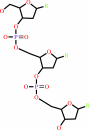 DNA(n)
|
+
|
2'-deoxyribonucleoside 5'-triphosphate
|
=
|
DNA(n+1)
|
+
|
 diphosphate
|
|
|
|
|
|
|
|
|
|
|
|
|
Molecule diagrams generated from .mol files obtained from the
KEGG ftp site
|
|
|
|
|
|
|
|
|
|
|
|
|
|
 |
|
|
|
|
|
|
| |
|
|
| |
|
DOI no:
|
EMBO J
24:2957-2967
(2005)
|
|
PubMed id:
|
|
|
|
|
|
| |
|
Fidelity of Dpo4: effect of metal ions, nucleotide selection and pyrophosphorolysis.
|
|
A.Vaisman,
H.Ling,
R.Woodgate,
W.Yang.
|
|
|
|
|
| |
ABSTRACT
|
|
|
|
| |
|
|
We report the crystal structures of a translesion DNA polymerase, Dpo4,
complexed with a matched or mismatched incoming nucleotide and with a
pyrophosphate product after misincorporation. These structures suggest two
mechanisms by which Dpo4 may reject a wrong incoming nucleotide with its
preformed and open active site. First, a mismatched replicating base pair leads
to poor base stacking and alignment of the metal ions and as a consequence,
inhibits incorporation. By replacing Mg2+ with Mn2+, which has a relaxed
coordination requirement and tolerates misalignment, the catalytic efficiency of
misincorporation increases dramatically. Mn2+ also enhances translesion
synthesis by Dpo4. Subtle conformational changes that lead to the proper metal
ion coordination may, therefore, be a key step in catalysis. Second, the slow
release of pyrophosphate may increase the fidelity of Dpo4 by stalling mispaired
primer extension and promoting pyrophosphorolysis that reverses the
polymerization reaction. Indeed, Dpo4 has robust pyrophosphorolysis activity and
degrades the primer strand in the presence of pyrophosphate. The correct
incoming nucleotide allows DNA synthesis to overcome pyrophosphorolysis, but an
incorrect incoming nucleotide does not.
|
|
|
|
|
|
| |
Selected figure(s)
|
|
|
|
| |
|
|

|
|

|
|
Figure 1.
Figure 1 Ribbon diagrams of the T/dATP (A), T/dGTP-1 (B) and
T/dGTP-2 (C) and T/G (D) structures around the active site. Dpo4
is shown as ribbons. The three conserved carboxylates in the
active site, the last two base pairs of the primer/template and
the replicating base pair are shown as ball-and-stick models.
The template strand is shown in blue and the primer strand in
purple. The incoming nucleotide is shown in different colors for
each crystal structure. The metal ions are shown as green
spheres. The 2F[o]-F[c] electron density maps are contoured at 1
 level
and superimposed onto the nucleic acid portion. level
and superimposed onto the nucleic acid portion.
|
|
Figure 2.
Figure 2 Structural comparison of Dpo4 and T7 DNA polymerase.
(A) The replicating base pairs in three Dpo4 structures (T/dGTP,
T/dATP and Ab-2A) are shown as ball-and-stick models. The two
metal ions (A and B) are shown as green spheres. The A-metal ion
position differs in each structure. The conformation of the
triphosphate is denoted as 'chair-like' and 'goat tail-like'.
(B) Superposition of T/dATP, T/dGTP and Ab-2A structures. The C
 traces,
DNA and nucleotide substrate are shown in stick models. A
zoom-in stereo view of the finger domain with the replicating
base pair and metal ions (outlined in gray) is shown on the
right. The colors representing each structure are indicated. (C)
Superposition of the metal ion coordination in Dpo4 (Ab-2A,
yellow and brown colors) and T7 DNA polymerase (PDB: 1T7P, blue
and green colors) in a stereo view. The oxygen atoms of the
three conserved carboxylates and those involved in metal ion
coordination are highlighted in red. The metal ion coordination
is schematically drawn on the right. Red indicates ligands
conserved in both polymerases, light green in Dpo4 only and blue
in T7 only. The hypothesized 3'-OH of the primer strand is shown
in gray. traces,
DNA and nucleotide substrate are shown in stick models. A
zoom-in stereo view of the finger domain with the replicating
base pair and metal ions (outlined in gray) is shown on the
right. The colors representing each structure are indicated. (C)
Superposition of the metal ion coordination in Dpo4 (Ab-2A,
yellow and brown colors) and T7 DNA polymerase (PDB: 1T7P, blue
and green colors) in a stereo view. The oxygen atoms of the
three conserved carboxylates and those involved in metal ion
coordination are highlighted in red. The metal ion coordination
is schematically drawn on the right. Red indicates ligands
conserved in both polymerases, light green in Dpo4 only and blue
in T7 only. The hypothesized 3'-OH of the primer strand is shown
in gray.
|
|
|
|
|
|
| |
The above figures are
reprinted
by permission from Macmillan Publishers Ltd:
EMBO J
(2005,
24,
2957-2967)
copyright 2005.
|
|
| |
Figures were
selected
by an automated process.
|
|
|
|
|
|
|
|
|
|
|
|
|
|
|
|
 |
 |
 |
|
Literature references that cite this PDB file's key reference
|
|
|
| |
PubMed id
|
|
Reference
|
|
|
|
|
|
K.Bebenek,
L.C.Pedersen,
and
T.A.Kunkel
(2011).
Replication infidelity via a mismatch with Watson-Crick geometry.
|
| |
Proc Natl Acad Sci U S A,
108,
1862-1867.
|
|
|
PDB codes:
|
|
|
|
|
|
|
|
J.A.Brown,
L.Zhang,
S.M.Sherrer,
J.S.Taylor,
P.M.Burgers,
and
Z.Suo
(2010).
Pre-Steady-State Kinetic Analysis of Truncated and Full-Length Saccharomyces cerevisiae DNA Polymerase Eta.
|
| |
J Nucleic Acids,
2010,
0.
|
|
|
|
|
|
|
J.D.Pata
(2010).
Structural diversity of the Y-family DNA polymerases.
|
| |
Biochim Biophys Acta,
1804,
1124-1135.
|
|
|
|
|
|
|
O.Rechkoblit,
A.Kolbanovskiy,
L.Malinina,
N.E.Geacintov,
S.Broyde,
and
D.J.Patel
(2010).
Mechanism of error-free and semitargeted mutagenic bypass of an aromatic amine lesion by Y-family polymerase Dpo4.
|
| |
Nat Struct Mol Biol,
17,
379-388.
|
|
|
PDB codes:
|
|
|
|
|
|
|
|
S.Chandani,
C.Jacobs,
and
E.L.Loechler
(2010).
Architecture of y-family DNA polymerases relevant to translesion DNA synthesis as revealed in structural and molecular modeling studies.
|
| |
J Nucleic Acids,
2010,
0.
|
|
|
|
|
|
|
S.H.Chan,
L.Opitz,
L.Higgins,
D.O'loane,
and
S.Y.Xu
(2010).
Cofactor requirement of HpyAV restriction endonuclease.
|
| |
PLoS One,
5,
e9071.
|
|
|
|
|
|
|
T.D.Silverstein,
R.E.Johnson,
R.Jain,
L.Prakash,
S.Prakash,
and
A.K.Aggarwal
(2010).
Structural basis for the suppression of skin cancers by DNA polymerase eta.
|
| |
Nature,
465,
1039-1043.
|
|
|
PDB codes:
|
|
|
|
|
|
|
|
C.Xu,
B.A.Maxwell,
J.A.Brown,
L.Zhang,
and
Z.Suo
(2009).
Global conformational dynamics of a Y-family DNA polymerase during catalysis.
|
| |
PLoS Biol,
7,
e1000225.
|
|
|
|
|
|
|
H.Zhang,
J.Beckman,
J.Wang,
and
W.Konigsberg
(2009).
RB69 DNA polymerase mutants with expanded nascent base-pair-binding pockets are highly efficient but have reduced base selectivity.
|
| |
Biochemistry,
48,
6940-6950.
|
|
|
|
|
|
|
H.Zhang,
R.L.Eoff,
I.D.Kozekov,
C.J.Rizzo,
M.Egli,
and
F.P.Guengerich
(2009).
Versatility of Y-family Sulfolobus solfataricus DNA Polymerase Dpo4 in Translesion Synthesis Past Bulky N2-Alkylguanine Adducts.
|
| |
J Biol Chem,
284,
3563-3576.
|
|
|
PDB codes:
|
|
|
|
|
|
|
|
H.Zhang,
R.L.Eoff,
I.D.Kozekov,
C.J.Rizzo,
M.Egli,
and
F.P.Guengerich
(2009).
Structure-function relationships in miscoding by Sulfolobus solfataricus DNA polymerase Dpo4: guanine N2,N2-dimethyl substitution produces inactive and miscoding polymerase complexes.
|
| |
J Biol Chem,
284,
17687-17699.
|
|
|
PDB codes:
|
|
|
|
|
|
|
|
H.Zhang,
U.Bren,
I.D.Kozekov,
C.J.Rizzo,
D.F.Stec,
and
F.P.Guengerich
(2009).
Steric and electrostatic effects at the C2 atom substituent influence replication and miscoding of the DNA deamination product deoxyxanthosine and analogs by DNA polymerases.
|
| |
J Mol Biol,
392,
251-269.
|
|
|
|
|
|
|
J.D.Fowler,
J.A.Brown,
M.Kvaratskhelia,
and
Z.Suo
(2009).
Probing conformational changes of human DNA polymerase lambda using mass spectrometry-based protein footprinting.
|
| |
J Mol Biol,
390,
368-379.
|
|
|
|
|
|
|
K.N.Kirouac,
and
H.Ling
(2009).
Structural basis of error-prone replication and stalling at a thymine base by human DNA polymerase iota.
|
| |
EMBO J,
28,
1644-1654.
|
|
|
PDB codes:
|
|
|
|
|
|
|
|
K.Y.Seo,
J.Yin,
P.Donthamsetti,
S.Chandani,
C.H.Lee,
and
E.L.Loechler
(2009).
Amino acid architecture that influences dNTP insertion efficiency in Y-family DNA polymerase V of E. coli.
|
| |
J Mol Biol,
392,
270-282.
|
|
|
|
|
|
|
M.Wang,
H.R.Lee,
and
W.Konigsberg
(2009).
Effect of A and B metal ion site occupancy on conformational changes in an RB69 DNA polymerase ternary complex.
|
| |
Biochemistry,
48,
2075-2086.
|
|
|
|
|
|
|
O.Rechkoblit,
L.Malinina,
Y.Cheng,
N.E.Geacintov,
S.Broyde,
and
D.J.Patel
(2009).
Impact of conformational heterogeneity of OxoG lesions and their pairing partners on bypass fidelity by Y family polymerases.
|
| |
Structure,
17,
725-736.
|
|
|
PDB codes:
|
|
|
|
|
|
|
|
P.Xu,
L.Oum,
Y.C.Lee,
N.E.Geacintov,
and
S.Broyde
(2009).
Visualizing sequence-governed nucleotide selectivities and mutagenic consequences through a replicative cycle: processing of a bulky carcinogen N2-dG lesion in a Y-family DNA polymerase.
|
| |
Biochemistry,
48,
4677-4690.
|
|
|
|
|
|
|
R.L.Eoff,
R.Sanchez-Ponce,
and
F.P.Guengerich
(2009).
Conformational Changes during Nucleotide Selection by Sulfolobus solfataricus DNA Polymerase Dpo4.
|
| |
J Biol Chem,
284,
21090-21099.
|
|
|
|
|
|
|
S.Chandani,
and
E.L.Loechler
(2009).
Y-Family DNA polymerases may use two different dNTP shapes for insertion: a hypothesis and its implications.
|
| |
J Mol Graph Model,
27,
759-769.
|
|
|
|
|
|
|
E.J.Little,
A.C.Babic,
and
N.C.Horton
(2008).
Early interrogation and recognition of DNA sequence by indirect readout.
|
| |
Structure,
16,
1828-1837.
|
|
|
PDB code:
|
|
|
|
|
|
|
|
J.Cramer,
G.Rangam,
A.Marx,
and
T.Restle
(2008).
Varied active-site constraints in the klenow fragment of E. coli DNA polymerase I and the lesion-bypass Dbh DNA polymerase.
|
| |
Chembiochem,
9,
1243-1250.
|
|
|
|
|
|
|
J.Y.Choi,
and
F.P.Guengerich
(2008).
Kinetic Analysis of Translesion Synthesis Opposite Bulky N2- and O6-Alkylguanine DNA Adducts by Human DNA Polymerase REV1.
|
| |
J Biol Chem,
283,
23645-23655.
|
|
|
|
|
|
|
L.DeCarlo,
A.S.Gowda,
Z.Suo,
and
T.E.Spratt
(2008).
Formation of purine-purine mispairs by Sulfolobus solfataricus DNA polymerase IV.
|
| |
Biochemistry,
47,
8157-8164.
|
|
|
|
|
|
|
L.Jia,
N.E.Geacintov,
and
S.Broyde
(2008).
The N-clasp of human DNA polymerase kappa promotes blockage or error-free bypass of adenine- or guanine-benzo[a]pyrenyl lesions.
|
| |
Nucleic Acids Res,
36,
6571-6584.
|
|
|
|
|
|
|
P.Lin,
V.K.Batra,
L.C.Pedersen,
W.A.Beard,
S.H.Wilson,
and
L.G.Pedersen
(2008).
Incorrect nucleotide insertion at the active site of a G:A mismatch catalyzed by DNA polymerase beta.
|
| |
Proc Natl Acad Sci U S A,
105,
5670-5674.
|
|
|
|
|
|
|
S.Broyde,
L.Wang,
O.Rechkoblit,
N.E.Geacintov,
and
D.J.Patel
(2008).
Lesion processing: high-fidelity versus lesion-bypass DNA polymerases.
|
| |
Trends Biochem Sci,
33,
209-219.
|
|
|
|
|
|
|
V.K.Batra,
W.A.Beard,
D.D.Shock,
L.C.Pedersen,
and
S.H.Wilson
(2008).
Structures of DNA polymerase beta with active-site mismatches suggest a transient abasic site intermediate during misincorporation.
|
| |
Mol Cell,
30,
315-324.
|
|
|
PDB codes:
|
|
|
|
|
|
|
|
W.Yang
(2008).
Structure and mechanism for DNA lesion recognition.
|
| |
Cell Res,
18,
184-197.
|
|
|
|
|
|
|
A.Irimia,
R.L.Eoff,
P.S.Pallan,
F.P.Guengerich,
and
M.Egli
(2007).
Structure and activity of Y-class DNA polymerase DPO4 from Sulfolobus solfataricus with templates containing the hydrophobic thymine analog 2,4-difluorotoluene.
|
| |
J Biol Chem,
282,
36421-36433.
|
|
|
PDB codes:
|
|
|
|
|
|
|
|
E.G.Frank,
and
R.Woodgate
(2007).
Increased catalytic activity and altered fidelity of human DNA polymerase iota in the presence of manganese.
|
| |
J Biol Chem,
282,
24689-24696.
|
|
|
|
|
|
|
J.Bauer,
G.Xing,
H.Yagi,
J.M.Sayer,
D.M.Jerina,
and
H.Ling
(2007).
A structural gap in Dpo4 supports mutagenic bypass of a major benzo[a]pyrene dG adduct in DNA through template misalignment.
|
| |
Proc Natl Acad Sci U S A,
104,
14905-14910.
|
|
|
PDB codes:
|
|
|
|
|
|
|
|
K.A.Fiala,
J.A.Brown,
H.Ling,
A.K.Kshetry,
J.Zhang,
J.S.Taylor,
W.Yang,
and
Z.Suo
(2007).
Mechanism of template-independent nucleotide incorporation catalyzed by a template-dependent DNA polymerase.
|
| |
J Mol Biol,
365,
590-602.
|
|
|
PDB code:
|
|
|
|
|
|
|
|
K.A.Fiala,
and
Z.Suo
(2007).
Sloppy bypass of an abasic lesion catalyzed by a Y-family DNA polymerase.
|
| |
J Biol Chem,
282,
8199-8206.
|
|
|
|
|
|
|
M.Garcia-Diaz,
K.Bebenek,
J.M.Krahn,
L.C.Pedersen,
and
T.A.Kunkel
(2007).
Role of the catalytic metal during polymerization by DNA polymerase lambda.
|
| |
DNA Repair (Amst),
6,
1333-1340.
|
|
|
PDB codes:
|
|
|
|
|
|
|
|
P.R.Meyer,
W.Rutvisuttinunt,
S.E.Matsuura,
A.G.So,
and
W.A.Scott
(2007).
Stable complexes formed by HIV-1 reverse transcriptase at distinct positions on the primer-template controlled by binding deoxynucleoside triphosphates or foscarnet.
|
| |
J Mol Biol,
369,
41-54.
|
|
|
|
|
|
|
S.J.Garforth,
T.W.Kim,
M.A.Parniak,
E.T.Kool,
and
V.R.Prasad
(2007).
Site-directed mutagenesis in the fingers subdomain of HIV-1 reverse transcriptase reveals a specific role for the beta3-beta4 hairpin loop in dNTP selection.
|
| |
J Mol Biol,
365,
38-49.
|
|
|
|
|
|
|
W.Yang,
and
R.Woodgate
(2007).
What a difference a decade makes: insights into translesion DNA synthesis.
|
| |
Proc Natl Acad Sci U S A,
104,
15591-15598.
|
|
|
|
|
|
|
Y.Wang,
S.Reddy,
W.A.Beard,
S.H.Wilson,
and
T.Schlick
(2007).
Differing conformational pathways before and after chemistry for insertion of dATP versus dCTP opposite 8-oxoG in DNA polymerase beta.
|
| |
Biophys J,
92,
3063-3070.
|
|
|
|
|
|
|
A.M.DeLucia,
S.Chaudhuri,
O.Potapova,
N.D.Grindley,
and
C.M.Joyce
(2006).
The properties of steric gate mutants reveal different constraints within the active sites of Y-family and A-family DNA polymerases.
|
| |
J Biol Chem,
281,
27286-27291.
|
|
|
|
|
|
|
B.J.Lamarche,
S.Kumar,
and
M.D.Tsai
(2006).
ASFV DNA polymerse X is extremely error-prone under diverse assay conditions and within multiple DNA sequence contexts.
|
| |
Biochemistry,
45,
14826-14833.
|
|
|
|
|
|
|
G.Maga,
I.Shevelev,
G.Villani,
S.Spadari,
and
U.Hübscher
(2006).
Human replication protein A can suppress the intrinsic in vitro mutator phenotype of human DNA polymerase lambda.
|
| |
Nucleic Acids Res,
34,
1405-1415.
|
|
|
|
|
|
|
H.Zang,
A.Irimia,
J.Y.Choi,
K.C.Angel,
L.V.Loukachevitch,
M.Egli,
and
F.P.Guengerich
(2006).
Efficient and high fidelity incorporation of dCTP opposite 7,8-dihydro-8-oxodeoxyguanosine by Sulfolobus solfataricus DNA polymerase Dpo4.
|
| |
J Biol Chem,
281,
2358-2372.
|
|
|
PDB codes:
|
|
|
|
|
|
|
|
I.G.Duggin,
and
S.D.Bell
(2006).
The chromosome replication machinery of the archaeon Sulfolobus solfataricus.
|
| |
J Biol Chem,
281,
15029-15032.
|
|
|
|
|
|
|
L.Wang,
and
S.Broyde
(2006).
A new anti conformation for N-(deoxyguanosin-8-yl)-2-acetylaminofluorene (AAF-dG) allows Watson-Crick pairing in the Sulfolobus solfataricus P2 DNA polymerase IV (Dpo4).
|
| |
Nucleic Acids Res,
34,
785-795.
|
|
|
|
|
|
|
L.Zhang,
O.Rechkoblit,
L.Wang,
D.J.Patel,
R.Shapiro,
and
S.Broyde
(2006).
Mutagenic nucleotide incorporation and hindered translocation by a food carcinogen C8-dG adduct in Sulfolobus solfataricus P2 DNA polymerase IV (Dpo4): modeling and dynamics studies.
|
| |
Nucleic Acids Res,
34,
3326-3337.
|
|
|
|
|
|
|
O.Rechkoblit,
L.Malinina,
Y.Cheng,
V.Kuryavyi,
S.Broyde,
N.E.Geacintov,
and
D.J.Patel
(2006).
Stepwise translocation of Dpo4 polymerase during error-free bypass of an oxoG lesion.
|
| |
PLoS Biol,
4,
e11.
|
|
|
PDB codes:
|
|
|
|
|
|
|
|
W.Yang,
J.Y.Lee,
and
M.Nowotny
(2006).
Making and breaking nucleic acids: two-Mg2+-ion catalysis and substrate specificity.
|
| |
Mol Cell,
22,
5.
|
|
|
|
|
|
|
Y.Wang,
K.Arora,
and
T.Schlick
(2006).
Subtle but variable conformational rearrangements in the replication cycle of Sulfolobus solfataricus P2 DNA polymerase IV (Dpo4) may accommodate lesion bypass.
|
| |
Protein Sci,
15,
135-151.
|
|
|
|
|
|
|
D.Chiapperino,
M.Cai,
J.M.Sayer,
H.Yagi,
H.Kroth,
C.Masutani,
F.Hanaoka,
D.M.Jerina,
and
A.M.Cheh
(2005).
Error-prone translesion synthesis by human DNA polymerase eta on DNA-containing deoxyadenosine adducts of 7,8-dihydroxy-9,10-epoxy-7,8,9,10-tetrahydrobenzo[a]pyrene.
|
| |
J Biol Chem,
280,
39684-39692.
|
|
|
|
|
|
The most recent references are shown first.
Citation data come partly from CiteXplore and partly
from an automated harvesting procedure. Note that this is likely to be
only a partial list as not all journals are covered by
either method. However, we are continually building up the citation data
so more and more references will be included with time.
Where a reference describes a PDB structure, the PDB
codes are
shown on the right.
|
|


 Links
Links


