 |
PDBsum entry 1i6j

|
|
|
|
|
|

|

|

|

|
|

|
|

|
|

|
|

|
|
|
 |

|

|
|
|
|
|
|
|
|
|
|
|
|
|
|
|
|
|
|
|
|
|
|
|
|
|
|
|
|
|
|
|
|
|
Transferase/DNA
|
PDB id
|
|
|
|
1i6j
|
|
|
|
|
|
|
|
|
|
|
|
|
|
|

|

|

|
|
|
|
|
|
|
|
 |
Contents |
 |
|
|
|
|
|
|
|
|
|
|
|
|
* Residue conservation analysis
|
|
|
|
|
|
|
|
|
|
|
Enzyme class 2:
|
|
E.C.2.7.7.-
- ?????
|
|
|
|
|
|
|
Enzyme class 3:
|
|
E.C.2.7.7.49
- RNA-directed Dna polymerase.
|
|
|
|
|
|
|
Reaction:
|
|
DNA(n) + a 2'-deoxyribonucleoside 5'-triphosphate = DNA(n+1) + diphosphate
|
|
|
|
|
|
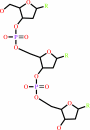 DNA(n)
|
+
|
2'-deoxyribonucleoside 5'-triphosphate
|
=
|
DNA(n+1)
|
+
|
 diphosphate
|
|
|
|
|
|
|
|
|
|
Enzyme class 4:
|
|
E.C.2.7.7.7
- DNA-directed Dna polymerase.
|
|
|
|
|
|
|
Reaction:
|
|
DNA(n) + a 2'-deoxyribonucleoside 5'-triphosphate = DNA(n+1) + diphosphate
|
|
|
|
|
|
DNA(n)
|
+
|
2'-deoxyribonucleoside 5'-triphosphate
|
=
|
DNA(n+1)
|
+
|
diphosphate
|
|
|
|
|
|
|
|
|
|
Enzyme class 5:
|
|
E.C.3.1.-.-
|
|
|
|
|
|
|
Enzyme class 6:
|
|
E.C.3.1.26.4
- ribonuclease H.
|
|
|
|
|
|
|
Reaction:
|
|
Endonucleolytic cleavage to 5'-phosphomonoester.
|
|
|
|
|
|
Enzyme class 7:
|
|
E.C.3.4.23.-
- ?????
|
|
|
|
|
|
|
|
|
|
Note, where more than one E.C. class is given (as above), each may
correspond to a different protein domain or, in the case of polyprotein
precursors, to a different mature protein.
|
|
|
|
Molecule diagrams generated from .mol files obtained from the
KEGG ftp site
|
|
|
|
|
|
|
|
|
|
|
|
|
|
 |
|
|
|
|
|
|
| |
|
|
| |
|
DOI no:
|
Acta Crystallogr D Biol Crystallogr
57:1238-1250
(2001)
|
|
PubMed id:
|
|
|
|
|
|
| |
|
Structure of a pseudo-16-mer DNA with stacked guanines and two G-A mispairs complexed with the N-terminal fragment of Moloney murine leukemia virus reverse transcriptase.
|
|
M.L.Coté,
M.M.Georgiadis.
|
|
|
|
|
| |
ABSTRACT
|
|
|
|
| |
|
|
The X-ray crystal structure at 2.0 A resolution of a DNA molecule complexed with
the N-terminal fragment of Moloney murine leukemia virus reverse transcriptase
(MMLV RT) has been determined. This method allows the study of nucleic acids in
a unique and largely unfettered environment without the complicated lattice
interactions typically observed in DNA-only crystal structures.
Molecular-replacement phasing using only the protein provided readily
interpretable electron density with no model bias for the DNA. The asymmetric
unit of the structure consists of the protein molecule bound to the blunt end of
a DNA 6/10-mer, which is composed of a six-base strand (5'-GTCGTC-3') and a
ten-base strand (3'-CAGCAGGGCA-5'), resulting in a six-base-pair duplex with a
four-base single-stranded overhang. In the crystal structure, the bases of the
overhang reciprocally pair to yield a doubly nicked pseudo-hexadecamer primarily
B-form DNA molecule. The pairing between the single strands gives two standard
(G-C) Watson-Crick pairs and two G(anti)-A(anti) mispairs. The mispairs reside
in a G-C-rich environment and the three consecutive guanines on the 10-mer
impart interesting structural features to the pseudo-hexadecamer, such as the
preference for a guanine stack, stretching the C-G base pairs flanking the
mispair to the point of loss of intra-base-pair hydrogen bonding. The DNA was
designed for the purpose of comparison with a previous structure, which was
determined in the same crystal lattice. In all of the authors' previous
fragment-DNA complexes, the nucleotide at the blunt-ended 3'-hydroxyl was a
purine. Consistent with the proposed mechanistic role of interactions with the
3'-hydroxyl in processive DNA synthesis by RT, it was found that a pyrimidine at
this position in the DNA makes indentical interactions with the strictly
conserved Gly191 and the main chain of Leu115 of MMLV RT.
|
|
|
|
|
|
| |
Selected figure(s)
|
|
|
|
| |
|
|

|
|

|
|
Figure 4.
Figure 4 Comparative views (Kraulis, 1991[Kraulis, P. J. (1991).
J. Appl. Cryst. 24, 946-950.]; Merritt & Bacon, 1997[Merritt, E.
A. & Bacon, D. J. (1997). Methods Enzymol. 277, 505-524.]) of
the protein-DNA binding sites of the (a) form IVa and the (b)
form IVb structures. In each view, the characteristic ion-pair
between Asp114 and Arg116 is shown with black dotted lines.
Green dotted lines denote hydrogen bonds whose distances range
from 2.4 to 3.3 Å. Magenta dashed lines represent contacts
whose distances are greater than 3.3 Å and less than 3.8 Å.
Note the difference in the disposition of the Asp114-Arg116 ion
pair in its interaction with the nucleic acid in the form IVa
versus the IVb structure. Note the absence of contacts to the
DNA from Tyr64 in the form IVb structure.
|
|
Figure 6.
Figure 6 Stereoview (Kraulis, 1991[Kraulis, P. J. (1991). J.
Appl. Cryst. 24, 946-950.]; Merritt & Bacon, 1997[Merritt, E. A.
& Bacon, D. J. (1997). Methods Enzymol. 277, 505-524.]) of the
form IVa and form IVb pseudo-hexadecamers resulting from the
superpositioning of the C^  atoms
of the protein molecules of their structures. Note the
near-exact match of the 3'-OH ribose rings and the lack of
matches elsewhere. The form IVb DNA is shown in red and the form
IVa DNA is shown in white, retaining its A7 base in the anti
conformation. atoms
of the protein molecules of their structures. Note the
near-exact match of the 3'-OH ribose rings and the lack of
matches elsewhere. The form IVb DNA is shown in red and the form
IVa DNA is shown in white, retaining its A7 base in the anti
conformation.
|
|
|
|
|
|
| |
The above figures are
reprinted
by permission from the IUCr:
Acta Crystallogr D Biol Crystallogr
(2001,
57,
1238-1250)
copyright 2001.
|
|
| |
Figures were
selected
by an automated process.
|
|
|
|
|
|
|
|
|
|
|
|
|
|
|
|
 |
 |
 |
|
Literature references that cite this PDB file's key reference
|
|
|
| |
PubMed id
|
|
Reference
|
|
|
|
|
|
J.Xie,
P.Zhang,
C.Li,
Q.Huang,
R.Zhou,
and
T.Peng
(2011).
Mechanistic insights into the roles of three linked single-stranded template binding residues of MMLV reverse transcriptase in misincorporation and mispair extension fidelity of DNA synthesis.
|
| |
Gene,
479,
47-56.
|
|
|
|
|
|
|
L.S.Glass,
B.Nguyen,
K.D.Goodwin,
C.Dardonville,
W.D.Wilson,
E.C.Long,
and
M.M.Georgiadis
(2009).
Crystal structure of a trypanocidal 4,4'-bis(imidazolinylamino)diphenylamine bound to DNA.
|
| |
Biochemistry,
48,
5943-5952.
|
|
|
PDB code:
|
|
|
|
|
|
|
|
B.R.Bowman,
S.Lee,
S.Wang,
and
G.L.Verdine
(2008).
Structure of the E. coli DNA glycosylase AlkA bound to the ends of duplex DNA: a system for the structure determination of lesion-containing DNA.
|
| |
Structure,
16,
1166-1174.
|
|
|
PDB codes:
|
|
|
|
|
|
|
|
M.L.Coté,
and
M.J.Roth
(2008).
Murine leukemia virus reverse transcriptase: structural comparison with HIV-1 reverse transcriptase.
|
| |
Virus Res,
134,
186-202.
|
|
|
|
|
|
|
K.D.Goodwin,
M.A.Lewis,
F.A.Tanious,
R.R.Tidwell,
W.D.Wilson,
M.M.Georgiadis,
and
E.C.Long
(2006).
A high-throughput, high-resolution strategy for the study of site-selective DNA binding agents: analysis of a "highly twisted" benzimidazole-diamidine.
|
| |
J Am Chem Soc,
128,
7846-7854.
|
|
|
PDB codes:
|
|
|
|
|
|
|
|
S.P.Montaño,
M.L.Coté,
M.J.Roth,
and
M.M.Georgiadis
(2006).
Crystal structures of oligonucleotides including the integrase processing site of the Moloney murine leukemia virus.
|
| |
Nucleic Acids Res,
34,
5353-5360.
|
|
|
PDB codes:
|
|
|
|
|
|
|
|
K.D.Goodwin,
E.C.Long,
and
M.M.Georgiadis
(2005).
A host-guest approach for determining drug-DNA interactions: an example using netropsin.
|
| |
Nucleic Acids Res,
33,
4106-4116.
|
|
|
PDB codes:
|
|
|
|
|
|
|
|
D.Das,
and
M.M.Georgiadis
(2004).
The crystal structure of the monomeric reverse transcriptase from Moloney murine leukemia virus.
|
| |
Structure,
12,
819-829.
|
|
|
PDB code:
|
|
|
|
|
|
|
|
R.L.Crowther,
D.P.Remeta,
C.A.Minetti,
D.Das,
S.P.Montano,
and
M.M.Georgiadis
(2004).
Structural and energetic characterization of nucleic acid-binding to the fingers domain of Moloney murine leukemia virus reverse transcriptase.
|
| |
Proteins,
57,
15-26.
|
|
|
PDB code:
|
|
|
|
|
|
|
The most recent references are shown first.
Citation data come partly from CiteXplore and partly
from an automated harvesting procedure. Note that this is likely to be
only a partial list as not all journals are covered by
either method. However, we are continually building up the citation data
so more and more references will be included with time.
Where a reference describes a PDB structure, the PDB
code is
shown on the right.
|
|


 Links
Links


