 |
PDBsum entry 2ozm

|
|
|
|
|
|

|

|

|

|
|

|
|

|
|

|
|

|
|

|
|

|
|

|
|
|
 |

|

|
|
|
|
|
|
|
|
|
|
|
|
|
|
|
|
|
|
|
|
|
|
|
|
|
|
|
|
|
|
|
|
|
|
|
|
Transferase/DNA
|
PDB id
|
|
|
|
2ozm
|
|
|
|
|
|
|
|
|
|
|
|
|
|
|

|

|

|
|
|
|
|
|
|
|
 |
Contents |
 |
|
|
|
|
|
|
|
|
|
|
|
|
|
|
|
|
* Residue conservation analysis
|
|
|
|
|
|
|
|
|
|
|
Enzyme class:
|
|
E.C.2.7.7.7
- DNA-directed Dna polymerase.
|
|
|
|
|
|
|
Reaction:
|
|
DNA(n) + a 2'-deoxyribonucleoside 5'-triphosphate = DNA(n+1) + diphosphate
|
|
|
|
|
|
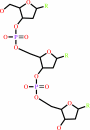 DNA(n)
|
+
|
2'-deoxyribonucleoside 5'-triphosphate
|
=
|
DNA(n+1)
|
+
|
 diphosphate
|
|
|
|
|
|
|
|
|
|
|
|
|
Molecule diagrams generated from .mol files obtained from the
KEGG ftp site
|
|
|
|
|
|
|
|
|
|
|
|
|
|
 |
|
|
|
|
|
|
| |
|
|
| |
|
|
Biochemistry
46:10551-10561
(2007)
|
|
PubMed id:
|
|
|
|
|
|
| |
|
Caught bending the A-rule: crystal structures of translesion DNA synthesis with a non-natural nucleotide.
|
|
K.E.Zahn,
H.Belrhali,
S.S.Wallace,
S.Doublié.
|
|
|
|
|
| |
ABSTRACT
|
|
|
|
| |
|
|
Damage to DNA involving excision of the nucleobase at the N-glycosidic bond
forms abasic sites. If a nucleotide becomes incorporated opposite an unrepaired
abasic site during DNA synthesis, most B family polymerases obey the A-rule and
preferentially incorporate dAMP without instruction from the template. In
addition to being potentially mutagenic, abasic sites provide strong blocks to
DNA synthesis. A previous crystal structure of an exonuclease deficient variant
of the replicative B family DNA polymerase from bacteriophage RB69 (RB69 gp43
exo-) illustrated these properties, showing that the polymerase failed to
translocate the DNA following insertion of dAMP opposite an abasic site. We
examine four new structures depicting several steps of translesion DNA synthesis
by RB69 gp43 exo-, employing a non-natural purine triphosphate analogue,
5-nitro-1-indolyl-2'-deoxyriboside-5'-triphosphate (5-NITP), that is
incorporated more efficiently than dAMP opposite abasic sites. Our structures
indicate that a dipole-induced dipole stacking interaction between the 5-nitro
group and base 3' to the templating lesion explains the enhanced kinetics of
5-NITP. As with dAMP, the DNA fails to translocate following insertion of
5-NIMP, although distortions at the nascent primer terminus contribute less than
previously thought in inducing the stall, given that 5-NIMP preserves relatively
undistorted geometry at the insertion site following phosphoryl transfer. An
open ternary configuration, novel in B family polymerases, reveals an initial
template independent binding of 5-NITP adjacent to the active site of the open
polymerase, suggesting that closure of the fingers domain shuttles the
nucleotide to the active site while testing the substrate against the template.
|
|
|
|
|
|
|
|
|
|
|
|
|
|
|
|
|
|
 |
 |
 |
|
Literature references that cite this PDB file's key reference
|
|
|
| |
PubMed id
|
|
Reference
|
|
|
|
|
|
K.Das,
S.E.Martinez,
J.D.Bauman,
and
E.Arnold
(2012).
HIV-1 reverse transcriptase complex with DNA and nevirapine reveals non-nucleoside inhibition mechanism.
|
| |
Nat Struct Mol Biol,
19,
253-259.
|
|
|
PDB codes:
|
|
|
|
|
|
|
|
E.A.Motea,
I.Lee,
and
A.J.Berdis
(2011).
Quantifying the energetic contributions of desolvation and {pi}-electron density during translesion DNA synthesis.
|
| |
Nucleic Acids Res,
39,
1623-1637.
|
|
|
|
|
|
|
M.Hogg,
J.Rudnicki,
J.Midkiff,
L.Reha-Krantz,
S.Doublié,
and
S.S.Wallace
(2010).
Kinetics of mismatch formation opposite lesions by the replicative DNA polymerase from bacteriophage RB69.
|
| |
Biochemistry,
49,
2317-2325.
|
|
|
PDB code:
|
|
|
|
|
|
|
|
P.Aller,
Y.Ye,
S.S.Wallace,
C.J.Burrows,
and
S.Doublié
(2010).
Crystal structure of a replicative DNA polymerase bound to the oxidized guanine lesion guanidinohydantoin.
|
| |
Biochemistry,
49,
2502-2509.
|
|
|
PDB code:
|
|
|
|
|
|
|
|
S.J.Hyde,
B.E.Eckenroth,
B.A.Smith,
W.A.Eberley,
N.H.Heintz,
J.E.Jackman,
and
S.Doublié
(2010).
tRNA(His) guanylyltransferase (THG1), a unique 3'-5' nucleotidyl transferase, shares unexpected structural homology with canonical 5'-3' DNA polymerases.
|
| |
Proc Natl Acad Sci U S A,
107,
20305-20310.
|
|
|
PDB codes:
|
|
|
|
|
|
|
|
S.Obeid,
N.Blatter,
R.Kranaster,
A.Schnur,
K.Diederichs,
W.Welte,
and
A.Marx
(2010).
Replication through an abasic DNA lesion: structural basis for adenine selectivity.
|
| |
EMBO J,
29,
1738-1747.
|
|
|
PDB codes:
|
|
|
|
|
|
|
|
D.Loakes,
J.Gallego,
V.B.Pinheiro,
E.T.Kool,
and
P.Holliger
(2009).
Evolving a polymerase for hydrophobic base analogues.
|
| |
J Am Chem Soc,
131,
14827-14837.
|
|
|
|
|
|
|
D.T.Nair,
R.E.Johnson,
L.Prakash,
S.Prakash,
and
A.K.Aggarwal
(2009).
DNA synthesis across an abasic lesion by human DNA polymerase iota.
|
| |
Structure,
17,
530-537.
|
|
|
PDB codes:
|
|
|
|
|
|
|
|
W.A.Beard,
D.D.Shock,
V.K.Batra,
L.C.Pedersen,
and
S.H.Wilson
(2009).
DNA polymerase beta substrate specificity: side chain modulation of the "A-rule".
|
| |
J Biol Chem,
284,
31680-31689.
|
|
|
PDB codes:
|
|
|
|
|
|
|
|
A.Sheriff,
E.Motea,
I.Lee,
and
A.J.Berdis
(2008).
Mechanism and dynamics of translesion DNA synthesis catalyzed by the Escherichia coli Klenow fragment.
|
| |
Biochemistry,
47,
8527-8537.
|
|
|
|
|
|
|
J.C.Delaney,
and
J.M.Essigmann
(2008).
Biological properties of single chemical-DNA adducts: a twenty year perspective.
|
| |
Chem Res Toxicol,
21,
232-252.
|
|
|
|
|
|
|
X.Zhong,
L.C.Pedersen,
and
T.A.Kunkel
(2008).
Characterization of a replicative DNA polymerase mutant with reduced fidelity and increased translesion synthesis capacity.
|
| |
Nucleic Acids Res,
36,
3892-3904.
|
|
|
PDB code:
|
|
|
|
|
|
|
The most recent references are shown first.
Citation data come partly from CiteXplore and partly
from an automated harvesting procedure. Note that this is likely to be
only a partial list as not all journals are covered by
either method. However, we are continually building up the citation data
so more and more references will be included with time.
Where a reference describes a PDB structure, the PDB
codes are
shown on the right.
|
|


 Links
Links


