
|
|
|
|
|
 |
Contents |
 |
|
|
|
|
|
|
|
|
|
|
|
|
|
|
* Residue conservation analysis
|
|
|
|
|
|
|
|
|
|
Enzyme class 1:
|
|
Chains A, B:
E.C.2.7.7.-
- ?????
|
|
|
|
|
|
|
Enzyme class 2:
|
|
Chains A, B:
E.C.2.7.7.49
- RNA-directed Dna polymerase.
|
|
|
|
|
|
|
Reaction:
|
|
DNA(n) + a 2'-deoxyribonucleoside 5'-triphosphate = DNA(n+1) + diphosphate
|
|
|
|
|
|
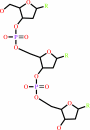 DNA(n)
|
+
|
2'-deoxyribonucleoside 5'-triphosphate
|
=
|
DNA(n+1)
|
+
|
 diphosphate
|
|
|
|
|
|
|
|
|
|
Enzyme class 3:
|
|
Chains A, B:
E.C.2.7.7.7
- DNA-directed Dna polymerase.
|
|
|
|
|
|
|
Reaction:
|
|
DNA(n) + a 2'-deoxyribonucleoside 5'-triphosphate = DNA(n+1) + diphosphate
|
|
|
|
|
|
DNA(n)
|
+
|
2'-deoxyribonucleoside 5'-triphosphate
|
=
|
DNA(n+1)
|
+
|
diphosphate
|
|
|
|
|
|
|
|
|
|
Enzyme class 4:
|
|
Chains A, B:
E.C.3.1.-.-
|
|
|
|
|
|
|
Enzyme class 5:
|
|
Chains A, B:
E.C.3.1.13.2
- exoribonuclease H.
|
|
|
|
|
|
|
Reaction:
|
|
Exonucleolytic cleavage to 5'-phosphomonoester oligonucleotides in both 5'- to 3'- and 3'- to 5'-directions.
|
|
|
|
|
|
Enzyme class 6:
|
|
Chains A, B:
E.C.3.1.26.13
- retroviral ribonuclease H.
|
|
|
|
|
|
|
Enzyme class 7:
|
|
Chains A, B:
E.C.3.4.23.16
- HIV-1 retropepsin.
|
|
|
|
|
|
|
Reaction:
|
|
Specific for a P1 residue that is hydrophobic, and P1' variable, but often Pro.
|
|
|
|
|
|
|
|
|
Note, where more than one E.C. class is given (as above), each may
correspond to a different protein domain or, in the case of polyprotein
precursors, to a different mature protein.
|
|
|
|
Molecule diagrams generated from .mol files obtained from the
KEGG ftp site
|
|
|
|
|
|
|
|
|
|
|
|
|
|
 |
|
|
|
|
|
|
| |
|
|
| |
|
DOI no:
|
J Med Chem
48:7582-7591
(2005)
|
|
PubMed id:
|
|
|
|
|
|
| |
|
Crystal structures for HIV-1 reverse transcriptase in complexes with three pyridinone derivatives: a new class of non-nucleoside inhibitors effective against a broad range of drug-resistant strains.
|
|
D.M.Himmel,
K.Das,
A.D.Clark,
S.H.Hughes,
A.Benjahad,
S.Oumouch,
J.Guillemont,
S.Coupa,
A.Poncelet,
I.Csoka,
C.Meyer,
K.Andries,
C.H.Nguyen,
D.S.Grierson,
E.Arnold.
|
|
|
|
|
| |
ABSTRACT
|
|
|
|
| |
|
|
In the treatment of AIDS, the efficacy of all drugs, including non-nucleoside
inhibitors (NNRTIs) of HIV-1 reverse transcriptase (RT), has been limited by the
rapid appearance of drug-resistant viruses. Lys103Asn, Tyr181Cys, and Tyr188Leu
are some of the most common RT mutations that cause resistance to NNRTIs in the
clinic. We report X-ray crystal structures for RT complexed with three different
pyridinone derivatives, R157208, R165481, and R221239, at 2.95, 2.9, and 2.43 A
resolution, respectively. All three ligands exhibit nanomolar or subnanomolar
inhibitory activity against wild-type RT, but varying activities against
drug-resistant mutants. R165481 and R221239 differ from most NNRTIs in that
binding does not involve significant contacts with Tyr181. These compounds
strongly inhibit wild-type HIV-1 RT and drug-resistant variants, including
Tyr181Cys and Lys103Asn RT. These properties result in part from an iodine atom
on the pyridinone ring of both inhibitors that interacts with the main-chain
carbonyl oxygen of Tyr188. An acrylonitrile substituent on R165481 substantially
improves the activity of the compound against wild-type RT (and several mutants)
and provides a way to generate novel inhibitors that could interact with
conserved elements of HIV-1 RT at the polymerase catalytic site. In R221239,
there is a flexible linker to a furan ring that permits interactions with
Val106, Phe227, and Pro236. These contacts appear to enhance the inhibitory
activity of R221239 against the HIV-1 strains that carry the Val106Ala,
Tyr188Leu, and Phe227Cys mutations.
|
|
|
|
|
|
|
|
|
|
|
|
|
|
|
|
|
|
 |
 |
 |
|
Literature references that cite this PDB file's key reference
|
|
|
| |
PubMed id
|
|
Reference
|
|
|
|
|
|
E.Parisini,
P.Metrangolo,
T.Pilati,
G.Resnati,
and
G.Terraneo
(2011).
Halogen bonding in halocarbon-protein complexes: a structural survey.
|
| |
Chem Soc Rev,
40,
2267-2278.
|
|
|
|
|
|
|
W.Zierkiewicz,
R.Wieczorek,
P.Hobza,
and
D.Michalska
(2011).
Halogen bonded complexes between volatile anaesthetics (chloroform, halothane, enflurane, isoflurane) and formaldehyde: a theoretical study.
|
| |
Phys Chem Chem Phys,
13,
5105-5113.
|
|
|
|
|
|
|
C.Bissantz,
B.Kuhn,
and
M.Stahl
(2010).
A medicinal chemist's guide to molecular interactions.
|
| |
J Med Chem,
53,
5061-5084.
|
|
|
|
|
|
|
C.S.Leung,
J.G.Zeevaart,
R.A.Domaoal,
M.Bollini,
V.V.Thakur,
K.A.Spasov,
K.S.Anderson,
and
W.L.Jorgensen
(2010).
Eastern extension of azoles as non-nucleoside inhibitors of HIV-1 reverse transcriptase; cyano group alternatives.
|
| |
Bioorg Med Chem Lett,
20,
2485-2488.
|
|
|
|
|
|
|
Y.Lu,
Y.Wang,
and
W.Zhu
(2010).
Nonbonding interactions of organic halogens in biological systems: implications for drug discovery and biomolecular design.
|
| |
Phys Chem Chem Phys,
12,
4543-4551.
|
|
|
|
|
|
|
M.D.Cullen,
W.C.Ho,
J.D.Bauman,
K.Das,
E.Arnold,
T.L.Hartman,
K.M.Watson,
R.W.Buckheit,
C.Pannecouque,
E.De Clercq,
and
M.Cushman
(2009).
Crystallographic study of a novel subnanomolar inhibitor provides insight on the binding interactions of alkenyldiarylmethanes with human immunodeficiency virus-1 reverse transcriptase.
|
| |
J Med Chem,
52,
6467-6473.
|
|
|
PDB codes:
|
|
|
|
|
|
|
|
S.E.Nichols,
R.A.Domaoal,
V.V.Thakur,
J.Tirado-Rives,
K.S.Anderson,
and
W.L.Jorgensen
(2009).
Discovery of wild-type and Y181C mutant non-nucleoside HIV-1 reverse transcriptase inhibitors using virtual screening with multiple protein structures.
|
| |
J Chem Inf Model,
49,
1272-1279.
|
|
|
|
|
|
|
Y.X.Lu,
J.W.Zou,
J.C.Fan,
W.N.Zhao,
Y.J.Jiang,
and
Q.S.Yu
(2009).
Ab initio calculations on halogen-bonded complexes and comparison with density functional methods.
|
| |
J Comput Chem,
30,
725-732.
|
|
|
|
|
|
|
J.G.Zeevaart,
L.Wang,
V.V.Thakur,
C.S.Leung,
J.Tirado-Rives,
C.M.Bailey,
R.A.Domaoal,
K.S.Anderson,
and
W.L.Jorgensen
(2008).
Optimization of azoles as anti-human immunodeficiency virus agents guided by free-energy calculations.
|
| |
J Am Chem Soc,
130,
9492-9499.
|
|
|
|
|
|
|
K.Danel,
L.M.Larsen,
E.B.Pedersen,
G.Sanna,
P.La Colla,
and
R.Loddo
(2008).
Synthesis and antiviral activity of new dimeric inhibitors against HIV-1.
|
| |
Bioorg Med Chem,
16,
511-517.
|
|
|
|
|
|
|
K.Das,
J.D.Bauman,
A.D.Clark,
Y.V.Frenkel,
P.J.Lewi,
A.J.Shatkin,
S.H.Hughes,
and
E.Arnold
(2008).
High-resolution structures of HIV-1 reverse transcriptase/TMC278 complexes: strategic flexibility explains potency against resistance mutations.
|
| |
Proc Natl Acad Sci U S A,
105,
1466-1471.
|
|
|
PDB codes:
|
|
|
|
|
|
|
|
M.Radi,
C.Falciani,
L.Contemori,
E.Petricci,
G.Maga,
A.Samuele,
S.Zanoli,
M.Terrazas,
M.Castria,
A.Togninelli,
J.A.Esté,
I.Clotet-Codina,
M.Armand-Ugón,
and
M.Botta
(2008).
A multidisciplinary approach for the identification of novel HIV-1 non-nucleoside reverse transcriptase inhibitors: S-DABOCs and DAVPs.
|
| |
ChemMedChem,
3,
573-593.
|
|
|
|
|
|
|
G.Barreiro,
J.T.Kim,
C.R.Guimarães,
C.M.Bailey,
R.A.Domaoal,
L.Wang,
K.S.Anderson,
and
W.L.Jorgensen
(2007).
From docking false-positive to active anti-HIV agent.
|
| |
J Med Chem,
50,
5324-5329.
|
|
|
|
|
|
|
J.L.Medina-Franco,
K.Martínez-Mayorga,
C.Juárez-Gordiano,
and
R.Castillo
(2007).
Pyridin-2(1H)-ones: A Promising Class of HIV-1 Non-nucleoside Reverse Transcriptase Inhibitors.
|
| |
ChemMedChem,
2,
1141-1147.
|
|
|
|
|
|
|
A.Lavecchia,
R.Costi,
M.Artico,
G.Miele,
E.Novellino,
A.Bergamini,
E.Crespan,
G.Maga,
and
R.Di Santo
(2006).
Arylthiopyrrole (AThP) derivatives as non-nucleoside HIV-1 reverse transcriptase inhibitors: synthesis, structure-activity relationships, and docking studies (part 2).
|
| |
ChemMedChem,
1,
1379-1390.
|
|
|
|
|
|
The most recent references are shown first.
Citation data come partly from CiteXplore and partly
from an automated harvesting procedure. Note that this is likely to be
only a partial list as not all journals are covered by
either method. However, we are continually building up the citation data
so more and more references will be included with time.
Where a reference describes a PDB structure, the PDB
codes are
shown on the right.
|
 |


 Links
Links


