
|
|
|
|
|
 |
Contents |
 |
|
|
|
|
|
|
|
|
|
|
|
|
* Residue conservation analysis
|
|
|
|
|
|
|
|
|
|
Enzyme class 1:
|
|
Chains A, B:
E.C.2.7.7.-
- ?????
|
|
|
|
|
|
|
Enzyme class 2:
|
|
Chains A, B:
E.C.2.7.7.49
- RNA-directed Dna polymerase.
|
|
|
|
|
|
|
Reaction:
|
|
DNA(n) + a 2'-deoxyribonucleoside 5'-triphosphate = DNA(n+1) + diphosphate
|
|
|
|
|
|
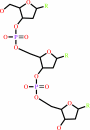 DNA(n)
|
+
|
2'-deoxyribonucleoside 5'-triphosphate
|
=
|
DNA(n+1)
|
+
|
 diphosphate
|
|
|
|
|
|
|
|
|
|
Enzyme class 3:
|
|
Chains A, B:
E.C.2.7.7.7
- DNA-directed Dna polymerase.
|
|
|
|
|
|
|
Reaction:
|
|
DNA(n) + a 2'-deoxyribonucleoside 5'-triphosphate = DNA(n+1) + diphosphate
|
|
|
|
|
|
DNA(n)
|
+
|
2'-deoxyribonucleoside 5'-triphosphate
|
=
|
DNA(n+1)
|
+
|
diphosphate
|
|
|
|
|
|
|
|
|
|
Enzyme class 4:
|
|
Chains A, B:
E.C.3.1.-.-
|
|
|
|
|
|
|
Enzyme class 5:
|
|
Chains A, B:
E.C.3.1.13.2
- exoribonuclease H.
|
|
|
|
|
|
|
Reaction:
|
|
Exonucleolytic cleavage to 5'-phosphomonoester oligonucleotides in both 5'- to 3'- and 3'- to 5'-directions.
|
|
|
|
|
|
Enzyme class 6:
|
|
Chains A, B:
E.C.3.1.26.13
- retroviral ribonuclease H.
|
|
|
|
|
|
|
Enzyme class 7:
|
|
Chains A, B:
E.C.3.4.23.16
- HIV-1 retropepsin.
|
|
|
|
|
|
|
Reaction:
|
|
Specific for a P1 residue that is hydrophobic, and P1' variable, but often Pro.
|
|
|
|
|
|
|
|
|
Note, where more than one E.C. class is given (as above), each may
correspond to a different protein domain or, in the case of polyprotein
precursors, to a different mature protein.
|
|
|
|
Molecule diagrams generated from .mol files obtained from the
KEGG ftp site
|
|
|
|
|
|
|
|
|
|
|
|
|
|
 |
|
|
|
|
|
|
| |
|
|
| |
|
DOI no:
|
Proc Natl Acad Sci U S A
105:1466-1471
(2008)
|
|
PubMed id:
|
|
|
|
|
|
| |
|
High-resolution structures of HIV-1 reverse transcriptase/TMC278 complexes: strategic flexibility explains potency against resistance mutations.
|
|
K.Das,
J.D.Bauman,
A.D.Clark,
Y.V.Frenkel,
P.J.Lewi,
A.J.Shatkin,
S.H.Hughes,
E.Arnold.
|
|
|
|
|
| |
ABSTRACT
|
|
|
|
| |
|
|
TMC278 is a diarylpyrimidine (DAPY) nonnucleoside reverse transcriptase
inhibitor (NNRTI) that is highly effective in treating wild-type and
drug-resistant HIV-1 infections in clinical trials at relatively low doses (
approximately 25-75 mg/day). We have determined the structure of wild-type HIV-1
RT complexed with TMC278 at 1.8 A resolution, using an RT crystal form
engineered by systematic RT mutagenesis. This high-resolution structure reveals
that the cyanovinyl group of TMC278 is positioned in a hydrophobic tunnel
connecting the NNRTI-binding pocket to the nucleic acid-binding cleft. The
crystal structures of TMC278 in complexes with the double mutant K103N/Y181C
(2.1 A) and L100I/K103N HIV-1 RTs (2.9 A) demonstrated that TMC278 adapts to
bind mutant RTs. In the K103N/Y181C RT/TMC278 structure, loss of the aromatic
ring interaction caused by the Y181C mutation is counterbalanced by interactions
between the cyanovinyl group of TMC278 and the aromatic side chain of Y183,
which is facilitated by an approximately 1.5 A shift of the conserved Y(183)MDD
motif. In the L100I/K103N RT/TMC278 structure, the binding mode of TMC278 is
significantly altered so that the drug conforms to changes in the binding pocket
primarily caused by the L100I mutation. The flexible binding pocket acts as a
molecular "shrink wrap" that makes a shape complementary to the
optimized TMC278 in wild-type and drug-resistant forms of HIV-1 RT. The crystal
structures provide a better understanding of how the flexibility of an inhibitor
can compensate for drug-resistance mutations.
|
|
|
|
|
|
| |
Selected figure(s)
|
|
|
|
| |
|
|

|
|

|
|
Figure 2.
Binding mode of TMC278 to HIV-1 RT. (A) Interactions of
TMC278 (gray) with NNRTI-binding pocket residues (in yellow).
(B) The molecular surface (orange) defines the hydrophobic
tunnel that accommodates the cyanovinyl group of TMC278.
|
|
Figure 4.
Comparison of L100I/K103N mutant RT (orange side
chains)/TMC278 (cyan) structure with the wild-type RT (yellow
side chains)/TMC278 (gray) structures reveals wiggling (A) and
jiggling (B) of TMC278.
|
|
|
|
| |
Figures were
selected
by the author.
|
|
|
|
|
|
|
|
|
|
|
|
|
|
|
|
 |
 |
 |
|
Literature references that cite this PDB file's key reference
|
|
|
| |
PubMed id
|
|
Reference
|
|
|
|
|
|
Z.Li,
H.Zhang,
Y.Li,
J.Zhang,
and
H.F.Chen
(2011).
Drug resistant mechanism of diaryltriazine analog inhibitors of HIV-1 reverse transcriptase using molecular dynamics simulation and 3D-QSAR.
|
| |
Chem Biol Drug Des,
77,
63-74.
|
|
|
|
|
|
|
Z.S.Derewenda
(2011).
It's all in the crystals….
|
| |
Acta Crystallogr D Biol Crystallogr,
67,
243-248.
|
|
|
|
|
|
|
A.Herschhorn,
and
A.Hizi
(2010).
Retroviral reverse transcriptases.
|
| |
Cell Mol Life Sci,
67,
2717-2747.
|
|
|
|
|
|
|
C.S.Adamson,
and
E.O.Freed
(2010).
Novel approaches to inhibiting HIV-1 replication.
|
| |
Antiviral Res,
85,
119-141.
|
|
|
|
|
|
|
G.J.van Westen,
J.K.Wegner,
A.Bender,
A.P.Ijzerman,
and
H.W.van Vlijmen
(2010).
Mining protein dynamics from sets of crystal structures using "consensus structures".
|
| |
Protein Sci,
19,
742-752.
|
|
|
|
|
|
|
H.Azijn,
I.Tirry,
J.Vingerhoets,
M.P.de Béthune,
G.Kraus,
K.Boven,
D.Jochmans,
E.Van Craenenbroeck,
G.Picchio,
and
L.T.Rimsky
(2010).
TMC278, a next-generation nonnucleoside reverse transcriptase inhibitor (NNRTI), active against wild-type and NNRTI-resistant HIV-1.
|
| |
Antimicrob Agents Chemother,
54,
718-727.
|
|
|
|
|
|
|
H.Okumura,
E.Gallicchio,
and
R.M.Levy
(2010).
Conformational populations of ligand-sized molecules by replica exchange molecular dynamics and temperature reweighting.
|
| |
J Comput Chem,
31,
1357-1367.
|
|
|
|
|
|
|
J.Frank,
and
R.L.Gonzalez
(2010).
Structure and dynamics of a processive Brownian motor: the translating ribosome.
|
| |
Annu Rev Biochem,
79,
381-412.
|
|
|
|
|
|
|
K.Singh,
B.Marchand,
K.A.Kirby,
E.Michailidis,
and
S.G.Sarafianos
(2010).
Structural Aspects of Drug Resistance and Inhibition of HIV-1 Reverse Transcriptase.
|
| |
Viruses,
2,
606-638.
|
|
|
|
|
|
|
N.Basse,
J.L.Kaar,
G.Settanni,
A.C.Joerger,
T.J.Rutherford,
and
A.R.Fersht
(2010).
Toward the rational design of p53-stabilizing drugs: probing the surface of the oncogenic Y220C mutant.
|
| |
Chem Biol,
17,
46-56.
|
|
|
PDB codes:
|
|
|
|
|
|
|
|
O.Doppelt-Azeroual,
F.Delfaud,
F.Moriaud,
and
A.G.de Brevern
(2010).
Fast and automated functional classification with MED-SuMo: an application on purine-binding proteins.
|
| |
Protein Sci,
19,
847-867.
|
|
|
|
|
|
|
A.Ghosh,
A.Remorino,
M.J.Tucker,
and
R.M.Hochstrasser
(2009).
2D IR photon echo spectroscopy reveals hydrogen bond dynamics of aromatic nitriles.
|
| |
Chem Phys Lett,
469,
325-330.
|
|
|
|
|
|
|
L.L.Dunn,
M.J.McWilliams,
K.Das,
E.Arnold,
and
S.H.Hughes
(2009).
Mutations in the thumb allow human immunodeficiency virus type 1 reverse transcriptase to be cleaved by protease in virions.
|
| |
J Virol,
83,
12336-12344.
|
|
|
|
|
|
|
M.D.Cullen,
W.C.Ho,
J.D.Bauman,
K.Das,
E.Arnold,
T.L.Hartman,
K.M.Watson,
R.W.Buckheit,
C.Pannecouque,
E.De Clercq,
and
M.Cushman
(2009).
Crystallographic study of a novel subnanomolar inhibitor provides insight on the binding interactions of alkenyldiarylmethanes with human immunodeficiency virus-1 reverse transcriptase.
|
| |
J Med Chem,
52,
6467-6473.
|
|
|
PDB codes:
|
|
|
|
|
|
|
|
P.Fletcher,
S.Harman,
H.Azijn,
N.Armanasco,
P.Manlow,
D.Perumal,
M.P.de Bethune,
J.Nuttall,
J.Romano,
and
R.Shattock
(2009).
Inhibition of human immunodeficiency virus type 1 infection by the candidate microbicide dapivirine, a nonnucleoside reverse transcriptase inhibitor.
|
| |
Antimicrob Agents Chemother,
53,
487-495.
|
|
|
|
|
|
|
P.P.Fulco,
and
I.R.McNicholl
(2009).
Etravirine and rilpivirine: nonnucleoside reverse transcriptase inhibitors with activity against human immunodeficiency virus type 1 strains resistant to previous nonnucleoside agents.
|
| |
Pharmacotherapy,
29,
281-294.
|
|
|
|
|
|
|
X.Q.Feng,
Y.H.Liang,
Z.S.Zeng,
F.E.Chen,
J.Balzarini,
C.Pannecouque,
and
E.De Clercq
(2009).
Structural modifications of DAPY analogues with potent anti-HIV-1 activity.
|
| |
ChemMedChem,
4,
219-224.
|
|
|
|
|
|
|
X.Tian,
B.Qin,
H.Lu,
W.Lai,
S.Jiang,
K.H.Lee,
C.H.Chen,
and
L.Xie
(2009).
Discovery of diarylpyridine derivatives as novel non-nucleoside HIV-1 reverse transcriptase inhibitors.
|
| |
Bioorg Med Chem Lett,
19,
5482-5485.
|
|
|
|
|
|
|
Y.Bustanji,
I.M.Al-Masri,
A.Qasem,
A.G.Al-Bakri,
and
M.O.Taha
(2009).
In silico screening for non-nucleoside HIV-1 reverse transcriptase inhibitors using physicochemical filters and high-throughput docking followed by in vitro evaluation.
|
| |
Chem Biol Drug Des,
74,
258-265.
|
|
|
|
|
|
|
Y.S.Kim,
and
R.M.Hochstrasser
(2009).
Applications of 2D IR spectroscopy to peptides, proteins, and hydrogen-bond dynamics.
|
| |
J Phys Chem B,
113,
8231-8251.
|
|
|
|
|
|
|
Y.V.Frenkel,
E.Gallicchio,
K.Das,
R.M.Levy,
and
E.Arnold
(2009).
Molecular dynamics study of non-nucleoside reverse transcriptase inhibitor 4-[[4-[[4-[(E)-2-cyanoethenyl]-2,6-dimethylphenyl]amino]-2-pyrimidinyl]amino]benzonitrile (TMC278/rilpivirine) aggregates: correlation between amphiphilic properties of the drug and oral bioavailability.
|
| |
J Med Chem,
52,
5896-5905.
|
|
|
|
|
|
|
C.Fang,
J.D.Bauman,
K.Das,
A.Remorino,
E.Arnold,
and
R.M.Hochstrasser
(2008).
Two-dimensional infrared spectra reveal relaxation of the nonnucleoside inhibitor TMC278 complexed with HIV-1 reverse transcriptase.
|
| |
Proc Natl Acad Sci U S A,
105,
1472-1477.
|
|
|
|
|
|
|
D.P.Wilson,
P.M.Coplan,
M.A.Wainberg,
and
S.M.Blower
(2008).
The paradoxical effects of using antiretroviral-based microbicides to control HIV epidemics.
|
| |
Proc Natl Acad Sci U S A,
105,
9835-9840.
|
|
|
|
|
|
|
J.D.Bauman,
K.Das,
W.C.Ho,
M.Baweja,
D.M.Himmel,
A.D.Clark,
D.A.Oren,
P.L.Boyer,
S.H.Hughes,
A.J.Shatkin,
and
E.Arnold
(2008).
Crystal engineering of HIV-1 reverse transcriptase for structure-based drug design.
|
| |
Nucleic Acids Res,
36,
5083-5092.
|
|
|
PDB code:
|
|
|
|
|
|
|
|
J.M.Sadler,
O.Ojewoye,
and
K.L.Seley-Radtke
(2008).
"Reverse fleximers": introduction of a series of 5-substituted carbocyclic uridine analogues.
|
| |
Nucleic Acids Symp Ser (Oxf),
(),
571-572.
|
|
|
|
|
|
The most recent references are shown first.
Citation data come partly from CiteXplore and partly
from an automated harvesting procedure. Note that this is likely to be
only a partial list as not all journals are covered by
either method. However, we are continually building up the citation data
so more and more references will be included with time.
Where a reference describes a PDB structure, the PDB
codes are
shown on the right.
|
 |


 Links
Links


