 |
PDBsum entry 1tgo

|
|
|
|
|
 |
Contents |
 |
|
|
|
|
|
|
|
|
|
|
* Residue conservation analysis
|
|
|
|
|
|
|
|
|
|
|
Enzyme class:
|
|
E.C.2.7.7.7
- DNA-directed Dna polymerase.
|
|
|
|
|
|
|
Reaction:
|
|
DNA(n) + a 2'-deoxyribonucleoside 5'-triphosphate = DNA(n+1) + diphosphate
|
|
|
|
|
|
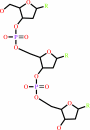 DNA(n)
|
+
|
2'-deoxyribonucleoside 5'-triphosphate
|
=
|
DNA(n+1)
|
+
|
 diphosphate
|
|
|
|
|
|
|
|
|
|
|
|
|
Molecule diagrams generated from .mol files obtained from the
KEGG ftp site
|
|
|
|
|
|
|
|
|
|
|
|
|
|
 |
|
|
|
|
|
|
| |
|
|
| |
|
DOI no:
|
Proc Natl Acad Sci U S A
96:3600-3605
(1999)
|
|
PubMed id:
|
|
|
|
|
|
| |
|
Crystal structure of a thermostable type B DNA polymerase from Thermococcus gorgonarius.
|
|
K.P.Hopfner,
A.Eichinger,
R.A.Engh,
F.Laue,
W.Ankenbauer,
R.Huber,
B.Angerer.
|
|
|
|
|
| |
ABSTRACT
|
|
|
|
| |
|
|
Most known archaeal DNA polymerases belong to the type B family, which also
includes the DNA replication polymerases of eukaryotes, but maintain high
fidelity at extreme conditions. We describe here the 2.5 A resolution crystal
structure of a DNA polymerase from the Archaea Thermococcus gorgonarius and
identify structural features of the fold and the active site that are likely
responsible for its thermostable function. Comparison with the mesophilic B type
DNA polymerase gp43 of the bacteriophage RB69 highlights thermophilic
adaptations, which include the presence of two disulfide bonds and an enhanced
electrostatic complementarity at the DNA-protein interface. In contrast to gp43,
several loops in the exonuclease and thumb domains are more closely packed; this
apparently blocks primer binding to the exonuclease active site. A physiological
role of this "closed" conformation is unknown but may represent a polymerase
mode, in contrast to an editing mode with an open exonuclease site. This
archaeal B DNA polymerase structure provides a starting point for
structure-based design of polymerases or ligands with applications in
biotechnology and the development of antiviral or anticancer agents.
|
|
|
|
|
|
| |
Selected figure(s)
|
|
|
|
| |
|
|

|
|

|
|
Figure 1.
Fig. 1. Stereorepresentation of the electron-density map.
The 2 (F[o]  F[c])
electron density contoured at 1.0 F[c])
electron density contoured at 1.0  at the
polymerase active site is well defined for the refined model
(stick representation). at the
polymerase active site is well defined for the refined model
(stick representation).
|
|
Figure 4.
Fig. 4. Polymerase active site. (A) Stereoribbon
representation (using color code as in Fig. 2) with modeled DNA.
Active-site residues are shown as ball-and-stick representations
with carbon (green), nitrogen (blue), and oxygen (red) atoms.
The DNA template (light brown), primer (light brown), and dNTP
(orange) complex has been taken from the coordinates of T7
replication complex (15) by superimposing D404, D542, and
adjacent residues with corresponding residues in T7 pol (D475
and D654). Phosphorus atoms are yellow. The two metals of the T7
replication complex are shown as magenta spheres. (B)
Experimentally observed metal-binding site for Mn^2+ (F[o] F[c]
density contoured at 5 ) and Zn^2+
in the "low salt" crystal form. The carboxylates E578 and E580
are conserved in type B polymerases (Fig. 3).
|
|
|
|
| |
Figures were
selected
by an automated process.
|
|
|
|
|
|
|
|
|
|
|
|
|
|
|
|
 |
 |
 |
|
Literature references that cite this PDB file's key reference
|
 Google scholar
|
|
|
| |
PubMed id
|
|
Reference
|
|
|
|
|
|
C.J.Hansen,
L.Wu,
J.D.Fox,
B.Arezi,
and
H.H.Hogrefe
(2011).
Engineered split in Pfu DNA polymerase fingers domain improves incorporation of nucleotide gamma-phosphate derivative.
|
| |
Nucleic Acids Res,
39,
1801-1810.
|
|
|
|
|
|
|
K.Mayanagi,
S.Kiyonari,
H.Nishida,
M.Saito,
D.Kohda,
Y.Ishino,
T.Shirai,
and
K.Morikawa
(2011).
Architecture of the DNA polymerase B-proliferating cell nuclear antigen (PCNA)-DNA ternary complex.
|
| |
Proc Natl Acad Sci U S A,
108,
1845-1849.
|
|
|
|
|
|
|
S.K.Jozwiakowski,
and
B.A.Connolly
(2011).
A modified family-B archaeal DNA polymerase with reverse transcriptase activity.
|
| |
Chembiochem,
12,
35-37.
|
|
|
|
|
|
|
C.DebRoy,
E.Roberts,
M.Davis,
and
A.Bumbaugh
(2010).
Multiplex polymerase chain reaction assay for detection of nonserotypable Shiga toxin-producing Escherichia coli strains of serogroup O147.
|
| |
Foodborne Pathog Dis,
7,
1407-1414.
|
|
|
|
|
|
|
E.Johansson,
and
S.A.Macneill
(2010).
The eukaryotic replicative DNA polymerases take shape.
|
| |
Trends Biochem Sci,
35,
339-347.
|
|
|
|
|
|
|
J.G.Song,
E.J.Kil,
S.S.Cho,
I.H.Kim,
and
S.T.Kwon
(2010).
An amino acid residue in the middle of the fingers subdomain is involved in Neq DNA polymerase processivity: enhanced processivity of engineered Neq DNA polymerase and its PCR application.
|
| |
Protein Eng Des Sel,
23,
835-842.
|
|
|
|
|
|
|
M.H.Nørholm
(2010).
A mutant Pfu DNA polymerase designed for advanced uracil-excision DNA engineering.
|
| |
BMC Biotechnol,
10,
21.
|
|
|
|
|
|
|
H.J.Russell,
T.T.Richardson,
K.Emptage,
and
B.A.Connolly
(2009).
The 3'-5' proofreading exonuclease of archaeal family-B DNA polymerase hinders the copying of template strand deaminated bases.
|
| |
Nucleic Acids Res,
37,
7603-7611.
|
|
|
|
|
|
|
H.Matsukawa,
T.Yamagami,
Y.Kawarabayasi,
Y.Miyashita,
M.Takahashi,
and
Y.Ishino
(2009).
A useful strategy to construct DNA polymerases with different properties by using genetic resources from environmental DNA.
|
| |
Genes Genet Syst,
84,
3.
|
|
|
|
|
|
|
I.Rodríguez,
J.M.Lázaro,
M.Salas,
and
M.de Vega
(2009).
Involvement of the TPR2 subdomain movement in the activities of phi29 DNA polymerase.
|
| |
Nucleic Acids Res,
37,
193-203.
|
|
|
|
|
|
|
M.C.Kuo,
D.C.Liang,
C.F.Huang,
Y.S.Shih,
J.H.Wu,
T.L.Lin,
and
L.Y.Shih
(2009).
RUNX1 mutations are frequent in chronic myelomonocytic leukemia and mutations at the C-terminal region might predict acute myeloid leukemia transformation.
|
| |
Leukemia,
23,
1426-1431.
|
|
|
|
|
|
|
N.A.Cavanaugh,
M.Urban,
J.Beckman,
T.E.Spratt,
and
R.D.Kuchta
(2009).
Identifying the features of purine dNTPs that allow accurate and efficient DNA replication by herpes simplex virus I DNA polymerase.
|
| |
Biochemistry,
48,
3554-3564.
|
|
|
|
|
|
|
V.Sarri,
S.Minelli,
F.Panara,
M.Morgante,
I.Jurman,
A.Zuccolo,
and
P.G.Cionini
(2008).
Characterization and chromosomal organization of satellite DNA sequences in Picea abies.
|
| |
Genome,
51,
705-713.
|
|
|
|
|
|
|
X.Ding,
Z.M.Lv,
Y.Zhao,
H.Min,
and
W.J.Yang
(2008).
MTH1745, a protein disulfide isomerase-like protein from thermophilic archaea, Methanothermobacter thermoautotrophicum involving in stress response.
|
| |
Cell Stress Chaperones,
13,
239-246.
|
|
|
|
|
|
|
Y.Zuo,
H.Zheng,
Y.Wang,
M.Chruszcz,
M.Cymborowski,
T.Skarina,
A.Savchenko,
A.Malhotra,
and
W.Minor
(2007).
Crystal structure of RNase T, an exoribonuclease involved in tRNA maturation and end turnover.
|
| |
Structure,
15,
417-428.
|
|
|
PDB codes:
|
|
|
|
|
|
|
|
E.V.Koonin
(2006).
Temporal order of evolution of DNA replication systems inferred by comparison of cellular and viral DNA polymerases.
|
| |
Biol Direct,
1,
39.
|
|
|
|
|
|
|
J.B.Sweasy,
J.M.Lauper,
and
K.A.Eckert
(2006).
DNA polymerases and human diseases.
|
| |
Radiat Res,
166,
693-714.
|
|
|
|
|
|
|
J.J.Perry,
S.M.Yannone,
L.G.Holden,
C.Hitomi,
A.Asaithamby,
S.Han,
P.K.Cooper,
D.J.Chen,
and
J.A.Tainer
(2006).
WRN exonuclease structure and molecular mechanism imply an editing role in DNA end processing.
|
| |
Nat Struct Mol Biol,
13,
414-422.
|
|
|
PDB codes:
|
|
|
|
|
|
|
|
M.H.Lamers,
R.E.Georgescu,
S.G.Lee,
M.O'Donnell,
and
J.Kuriyan
(2006).
Crystal structure of the catalytic alpha subunit of E. coli replicative DNA polymerase III.
|
| |
Cell,
126,
881-892.
|
|
|
PDB codes:
|
|
|
|
|
|
|
|
M.Nakka,
R.B.Iyer,
and
L.G.Bachas
(2006).
Intersubunit disulfide interactions play a critical role in maintaining the thermostability of glucose-6-phosphate dehydrogenase from the hyperthermophilic bacterium Aquifex aeolicus.
|
| |
Protein J,
25,
17-21.
|
|
|
|
|
|
|
P.Pérez-Arnaiz,
J.M.Lázaro,
M.Salas,
and
M.de Vega
(2006).
Involvement of phi29 DNA polymerase thumb subdomain in the proper coordination of synthesis and degradation during DNA replication.
|
| |
Nucleic Acids Res,
34,
3107-3115.
|
|
|
|
|
|
|
R.Shi,
A.Azzi,
C.Gilbert,
G.Boivin,
and
S.X.Lin
(2006).
Three-dimensional modeling of cytomegalovirus DNA polymerase and preliminary analysis of drug resistance.
|
| |
Proteins,
64,
301-307.
|
|
|
|
|
|
|
I.Rodríguez,
J.M.Lázaro,
L.Blanco,
S.Kamtekar,
A.J.Berman,
J.Wang,
T.A.Steitz,
M.Salas,
and
M.de Vega
(2005).
A specific subdomain in phi29 DNA polymerase confers both processivity and strand-displacement capacity.
|
| |
Proc Natl Acad Sci U S A,
102,
6407-6412.
|
|
|
|
|
|
|
J.Eichler,
and
M.W.Adams
(2005).
Posttranslational protein modification in Archaea.
|
| |
Microbiol Mol Biol Rev,
69,
393-425.
|
|
|
|
|
|
|
L.M.Iyer,
E.V.Koonin,
D.D.Leipe,
and
L.Aravind
(2005).
Origin and evolution of the archaeo-eukaryotic primase superfamily and related palm-domain proteins: structural insights and new members.
|
| |
Nucleic Acids Res,
33,
3875-3896.
|
|
|
|
|
|
|
A.Paz,
D.Mester,
I.Baca,
E.Nevo,
and
A.Korol
(2004).
Adaptive role of increased frequency of polypurine tracts in mRNA sequences of thermophilic prokaryotes.
|
| |
Proc Natl Acad Sci U S A,
101,
2951-2956.
|
|
|
|
|
|
|
A.R.Pavlov,
N.V.Pavlova,
S.A.Kozyavkin,
and
A.I.Slesarev
(2004).
Recent developments in the optimization of thermostable DNA polymerases for efficient applications.
|
| |
Trends Biotechnol,
22,
253-260.
|
|
|
|
|
|
|
B.D.Biles,
and
B.A.Connolly
(2004).
Low-fidelity Pyrococcus furiosus DNA polymerase mutants useful in error-prone PCR.
|
| |
Nucleic Acids Res,
32,
e176.
|
|
|
|
|
|
|
D.Das,
and
M.M.Georgiadis
(2004).
The crystal structure of the monomeric reverse transcriptase from Moloney murine leukemia virus.
|
| |
Structure,
12,
819-829.
|
|
|
PDB codes:
|
|
|
|
|
|
|
|
E.Freisinger,
A.P.Grollman,
H.Miller,
and
C.Kisker
(2004).
Lesion (in)tolerance reveals insights into DNA replication fidelity.
|
| |
EMBO J,
23,
1494-1505.
|
|
|
PDB codes:
|
|
|
|
|
|
|
|
L.S.Kaguni
(2004).
DNA polymerase gamma, the mitochondrial replicase.
|
| |
Annu Rev Biochem,
73,
293-320.
|
|
|
|
|
|
|
M.Hogg,
S.S.Wallace,
and
S.Doublié
(2004).
Crystallographic snapshots of a replicative DNA polymerase encountering an abasic site.
|
| |
EMBO J,
23,
1483-1493.
|
|
|
PDB codes:
|
|
|
|
|
|
|
|
T.J.Moriarty,
D.T.Marie-Egyptienne,
and
C.Autexier
(2004).
Functional organization of repeat addition processivity and DNA synthesis determinants in the human telomerase multimer.
|
| |
Mol Cell Biol,
24,
3720-3733.
|
|
|
|
|
|
|
V.M.Petrov,
and
J.D.Karam
(2004).
Diversity of structure and function of DNA polymerase (gp43) of T4-related bacteriophages.
|
| |
Biochemistry (Mosc),
69,
1213-1218.
|
|
|
|
|
|
|
V.Truniger,
J.M.Lázaro,
and
M.Salas
(2004).
Function of the C-terminus of phi29 DNA polymerase in DNA and terminal protein binding.
|
| |
Nucleic Acids Res,
32,
361-370.
|
|
|
|
|
|
|
Y.Wang,
D.E.Prosen,
L.Mei,
J.C.Sullivan,
M.Finney,
and
P.B.Vander Horn
(2004).
A novel strategy to engineer DNA polymerases for enhanced processivity and improved performance in vitro.
|
| |
Nucleic Acids Res,
32,
1197-1207.
|
|
|
|
|
|
|
B.Grabowski,
and
Z.Kelman
(2003).
Archeal DNA replication: eukaryal proteins in a bacterial context.
|
| |
Annu Rev Microbiol,
57,
487-516.
|
|
|
|
|
|
|
S.J.Johnson,
J.S.Taylor,
and
L.S.Beese
(2003).
Processive DNA synthesis observed in a polymerase crystal suggests a mechanism for the prevention of frameshift mutations.
|
| |
Proc Natl Acad Sci U S A,
100,
3895-3900.
|
|
|
PDB codes:
|
|
|
|
|
|
|
|
A.Bebenek,
G.T.Carver,
H.K.Dressman,
F.A.Kadyrov,
J.K.Haseman,
V.Petrov,
W.H.Konigsberg,
J.D.Karam,
and
J.W.Drake
(2002).
Dissecting the fidelity of bacteriophage RB69 DNA polymerase: site-specific modulation of fidelity by polymerase accessory proteins.
|
| |
Genetics,
162,
1003-1018.
|
|
|
|
|
|
|
G.Yang,
M.Franklin,
J.Li,
T.C.Lin,
and
W.Konigsberg
(2002).
A conserved Tyr residue is required for sugar selectivity in a Pol alpha DNA polymerase.
|
| |
Biochemistry,
41,
10256-10261.
|
|
|
|
|
|
|
J.Dietrich,
P.Schmitt,
M.Zieger,
B.Preve,
J.L.Rolland,
H.Chaabihi,
and
Y.Gueguen
(2002).
PCR performance of the highly thermostable proof-reading B-type DNA polymerase from Pyrococcus abyssi.
|
| |
FEMS Microbiol Lett,
217,
89-94.
|
|
|
|
|
|
|
M.J.Fogg,
L.H.Pearl,
and
B.A.Connolly
(2002).
Structural basis for uracil recognition by archaeal family B DNA polymerases.
|
| |
Nat Struct Biol,
9,
922-927.
|
|
|
|
|
|
|
P.Cramer
(2002).
Common structural features of nucleic acid polymerases.
|
| |
Bioessays,
24,
724-729.
|
|
|
|
|
|
|
R.Eisenbrandt,
J.M.Lázaro,
M.Salas,
and
M.de Vega
(2002).
Phi29 DNA polymerase residues Tyr59, His61 and Phe69 of the highly conserved ExoII motif are essential for interaction with the terminal protein.
|
| |
Nucleic Acids Res,
30,
1379-1386.
|
|
|
|
|
|
|
V.M.Petrov,
and
J.D.Karam
(2002).
RNA determinants of translational operator recognition by the DNA polymerases of bacteriophages T4 and RB69.
|
| |
Nucleic Acids Res,
30,
3341-3348.
|
|
|
|
|
|
|
V.Truniger,
J.M.Lázaro,
F.J.Esteban,
L.Blanco,
and
M.Salas
(2002).
A positively charged residue of phi29 DNA polymerase, highly conserved in DNA polymerases from families A and B, is involved in binding the incoming nucleotide.
|
| |
Nucleic Acids Res,
30,
1483-1492.
|
|
|
|
|
|
|
C.Vieille,
and
G.J.Zeikus
(2001).
Hyperthermophilic enzymes: sources, uses, and molecular mechanisms for thermostability.
|
| |
Microbiol Mol Biol Rev,
65,
1.
|
|
|
|
|
|
|
F.J.Ghadessy,
J.L.Ong,
and
P.Holliger
(2001).
Directed evolution of polymerase function by compartmentalized self-replication.
|
| |
Proc Natl Acad Sci U S A,
98,
4552-4557.
|
|
|
|
|
|
|
M.Albà
(2001).
Replicative DNA polymerases.
|
| |
Genome Biol,
2,
REVIEWS3002.
|
|
|
|
|
|
|
P.M.Leonard,
S.H.Smits,
S.E.Sedelnikova,
A.B.Brinkman,
W.M.de Vos,
J.van der Oost,
D.W.Rice,
and
J.B.Rafferty
(2001).
Crystal structure of the Lrp-like transcriptional regulator from the archaeon Pyrococcus furiosus.
|
| |
EMBO J,
20,
990-997.
|
|
|
PDB code:
|
|
|
|
|
|
|
|
S.A.MacNeill
(2001).
Understanding the enzymology of archaeal DNA replication: progress in form and function.
|
| |
Mol Microbiol,
40,
520-529.
|
|
|
|
|
|
|
S.Ramanathan,
K.V.Chary,
and
B.J.Rao
(2001).
Incoming nucleotide binds to Klenow ternary complex leading to stable physical sequestration of preceding dNTP on DNA.
|
| |
Nucleic Acids Res,
29,
2097-2105.
|
|
|
|
|
|
|
Y.I.Pavlov,
P.V.Shcherbakova,
and
T.A.Kunkel
(2001).
In vivo consequences of putative active site mutations in yeast DNA polymerases alpha, epsilon, delta, and zeta.
|
| |
Genetics,
159,
47-64.
|
|
|
|
|
|
|
H.J.Zuccola,
D.J.Filman,
D.M.Coen,
and
J.M.Hogle
(2000).
The crystal structure of an unusual processivity factor, herpes simplex virus UL42, bound to the C terminus of its cognate polymerase.
|
| |
Mol Cell,
5,
267-278.
|
|
|
PDB code:
|
|
|
|
|
|
|
|
J.L.Keck,
and
J.M.Berger
(2000).
DNA replication at high resolution.
|
| |
Chem Biol,
7,
R63-R71.
|
|
|
|
|
|
|
K.Böhlke,
F.M.Pisani,
C.E.Vorgias,
B.Frey,
H.Sobek,
M.Rossi,
and
G.Antranikian
(2000).
PCR performance of the B-type DNA polymerase from the thermophilic euryarchaeon Thermococcus aggregans improved by mutations in the Y-GG/A motif.
|
| |
Nucleic Acids Res,
28,
3910-3917.
|
|
|
|
|
|
|
K.Vastmans,
S.Pochet,
A.Peys,
L.Kerremans,
A.Van Aerschot,
C.Hendrix,
P.Marlière,
and
P.Herdewijn
(2000).
Enzymatic incorporation in DNA of 1,5-anhydrohexitol nucleotides.
|
| |
Biochemistry,
39,
12757-12765.
|
|
|
|
|
|
|
S.J.Evans,
M.J.Fogg,
A.Mamone,
M.Davis,
L.H.Pearl,
and
B.A.Connolly
(2000).
Improving dideoxynucleotide-triphosphate utilisation by the hyper-thermophilic DNA polymerase from the archaeon Pyrococcus furiosus.
|
| |
Nucleic Acids Res,
28,
1059-1066.
|
|
|
|
|
|
|
I.K.Cann,
and
Y.Ishino
(1999).
Archaeal DNA replication: identifying the pieces to solve a puzzle.
|
| |
Genetics,
152,
1249-1267.
|
|
|
|
|
|
|
Y.Zhao,
D.Jeruzalmi,
I.Moarefi,
L.Leighton,
R.Lasken,
and
J.Kuriyan
(1999).
Crystal structure of an archaebacterial DNA polymerase.
|
| |
Structure,
7,
1189-1199.
|
|
|
PDB codes:
|
|
|
|
|
|
|
The most recent references are shown first.
Citation data come partly from CiteXplore and partly
from an automated harvesting procedure. Note that this is likely to be
only a partial list as not all journals are covered by
either method. However, we are continually building up the citation data
so more and more references will be included with time.
Where a reference describes a PDB structure, the PDB
codes are
shown on the right.
|
|


 Links
Links


