|
PDBsum entry 1qqc

|
|
|
|
|
 |
Contents |
 |
|
|
|
|
|
|
|
|
|
|
|
|
|
|
* Residue conservation analysis
|
|
|
|
|
|
|
|
|
|
|
Enzyme class:
|
|
E.C.2.7.7.7
- DNA-directed Dna polymerase.
|
|
|
|
|
|
|
Reaction:
|
|
DNA(n) + a 2'-deoxyribonucleoside 5'-triphosphate = DNA(n+1) + diphosphate
|
|
|
|
|
|
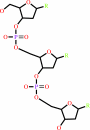 DNA(n)
|
+
|
2'-deoxyribonucleoside 5'-triphosphate
|
=
|
DNA(n+1)
|
+
|
 diphosphate
|
|
|
|
|
|
|
|
|
|
|
|
|
Molecule diagrams generated from .mol files obtained from the
KEGG ftp site
|
|
|
|
|
|
|
|
|
|
|
|
|
|
 |
|
|
|
|
|
|
| |
|
|
| |
|
DOI no:
|
Structure Fold Des
7:1189-1199
(1999)
|
|
PubMed id:
|
|
|
|
|
|
| |
|
Crystal structure of an archaebacterial DNA polymerase.
|
|
Y.Zhao,
D.Jeruzalmi,
I.Moarefi,
L.Leighton,
R.Lasken,
J.Kuriyan.
|
|
|
|
|
| |
ABSTRACT
|
|
|
|
| |
|
|
BACKGROUND: Members of the Pol II family of DNA polymerases are responsible for
chromosomal replication in eukaryotes, and carry out highly processive DNA
replication when attached to ring-shaped processivity clamps. The sequences of
Pol II polymerases are distinct from those of members of the well-studied Pol I
family of DNA polymerases. The DNA polymerase from the archaebacterium
Desulfurococcus strain Tok (D. Tok Pol) is a member of the Pol II family that
retains catalytic activity at elevated temperatures. RESULTS: The crystal
structure of D. Tok Pol has been determined at 2.4 A resolution. The
architecture of this Pol II type DNA polymerase resembles that of the DNA
polymerase from the bacteriophage RB69, with which it shares less than
approximately 20% sequence identity. As in RB69, the central catalytic region of
the DNA polymerase is located within the 'palm' subdomain and is strikingly
similar in structure to the corresponding regions of Pol I type DNA polymerases.
The structural scaffold that surrounds the catalytic core in D. Tok Pol is
unrelated in structure to that of Pol I type polymerases. The 3'-5' proofreading
exonuclease domain of D. Tok Pol resembles the corresponding domains of RB69 Pol
and Pol I type DNA polymerases. The exonuclease domain in D. Tok Pol is located
in the same position relative to the polymerase domain as seen in RB69, and on
the opposite side of the palm subdomain compared to its location in Pol I type
polymerases. The N-terminal domain of D. Tok Pol has structural similarity to
RNA-binding domains. Sequence alignments suggest that this domain is conserved
in the eukaryotic DNA polymerases delta and epsilon. CONCLUSIONS: The structure
of D. Tok Pol confirms that the modes of binding of the template and extrusion
of newly synthesized duplex DNA are likely to be similar in both Pol II and Pol
I type DNA polymerases. However, the mechanism by which the newly synthesized
product transits in and out of the proofreading exonuclease domain has to be
quite different. The discovery of a domain that seems to be an RNA-binding
module raises the possibility that Pol II family members interact with RNA.
|
|
|
|
|
|
| |
Selected figure(s)
|
|
|
|
| |
|
|

|
|
Figure 6.
Figure 6. Comparison of surface charges in D. Tok Pol and
RB69 Pol. Accessible-surface representation of (a) D. Tok Pol
and (b) RB69 Pol in the same orientation after superposition of
their palm subdomains. Surface regions corresponding to the
terminal oxygen atoms of aspartate and glutamate are colored
red, whereas surface regions contributed by the sidechain
nitrogen of lysines and arginines are colored blue. D. Tok Pol
has a striking pairing of oppositely charged residues not seen
in RB69 pol. A representation of D. Tok Pol as a worm is
included for orientation.
|
|
|
|
|
|
| |
The above figure is
reprinted
by permission from Cell Press:
Structure Fold Des
(1999,
7,
1189-1199)
copyright 1999.
|
|
| |
Figure was
selected
by an automated process.
|
|
|
|
|
|
|
|
|
|
|
|
|
|
|
|
 |
 |
 |
|
Literature references that cite this PDB file's key reference
|
|
|
| |
PubMed id
|
|
Reference
|
|
|
|
|
|
E.Johansson,
and
S.A.Macneill
(2010).
The eukaryotic replicative DNA polymerases take shape.
|
| |
Trends Biochem Sci,
35,
339-347.
|
|
|
|
|
|
|
I.B.Rogozin,
K.S.Makarova,
Y.I.Pavlov,
and
E.V.Koonin
(2008).
A highly conserved family of inactivated archaeal B family DNA polymerases.
|
| |
Biol Direct,
3,
32.
|
|
|
|
|
|
|
K.F.Bryant,
and
D.M.Coen
(2008).
Inhibition of translation by a short element in the 5' leader of the herpes simplex virus 1 DNA polymerase transcript.
|
| |
J Virol,
82,
77-85.
|
|
|
|
|
|
|
A.P.Silverman,
Q.Jiang,
M.F.Goodman,
and
E.T.Kool
(2007).
Steric and electrostatic effects in DNA synthesis by the SOS-induced DNA polymerases II and IV of Escherichia coli.
|
| |
Biochemistry,
46,
13874-13881.
|
|
|
|
|
|
|
M.Hogg,
P.Aller,
W.Konigsberg,
S.S.Wallace,
and
S.Doublié
(2007).
Structural and biochemical investigation of the role in proofreading of a beta hairpin loop found in the exonuclease domain of a replicative DNA polymerase of the B family.
|
| |
J Biol Chem,
282,
1432-1444.
|
|
|
PDB code:
|
|
|
|
|
|
|
|
H.Moussard,
G.Henneke,
D.Moreira,
V.Jouffe,
P.López-García,
and
C.Jeanthon
(2006).
Thermophilic lifestyle for an uncultured archaeon from hydrothermal vents: evidence from environmental genomics.
|
| |
Appl Environ Microbiol,
72,
2268-2271.
|
|
|
|
|
|
|
M.H.Lamers,
R.E.Georgescu,
S.G.Lee,
M.O'Donnell,
and
J.Kuriyan
(2006).
Crystal structure of the catalytic alpha subunit of E. coli replicative DNA polymerase III.
|
| |
Cell,
126,
881-892.
|
|
|
PDB codes:
|
|
|
|
|
|
|
|
P.Pérez-Arnaiz,
J.M.Lázaro,
M.Salas,
and
M.de Vega
(2006).
Involvement of phi29 DNA polymerase thumb subdomain in the proper coordination of synthesis and degradation during DNA replication.
|
| |
Nucleic Acids Res,
34,
3107-3115.
|
|
|
|
|
|
|
R.Shi,
A.Azzi,
C.Gilbert,
G.Boivin,
and
S.X.Lin
(2006).
Three-dimensional modeling of cytomegalovirus DNA polymerase and preliminary analysis of drug resistance.
|
| |
Proteins,
64,
301-307.
|
|
|
|
|
|
|
S.Liu,
J.D.Knafels,
J.S.Chang,
G.A.Waszak,
E.T.Baldwin,
M.R.Deibel,
D.R.Thomsen,
F.L.Homa,
P.A.Wells,
M.C.Tory,
R.A.Poorman,
H.Gao,
X.Qiu,
and
A.P.Seddon
(2006).
Crystal structure of the herpes simplex virus 1 DNA polymerase.
|
| |
J Biol Chem,
281,
18193-18200.
|
|
|
PDB code:
|
|
|
|
|
|
|
|
K.Nagasaki,
Y.Shirai,
Y.Tomaru,
K.Nishida,
and
S.Pietrokovski
(2005).
Algal viruses with distinct intraspecies host specificities include identical intein elements.
|
| |
Appl Environ Microbiol,
71,
3599-3607.
|
|
|
|
|
|
|
A.F.Gardner,
C.M.Joyce,
and
W.E.Jack
(2004).
Comparative kinetics of nucleotide analog incorporation by vent DNA polymerase.
|
| |
J Biol Chem,
279,
11834-11842.
|
|
|
|
|
|
|
A.R.Pavlov,
N.V.Pavlova,
S.A.Kozyavkin,
and
A.I.Slesarev
(2004).
Recent developments in the optimization of thermostable DNA polymerases for efficient applications.
|
| |
Trends Biotechnol,
22,
253-260.
|
|
|
|
|
|
|
B.D.Biles,
and
B.A.Connolly
(2004).
Low-fidelity Pyrococcus furiosus DNA polymerase mutants useful in error-prone PCR.
|
| |
Nucleic Acids Res,
32,
e176.
|
|
|
|
|
|
|
D.Das,
and
M.M.Georgiadis
(2004).
The crystal structure of the monomeric reverse transcriptase from Moloney murine leukemia virus.
|
| |
Structure,
12,
819-829.
|
|
|
PDB codes:
|
|
|
|
|
|
|
|
V.M.Petrov,
and
J.D.Karam
(2004).
Diversity of structure and function of DNA polymerase (gp43) of T4-related bacteriophages.
|
| |
Biochemistry (Mosc),
69,
1213-1218.
|
|
|
|
|
|
|
V.Truniger,
J.M.Lázaro,
and
M.Salas
(2004).
Function of the C-terminus of phi29 DNA polymerase in DNA and terminal protein binding.
|
| |
Nucleic Acids Res,
32,
361-370.
|
|
|
|
|
|
|
B.Grabowski,
and
Z.Kelman
(2003).
Archeal DNA replication: eukaryal proteins in a bacterial context.
|
| |
Annu Rev Microbiol,
57,
487-516.
|
|
|
|
|
|
|
M.Ogawa,
S.Limsirichaikul,
A.Niimi,
S.Iwai,
S.Yoshida,
and
M.Suzuki
(2003).
Distinct function of conserved amino acids in the fingers of Saccharomyces cerevisiae DNA polymerase alpha.
|
| |
J Biol Chem,
278,
19071-19078.
|
|
|
|
|
|
|
S.J.Johnson,
J.S.Taylor,
and
L.S.Beese
(2003).
Processive DNA synthesis observed in a polymerase crystal suggests a mechanism for the prevention of frameshift mutations.
|
| |
Proc Natl Acad Sci U S A,
100,
3895-3900.
|
|
|
PDB codes:
|
|
|
|
|
|
|
|
M.J.Fogg,
L.H.Pearl,
and
B.A.Connolly
(2002).
Structural basis for uracil recognition by archaeal family B DNA polymerases.
|
| |
Nat Struct Biol,
9,
922-927.
|
|
|
|
|
|
|
V.M.Petrov,
S.S.Ng,
and
J.D.Karam
(2002).
Protein determinants of RNA binding by DNA polymerase of the T4-related bacteriophage RB69.
|
| |
J Biol Chem,
277,
33041-33048.
|
|
|
|
|
|
|
M.I.Hadjimarcou,
R.J.Kokoska,
T.D.Petes,
and
L.J.Reha-Krantz
(2001).
Identification of a mutant DNA polymerase delta in Saccharomyces cerevisiae with an antimutator phenotype for frameshift mutations.
|
| |
Genetics,
158,
177-186.
|
|
|
|
|
|
|
S.A.MacNeill
(2001).
Understanding the enzymology of archaeal DNA replication: progress in form and function.
|
| |
Mol Microbiol,
40,
520-529.
|
|
|
|
|
|
|
S.Ramanathan,
K.V.Chary,
and
B.J.Rao
(2001).
Incoming nucleotide binds to Klenow ternary complex leading to stable physical sequestration of preceding dNTP on DNA.
|
| |
Nucleic Acids Res,
29,
2097-2105.
|
|
|
|
|
|
|
Y.I.Pavlov,
P.V.Shcherbakova,
and
T.A.Kunkel
(2001).
In vivo consequences of putative active site mutations in yeast DNA polymerases alpha, epsilon, delta, and zeta.
|
| |
Genetics,
159,
47-64.
|
|
|
|
|
|
|
A.R.Pavlov,
and
J.D.Karam
(2000).
Nucleotide-sequence-specific and non-specific interactions of T4 DNA polymerase with its own mRNA.
|
| |
Nucleic Acids Res,
28,
4657-4664.
|
|
|
|
|
|
The most recent references are shown first.
Citation data come partly from CiteXplore and partly
from an automated harvesting procedure. Note that this is likely to be
only a partial list as not all journals are covered by
either method. However, we are continually building up the citation data
so more and more references will be included with time.
Where a reference describes a PDB structure, the PDB
code is
shown on the right.
|
|


 Links
Links