
|
|
|
|
|
 |
Contents |
 |
|
|
|
|
|
|
|
|
|
|
* Residue conservation analysis
|
|
|
|
|
|
|
|
|
|
Enzyme class 1:
|
|
Chains A, B:
E.C.2.7.7.-
- ?????
|
|
|
|
|
|
|
Enzyme class 2:
|
|
Chains A, B:
E.C.2.7.7.49
- RNA-directed Dna polymerase.
|
|
|
|
|
|
|
Reaction:
|
|
DNA(n) + a 2'-deoxyribonucleoside 5'-triphosphate = DNA(n+1) + diphosphate
|
|
|
|
|
|
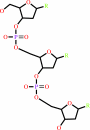 DNA(n)
|
+
|
2'-deoxyribonucleoside 5'-triphosphate
|
=
|
DNA(n+1)
|
+
|
 diphosphate
|
|
|
|
|
|
|
|
|
|
Enzyme class 3:
|
|
Chains A, B:
E.C.2.7.7.7
- DNA-directed Dna polymerase.
|
|
|
|
|
|
|
Reaction:
|
|
DNA(n) + a 2'-deoxyribonucleoside 5'-triphosphate = DNA(n+1) + diphosphate
|
|
|
|
|
|
DNA(n)
|
+
|
2'-deoxyribonucleoside 5'-triphosphate
|
=
|
DNA(n+1)
|
+
|
diphosphate
|
|
|
|
|
|
|
|
|
|
Enzyme class 4:
|
|
Chains A, B:
E.C.3.1.-.-
|
|
|
|
|
|
|
Enzyme class 5:
|
|
Chains A, B:
E.C.3.1.13.2
- exoribonuclease H.
|
|
|
|
|
|
|
Reaction:
|
|
Exonucleolytic cleavage to 5'-phosphomonoester oligonucleotides in both 5'- to 3'- and 3'- to 5'-directions.
|
|
|
|
|
|
Enzyme class 6:
|
|
Chains A, B:
E.C.3.1.26.13
- retroviral ribonuclease H.
|
|
|
|
|
|
|
Enzyme class 7:
|
|
Chains A, B:
E.C.3.4.23.16
- HIV-1 retropepsin.
|
|
|
|
|
|
|
Reaction:
|
|
Specific for a P1 residue that is hydrophobic, and P1' variable, but often Pro.
|
|
|
|
|
|
|
|
|
Note, where more than one E.C. class is given (as above), each may
correspond to a different protein domain or, in the case of polyprotein
precursors, to a different mature protein.
|
|
|
|
Molecule diagrams generated from .mol files obtained from the
KEGG ftp site
|
|
|
|
|
|
|
|
|
|
|
|
|
|
 |
|
|
|
|
|
|
| |
|
|
| |
|
DOI no:
|
J Med Chem
47:2550-2560
(2004)
|
|
PubMed id:
|
|
|
|
|
|
| |
|
Roles of conformational and positional adaptability in structure-based design of TMC125-R165335 (etravirine) and related non-nucleoside reverse transcriptase inhibitors that are highly potent and effective against wild-type and drug-resistant HIV-1 variants.
|
|
K.Das,
A.D.Clark,
P.J.Lewi,
J.Heeres,
M.R.De Jonge,
L.M.Koymans,
H.M.Vinkers,
F.Daeyaert,
D.W.Ludovici,
M.J.Kukla,
B.De Corte,
R.W.Kavash,
C.Y.Ho,
H.Ye,
M.A.Lichtenstein,
K.Andries,
R.Pauwels,
M.P.De Béthune,
P.L.Boyer,
P.Clark,
S.H.Hughes,
P.A.Janssen,
E.Arnold.
|
|
|
|
|
| |
ABSTRACT
|
|
|
|
| |
|
|
Anti-AIDS drug candidate and non-nucleoside reverse transcriptase inhibitor
(NNRTI) TMC125-R165335 (etravirine) caused an initial drop in viral load similar
to that observed with a five-drug combination in naïve patients and retains
potency in patients infected with NNRTI-resistant HIV-1 variants. TMC125-R165335
and related anti-AIDS drug candidates can bind the enzyme RT in multiple
conformations and thereby escape the effects of drug-resistance mutations.
Structural studies showed that this inhibitor and other diarylpyrimidine (DAPY)
analogues can adapt to changes in the NNRTI-binding pocket in several ways: (1).
DAPY analogues can bind in at least two conformationally distinct modes; (2).
within a given binding mode, torsional flexibility ("wiggling") of DAPY
analogues permits access to numerous conformational variants; and (3). the
compact design of the DAPY analogues permits significant repositioning and
reorientation (translation and rotation) within the pocket ("jiggling"). Such
adaptations appear to be critical for potency against wild-type and a wide range
of drug-resistant mutant HIV-1 RTs. Exploitation of favorable components of
inhibitor conformational flexibility (such as torsional flexibility about
strategically located chemical bonds) can be a powerful drug design concept,
especially for designing drugs that will be effective against rapidly mutating
targets.
|
|
|
|
|
|
|
|
|
|
|
|
|
|
|
|
|
|
 |
 |
 |
|
Literature references that cite this PDB file's key reference
|
|
|
| |
PubMed id
|
|
Reference
|
|
|
|
|
|
K.Das,
S.E.Martinez,
J.D.Bauman,
and
E.Arnold
(2012).
HIV-1 reverse transcriptase complex with DNA and nevirapine reveals non-nucleoside inhibition mechanism.
|
| |
Nat Struct Mol Biol,
19,
253-259.
|
|
|
PDB codes:
|
|
|
|
|
|
|
|
P.Decha,
P.Intharathep,
T.Udommaneethanakit,
P.Sompornpisut,
S.Hannongbua,
P.Wolschann,
and
V.Parasuk
(2011).
Theoretical studies on the molecular basis of HIV-1RT/NNRTIs interactions.
|
| |
J Enzyme Inhib Med Chem,
26,
29-36.
|
|
|
|
|
|
|
S.Ibe,
and
W.Sugiura
(2011).
Clinical significance of HIV reverse-transcriptase inhibitor-resistance mutations.
|
| |
Future Microbiol,
6,
295-315.
|
|
|
|
|
|
|
Z.Li,
H.Zhang,
Y.Li,
J.Zhang,
and
H.F.Chen
(2011).
Drug resistant mechanism of diaryltriazine analog inhibitors of HIV-1 reverse transcriptase using molecular dynamics simulation and 3D-QSAR.
|
| |
Chem Biol Drug Des,
77,
63-74.
|
|
|
|
|
|
|
A.G.Marcelin,
P.Flandre,
D.Descamps,
L.Morand-Joubert,
C.Charpentier,
J.Izopet,
M.A.Trabaud,
H.Saoudin,
C.Delaugerre,
C.Tamalet,
J.Cottalorda,
M.Bouvier-Alias,
D.Bettinger,
G.Dos Santos,
A.Ruffault,
C.Alloui,
C.Henquell,
S.Rogez,
F.Barin,
A.Signori-Schmuck,
S.Vallet,
B.Masquelier,
V.Calvez,
C.Alloui,
D.Bettinger,
G.Anies,
B.Masquelier,
S.Vallet,
C.Henquell,
M.Bouvier-Alias,
G.Dos Santos,
A.Signori-Schmuck,
S.Rogez,
P.Andre,
J.C.Tardy,
M.A.Trabaud,
C.Tamalet,
B.Montes,
J.Cottalorda,
D.Descamps,
F.Brun-Vézinet,
C.Charpentier,
M.L.Chaix,
S.Fourati,
A.G.Marcelin,
V.Calvez,
P.Flandre,
L.Morand-Joubert,
C.Delaugerre,
A.Ruffault,
A.Maillard,
T.Bourlet,
H.Saoudin,
J.Izopet,
F.Barin,
O.Bouchaud,
B.Hoen,
M.Dupon,
P.Morlat,
D.Neau,
M.Garré,
V.Bellein,
C.Jacomet,
Y.Lévy,
S.Dominguez,
A.Cabié,
P.Leclercq,
P.Weinbreck,
L.Cotte,
I.Poizot-Martin,
I.Ravaud,
J.Reynes,
P.Dellamonica,
P.Yeni,
R.Landman,
L.Weiss,
C.Piketty,
J.P.Viard,
C.Katlama,
A.Simon,
P.M.Girard,
J.L.Meynard,
J.M.Molina,
M.T.Goeger-Sow,
I.Lamaury,
C.Michelet,
F.Lucht,
B.Marchou,
P.Massip,
and
J.M.Besnier
(2010).
Factors associated with virological response to etravirine in nonnucleoside reverse transcriptase inhibitor-experienced HIV-1-infected patients.
|
| |
Antimicrob Agents Chemother,
54,
72-77.
|
|
|
|
|
|
|
A.Herschhorn,
and
A.Hizi
(2010).
Retroviral reverse transcriptases.
|
| |
Cell Mol Life Sci,
67,
2717-2747.
|
|
|
|
|
|
|
A.R.Geonnotti,
and
D.F.Katz
(2010).
Compartmental transport model of microbicide delivery by an intravaginal ring.
|
| |
J Pharm Sci,
99,
3514-3521.
|
|
|
|
|
|
|
B.Taiwo,
R.L.Murphy,
and
C.Katlama
(2010).
Novel antiretroviral combinations in treatment-experienced patients with HIV infection: rationale and results.
|
| |
Drugs,
70,
1629-1642.
|
|
|
|
|
|
|
E.C.Reuman,
S.Y.Rhee,
S.P.Holmes,
and
R.W.Shafer
(2010).
Constrained patterns of covariation and clustering of HIV-1 non-nucleoside reverse transcriptase inhibitor resistance mutations.
|
| |
J Antimicrob Chemother,
65,
1477-1485.
|
|
|
|
|
|
|
G.N.Nikolenko,
K.A.Delviks-Frankenberry,
and
V.K.Pathak
(2010).
A novel molecular mechanism of dual resistance to nucleoside and nonnucleoside reverse transcriptase inhibitors.
|
| |
J Virol,
84,
5238-5249.
|
|
|
|
|
|
|
H.Gatanaga,
H.Ode,
A.Hachiya,
T.Hayashida,
H.Sato,
M.Takiguchi,
and
S.Oka
(2010).
Impact of human leukocyte antigen-B*51-restricted cytotoxic T-lymphocyte pressure on mutation patterns of nonnucleoside reverse transcriptase inhibitor resistance.
|
| |
AIDS,
24,
F15-F22.
|
|
|
|
|
|
|
H.Gatanaga,
H.Ode,
A.Hachiya,
T.Hayashida,
H.Sato,
and
S.Oka
(2010).
Combination of V106I and V179D polymorphic mutations in human immunodeficiency virus type 1 reverse transcriptase confers resistance to efavirenz and nevirapine but not etravirine.
|
| |
Antimicrob Agents Chemother,
54,
1596-1602.
|
|
|
|
|
|
|
H.J.Stellbrink
(2010).
Etravirine (TMC-125): The evidence for its place in the treatment of HIV-1 infection.
|
| |
Core Evid,
4,
149-158.
|
|
|
|
|
|
|
H.T.Xu,
M.Oliveira,
Y.Quan,
T.Bar-Magen,
and
M.A.Wainberg
(2010).
Differential impact of the HIV-1 non-nucleoside reverse transcriptase inhibitor mutations K103N and M230L on viral replication and enzyme function.
|
| |
J Antimicrob Chemother,
65,
2291-2299.
|
|
|
|
|
|
|
K.Singh,
B.Marchand,
K.A.Kirby,
E.Michailidis,
and
S.G.Sarafianos
(2010).
Structural Aspects of Drug Resistance and Inhibition of HIV-1 Reverse Transcriptase.
|
| |
Viruses,
2,
606-638.
|
|
|
|
|
|
|
L.Tambuyzer,
J.Vingerhoets,
H.Azijn,
B.Daems,
S.Nijs,
M.P.de Béthune,
and
G.Picchio
(2010).
Characterization of genotypic and phenotypic changes in HIV-1-infected patients with virologic failure on an etravirine-containing regimen in the DUET-1 and DUET-2 clinical studies.
|
| |
AIDS Res Hum Retroviruses,
26,
1197-1205.
|
|
|
|
|
|
|
M.R.Nicol,
and
A.D.Kashuba
(2010).
Pharmacologic opportunities for HIV prevention.
|
| |
Clin Pharmacol Ther,
88,
598-609.
|
|
|
|
|
|
|
S.Margeridon-Thermet,
and
R.W.Shafer
(2010).
Comparison of the Mechanisms of Drug Resistance among HIV, Hepatitis B, and Hepatitis C.
|
| |
Viruses,
2,
2696-2739.
|
|
|
|
|
|
|
A.Ivetac,
and
J.A.McCammon
(2009).
Elucidating the inhibition mechanism of HIV-1 non-nucleoside reverse transcriptase inhibitors through multicopy molecular dynamics simulations.
|
| |
J Mol Biol,
388,
644-658.
|
|
|
|
|
|
|
F.Ni,
B.K.Poon,
Q.Wang,
and
J.Ma
(2009).
Application of normal-mode refinement to X-ray crystal structures at the lower resolution limit.
|
| |
Acta Crystallogr D Biol Crystallogr,
65,
633-643.
|
|
|
|
|
|
|
H.Xu,
Y.Quan,
B.G.Brenner,
T.Bar-Magen,
M.Oliveira,
S.M.Schader,
and
M.A.Wainberg
(2009).
Human immunodeficiency virus type 1 recombinant reverse transcriptase enzymes containing the G190A and Y181C resistance mutations remain sensitive to etravirine.
|
| |
Antimicrob Agents Chemother,
53,
4667-4672.
|
|
|
|
|
|
|
M.D.Cullen,
W.C.Ho,
J.D.Bauman,
K.Das,
E.Arnold,
T.L.Hartman,
K.M.Watson,
R.W.Buckheit,
C.Pannecouque,
E.De Clercq,
and
M.Cushman
(2009).
Crystallographic study of a novel subnanomolar inhibitor provides insight on the binding interactions of alkenyldiarylmethanes with human immunodeficiency virus-1 reverse transcriptase.
|
| |
J Med Chem,
52,
6467-6473.
|
|
|
PDB codes:
|
|
|
|
|
|
|
|
M.Harris,
J.B.Angel,
J.G.Baril,
A.Rachlis,
and
B.Trottier
(2009).
Canadian consensus guidelines for the optimal use of etravirine in the treatment of HIV-infected adults.
|
| |
Can J Infect Dis Med Microbiol,
20,
e24-e34.
|
|
|
|
|
|
|
M.Iwata,
H.Fujii,
S.Yoshida,
and
Y.Harada
(2009).
[Pharmacological and clinical profile of Etravirine (Intelence)]
|
| |
Nippon Yakurigaku Zasshi,
134,
225-231.
|
|
|
|
|
|
|
M.X.Ho,
B.P.Hudson,
K.Das,
E.Arnold,
and
R.H.Ebright
(2009).
Structures of RNA polymerase-antibiotic complexes.
|
| |
Curr Opin Struct Biol,
19,
715-723.
|
|
|
|
|
|
|
R.M.Kagan,
P.Sista,
T.Pattery,
L.Bacheler,
and
D.A.Schwab
(2009).
Additional HIV-1 mutation patterns associated with reduced phenotypic susceptibility to etravirine in clinical samples.
|
| |
AIDS,
23,
1602-1605.
|
|
|
|
|
|
|
S.G.Sarafianos,
B.Marchand,
K.Das,
D.M.Himmel,
M.A.Parniak,
S.H.Hughes,
and
E.Arnold
(2009).
Structure and function of HIV-1 reverse transcriptase: molecular mechanisms of polymerization and inhibition.
|
| |
J Mol Biol,
385,
693-713.
|
|
|
|
|
|
|
X.Q.Feng,
Y.H.Liang,
Z.S.Zeng,
F.E.Chen,
J.Balzarini,
C.Pannecouque,
and
E.De Clercq
(2009).
Structural modifications of DAPY analogues with potent anti-HIV-1 activity.
|
| |
ChemMedChem,
4,
219-224.
|
|
|
|
|
|
|
Y.H.Liang,
X.Q.Feng,
Z.S.Zeng,
F.E.Chen,
J.Balzarini,
C.Pannecouque,
and
E.De Clercq
(2009).
Design, synthesis, and SAR of naphthyl-substituted Diarylpyrimidines as non-nucleoside inhibitors of HIV-1 reverse transcriptase.
|
| |
ChemMedChem,
4,
1537-1545.
|
|
|
|
|
|
|
Y.S.Kim,
and
R.M.Hochstrasser
(2009).
Applications of 2D IR spectroscopy to peptides, proteins, and hydrogen-bond dynamics.
|
| |
J Phys Chem B,
113,
8231-8251.
|
|
|
|
|
|
|
Y.V.Frenkel,
E.Gallicchio,
K.Das,
R.M.Levy,
and
E.Arnold
(2009).
Molecular dynamics study of non-nucleoside reverse transcriptase inhibitor 4-[[4-[[4-[(E)-2-cyanoethenyl]-2,6-dimethylphenyl]amino]-2-pyrimidinyl]amino]benzonitrile (TMC278/rilpivirine) aggregates: correlation between amphiphilic properties of the drug and oral bioavailability.
|
| |
J Med Chem,
52,
5896-5905.
|
|
|
|
|
|
|
A.M.Geretti
(2008).
Shifting paradigms: the resistance profile of etravirine.
|
| |
J Antimicrob Chemother,
62,
643-647.
|
|
|
|
|
|
|
C.Fang,
J.D.Bauman,
K.Das,
A.Remorino,
E.Arnold,
and
R.M.Hochstrasser
(2008).
Two-dimensional infrared spectra reveal relaxation of the nonnucleoside inhibitor TMC278 complexed with HIV-1 reverse transcriptase.
|
| |
Proc Natl Acad Sci U S A,
105,
1472-1477.
|
|
|
|
|
|
|
D.T.Jayaweera,
L.Espinoza,
and
J.Castro
(2008).
Etravirine: the renaissance of non-nucleoside reverse transcriptase inhibitors.
|
| |
Expert Opin Pharmacother,
9,
3083-3094.
|
|
|
|
|
|
|
E.Seminari,
A.Castagna,
and
A.Lazzarin
(2008).
Etravirine for the treatment of HIV infection.
|
| |
Expert Rev Anti Infect Ther,
6,
427-433.
|
|
|
|
|
|
|
J.D.Bauman,
K.Das,
W.C.Ho,
M.Baweja,
D.M.Himmel,
A.D.Clark,
D.A.Oren,
P.L.Boyer,
S.H.Hughes,
A.J.Shatkin,
and
E.Arnold
(2008).
Crystal engineering of HIV-1 reverse transcriptase for structure-based drug design.
|
| |
Nucleic Acids Res,
36,
5083-5092.
|
|
|
PDB code:
|
|
|
|
|
|
|
|
J.G.Zeevaart,
L.Wang,
V.V.Thakur,
C.S.Leung,
J.Tirado-Rives,
C.M.Bailey,
R.A.Domaoal,
K.S.Anderson,
and
W.L.Jorgensen
(2008).
Optimization of azoles as anti-human immunodeficiency virus agents guided by free-energy calculations.
|
| |
J Am Chem Soc,
130,
9492-9499.
|
|
|
|
|
|
|
J.J.Minuto,
and
R.Haubrich
(2008).
Etravirine: a second-generation NNRTI for treatment-experienced adults with resistant HIV-1 infection.
|
| |
Futur HIV Ther,
2,
525-537.
|
|
|
|
|
|
|
J.M.Sadler,
O.Ojewoye,
and
K.L.Seley-Radtke
(2008).
"Reverse fleximers": introduction of a series of 5-substituted carbocyclic uridine analogues.
|
| |
Nucleic Acids Symp Ser (Oxf),
(),
571-572.
|
|
|
|
|
|
|
J.Montaner,
P.Yeni,
N.N.Clumeck,
G.Fätkenheuer,
J.Gatell,
P.Hay,
E.Seminari,
M.P.Peeters,
M.Schöller-Gyüre,
M.Simonts,
and
B.Woodfall
(2008).
Safety, tolerability, and preliminary efficacy of 48 weeks of etravirine therapy in a phase IIb dose-ranging study involving treatment-experienced patients with HIV-1 infection.
|
| |
Clin Infect Dis,
47,
969-978.
|
|
|
|
|
|
|
J.P.Nuttall,
D.C.Thake,
M.G.Lewis,
J.W.Ferkany,
J.W.Romano,
and
M.A.Mitchnick
(2008).
Concentrations of dapivirine in the rhesus macaque and rabbit following once daily intravaginal administration of a gel formulation of [14C]dapivirine for 7 days.
|
| |
Antimicrob Agents Chemother,
52,
909-914.
|
|
|
|
|
|
|
J.Rebehmed,
F.Barbault,
C.Teixeira,
and
F.Maurel
(2008).
2D and 3D QSAR studies of diarylpyrimidine HIV-1 reverse transcriptase inhibitors.
|
| |
J Comput Aided Mol Des,
22,
831-841.
|
|
|
|
|
|
|
K.Das,
J.D.Bauman,
A.D.Clark,
Y.V.Frenkel,
P.J.Lewi,
A.J.Shatkin,
S.H.Hughes,
and
E.Arnold
(2008).
High-resolution structures of HIV-1 reverse transcriptase/TMC278 complexes: strategic flexibility explains potency against resistance mutations.
|
| |
Proc Natl Acad Sci U S A,
105,
1466-1471.
|
|
|
PDB codes:
|
|
|
|
|
|
|
|
K.M.Gupta,
S.M.Pearce,
A.E.Poursaid,
H.A.Aliyar,
P.A.Tresco,
M.A.Mitchnik,
and
P.F.Kiser
(2008).
Polyurethane intravaginal ring for controlled delivery of dapivirine, a nonnucleoside reverse transcriptase inhibitor of HIV-1.
|
| |
J Pharm Sci,
97,
4228-4239.
|
|
|
|
|
|
|
M.Radi,
C.Falciani,
L.Contemori,
E.Petricci,
G.Maga,
A.Samuele,
S.Zanoli,
M.Terrazas,
M.Castria,
A.Togninelli,
J.A.Esté,
I.Clotet-Codina,
M.Armand-Ugón,
and
M.Botta
(2008).
A multidisciplinary approach for the identification of novel HIV-1 non-nucleoside reverse transcriptase inhibitors: S-DABOCs and DAVPs.
|
| |
ChemMedChem,
3,
573-593.
|
|
|
|
|
|
|
P.Srivab,
and
S.Hannongbua
(2008).
A study of the binding energies of efavirenz to wild-type and K103N/Y181C HIV-1 reverse transcriptase based on the ONIOM method.
|
| |
ChemMedChem,
3,
803-811.
|
|
|
|
|
|
|
Z.Li,
J.Han,
and
H.F.Chen
(2008).
Revealing interaction mode between HIV-1 reverse transcriptase and diaryltriazine analog inhibitor.
|
| |
Chem Biol Drug Des,
72,
350-359.
|
|
|
|
|
|
|
G.Barreiro,
C.R.Guimarães,
I.Tubert-Brohman,
T.M.Lyons,
J.Tirado-Rives,
and
W.L.Jorgensen
(2007).
Search for non-nucleoside inhibitors of HIV-1 reverse transcriptase using chemical similarity, molecular docking, and MM-GB/SA scoring.
|
| |
J Chem Inf Model,
47,
2416-2428.
|
|
|
|
|
|
|
G.Barreiro,
J.T.Kim,
C.R.Guimarães,
C.M.Bailey,
R.A.Domaoal,
L.Wang,
K.S.Anderson,
and
W.L.Jorgensen
(2007).
From docking false-positive to active anti-HIV agent.
|
| |
J Med Chem,
50,
5324-5329.
|
|
|
|
|
|
|
M.L.Morningstar,
T.Roth,
D.W.Farnsworth,
M.K.Smith,
K.Watson,
R.W.Buckheit,
K.Das,
W.Zhang,
E.Arnold,
J.G.Julias,
S.H.Hughes,
and
C.J.Michejda
(2007).
Synthesis, biological activity, and crystal structure of potent nonnucleoside inhibitors of HIV-1 reverse transcriptase that retain activity against mutant forms of the enzyme.
|
| |
J Med Chem,
50,
4003-4015.
|
|
|
|
|
|
|
W.L.Jorgensen,
K.P.Jensen,
and
A.N.Alexandrova
(2007).
Polarization Effects for Hydrogen-Bonded Complexes of Substituted Phenols with Water and Chloride Ion.
|
| |
J Chem Theory Comput,
3,
1987-1992.
|
|
|
|
|
|
|
C.Fortin,
V.Joly,
and
P.Yeni
(2006).
Emerging reverse transcriptase inhibitors for the treatment of HIV infection in adults.
|
| |
Expert Opin Emerg Drugs,
11,
217-230.
|
|
|
|
|
|
|
D.M.Himmel,
S.G.Sarafianos,
S.Dharmasena,
M.M.Hossain,
K.McCoy-Simandle,
T.Ilina,
A.D.Clark,
J.L.Knight,
J.G.Julias,
P.K.Clark,
K.Krogh-Jespersen,
R.M.Levy,
S.H.Hughes,
M.A.Parniak,
and
E.Arnold
(2006).
HIV-1 reverse transcriptase structure with RNase H inhibitor dihydroxy benzoyl naphthyl hydrazone bound at a novel site.
|
| |
ACS Chem Biol,
1,
702-712.
|
|
|
PDB code:
|
|
|
|
|
|
|
|
K.Hanson,
and
C.Hicks
(2006).
New antiretroviral drugs.
|
| |
Curr HIV/AIDS Rep,
3,
93.
|
|
|
|
|
|
|
T.Maruyama,
S.Kozai,
Y.Demizu,
M.Witvrouw,
C.Pannecouque,
J.Balzarini,
R.Snoecks,
G.Andrei,
and
E.De Clercq
(2006).
Synthesis and anti-HIV-1 and anti-HCMV activity of 1-substituted 3-(3,5-dimethylbenzyl)uracil derivatives.
|
| |
Chem Pharm Bull (Tokyo),
54,
325-333.
|
|
|
|
|
|
|
Z.Yu,
M.P.Jacobson,
and
R.A.Friesner
(2006).
What role do surfaces play in GB models? A new-generation of surface-generalized born model based on a novel gaussian surface for biomolecules.
|
| |
J Comput Chem,
27,
72-89.
|
|
|
|
|
|
|
E.A.Campbell,
O.Pavlova,
N.Zenkin,
F.Leon,
H.Irschik,
R.Jansen,
K.Severinov,
and
S.A.Darst
(2005).
Structural, functional, and genetic analysis of sorangicin inhibition of bacterial RNA polymerase.
|
| |
EMBO J,
24,
674-682.
|
|
|
PDB codes:
|
|
|
|
|
|
|
|
J.L.Medina-Franco,
A.Golbraikh,
S.Oloff,
R.Castillo,
and
A.Tropsha
(2005).
Quantitative structure-activity relationship analysis of pyridinone HIV-1 reverse transcriptase inhibitors using the k nearest neighbor method and QSAR-based database mining.
|
| |
J Comput Aided Mol Des,
19,
229-242.
|
|
|
|
|
|
|
J.Ren,
and
D.K.Stammers
(2005).
HIV reverse transcriptase structures: designing new inhibitors and understanding mechanisms of drug resistance.
|
| |
Trends Pharmacol Sci,
26,
4-7.
|
|
|
|
|
|
|
J.Vingerhoets,
H.Azijn,
E.Fransen,
I.De Baere,
L.Smeulders,
D.Jochmans,
K.Andries,
R.Pauwels,
and
M.P.de Béthune
(2005).
TMC125 displays a high genetic barrier to the development of resistance: evidence from in vitro selection experiments.
|
| |
J Virol,
79,
12773-12782.
|
|
|
|
|
|
|
W.L.Jorgensen,
and
J.Tirado-Rives
(2005).
Molecular modeling of organic and biomolecular systems using BOSS and MCPRO.
|
| |
J Comput Chem,
26,
1689-1700.
|
|
|
|
|
|
|
A.Fernández,
K.Rogale,
R.Scott,
and
H.A.Scheraga
(2004).
Inhibitor design by wrapping packing defects in HIV-1 proteins.
|
| |
Proc Natl Acad Sci U S A,
101,
11640-11645.
|
|
|
|
|
|
|
K.Andries,
H.Azijn,
T.Thielemans,
D.Ludovici,
M.Kukla,
J.Heeres,
P.Janssen,
B.De Corte,
J.Vingerhoets,
R.Pauwels,
and
M.P.de Béthune
(2004).
TMC125, a novel next-generation nonnucleoside reverse transcriptase inhibitor active against nonnucleoside reverse transcriptase inhibitor-resistant human immunodeficiency virus type 1.
|
| |
Antimicrob Agents Chemother,
48,
4680-4686.
|
|
|
|
|
|
The most recent references are shown first.
Citation data come partly from CiteXplore and partly
from an automated harvesting procedure. Note that this is likely to be
only a partial list as not all journals are covered by
either method. However, we are continually building up the citation data
so more and more references will be included with time.
Where a reference describes a PDB structure, the PDB
codes are
shown on the right.
|
 |


 Links
Links


