 |
PDBsum entry 1q9y

|
|
|
|
|
|

|

|

|

|
|

|
|

|
|

|
|

|
|

|
|

|
|
|
 |

|

|
|
|
|
|
|
|
|
|
|
|
|
|
|
|
|
|
|
|
|
|
|
|
|
|
|
|
|
|
|
|
|
|
|
|
Transferase, replication/DNA
|
PDB id
|
|
|
|
1q9y
|
|
|
|
|
|
|
|
|
|
|
|
|
|
|

|

|

|
|
|
|
|
|
|
|
 |
Contents |
 |
|
|
|
|
|
|
|
|
|
|
|
|
|
|
|
|
* Residue conservation analysis
|
|
|
|
|
|
|
|
|
|
|
Enzyme class:
|
|
E.C.2.7.7.7
- DNA-directed Dna polymerase.
|
|
|
|
|
|
|
Reaction:
|
|
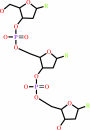
DNA(n) + a 2'-deoxyribonucleoside 5'-triphosphate = DNA(n+1) + diphosphate
|
|
|
|
|
|
 DNA(n)
|
+
|
2'-deoxyribonucleoside 5'-triphosphate
|
=
|
DNA(n+1)
|
+
|
 diphosphate
|
|
|
|
|
|
|
|
|
|
|
|
|
Molecule diagrams generated from .mol files obtained from the
KEGG ftp site
|
|
|
|
|
|
|
|
|
|
|
|
|
|
 |
|
|
|
|
|
|
| |
|
|
| |
|
DOI no:
|
EMBO J
23:1494-1505
(2004)
|
|
PubMed id:
|
|
|
|
|
|
| |
|
Lesion (in)tolerance reveals insights into DNA replication fidelity.
|
|
E.Freisinger,
A.P.Grollman,
H.Miller,
C.Kisker.
|
|
|
|
|
| |
ABSTRACT
|
|
|
|
| |
|
|
The initial encounter of an unrepaired DNA lesion is likely to be with a
replicative DNA polymerase, and the outcome of this event determines whether an
error-prone or error-free damage avoidance pathway is taken. To understand the
atomic details of this critical encounter, we have determined the crystal
structures of the pol alpha family RB69 DNA polymerase with DNA containing the
two most prevalent, spontaneously generated premutagenic lesions, an abasic site
and 2'-deoxy-7,8-dihydro-8-oxoguanosine (8-oxodG). Identification of the
interactions between these damaged nucleotides and the active site provides
insight into the capacity of the polymerase to incorporate a base opposite the
lesion. A novel open, catalytically inactive conformation of the DNA polymerase
has been identified in the complex with a primed abasic site template. This
structure provides the first molecular characterization of the DNA synthesis
barrier caused by an abasic site and suggests a general mechanism for polymerase
fidelity. In contrast, the structure of the ternary 8-oxodG:dCTP complex is
almost identical to the replicating complex containing unmodified DNA,
explaining the relative ease and fidelity by which this lesion is bypassed.
|
|
|
|
|
|
| |
Selected figure(s)
|
|
|
|
| |
|
|

|
|

|
|
Figure 1.
Figure 1 Oligonucleotide sequences and DNA adducts. (A) The 14
nt primers are identical in all trials and terminated by ddC
(indicated by C^*). Template strands are 18 nt long with a 3'-dG
overhang. X denotes the position of the lesion for
primer/template combinations (1) and (2), and the arrow the
position of dNTP incorporation. (B) Structures of the lesions at
position X in the templates 8-oxodG and tetrahydrofuran (abasic
site model).
|
|
Figure 7.
Figure 7 Influence of Gly 568 on DNA binding to the polymerase
active site. Column (I) shows the event of nucleotide insertion
opposite an unmodified template strand with adenine in the
active site, while column (II) depicts the case of a template
containing an abasic site as in the AP:dG complex. Vertical
arrows specify the strained (red) or the relaxed state (green),
respectively. Diagonal arrows indicate whether the polymerase is
in the closed (red) or open conformation (green). The template
strand is depicted in magenta and the incoming nucleotide in
green. The yellow box indicates the position of Gly 568. (IA)
and (IIA) show the polymerase in the strained state and the open
conformation. Transition into the relaxed state presumably
causes the adenine base of the unmodified template to be pushed
back (IB), while the AP-containing template is unaffected (IIB).
(IC) and (IIC) depict an incoming dNTP bound to the base of the
fingers domains. Transition to the closed and strained
conformation ensures the correct positioning of all residues to
enable the catalytic phosphodiester bond formation (ID). In the
case of AP, a closed and relaxed conformation is feasible (IID).
The missing complementary base causes the dNTP to be held in
place less tightly and phosphodiester bond formation is less
efficient (IIE).
|
|
|
|
|
|
| |
The above figures are
reprinted
from an Open Access publication published by Macmillan Publishers Ltd:
EMBO J
(2004,
23,
1494-1505)
copyright 2004.
|
|
| |
Figures were
selected
by an automated process.
|
|
|
|
|
|
|
|
|
|
|
|
|
|
|
|
 |
 |
 |
|
Literature references that cite this PDB file's key reference
|
|
|
| |
PubMed id
|
|
Reference
|
|
|
|
|
|
B.Knobloch,
A.Mucha,
B.P.Operschall,
H.Sigel,
M.Jeżowska-Bojczuk,
H.Kozłowski,
and
R.K.Sigel
(2011).
Stability and structure of mixed-ligand metal ion complexes that contain Ni2+, Cu2+, or Zn2+, and Histamine, as well as adenosine 5'-triphosphate (ATP4-) or uridine 5'-triphosphate (UTP(4-): an intricate network of equilibria.
|
| |
Chemistry,
17,
5393-5403.
|
|
|
|
|
|
|
C.J.Hansen,
L.Wu,
J.D.Fox,
B.Arezi,
and
H.H.Hogrefe
(2011).
Engineered split in Pfu DNA polymerase fingers domain improves incorporation of nucleotide gamma-phosphate derivative.
|
| |
Nucleic Acids Res,
39,
1801-1810.
|
|
|
|
|
|
|
J.Beckman,
M.Wang,
G.Blaha,
J.Wang,
and
W.H.Konigsberg
(2010).
Substitution of Ala for Tyr567 in RB69 DNA polymerase allows dAMP to be inserted opposite 7,8-dihydro-8-oxoguanine .
|
| |
Biochemistry,
49,
4116-4125.
|
|
|
PDB codes:
|
|
|
|
|
|
|
|
M.Hogg,
J.Rudnicki,
J.Midkiff,
L.Reha-Krantz,
S.Doublié,
and
S.S.Wallace
(2010).
Kinetics of mismatch formation opposite lesions by the replicative DNA polymerase from bacteriophage RB69.
|
| |
Biochemistry,
49,
2317-2325.
|
|
|
PDB code:
|
|
|
|
|
|
|
|
P.Aller,
Y.Ye,
S.S.Wallace,
C.J.Burrows,
and
S.Doublié
(2010).
Crystal structure of a replicative DNA polymerase bound to the oxidized guanine lesion guanidinohydantoin.
|
| |
Biochemistry,
49,
2502-2509.
|
|
|
PDB code:
|
|
|
|
|
|
|
|
S.Obeid,
N.Blatter,
R.Kranaster,
A.Schnur,
K.Diederichs,
W.Welte,
and
A.Marx
(2010).
Replication through an abasic DNA lesion: structural basis for adenine selectivity.
|
| |
EMBO J,
29,
1738-1747.
|
|
|
PDB codes:
|
|
|
|
|
|
|
|
T.D.Silverstein,
R.Jain,
R.E.Johnson,
L.Prakash,
S.Prakash,
and
A.K.Aggarwal
(2010).
Structural basis for error-free replication of oxidatively damaged DNA by yeast DNA polymerase η.
|
| |
Structure,
18,
1463-1470.
|
|
|
PDB codes:
|
|
|
|
|
|
|
|
F.Wang,
and
W.Yang
(2009).
Structural insight into translesion synthesis by DNA Pol II.
|
| |
Cell,
139,
1279-1289.
|
|
|
PDB codes:
|
|
|
|
|
|
|
|
G.E.Damsma,
and
P.Cramer
(2009).
Molecular basis of transcriptional mutagenesis at 8-oxoguanine.
|
| |
J Biol Chem,
284,
31658-31663.
|
|
|
PDB codes:
|
|
|
|
|
|
|
|
M.Wang,
H.R.Lee,
and
W.Konigsberg
(2009).
Effect of A and B metal ion site occupancy on conformational changes in an RB69 DNA polymerase ternary complex.
|
| |
Biochemistry,
48,
2075-2086.
|
|
|
|
|
|
|
O.Rechkoblit,
L.Malinina,
Y.Cheng,
N.E.Geacintov,
S.Broyde,
and
D.J.Patel
(2009).
Impact of conformational heterogeneity of OxoG lesions and their pairing partners on bypass fidelity by Y family polymerases.
|
| |
Structure,
17,
725-736.
|
|
|
PDB codes:
|
|
|
|
|
|
|
|
R.L.Eoff,
R.Sanchez-Ponce,
and
F.P.Guengerich
(2009).
Conformational Changes during Nucleotide Selection by Sulfolobus solfataricus DNA Polymerase Dpo4.
|
| |
J Biol Chem,
284,
21090-21099.
|
|
|
|
|
|
|
R.Vasquez-Del Carpio,
T.D.Silverstein,
S.Lone,
M.K.Swan,
J.R.Choudhury,
R.E.Johnson,
S.Prakash,
L.Prakash,
and
A.K.Aggarwal
(2009).
Structure of human DNA polymerase kappa inserting dATP opposite an 8-OxoG DNA lesion.
|
| |
PLoS One,
4,
e5766.
|
|
|
PDB codes:
|
|
|
|
|
|
|
|
S.D.McCulloch,
R.J.Kokoska,
P.Garg,
P.M.Burgers,
and
T.A.Kunkel
(2009).
The efficiency and fidelity of 8-oxo-guanine bypass by DNA polymerases delta and eta.
|
| |
Nucleic Acids Res,
37,
2830-2840.
|
|
|
|
|
|
|
S.M.Sherrer,
J.A.Brown,
L.R.Pack,
V.P.Jasti,
J.D.Fowler,
A.K.Basu,
and
Z.Suo
(2009).
Mechanistic Studies of the Bypass of a Bulky Single-base Lesion Catalyzed by a Y-family DNA Polymerase.
|
| |
J Biol Chem,
284,
6379-6388.
|
|
|
|
|
|
|
S.Schneider,
S.Schorr,
and
T.Carell
(2009).
Crystal structure analysis of DNA lesion repair and tolerance mechanisms.
|
| |
Curr Opin Struct Biol,
19,
87-95.
|
|
|
|
|
|
|
W.A.Beard,
D.D.Shock,
V.K.Batra,
L.C.Pedersen,
and
S.H.Wilson
(2009).
DNA polymerase beta substrate specificity: side chain modulation of the "A-rule".
|
| |
J Biol Chem,
284,
31680-31689.
|
|
|
PDB codes:
|
|
|
|
|
|
|
|
A.Mucha,
B.Knobloch,
M.Jezowska-Bojczuk,
H.Kozłowski,
and
R.K.Sigel
(2008).
Effect of the ribose versus 2'-deoxyribose residue on the metal ion-binding properties of purine nucleotides.
|
| |
Dalton Trans,
(),
5368-5377.
|
|
|
|
|
|
|
A.Sheriff,
E.Motea,
I.Lee,
and
A.J.Berdis
(2008).
Mechanism and dynamics of translesion DNA synthesis catalyzed by the Escherichia coli Klenow fragment.
|
| |
Biochemistry,
47,
8527-8537.
|
|
|
|
|
|
|
V.K.Batra,
W.A.Beard,
D.D.Shock,
L.C.Pedersen,
and
S.H.Wilson
(2008).
Structures of DNA polymerase beta with active-site mismatches suggest a transient abasic site intermediate during misincorporation.
|
| |
Mol Cell,
30,
315-324.
|
|
|
PDB codes:
|
|
|
|
|
|
|
|
X.Zhong,
L.C.Pedersen,
and
T.A.Kunkel
(2008).
Characterization of a replicative DNA polymerase mutant with reduced fidelity and increased translesion synthesis capacity.
|
| |
Nucleic Acids Res,
36,
3892-3904.
|
|
|
PDB code:
|
|
|
|
|
|
|
|
A.J.Berdis,
and
D.McCutcheon
(2007).
The use of non-natural nucleotides to probe template-independent DNA synthesis.
|
| |
Chembiochem,
8,
1399-1408.
|
|
|
|
|
|
|
A.J.Berman,
S.Kamtekar,
J.L.Goodman,
J.M.Lázaro,
M.de Vega,
L.Blanco,
M.Salas,
and
T.A.Steitz
(2007).
Structures of phi29 DNA polymerase complexed with substrate: the mechanism of translocation in B-family polymerases.
|
| |
EMBO J,
26,
3494-3505.
|
|
|
PDB codes:
|
|
|
|
|
|
|
|
A.P.Silverman,
Q.Jiang,
M.F.Goodman,
and
E.T.Kool
(2007).
Steric and electrostatic effects in DNA synthesis by the SOS-induced DNA polymerases II and IV of Escherichia coli.
|
| |
Biochemistry,
46,
13874-13881.
|
|
|
|
|
|
|
E.Fidalgo da Silva,
and
L.J.Reha-Krantz
(2007).
DNA polymerase proofreading: active site switching catalyzed by the bacteriophage T4 DNA polymerase.
|
| |
Nucleic Acids Res,
35,
5452-5463.
|
|
|
|
|
|
|
H.Zhang,
W.Cao,
E.Zakharova,
W.Konigsberg,
and
E.M.De La Cruz
(2007).
Fluorescence of 2-aminopurine reveals rapid conformational changes in the RB69 DNA polymerase-primer/template complexes upon binding and incorporation of matched deoxynucleoside triphosphates.
|
| |
Nucleic Acids Res,
35,
6052-6062.
|
|
|
|
|
|
|
M.Hogg,
P.Aller,
W.Konigsberg,
S.S.Wallace,
and
S.Doublié
(2007).
Structural and biochemical investigation of the role in proofreading of a beta hairpin loop found in the exonuclease domain of a replicative DNA polymerase of the B family.
|
| |
J Biol Chem,
282,
1432-1444.
|
|
|
PDB code:
|
|
|
|
|
|
|
|
M.de Vega,
and
M.Salas
(2007).
A highly conserved Tyrosine residue of family B DNA polymerases contributes to dictate translesion synthesis past 8-oxo-7,8-dihydro-2'-deoxyguanosine.
|
| |
Nucleic Acids Res,
35,
5096-5107.
|
|
|
|
|
|
|
R.L.Eoff,
A.Irimia,
K.C.Angel,
M.Egli,
and
F.P.Guengerich
(2007).
Hydrogen bonding of 7,8-dihydro-8-oxodeoxyguanosine with a charged residue in the little finger domain determines miscoding events in Sulfolobus solfataricus DNA polymerase Dpo4.
|
| |
J Biol Chem,
282,
19831-19843.
|
|
|
PDB codes:
|
|
|
|
|
|
|
|
Y.Wang,
S.Reddy,
W.A.Beard,
S.H.Wilson,
and
T.Schlick
(2007).
Differing conformational pathways before and after chemistry for insertion of dATP versus dCTP opposite 8-oxoG in DNA polymerase beta.
|
| |
Biophys J,
92,
3063-3070.
|
|
|
|
|
|
|
Y.Wang,
and
T.Schlick
(2007).
Distinct energetics and closing pathways for DNA polymerase beta with 8-oxoG template and different incoming nucleotides.
|
| |
BMC Struct Biol,
7,
7.
|
|
|
|
|
|
|
E.P.Tchesnokov,
C.Gilbert,
G.Boivin,
and
M.Götte
(2006).
Role of helix P of the human cytomegalovirus DNA polymerase in resistance and hypersusceptibility to the antiviral drug foscarnet.
|
| |
J Virol,
80,
1440-1450.
|
|
|
|
|
|
|
H.Zang,
A.Irimia,
J.Y.Choi,
K.C.Angel,
L.V.Loukachevitch,
M.Egli,
and
F.P.Guengerich
(2006).
Efficient and high fidelity incorporation of dCTP opposite 7,8-dihydro-8-oxodeoxyguanosine by Sulfolobus solfataricus DNA polymerase Dpo4.
|
| |
J Biol Chem,
281,
2358-2372.
|
|
|
PDB codes:
|
|
|
|
|
|
|
|
L.V.Gening,
S.A.Klincheva,
A.Reshetnjak,
A.P.Grollman,
and
H.Miller
(2006).
RNA aptamers selected against DNA polymerase beta inhibit the polymerase activities of DNA polymerases beta and kappa.
|
| |
Nucleic Acids Res,
34,
2579-2586.
|
|
|
|
|
|
|
M.A.Kalam,
K.Haraguchi,
S.Chandani,
E.L.Loechler,
M.Moriya,
M.M.Greenberg,
and
A.K.Basu
(2006).
Genetic effects of oxidative DNA damages: comparative mutagenesis of the imidazole ring-opened formamidopyrimidines (Fapy lesions) and 8-oxo-purines in simian kidney cells.
|
| |
Nucleic Acids Res,
34,
2305-2315.
|
|
|
|
|
|
|
M.Garcia-Diaz,
and
T.A.Kunkel
(2006).
Mechanism of a genetic glissando: structural biology of indel mutations.
|
| |
Trends Biochem Sci,
31,
206-214.
|
|
|
|
|
|
|
M.Hogg,
W.Cooper,
L.Reha-Krantz,
and
S.S.Wallace
(2006).
Kinetics of error generation in homologous B-family DNA polymerases.
|
| |
Nucleic Acids Res,
34,
2528-2535.
|
|
|
|
|
|
|
O.Rechkoblit,
L.Malinina,
Y.Cheng,
V.Kuryavyi,
S.Broyde,
N.E.Geacintov,
and
D.J.Patel
(2006).
Stepwise translocation of Dpo4 polymerase during error-free bypass of an oxoG lesion.
|
| |
PLoS Biol,
4,
e11.
|
|
|
PDB codes:
|
|
|
|
|
|
|
|
R.Shi,
A.Azzi,
C.Gilbert,
G.Boivin,
and
S.X.Lin
(2006).
Three-dimensional modeling of cytomegalovirus DNA polymerase and preliminary analysis of drug resistance.
|
| |
Proteins,
64,
301-307.
|
|
|
|
|
|
|
S.D.McCulloch,
and
T.A.Kunkel
(2006).
Multiple solutions to inefficient lesion bypass by T7 DNA polymerase.
|
| |
DNA Repair (Amst),
5,
1373-1383.
|
|
|
|
|
|
|
A.A.Ishchenko,
X.Yang,
D.Ramotar,
and
M.Saparbaev
(2005).
The 3'->5' exonuclease of Apn1 provides an alternative pathway to repair 7,8-dihydro-8-oxodeoxyguanosine in Saccharomyces cerevisiae.
|
| |
Mol Cell Biol,
25,
6380-6390.
|
|
|
|
|
|
|
K.D.Carlson,
and
M.T.Washington
(2005).
Mechanism of efficient and accurate nucleotide incorporation opposite 7,8-dihydro-8-oxoguanine by Saccharomyces cerevisiae DNA polymerase eta.
|
| |
Mol Cell Biol,
25,
2169-2176.
|
|
|
|
|
|
|
L.G.Brieba,
R.J.Kokoska,
K.Bebenek,
T.A.Kunkel,
and
T.Ellenberger
(2005).
A lysine residue in the fingers subdomain of T7 DNA polymerase modulates the miscoding potential of 8-oxo-7,8-dihydroguanosine.
|
| |
Structure,
13,
1653-1659.
|
|
|
PDB code:
|
|
|
|
|
|
|
|
W.A.Beard,
and
S.H.Wilson
(2005).
Syn-full behavior by T7 DNA polymerase.
|
| |
Structure,
13,
1580-1582.
|
|
|
|
|
|
|
G.W.Hsu,
J.R.Kiefer,
D.Burnouf,
O.J.Becherel,
R.P.Fuchs,
and
L.S.Beese
(2004).
Observing translesion synthesis of an aromatic amine DNA adduct by a high-fidelity DNA polymerase.
|
| |
J Biol Chem,
279,
50280-50285.
|
|
|
PDB codes:
|
|
|
|
|
|
|
|
G.W.Hsu,
M.Ober,
T.Carell,
and
L.S.Beese
(2004).
Error-prone replication of oxidatively damaged DNA by a high-fidelity DNA polymerase.
|
| |
Nature,
431,
217-221.
|
|
|
PDB codes:
|
|
|
|
|
|
|
|
L.G.Brieba,
B.F.Eichman,
R.J.Kokoska,
S.Doublié,
T.A.Kunkel,
and
T.Ellenberger
(2004).
Structural basis for the dual coding potential of 8-oxoguanosine by a high-fidelity DNA polymerase.
|
| |
EMBO J,
23,
3452-3461.
|
|
|
PDB codes:
|
|
|
|
|
|
|
The most recent references are shown first.
Citation data come partly from CiteXplore and partly
from an automated harvesting procedure. Note that this is likely to be
only a partial list as not all journals are covered by
either method. However, we are continually building up the citation data
so more and more references will be included with time.
Where a reference describes a PDB structure, the PDB
codes are
shown on the right.
|
|


 Links
Links


