 |
PDBsum entry 3gil

|
|
|
|
|
|

|

|

|

|
|

|
|

|
|

|
|

|
|

|
|

|
|

|
|

|
|
|
 |

|

|
|
|
|
|
|
|
|
|
|
|
|
|
|
|
|
|
|
|
|
|
|
|
|
|
|
|
|
|
|
|
|
|
|
|
|
|
Transferase/DNA
|
PDB id
|
|
|
|
3gil
|
|
|
|
|
|
|
|
|
|
|
|
|
|
|

|

|

|
|
|
|
|
|
|
|
 |
Contents |
 |
|
|
|
|
|
|
|
|
|
|
|
|
|
|
|
|
* Residue conservation analysis
|
|
|
|
|
|
|
|
|
|
|
Enzyme class:
|
|
E.C.2.7.7.7
- DNA-directed Dna polymerase.
|
|
|
|
|
|
|
Reaction:
|
|
DNA(n) + a 2'-deoxyribonucleoside 5'-triphosphate = DNA(n+1) + diphosphate
|
|
|
|
|
|
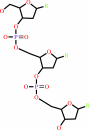 DNA(n)
|
+
|
2'-deoxyribonucleoside 5'-triphosphate
|
=
|
DNA(n+1)
|
+
|
 diphosphate
|
|
|
|
|
|
|
|
|
|
|
|
|
Molecule diagrams generated from .mol files obtained from the
KEGG ftp site
|
|
|
|
|
|
|
|
|
|
|
|
|
|
 |
|
|
|
|
|
|
| |
|
|
| |
|
|
Structure
17:725-736
(2009)
|
|
PubMed id:
|
|
|
|
|
|
| |
|
Impact of conformational heterogeneity of OxoG lesions and their pairing partners on bypass fidelity by Y family polymerases.
|
|
O.Rechkoblit,
L.Malinina,
Y.Cheng,
N.E.Geacintov,
S.Broyde,
D.J.Patel.
|
|
|
|
|
| |
ABSTRACT
|
|
|
|
| |
|
|
7,8-Dihydro-8-oxoguanine (oxoG), the predominant oxidative DNA damage lesion, is
processed differently by high-fidelity and Y-family lesion bypass polymerases.
Although high-fidelity polymerases extend predominantly from an A base opposite
an oxoG, the Y-family polymerases Dpo4 and human Pol eta preferentially extend
from the oxoG*C base pair. We have determined crystal structures of extension
Dpo4 ternary complexes with oxoG opposite C, A, G, or T and the next nascent
base pair. We demonstrate that neither template backbone nor the architecture of
the active site is perturbed by the oxoG(anti)*C and oxoG*A pairs. However, the
latter manifest conformational heterogeneity, adopting both oxoG(syn)*A(anti)
and oxoG(anti)*A(syn) alignment. Hence, the observed reduced primer extension
from the dynamically flexible 3'-terminal primer base A is explained. Because of
homology between Dpo4 and Pol eta, such a dynamic screening mechanism might be
utilized by Dpo4 and Pol eta to regulate error-free versus error-prone bypass of
oxoG and other lesions.
|
|
|
|
|
|
|
|
|
|
|
|
|
|
|
|
|
|
 |
 |
 |
|


 Links
Links


