Beta-lactamase (Class B1)
The L1 metallo-beta-lactamase from Stenotrophomonas maltophilia is unique among beta-lactamases in that it is tetrameric. S. maltophilia has emerged as a significant hospital-derived pathogen of immunocompromised hosts such as cancer, cystic fibrosis and transplant patients. L1 is localised to the periplasm and hydrolyses carbapenem drugs, conferring antibiotic resistance.
L1 is a Class B1 metallo-beta-lactamases as it binds two Zn(II) ions for the hydrolytic reaction, but its Zn2 binding site is different to most B1 type enzymes (it is also known as an L1 type 3 beta-lactamse).
Reference Protein and Structure
- Sequence
-
P52700
 (3.5.2.6)
 (Sequence Homologues)
(PDB Homologues)
(Sequence Homologues)
(PDB Homologues)
- Biological species
-
Stenotrophomonas maltophilia (Bacteria)
- PDB
-
1sml
- METALLO BETA LACTAMASE L1 FROM STENOTROPHOMONAS MALTOPHILIA
(1.7 Å)



- Catalytic CATH Domains
-
3.60.15.10
 (see all for 1sml)
- Cofactors
- Zinc(2+) (2) Metal MACiE
Enzyme Reaction (EC:3.5.2.6)




Enzyme Mechanism
Introduction
In this mechanism, the Zn1 polarises the substrate carbonyl to activate the group as an electrophile. A hydroxide ion bridges the zinc ions. This is nucleophilic and attacks the substrate carbonyl. The tetrahedral transition state is stabilised by Zn1, a helix dipole and Tyr 191. The substrate ring amide is cleaved, with the nitrogen leaving as an anion, stabilised by Zn2 acting as a superacid. The other end of the amide is a carboxylic acid. Finally, a water molecule, acidified by the zinc ions, protonates the nitroanion. The resulting hydroxide can be nucleophilic in the next catalytic cycle.
Catalytic Residues Roles
| UniProt | PDB* (1sml) | ||
| Tyr212 | Tyr191A | Part of the oxyanion hole that stabilises the negatively charged transition state. | hydrogen bond donor, electrostatic stabiliser |
| His105, His181, His107 | His84A, His160A, His86A | Binds one of the catalytic zinc ions | metal ligand |
| Asp109, His110, His246 | Asp88A, His89A, His225A | Binds one of the catalytic zinc ions. | metal ligand |
Chemical Components
bimolecular nucleophilic substitution, overall reactant used, decyclisation, intermediate formation, proton transfer, overall product formed, intermediate terminatedReferences
- Xu D et al. (2007), J Am Chem Soc, 129, 10814-10822. Antibiotic Deactivation by a Dizinc β-Lactamase: Mechanistic Insights from QM/MM and DFT Studies. DOI:10.1021/ja072532m. PMID:17691780.
- Ullah JH et al. (1998), J Mol Biol, 284, 125-136. The crystal structure of the L1 metallo-β-lactamase from Stenotrophomonas maltophilia at 1.7 å resolution. DOI:10.1006/jmbi.1998.2148. PMID:9811546.
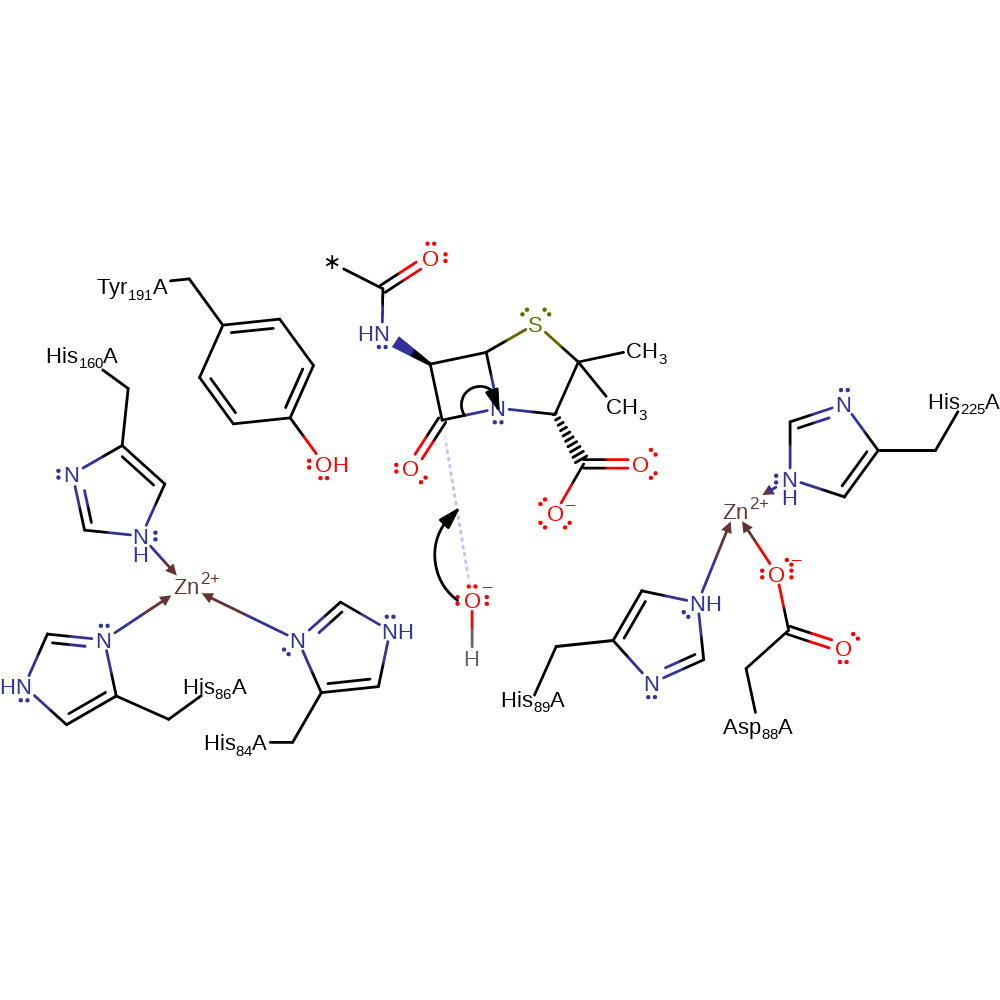
Step 1. Zinc activated water initiates a nucleophilic attack on the carbonyl of the beta-lactam ring, forming a tetrahedral transition state that is stabilised by Tyr191, before collapsing back to break the C-N bond.
Download: Image, Marvin FileCatalytic Residues Roles
| Residue | Roles |
|---|---|
| Tyr191A | hydrogen bond donor, electrostatic stabiliser |
| His84A | metal ligand |
| His86A | metal ligand |
| Asp88A | metal ligand |
| His89A | metal ligand |
| His160A | metal ligand |
| His225A | metal ligand |
Chemical Components
ingold: bimolecular nucleophilic substitution, overall reactant used, decyclisation, intermediate formation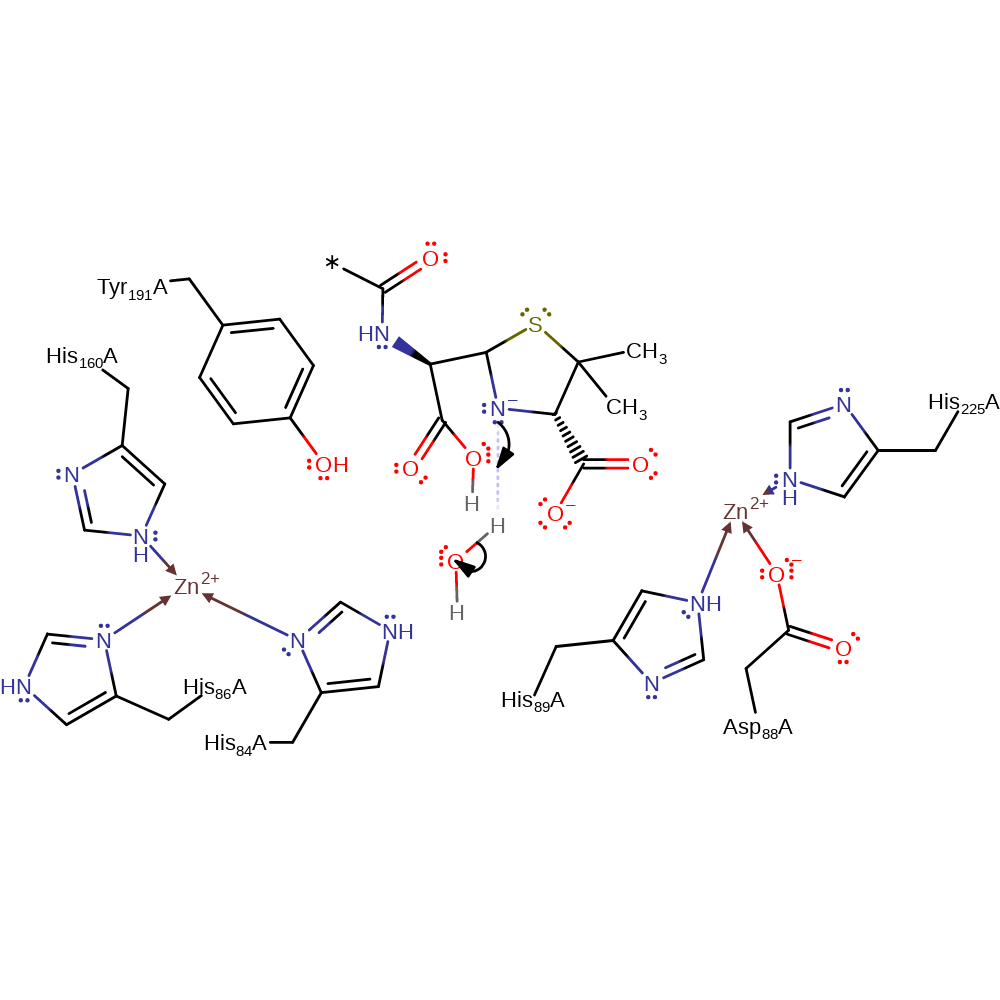
Step 2. The negatively charged nitrogen group deprotonates an incoming water molecule.
Download: Image, Marvin FileCatalytic Residues Roles
| Residue | Roles |
|---|---|
| His84A | metal ligand |
| His86A | metal ligand |
| Asp88A | metal ligand |
| His89A | metal ligand |
| His160A | metal ligand |
| His225A | metal ligand |
| Tyr191A | electrostatic stabiliser |
Chemical Components
proton transfer, overall reactant used, overall product formed, intermediate terminated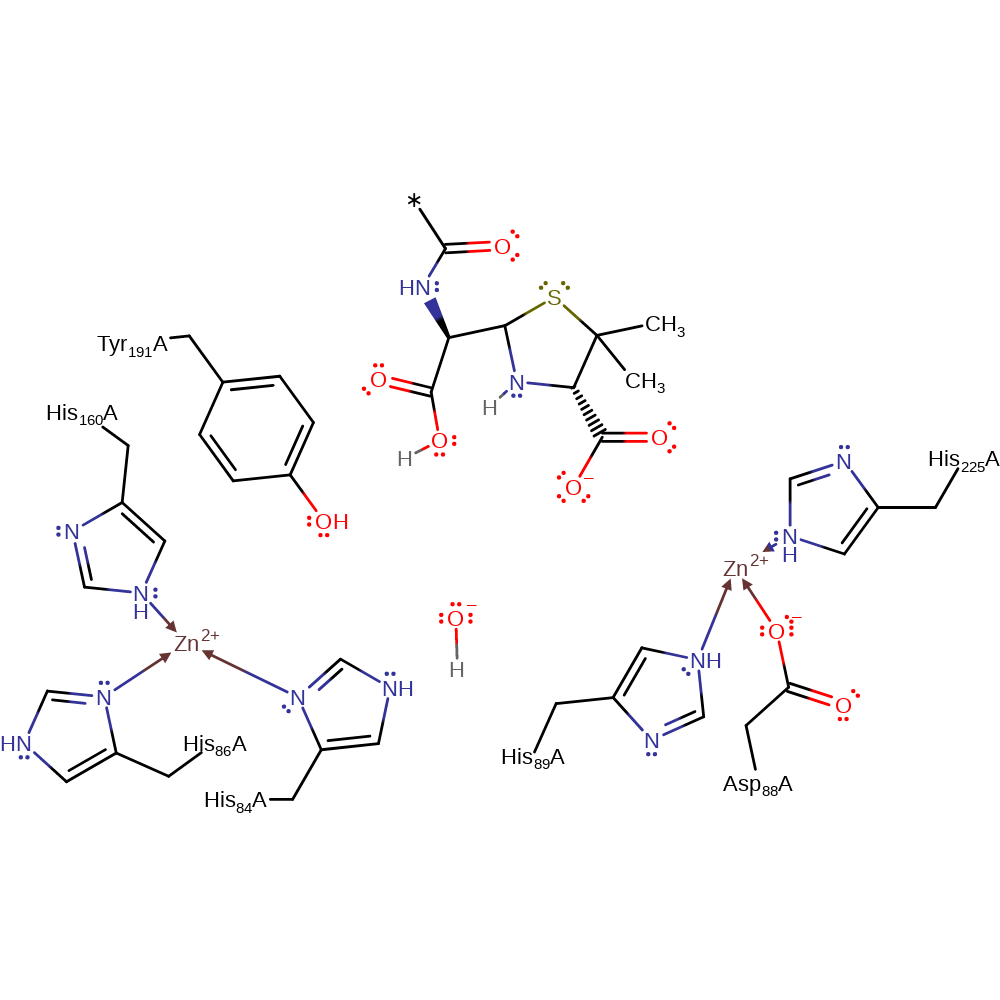 Download:
 Introduction
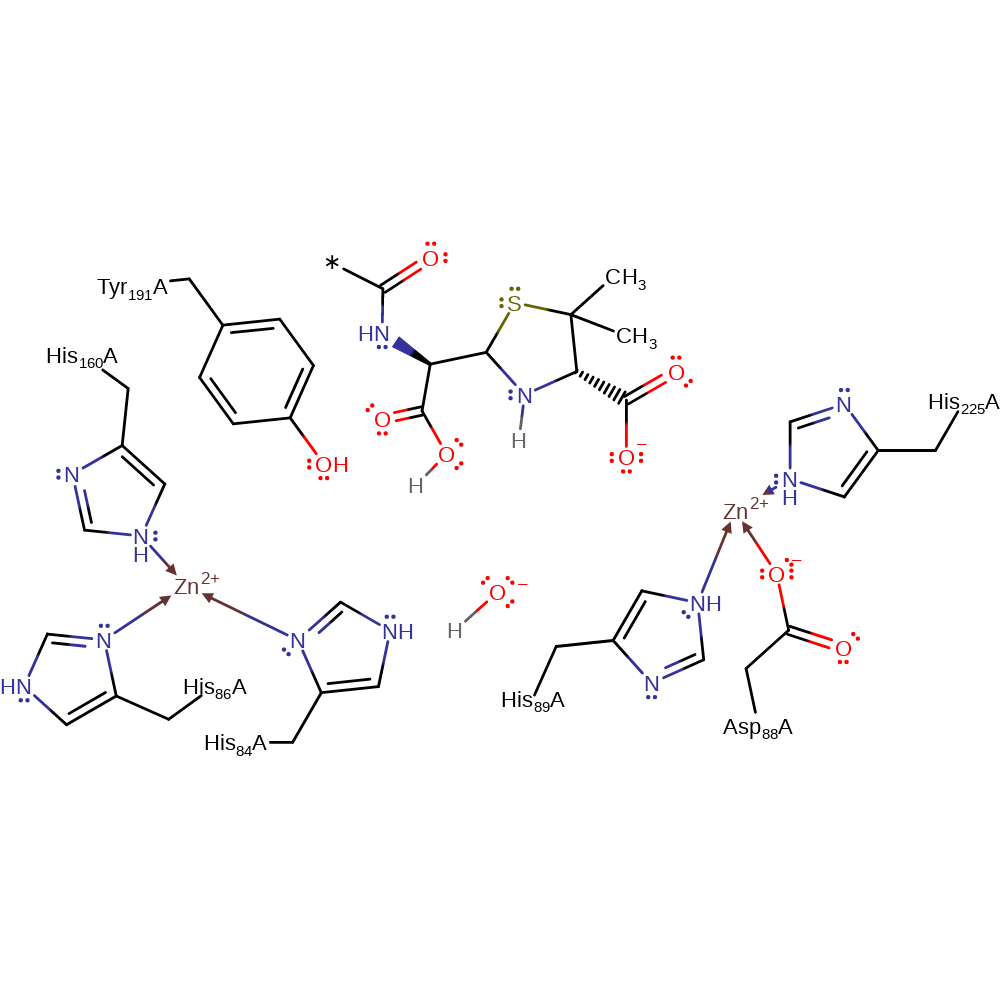
In this mechanism, the Zn1 polarises the substrate carbonyl to activate the group as an electrophile. A hydroxide ion bridges the zinc ions. This is nucleophilic and attacks the substrate carbonyl forming a tetrahedral intermediate that is stabilised by Zn1, a helix dipole and Tyr 191. The intermediate collapses and the substrate ring amide is cleaved, with the nitrogen leaving as an anion and reprotonating from a water molecule, acidified by the zinc ions. The resulting hydroxide can be nucleophilic in the next catalytic cycle.
Catalytic Residues Roles
| UniProt | PDB* (1sml) | ||
| Tyr212 | Tyr191A | Tyr 191 is part of the oxyanion hole, stabilising the tetrahedral transition state. This may be directly or via a water molecule. | hydrogen bond donor, electrostatic stabiliser |
| His105, His181, His107, Asp109, His110, His246 | His84A, His160A, His86A, Asp88A, His89A, His225A | Binds one of the catalytic zinc ions. | metal ligand |
Chemical Components
bimolecular nucleophilic substitution, overall reactant used, decyclisation, intermediate formation, proton transfer, overall product formed, intermediate terminatedReferences
- Xu D et al. (2007), J Am Chem Soc, 129, 10814-10822. Antibiotic Deactivation by a Dizinc β-Lactamase: Mechanistic Insights from QM/MM and DFT Studies. DOI:10.1021/ja072532m. PMID:17691780.
- Wang Z et al. (1999), Biochemistry, 38, 10013-10023. On the Mechanism of the Metallo-β-lactamase fromBacteroides fragilis†. DOI:10.1021/bi990356r. PMID:10433708.
- Ullah JH et al. (1998), J Mol Biol, 284, 125-136. The crystal structure of the L1 metallo-β-lactamase from Stenotrophomonas maltophilia at 1.7 å resolution. DOI:10.1006/jmbi.1998.2148. PMID:9811546.
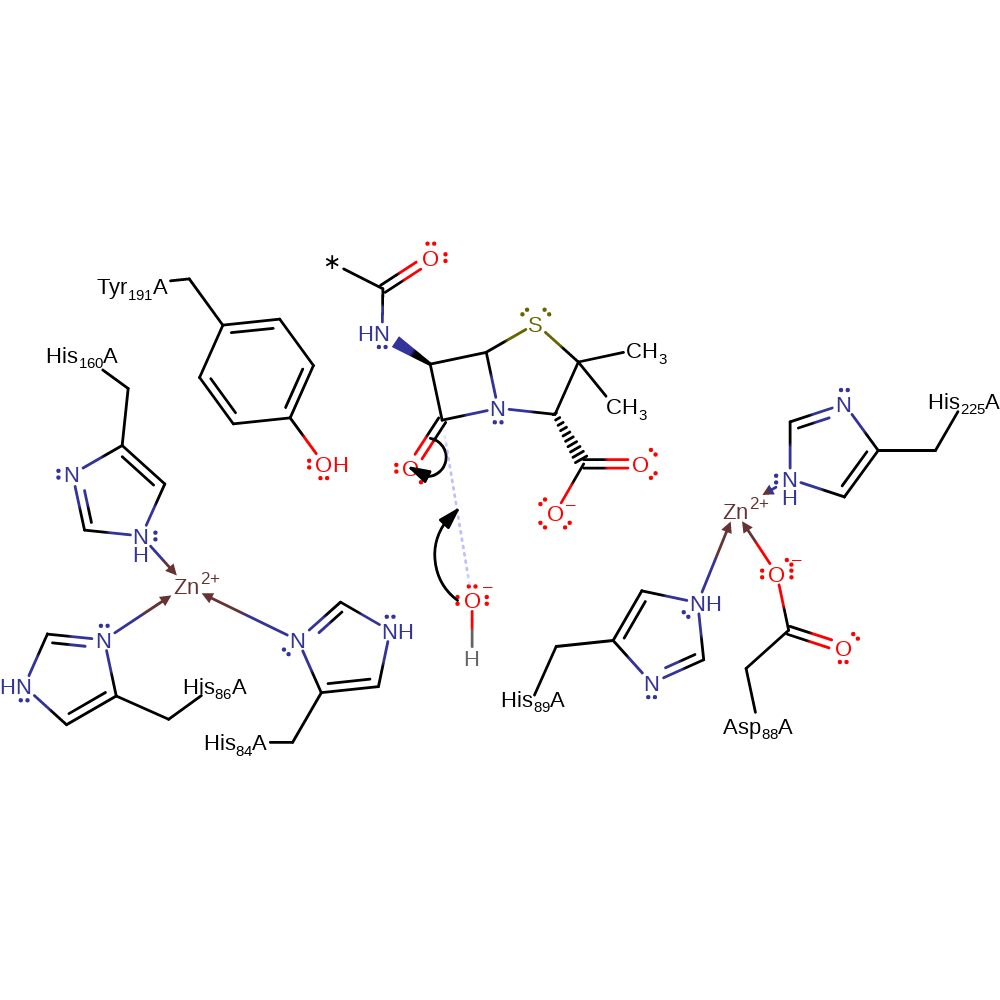
Step 1. Zinc activated water initiates a nucleophilic attack on the carbonyl of the beta-lactam ring, forming a tetrahedral intermediate that is stabilised by Tyr191.
Download: Image, Marvin FileCatalytic Residues Roles
| Residue | Roles |
|---|---|
| Tyr191A | hydrogen bond donor, electrostatic stabiliser |
| His84A | metal ligand |
| His86A | metal ligand |
| Asp88A | metal ligand |
| His89A | metal ligand |
| His160A | metal ligand |
| His225A | metal ligand |
Chemical Components
ingold: bimolecular nucleophilic substitution, overall reactant used, decyclisation, intermediate formation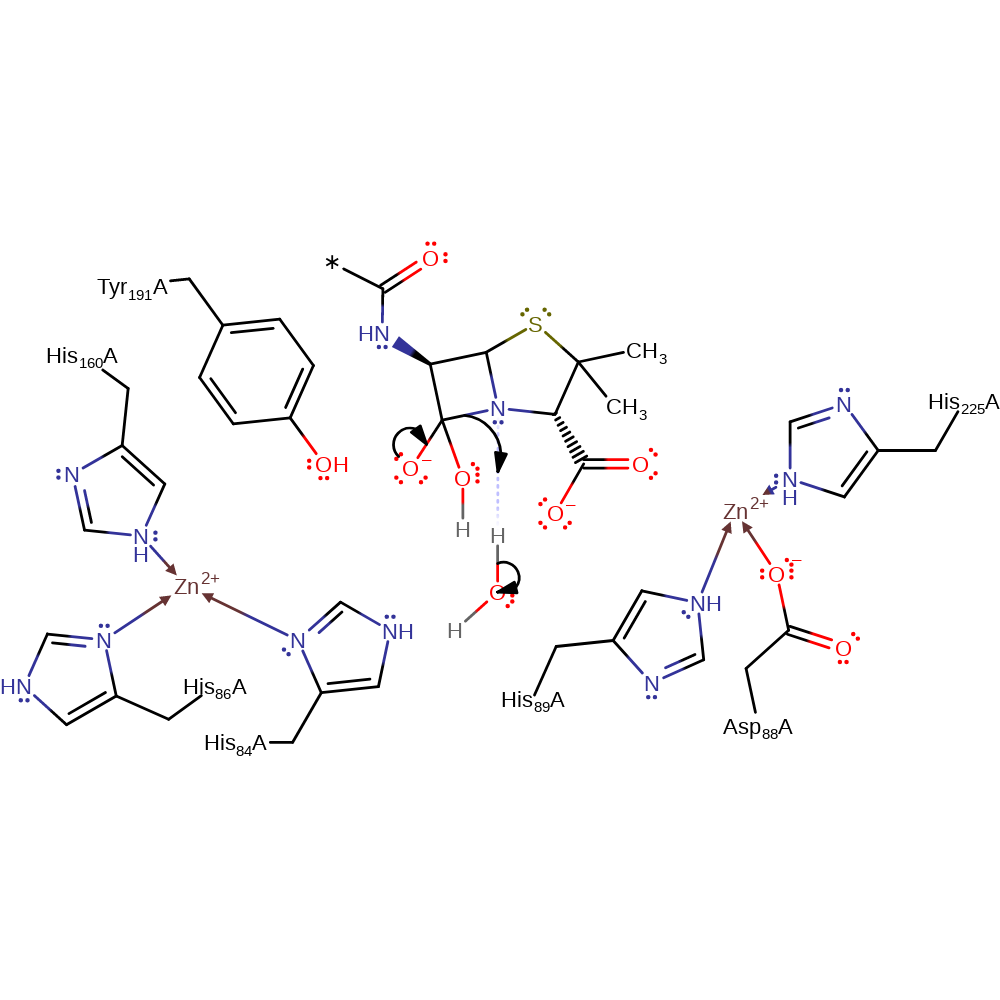
Step 2. The tetrahedral intermediate then collapses and the nitrogen group then deprotonates an incoming water molecule.
Download: Image, Marvin FileCatalytic Residues Roles
| Residue | Roles |
|---|---|
| Tyr191A | electrostatic stabiliser |
| His84A | metal ligand |
| His86A | metal ligand |
| Asp88A | metal ligand |
| His89A | metal ligand |
| His160A | metal ligand |
| His225A | metal ligand |
 Download: