 |
PDBsum entry 2f81

|
|
|
|
|
 |
Contents |
 |
|
|
|
|
|
|
|
|
|
|
|
|
|
|
* Residue conservation analysis
|
|
|
|
|
|
|
|
|
|
|
Enzyme class 1:
|
|
E.C.2.7.7.-
- ?????
|
|
|
|
|
|
|
Enzyme class 2:
|
|
E.C.2.7.7.49
- RNA-directed Dna polymerase.
|
|
|
|
|
|
|
Reaction:
|
|
DNA(n) + a 2'-deoxyribonucleoside 5'-triphosphate = DNA(n+1) + diphosphate
|
|
|
|
|
|
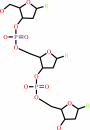 DNA(n)
|
+
|
2'-deoxyribonucleoside 5'-triphosphate
|
=
|
DNA(n+1)
|
+
|
 diphosphate
|
|
|
|
|
|
|
|
|
|
Enzyme class 3:
|
|
E.C.2.7.7.7
- DNA-directed Dna polymerase.
|
|
|
|
|
|
|
Reaction:
|
|
DNA(n) + a 2'-deoxyribonucleoside 5'-triphosphate = DNA(n+1) + diphosphate
|
|
|
|
|
|
DNA(n)
|
+
|
2'-deoxyribonucleoside 5'-triphosphate
|
=
|
DNA(n+1)
|
+
|
diphosphate
|
|
|
|
|
|
|
|
|
|
Enzyme class 4:
|
|
E.C.3.1.-.-
|
|
|
|
|
|
|
Enzyme class 5:
|
|
E.C.3.1.13.2
- exoribonuclease H.
|
|
|
|
|
|
|
Reaction:
|
|
Exonucleolytic cleavage to 5'-phosphomonoester oligonucleotides in both 5'- to 3'- and 3'- to 5'-directions.
|
|
|
|
|
|
Enzyme class 6:
|
|
E.C.3.1.26.13
- retroviral ribonuclease H.
|
|
|
|
|
|
|
Enzyme class 7:
|
|
E.C.3.4.23.16
- HIV-1 retropepsin.
|
|
|
|
|
|
|
Reaction:
|
|
Specific for a P1 residue that is hydrophobic, and P1' variable, but often Pro.
|
|
|
|
|
|
|
|
|
Note, where more than one E.C. class is given (as above), each may
correspond to a different protein domain or, in the case of polyprotein
precursors, to a different mature protein.
|
|
|
|
Molecule diagrams generated from .mol files obtained from the
KEGG ftp site
|
|
|
|
|
|
|
|
|
|
|
|
|
|
 |
|
|
|
|
|
|
| |
|
|
| |
|
DOI no:
|
J Med Chem
49:1379-1387
(2006)
|
|
PubMed id:
|
|
|
|
|
|
| |
|
Effectiveness of nonpeptide clinical inhibitor TMC-114 on HIV-1 protease with highly drug resistant mutations D30N, I50V, and L90M.
|
|
A.Y.Kovalevsky,
Y.Tie,
F.Liu,
P.I.Boross,
Y.F.Wang,
S.Leshchenko,
A.K.Ghosh,
R.W.Harrison,
I.T.Weber.
|
|
|
|
|
| |
ABSTRACT
|
|
|
|
| |
|
|
The potent new antiviral inhibitor TMC-114 (UIC-94017) of HIV-1 protease (PR)
has been studied with three PR variants containing single mutations D30N, I50V,
and L90M, which provide resistance to the major clinical inhibitors. The
inhibition constants (K(i)) of TMC-114 for mutants PR(D30N), PR(I50V), and
PR(L90M) were 30-, 9-, and 0.14-fold, respectively, relative to wild-type PR.
The molecular basis for the inhibition was analyzed using high-resolution
(1.22-1.45 A) crystal structures of PR mutant complexes with TMC-114. In
PR(D30N), the inhibitor has a water-mediated interaction with the side chain of
Asn30 rather than the direct interaction observed in PR, which is consistent
with the relative inhibition. Similarly, in PR(I50V) the inhibitor loses
favorable hydrophobic interactions with the side chain of Val50. TMC-114 has
additional van der Waals contacts in PR(L90M) structure compared to the PR
structure, leading to a tighter binding of the inhibitor. The observed changes
in PR structure and activity are discussed in relation to the potential for
development of resistant mutants on exposure to TMC-114.
|
|
|
|
|
|
|
|
|
|
|
|
|
|
|
|
|
|
 |
 |
 |
|
Literature references that cite this PDB file's key reference
|
|
|
| |
PubMed id
|
|
Reference
|
|
|
|
|
|
A.K.Ghosh,
C.X.Xu,
K.V.Rao,
A.Baldridge,
J.Agniswamy,
Y.F.Wang,
I.T.Weber,
M.Aoki,
S.G.Miguel,
M.Amano,
and
H.Mitsuya
(2010).
Probing multidrug-resistance and protein-ligand interactions with oxatricyclic designed ligands in HIV-1 protease inhibitors.
|
| |
ChemMedChem,
5,
1850-1854.
|
|
|
PDB code:
|
|
|
|
|
|
|
|
C.H.Shen,
Y.F.Wang,
A.Y.Kovalevsky,
R.W.Harrison,
and
I.T.Weber
(2010).
Amprenavir complexes with HIV-1 protease and its drug-resistant mutants altering hydrophobic clusters.
|
| |
FEBS J,
277,
3699-3714.
|
|
|
PDB codes:
|
|
|
|
|
|
|
|
J.Chen,
S.Zhang,
X.Liu,
and
Q.Zhang
(2010).
Insights into drug resistance of mutations D30N and I50V to HIV-1 protease inhibitor TMC-114: free energy calculation and molecular dynamic simulation.
|
| |
J Mol Model,
16,
459-468.
|
|
|
|
|
|
|
J.M.Sayer,
J.Agniswamy,
I.T.Weber,
and
J.M.Louis
(2010).
Autocatalytic maturation, physical/chemical properties, and crystal structure of group N HIV-1 protease: relevance to drug resistance.
|
| |
Protein Sci,
19,
2055-2072.
|
|
|
PDB code:
|
|
|
|
|
|
|
|
R.Ishima,
Q.Gong,
Y.Tie,
I.T.Weber,
and
J.M.Louis
(2010).
Highly conserved glycine 86 and arginine 87 residues contribute differently to the structure and activity of the mature HIV-1 protease.
|
| |
Proteins,
78,
1015-1025.
|
|
|
PDB codes:
|
|
|
|
|
|
|
|
A.J.Kandathil,
A.P.Joseph,
R.Kannangai,
N.Srinivasan,
O.C.Abraham,
S.A.Pulimood,
and
G.Sridharan
(2009).
Structural basis of drug resistance by genetic variants of HIV type 1 clade c protease from India.
|
| |
AIDS Res Hum Retroviruses,
25,
511-519.
|
|
|
|
|
|
|
A.K.Ghosh
(2009).
Harnessing nature's insight: design of aspartyl protease inhibitors from treatment of drug-resistant HIV to Alzheimer's disease.
|
| |
J Med Chem,
52,
2163-2176.
|
|
|
|
|
|
|
A.K.Ghosh,
S.Kulkarni,
D.D.Anderson,
L.Hong,
A.Baldridge,
Y.F.Wang,
A.A.Chumanevich,
A.Y.Kovalevsky,
Y.Tojo,
M.Amano,
Y.Koh,
J.Tang,
I.T.Weber,
and
H.Mitsuya
(2009).
Design, synthesis, protein-ligand X-ray structure, and biological evaluation of a series of novel macrocyclic human immunodeficiency virus-1 protease inhibitors to combat drug resistance.
|
| |
J Med Chem,
52,
7689-7705.
|
|
|
PDB codes:
|
|
|
|
|
|
|
|
D.Das,
Y.Koh,
Y.Tojo,
A.K.Ghosh,
and
H.Mitsuya
(2009).
Prediction of potency of protease inhibitors using free energy simulations with polarizable quantum mechanics-based ligand charges and a hybrid water model.
|
| |
J Chem Inf Model,
49,
2851-2862.
|
|
|
|
|
|
|
K.G.Sasková,
M.Kozísek,
P.Rezácová,
J.Brynda,
T.Yashina,
R.M.Kagan,
and
J.Konvalinka
(2009).
Molecular characterization of clinical isolates of human immunodeficiency virus resistant to the protease inhibitor darunavir.
|
| |
J Virol,
83,
8810-8818.
|
|
|
PDB codes:
|
|
|
|
|
|
|
|
A.Y.Kovalevsky,
A.K.Ghosh,
and
I.T.Weber
(2008).
Solution kinetics measurements suggest HIV-1 protease has two binding sites for darunavir and amprenavir.
|
| |
J Med Chem,
51,
6599-6603.
|
|
|
|
|
|
|
A.Y.Kovalevsky,
J.M.Louis,
A.Aniana,
A.K.Ghosh,
and
I.T.Weber
(2008).
Structural evidence for effectiveness of darunavir and two related antiviral inhibitors against HIV-2 protease.
|
| |
J Mol Biol,
384,
178-192.
|
|
|
PDB codes:
|
|
|
|
|
|
|
|
C.L.Tremblay
(2008).
Combating HIV resistance - focus on darunavir.
|
| |
Ther Clin Risk Manag,
4,
759-766.
|
|
|
|
|
|
|
E.Lefebvre,
and
C.A.Schiffer
(2008).
Resilience to resistance of HIV-1 protease inhibitors: profile of darunavir.
|
| |
AIDS Rev,
10,
131-142.
|
|
|
|
|
|
|
F.Liu,
A.Y.Kovalevsky,
Y.Tie,
A.K.Ghosh,
R.W.Harrison,
and
I.T.Weber
(2008).
Effect of flap mutations on structure of HIV-1 protease and inhibition by saquinavir and darunavir.
|
| |
J Mol Biol,
381,
102-115.
|
|
|
PDB codes:
|
|
|
|
|
|
|
|
X.Chen,
I.Weber,
and
R.W.Harrison
(2008).
Hydration water and bulk water in proteins have distinct properties in radial distributions calculated from 105 atomic resolution crystal structures.
|
| |
J Phys Chem B,
112,
12073-12080.
|
|
|
|
|
|
|
A.Y.Kovalevsky,
A.A.Chumanevich,
F.Liu,
J.M.Louis,
and
I.T.Weber
(2007).
Caught in the Act: the 1.5 A resolution crystal structures of the HIV-1 protease and the I54V mutant reveal a tetrahedral reaction intermediate.
|
| |
Biochemistry,
46,
14854-14864.
|
|
|
PDB codes:
|
|
|
|
|
|
|
|
M.Amano,
Y.Koh,
D.Das,
J.Li,
S.Leschenko,
Y.F.Wang,
P.I.Boross,
I.T.Weber,
A.K.Ghosh,
and
H.Mitsuya
(2007).
A novel bis-tetrahydrofuranylurethane-containing nonpeptidic protease inhibitor (PI), GRL-98065, is potent against multiple-PI-resistant human immunodeficiency virus in vitro.
|
| |
Antimicrob Agents Chemother,
51,
2143-2155.
|
|
|
|
|
|
|
M.Takahashi,
Y.Kudaka,
N.Okumura,
A.Hirano,
K.Banno,
and
T.Kaneda
(2007).
The validation of plasma darunavir concentrations determined by the HPLC method for protease inhibitors.
|
| |
Biol Pharm Bull,
30,
1947-1949.
|
|
|
|
|
|
|
S.A.Seibold,
and
R.I.Cukier
(2007).
A molecular dynamics study comparing a wild-type with a multiple drug resistant HIV protease: differences in flap and aspartate 25 cavity dimensions.
|
| |
Proteins,
69,
551-565.
|
|
|
|
|
|
|
S.Muzammil,
A.A.Armstrong,
L.W.Kang,
A.Jakalian,
P.R.Bonneau,
V.Schmelmer,
L.M.Amzel,
and
E.Freire
(2007).
Unique thermodynamic response of tipranavir to human immunodeficiency virus type 1 protease drug resistance mutations.
|
| |
J Virol,
81,
5144-5154.
|
|
|
PDB codes:
|
|
|
|
|
|
|
|
V.Lafont,
A.A.Armstrong,
H.Ohtaka,
Y.Kiso,
L.Mario Amzel,
and
E.Freire
(2007).
Compensating enthalpic and entropic changes hinder binding affinity optimization.
|
| |
Chem Biol Drug Des,
69,
413-422.
|
|
|
PDB codes:
|
|
|
|
|
|
|
|
Y.F.Wang,
Y.Tie,
P.I.Boross,
J.Tozser,
A.K.Ghosh,
R.W.Harrison,
and
I.T.Weber
(2007).
Potent new antiviral compound shows similar inhibition and structural interactions with drug resistant mutants and wild type HIV-1 protease.
|
| |
J Med Chem,
50,
4509-4515.
|
|
|
PDB codes:
|
|
|
|
|
|
|
|
Y.Koh,
S.Matsumi,
D.Das,
M.Amano,
D.A.Davis,
J.Li,
S.Leschenko,
A.Baldridge,
T.Shioda,
R.Yarchoan,
A.K.Ghosh,
and
H.Mitsuya
(2007).
Potent inhibition of HIV-1 replication by novel non-peptidyl small molecule inhibitors of protease dimerization.
|
| |
J Biol Chem,
282,
28709-28720.
|
|
|
|
|
|
|
Y.Tie,
A.Y.Kovalevsky,
P.Boross,
Y.F.Wang,
A.K.Ghosh,
J.Tozser,
R.W.Harrison,
and
I.T.Weber
(2007).
Atomic resolution crystal structures of HIV-1 protease and mutants V82A and I84V with saquinavir.
|
| |
Proteins,
67,
232-242.
|
|
|
PDB codes:
|
|
|
|
|
|
|
|
A.K.Ghosh,
P.Ramu Sridhar,
N.Kumaragurubaran,
Y.Koh,
I.T.Weber,
and
H.Mitsuya
(2006).
Bis-tetrahydrofuran: a privileged ligand for darunavir and a new generation of hiv protease inhibitors that combat drug resistance.
|
| |
ChemMedChem,
1,
939-950.
|
|
|
|
|
|
|
A.Y.Kovalevsky,
F.Liu,
S.Leshchenko,
A.K.Ghosh,
J.M.Louis,
R.W.Harrison,
and
I.T.Weber
(2006).
Ultra-high resolution crystal structure of HIV-1 protease mutant reveals two binding sites for clinical inhibitor TMC114.
|
| |
J Mol Biol,
363,
161-173.
|
|
|
PDB codes:
|
|
|
|
|
|
|
|
N.S.Gray
(2006).
Drug discovery through industry-academic partnerships.
|
| |
Nat Chem Biol,
2,
649-653.
|
|
|
|
|
|
|
Y.Mitsuya,
M.A.Winters,
W.J.Fessel,
S.Y.Rhee,
L.Hurley,
M.Horberg,
C.A.Schiffer,
A.R.Zolopa,
and
R.W.Shafer
(2006).
N88D facilitates the co-occurrence of D30N and L90M and the development of multidrug resistance in HIV type 1 protease following nelfinavir treatment failure.
|
| |
AIDS Res Hum Retroviruses,
22,
1300-1305.
|
|
|
|
|
|
The most recent references are shown first.
Citation data come partly from CiteXplore and partly
from an automated harvesting procedure. Note that this is likely to be
only a partial list as not all journals are covered by
either method. However, we are continually building up the citation data
so more and more references will be included with time.
Where a reference describes a PDB structure, the PDB
code is
shown on the right.
|
|


 Links
Links


