 |
PDBsum entry 6aoc

|
|
|
|
|
|

|

|

|

|
|

|
|

|
|

|
|

|
|

|
|

|
|
|
 |

|

|
|
|
|
|
|
|
|
|
|
|
|
|
|
|
|
|
|
|
|
|
|
|
|
|
|
|
|
|
|
|
|
|
|
|
Transferase / transferase inhibitor
|
PDB id
|
|
|
|
6aoc
|
|
|
|
|
|
|
|
|
|
|
|
|
|
|

|

|

|
|
|
|
|
|
|
|
|
|
|
Enzyme class 1:
|
|
Chains A, B, C, D:
E.C.2.7.7.-
- ?????
|
|
|
|
|
|
|
Enzyme class 2:
|
|
Chains A, B, C, D:
E.C.2.7.7.49
- RNA-directed Dna polymerase.
|
|
|
|
|
|
|
Reaction:
|
|
DNA(n) + a 2'-deoxyribonucleoside 5'-triphosphate = DNA(n+1) + diphosphate
|
|
|
|
|
|
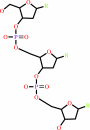 DNA(n)
|
+
|
2'-deoxyribonucleoside 5'-triphosphate
|
=
|
DNA(n+1)
|
+
|
 diphosphate
|
|
|
|
|
|
|
|
|
|
Enzyme class 3:
|
|
Chains A, B, C, D:
E.C.2.7.7.7
- DNA-directed Dna polymerase.
|
|
|
|
|
|
|
Reaction:
|
|
DNA(n) + a 2'-deoxyribonucleoside 5'-triphosphate = DNA(n+1) + diphosphate
|
|
|
|
|
|
DNA(n)
|
+
|
2'-deoxyribonucleoside 5'-triphosphate
|
=
|
DNA(n+1)
|
+
|
diphosphate
|
|
|
|
|
|
|
|
|
|
Enzyme class 4:
|
|
Chains A, B, C, D:
E.C.3.1.-.-
|
|
|
|
|
|
|
Enzyme class 5:
|
|
Chains A, B, C, D:
E.C.3.1.13.2
- exoribonuclease H.
|
|
|
|
|
|
|
Reaction:
|
|
Exonucleolytic cleavage to 5'-phosphomonoester oligonucleotides in both 5'- to 3'- and 3'- to 5'-directions.
|
|
|
|
|
|
Enzyme class 6:
|
|
Chains A, B, C, D:
E.C.3.1.26.13
- retroviral ribonuclease H.
|
|
|
|
|
|
|
Enzyme class 7:
|
|
Chains A, B, C, D:
E.C.3.4.23.16
- HIV-1 retropepsin.
|
|
|
|
|
|
|
Reaction:
|
|
Specific for a P1 residue that is hydrophobic, and P1' variable, but often Pro.
|
|
|
|
|
|
|
|
|
Note, where more than one E.C. class is given (as above), each may
correspond to a different protein domain or, in the case of polyprotein
precursors, to a different mature protein.
|
|
|
|
Molecule diagrams generated from .mol files obtained from the
KEGG ftp site
|
|
|
|
|
|
|
|
|
|
|
|
|
|
 |
|
|
|
|
|
|
| |
|
|
| |
|
|
Eur J Med Chem
141:149-161
(2017)
|
|
PubMed id:
|
|
|
|
|
|
| |
|
Design, synthesis and biological evaluations of N-Hydroxy thienopyrimidine-2,4-diones as inhibitors of HIV reverse transcriptase-associated RNase H.
|
|
J.Kankanala,
K.A.Kirby,
A.D.Huber,
M.C.Casey,
D.J.Wilson,
S.G.Sarafianos,
Z.Wang.
|
|
|
|
|
| |
ABSTRACT
|
|
|
|
| |
|
|
Human immunodeficiency virus (HIV) reverse transcriptase (RT) associated
ribonuclease H (RNase H) is the only HIV enzymatic function not targeted by
current antiviral drugs. Although various chemotypes have been reported to
inhibit HIV RNase H, few have shown significant antiviral activities. We report
herein the design, synthesis and biological evaluation of a novel N-hydroxy
thienopyrimidine-2,3-dione chemotype (11) which potently and selectively
inhibited RNase H with considerable potency against HIV-1 in cell culture.
Current structure-activity-relationship (SAR) identified analogue 11d as a
nanomolar inhibitor of RNase H (IC50 = 0.04 μM) with decent
antiviral potency (EC50 = 7.4 μM) and no cytotoxicity
(CC50 > 100 μM). In extended biochemical assays compound 11d
did not inhibit RT polymerase (pol) while inhibiting integrase strand transfer
(INST) with 53 fold lower potency (IC50 = 2.1 μM) than RNase H
inhibition. Crystallographic and molecular modeling studies confirmed the RNase
H active site binding mode.
|
|
|
|
|
|
|
|
|
|
|
|
|
|
|
|
|
|
 |
 |
 |
|
|


 Links
Links


