 |
PDBsum entry 1q1a

|
|
|
|
|
|

|

|

|

|
|

|
|

|
|

|
|

|
|

|
|

|
|
|
 |

|

|
|
|
|
|
|
|
|
|
|
|
|
|
|
|
|
|
|
|
|
|
|
|
|
|
|
|
|
|
|
|
|
|
|
|
Gene regulation
|
PDB id
|
|
|
|
1q1a
|
|
|
|
|
|
|
|
|
|
|
|
|
|
|

|

|

|
|
|
|
|
|
|
|
 |
Contents |
 |
|
|
|
|
|
|
|
|
|
|
|
|
|
|
* Residue conservation analysis
|
|
|
|
|
|
|
|
|
|
|
Enzyme class:
|
|
E.C.2.3.1.286
- protein acetyllysine N-acetyltransferase.
|
|
|
|
|
|
|
Reaction:
|
|
N6-acetyl-L-lysyl-[protein] + NAD+ + H2O = 2''-O-acetyl-ADP-D-ribose + nicotinamide + L-lysyl-[protein]
|
|
|
|
|
|
N(6)-acetyl-L-lysyl-[protein]
|
+
|
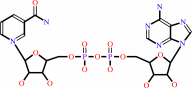 NAD(+)
|
+
|
H2O
Bound ligand (Het Group name = )
matches with 72.92% similarity
|
=
|
2''-O-acetyl-ADP-D-ribose
|
+
|
 nicotinamide
|
+
|
L-lysyl-[protein]
Bound ligand (Het Group name = )
matches with 61.54% similarity
|
|
|
|
|
|
|
|
|
|
|
|
|
Molecule diagrams generated from .mol files obtained from the
KEGG ftp site
|
|
|
|
|
|
|
|
|
|
|
|
|
|
 |
|
|
|
|
|
|
| |
|
|
| |
|
DOI no:
|
Structure
11:1403-1411
(2003)
|
|
PubMed id:
|
|
|
|
|
|
| |
|
Structure of the yeast Hst2 protein deacetylase in ternary complex with 2'-O-acetyl ADP ribose and histone peptide.
|
|
K.Zhao,
X.Chai,
R.Marmorstein.
|
|
|
|
|
| |
ABSTRACT
|
|
|
|
| |
|
|
Sir2 proteins are NAD(+)-dependant protein deactylases that have been implicated
in playing roles in gene silencing, DNA repair, genome stability, longevity,
metabolism, and cell physiology. To define the mechanism of Sir2 activity, we
report the 1.5 A crystal structure of the yeast Hst2 (yHst2) Sir2 protein in
ternary complex with 2'-O-acetyl ADP ribose and an acetylated histone H4
peptide. The structure captures both ligands meeting within an enclosed tunnel
between the small and large domains of the catalytic protein core and permits
the assignment of a detailed catalytic mechanism for the Sir2 proteins that is
consistent with solution and enzymatic studies. Comparison of the ternary
complex with the yHst2/NAD(+) complex, also reported here, and nascent yHst2
structure also reveals that NAD(+) binding accompanies intramolecular loop
rearrangement for more stable NAD(+) and acetyl-lysine binding, and that
acetyl-lysine peptide binding induces a trimer-monomer protein transition
involving nonconserved Sir2 residues.
|
|
|
|
|
|
| |
Selected figure(s)
|
|
|
|
| |
|
|

|
|
Figure 4.
Figure 4. The yHst2-Histone H4 Interface(A) Stereo view of
yHst2-histone H4 interactions within the ternary complex.
Hydrogen bonds are indicated with a dashed line. Residues that
mediate van der Waals interactions are also shown.(B) Summary of
yHst2-histone H4 interactions. Hydrogen bonds are indicated with
a dashed line, and van der Waals interactions are indicated with
a half-moon symbol. For clarity, histone H4 side chains that do
no participate in direct protein-peptide interactions are not
shown. The residues highlighted in cyan and red highlight
interactions with acetly-lysine peptide substrate that are
conserved and nonconserved, respectively, with the
protein-peptide interactions observed in the Af2-Sir2/p53
peptide structure.(C) The p53 peptide (purple) from the
Af2-Sir2/p53 peptide structure and the "pseudosubstrate" from
the nascent yHst2 structure (yellow) are overlayed with the
histone H4 peptide (green) onto a surface representation of
yHst2 from the ternary complex. Protein residues that make
conserved interactions between the three substrates are
indicated in blue, and protein residues that mediate variable
interactions are indicated in red.(D) Backbone overlay of
yHst2/NAD^+ (gray) and nascent yHst2 (cyan) homotrimers with the
yHst2/2'-O-acetyl ADP ribose/histone H4 monomer (red). The
ADP-ribose is highlighted in yellow, the histone H4 peptide is
highlighted in green, and the C-terminal domain of nascent yHst2
is highlighted in purple.
|
|
|
|
|
|
| |
The above figure is
reprinted
by permission from Cell Press:
Structure
(2003,
11,
1403-1411)
copyright 2003.
|
|
| |
Figure was
selected
by an automated process.
|
|
|
|
|
|
|
|
|
|
|
|
|
|
|
|
 |
 |
 |
|
Literature references that cite this PDB file's key reference
|
|
|
| |
PubMed id
|
|
Reference
|
|
|
|
|
|
P.Bheda,
J.T.Wang,
J.C.Escalante-Semerena,
and
C.Wolberger
(2011).
Structure of Sir2Tm bound to a propionylated peptide.
|
| |
Protein Sci,
20,
131-139.
|
|
|
PDB code:
|
|
|
|
|
|
|
|
S.Kaur,
A.V.Shivange,
and
N.Roy
(2010).
Structural analysis of trypanosomal sirtuin: an insight for selective drug design.
|
| |
Mol Divers,
14,
169-178.
|
|
|
|
|
|
|
D.Wang
(2009).
Computational studies on the histone deacetylases and the design of selective histone deacetylase inhibitors.
|
| |
Curr Top Med Chem,
9,
241-256.
|
|
|
|
|
|
|
J.G.Gardner,
and
J.C.Escalante-Semerena
(2009).
In Bacillus subtilis, the sirtuin protein deacetylase, encoded by the srtN gene (formerly yhdZ), and functions encoded by the acuABC genes control the activity of acetyl coenzyme A synthetase.
|
| |
J Bacteriol,
191,
1749-1755.
|
|
|
|
|
|
|
L.Jin,
W.Wei,
Y.Jiang,
H.Peng,
J.Cai,
C.Mao,
H.Dai,
W.Choy,
J.E.Bemis,
M.R.Jirousek,
J.C.Milne,
C.H.Westphal,
and
R.B.Perni
(2009).
Crystal structures of human SIRT3 displaying substrate-induced conformational changes.
|
| |
J Biol Chem,
284,
24394-24405.
|
|
|
PDB codes:
|
|
|
|
|
|
|
|
Z.A.Gurard-Levin,
J.Kim,
and
M.Mrksich
(2009).
Combining mass spectrometry and peptide arrays to profile the specificities of histone deacetylases.
|
| |
Chembiochem,
10,
2159-2161.
|
|
|
|
|
|
|
C.L.Wang,
J.Landry,
and
R.Sternglanz
(2008).
A yeast sir2 mutant temperature sensitive for silencing.
|
| |
Genetics,
180,
1955-1962.
|
|
|
|
|
|
|
J.B.French,
Y.Cen,
and
A.A.Sauve
(2008).
Plasmodium falciparum Sir2 is an NAD+-dependent deacetylase and an acetyllysine-dependent and acetyllysine-independent NAD+ glycohydrolase.
|
| |
Biochemistry,
47,
10227-10239.
|
|
|
|
|
|
|
P.Hu,
S.Wang,
and
Y.Zhang
(2008).
Highly dissociative and concerted mechanism for the nicotinamide cleavage reaction in Sir2Tm enzyme suggested by ab initio QM/MM molecular dynamics simulations.
|
| |
J Am Chem Soc,
130,
16721-16728.
|
|
|
|
|
|
|
S.Lee,
L.Tong,
and
J.M.Denu
(2008).
Quantification of endogenous sirtuin metabolite O-acetyl-ADP-ribose.
|
| |
Anal Biochem,
383,
174-179.
|
|
|
|
|
|
|
W.F.Hawse,
K.G.Hoff,
D.G.Fatkins,
A.Daines,
O.V.Zubkova,
V.L.Schramm,
W.Zheng,
and
C.Wolberger
(2008).
Structural insights into intermediate steps in the Sir2 deacetylation reaction.
|
| |
Structure,
16,
1368-1377.
|
|
|
PDB codes:
|
|
|
|
|
|
|
|
Z.A.Gurard-Levin,
and
M.Mrksich
(2008).
The activity of HDAC8 depends on local and distal sequences of its peptide substrates.
|
| |
Biochemistry,
47,
6242-6250.
|
|
|
|
|
|
|
A.Schuetz,
J.Min,
T.Antoshenko,
C.L.Wang,
A.Allali-Hassani,
A.Dong,
P.Loppnau,
M.Vedadi,
A.Bochkarev,
R.Sternglanz,
and
A.N.Plotnikov
(2007).
Structural basis of inhibition of the human NAD+-dependent deacetylase SIRT5 by suramin.
|
| |
Structure,
15,
377-389.
|
|
|
PDB code:
|
|
|
|
|
|
|
|
B.D.Sanders,
K.Zhao,
J.T.Slama,
and
R.Marmorstein
(2007).
Structural basis for nicotinamide inhibition and base exchange in Sir2 enzymes.
|
| |
Mol Cell,
25,
463-472.
|
|
|
PDB codes:
|
|
|
|
|
|
|
|
C.J.Merrick,
and
M.T.Duraisingh
(2007).
Plasmodium falciparum Sir2: an unusual sirtuin with dual histone deacetylase and ADP-ribosyltransferase activity.
|
| |
Eukaryot Cell,
6,
2081-2091.
|
|
|
|
|
|
|
H.Lin
(2007).
Nicotinamide adenine dinucleotide: beyond a redox coenzyme.
|
| |
Org Biomol Chem,
5,
2541-2554.
|
|
|
|
|
|
|
H.Yang,
J.A.Baur,
A.Chen,
C.Miller,
J.K.Adams,
A.Kisielewski,
K.T.Howitz,
R.E.Zipkin,
and
D.A.Sinclair
(2007).
Design and synthesis of compounds that extend yeast replicative lifespan.
|
| |
Aging Cell,
6,
35-43.
|
|
|
|
|
|
|
J.Mead,
R.McCord,
L.Youngster,
M.Sharma,
M.R.Gartenberg,
and
A.K.Vershon
(2007).
Swapping the gene-specific and regional silencing specificities of the Hst1 and Sir2 histone deacetylases.
|
| |
Mol Cell Biol,
27,
2466-2475.
|
|
|
|
|
|
|
S.Lall
(2007).
Primers on chromatin.
|
| |
Nat Struct Mol Biol,
14,
1110-1115.
|
|
|
|
|
|
|
A.A.Sauve,
C.Wolberger,
V.L.Schramm,
and
J.D.Boeke
(2006).
The biochemistry of sirtuins.
|
| |
Annu Rev Biochem,
75,
435-465.
|
|
|
|
|
|
|
A.G.Ladurner
(2006).
Rheostat control of gene expression by metabolites.
|
| |
Mol Cell,
24,
1.
|
|
|
|
|
|
|
A.L.Garske,
and
J.M.Denu
(2006).
SIRT1 top 40 hits: use of one-bead, one-compound acetyl-peptide libraries and quantum dots to probe deacetylase specificity.
|
| |
Biochemistry,
45,
94.
|
|
|
|
|
|
|
A.N.Khan,
and
P.N.Lewis
(2006).
Use of substrate analogs and mutagenesis to study substrate binding and catalysis in the Sir2 family of NAD-dependent protein deacetylases.
|
| |
J Biol Chem,
281,
11702-11711.
|
|
|
|
|
|
|
B.C.Smith,
and
J.M.Denu
(2006).
Sir2 protein deacetylases: evidence for chemical intermediates and functions of a conserved histidine.
|
| |
Biochemistry,
45,
272-282.
|
|
|
|
|
|
|
B.Yang,
and
A.L.Kirchmaier
(2006).
Bypassing the catalytic activity of SIR2 for SIR protein spreading in Saccharomyces cerevisiae.
|
| |
Mol Biol Cell,
17,
5287-5297.
|
|
|
|
|
|
|
D.A.King,
B.E.Hall,
M.A.Iwamoto,
K.Z.Win,
J.F.Chang,
and
T.Ellenberger
(2006).
Domain structure and protein interactions of the silent information regulator Sir3 revealed by screening a nested deletion library of protein fragments.
|
| |
J Biol Chem,
281,
20107-20119.
|
|
|
|
|
|
|
D.Sereno,
B.Vergnes,
F.Mathieu-Daude,
A.Cordeiro da Silva,
and
A.Ouaissi
(2006).
Looking for putative functions of the Leishmania cytosolic SIR2 deacetylase.
|
| |
Parasitol Res,
100,
1-9.
|
|
|
|
|
|
|
K.G.Hoff,
J.L.Avalos,
K.Sens,
and
C.Wolberger
(2006).
Insights into the sirtuin mechanism from ternary complexes containing NAD+ and acetylated peptide.
|
| |
Structure,
14,
1231-1240.
|
|
|
PDB codes:
|
|
|
|
|
|
|
|
A.N.Khan,
and
P.N.Lewis
(2005).
Unstructured conformations are a substrate requirement for the Sir2 family of NAD-dependent protein deacetylases.
|
| |
J Biol Chem,
280,
36073-36078.
|
|
|
|
|
|
|
E.A.Sickmier,
D.Brekasis,
S.Paranawithana,
J.B.Bonanno,
M.S.Paget,
S.K.Burley,
and
C.L.Kielkopf
(2005).
X-ray structure of a Rex-family repressor/NADH complex insights into the mechanism of redox sensing.
|
| |
Structure,
13,
43-54.
|
|
|
PDB code:
|
|
|
|
|
|
|
|
J.L.Avalos,
K.M.Bever,
and
C.Wolberger
(2005).
Mechanism of sirtuin inhibition by nicotinamide: altering the NAD(+) cosubstrate specificity of a Sir2 enzyme.
|
| |
Mol Cell,
17,
855-868.
|
|
|
PDB codes:
|
|
|
|
|
|
|
|
J.M.Denu
(2005).
The Sir 2 family of protein deacetylases.
|
| |
Curr Opin Chem Biol,
9,
431-440.
|
|
|
|
|
|
|
K.G.Hoff,
and
C.Wolberger
(2005).
Getting a grip on O-acetyl-ADP-ribose.
|
| |
Nat Struct Mol Biol,
12,
560-561.
|
|
|
PDB code:
|
|
|
|
|
|
|
|
R.Sawaya,
B.Schwer,
and
S.Shuman
(2005).
Structure-function analysis of the yeast NAD+-dependent tRNA 2'-phosphotransferase Tpt1.
|
| |
RNA,
11,
107-113.
|
|
|
|
|
|
The most recent references are shown first.
Citation data come partly from CiteXplore and partly
from an automated harvesting procedure. Note that this is likely to be
only a partial list as not all journals are covered by
either method. However, we are continually building up the citation data
so more and more references will be included with time.
Where a reference describes a PDB structure, the PDB
code is
shown on the right.
|
|


 Links
Links


