 |
PDBsum entry 3pdh

|
|
|
|
|
 |
Contents |
 |
|
|
|
|
|
|
|
|
|
|
|
|
* Residue conservation analysis
|
|
|
|
|
|
|
|
|
|
Enzyme class 1:
|
|
Chain A:
E.C.2.3.1.286
- protein acetyllysine N-acetyltransferase.
|
|
|
|
|
|
|
Reaction:
|
|
N6-acetyl-L-lysyl-[protein] + NAD+ + H2O = 2''-O-acetyl-ADP-D-ribose + nicotinamide + L-lysyl-[protein]
|
|
|
|
|
|
N(6)-acetyl-L-lysyl-[protein]
|
+
|
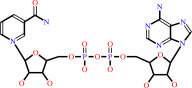 NAD(+)
|
+
|
H2O
|
=
|
2''-O-acetyl-ADP-D-ribose
|
+
|
 nicotinamide
|
+
|
L-lysyl-[protein]
|
|
|
|
|
|
|
|
|
|
Enzyme class 2:
|
|
Chain D:
E.C.?
|
|
|
|
|
|
|
|
|
|
Note, where more than one E.C. class is given (as above), each may
correspond to a different protein domain or, in the case of polyprotein
precursors, to a different mature protein.
|
|
|
|
Molecule diagrams generated from .mol files obtained from the
KEGG ftp site
|
|
|
|
|
|
|
|
|
|
|
|
|
|
 |
|
|
|
|
|
|
| |
|
|
| |
|
|
Protein Sci
20:131-139
(2011)
|
|
PubMed id:
|
|
|
|
|
|
| |
|
Structure of Sir2Tm bound to a propionylated peptide.
|
|
P.Bheda,
J.T.Wang,
J.C.Escalante-Semerena,
C.Wolberger.
|
|
|
|
|
| |
ABSTRACT
|
|
|
|
| |
|
|
Lysine propionylation is a recently identified post-translational modification
that has been observed in proteins such as p53 and histones and is thought to
play a role similar to acetylation in modulating protein activity. Members of
the sirtuin family of deacetylases have been shown to have depropionylation
activity, although the way in which the sirtuin catalytic site accommodates the
bulkier propionyl group is not clear. We have determined the 1.8 Å structure of
a Thermotoga maritima sirtuin, Sir2Tm, bound to a propionylated peptide derived
from p53. A comparison with the structure of Sir2Tm bound to an acetylated
peptide shows that hydrophobic residues in the active site shift to accommodate
the bulkier propionyl group. Isothermal titration calorimetry data show that
Sir2Tm binds propionylated substrates more tightly than acetylated substrates,
but kinetic assays reveal that the catalytic rate of Sir2Tm deacylation of
propionyl-lysine is slightly reduced to acetyl-lysine. These results serve to
broaden our understanding of the newly identified propionyl-lysine modification
and the ability of sirtuins to depropionylate, as well as deacetylate,
substrates.
|
|
|
|
|
|
|
|
|
|
|
|
|
|
|
|
|
|
 |
 |
 |
|
|


 Links
Links


