 |
PDBsum entry 6fv1
|
|

|
|
PDB id:
|
|
|
|
| Name: |
|
Hydrolase
|
|
|
Title:
|
|
Structure of human coronavirus nl63 main protease in complex with the alpha-ketoamide (s)-n-((s)-4-(benzylamino)-3,4-dioxo-1-((s)-2- oxopyrrolidin-3-yl)butan-2-yl)-2-cinnamamido-4-methylpentanamide (cinnamoyl-leucine-glnlactam-co-co-nh-benzyl)
|
|
Structure:
|
|
3c-like proteinase. Chain: a, b, c. Synonym: 3cl-pro,3clp,m-pro,nsp5,p34. Engineered: yes
|
|
Source:
|
|
Human coronavirus nl63. Hcov-nl63. Organism_taxid: 277944. Gene: rep, 1a-1b. Expressed in: escherichia coli. Expression_system_taxid: 562
|
|
Resolution:
|
|
|
2.30Å
|
R-factor:
|
0.197
|
R-free:
|
0.231
|
|
|
Authors:
|
|
L.Zhang,R.Hilgenfeld
|
|
Key ref:
|
|
L.Zhang
et al.
(2020).
α-Ketoamides as Broad-Spectrum Inhibitors of Coronavirus and Enterovirus Replication: Structure-Based Design, Synthesis, and Activity Assessment.
J Med Chem,
63,
4562-4578.
PubMed id:
DOI:
|
|
|
Date:
|
|
|
28-Feb-18
|
Release date:
|
20-Mar-19
|
|
|
|
|
|
|
PROCHECK
|

|
|
|
|
|
Headers
|
|
|
|
References
|
|
|
|
|
|

|
|
P0C6X5
(R1AB_CVHNL) -
Replicase polyprotein 1ab from Human coronavirus NL63
|
|
|
|
Seq:
Struc:
|
|
|
|
6729 a.a.
300 a.a.
|
|

|

|
|
|
|
|
|
|
|
|
|
|
|
Key: |
 |
PfamA domain |
|
|
 |
Secondary structure |
|
|
|
|
|
|
|
|
|
|
|
|
|
Enzyme class 2:
|
|
E.C.2.1.1.57
- methyltransferase cap1.
|
|
|
|
|
|
|
Reaction:
|
|
a 5'-end (N(7)-methyl 5'-triphosphoguanosine)-ribonucleoside in mRNA + S-adenosyl-L-methionine = a 5'-end (N(7)-methyl 5'-triphosphoguanosine)- (2'-O-methyl-ribonucleoside) in mRNA + S-adenosyl-L-homocysteine + H+
|
|
|
|
|
|
5'-end (N(7)-methyl 5'-triphosphoguanosine)-ribonucleoside in mRNA
|
+
|
 S-adenosyl-L-methionine
|
=
|
5'-end (N(7)-methyl 5'-triphosphoguanosine)- (2'-O-methyl-ribonucleoside) in mRNA
|
+
|
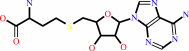 S-adenosyl-L-homocysteine
|
+
|
H(+)
|
|
|
|
|
|
|
|
|
|
Enzyme class 3:
|
|
E.C.2.7.7.48
- RNA-directed Rna polymerase.
|
|
|
|
|
|
|
Reaction:
|
|
RNA(n) + a ribonucleoside 5'-triphosphate = RNA(n+1) + diphosphate
|
|
|
|
|
|
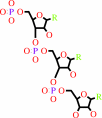 RNA(n)
|
+
|
ribonucleoside 5'-triphosphate
|
=
|
RNA(n+1)
|
+
|
 diphosphate
|
|
|
|
|
|
|
|
|
|
Enzyme class 4:
|
|
E.C.2.7.7.50
- mRNA guanylyltransferase.
|
|
|
|
|
|
|
Reaction:
|
|
a 5'-end diphospho-ribonucleoside in mRNA + GTP + H+ = a 5'-end (5'-triphosphoguanosine)-ribonucleoside in mRNA + diphosphate
|
|
|
|
|
|
5'-end diphospho-ribonucleoside in mRNA
|
+
|
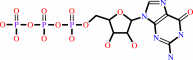 GTP
GTP
|
+
|
H(+)
|
=
|
5'-end (5'-triphosphoguanosine)-ribonucleoside in mRNA
|
+
|
diphosphate
|
|
|
|
|
|
|
|
|
|
Enzyme class 5:
|
|
E.C.3.1.13.-
- ?????
|
|
|
|
|
|
|
Enzyme class 6:
|
|
E.C.3.4.19.12
- ubiquitinyl hydrolase 1.
|
|
|
|
|
|
|
Reaction:
|
|
Thiol-dependent hydrolysis of ester, thiolester, amide, peptide and isopeptide bonds formed by the C-terminal Gly of ubiquitin (a 76-residue protein attached to proteins as an intracellular targeting signal).
|
|
|
|
|
|
Enzyme class 7:
|
|
E.C.3.4.22.-
- ?????
|
|
|
|
|
|
|
Enzyme class 8:
|
|
E.C.3.6.4.12
- Dna helicase.
|
|
|
|
|
|
|
Reaction:
|
|
ATP + H2O = ADP + phosphate + H+
|
|
|
|
|
|
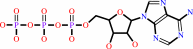 ATP
ATP
|
+
|
H2O
|
=
|
 ADP
ADP
|
+
|
 phosphate
|
+
|
H(+)
|
|
|
|
|
|
|
|
|
|
Enzyme class 9:
|
|
E.C.3.6.4.13
- Rna helicase.
|
|
|
|
|
|
|
Reaction:
|
|
ATP + H2O = ADP + phosphate + H+
|
|
|
|
|
|
ATP
|
+
|
H2O
|
=
|
ADP
|
+
|
phosphate
|
+
|
H(+)
|
|
|
|
|
|
|
|
|
|
Enzyme class 10:
|
|
E.C.4.6.1.-
- ?????
|
|
|
|
|
|
|
|
|
|
Note, where more than one E.C. class is given (as above), each may
correspond to a different protein domain or, in the case of polyprotein
precursors, to a different mature protein.
|
|
|
|
Molecule diagrams generated from .mol files obtained from the
KEGG ftp site
|
|
|
|
|
|
|
|
|
|
|
|
|
|
 |
|
|
|
|
|
|
| |
|
|
| |
|
DOI no:
|
J Med Chem
63:4562-4578
(2020)
|
|
PubMed id:
|
|
|
|
|
|
| |
|
α-Ketoamides as Broad-Spectrum Inhibitors of Coronavirus and Enterovirus Replication: Structure-Based Design, Synthesis, and Activity Assessment.
|
|
L.Zhang,
D.Lin,
Y.Kusov,
Y.Nian,
Q.Ma,
J.Wang,
A.von Brunn,
P.Leyssen,
K.Lanko,
J.Neyts,
A.de Wilde,
E.J.Snijder,
H.Liu,
R.Hilgenfeld.
|
|
|
|
|
| |
ABSTRACT
|
|
|
|
| |
|
|
The main protease of coronaviruses and the 3C protease of enteroviruses share a
similar active-site architecture and a unique requirement for glutamine in the
P1 position of the substrate. Because of their unique specificity and essential
role in viral polyprotein processing, these proteases are suitable targets for
the development of antiviral drugs. In order to obtain near-equipotent,
broad-spectrum antivirals against alphacoronaviruses, betacoronaviruses, and
enteroviruses, we pursued a structure-based design of peptidomimetic
α-ketoamides as inhibitors of main and 3C proteases. Six crystal structures of
protease-inhibitor complexes were determined as part of this study. Compounds
synthesized were tested against the recombinant proteases as well as in viral
replicons and virus-infected cell cultures; most of them were not cell-toxic.
Optimization of the P2 substituent of the α-ketoamides proved crucial for
achieving near-equipotency against the three virus genera. The best
near-equipotent inhibitors, 11u (P2 = cyclopentylmethyl) and 11r
(P2 = cyclohexylmethyl), display low-micromolar EC50 values against
enteroviruses, alphacoronaviruses, and betacoronaviruses in cell cultures. In
Huh7 cells, 11r exhibits three-digit picomolar activity against the
Middle East Respiratory Syndrome coronavirus.
|
|
|
|
|
|
|
|
|
|
|
|
|
|
|
|
|
|
 |
 |
 |
|


 Links
Links


